
The Ultimate Guide to Halibut Fishing on the Oregon Coast
Where to go, when to go, and what to bring for the West Coast’s most prized flatfish, with 2026 seasons, charter picks, and field-tested gear.
At a glance
Halibut fishing on the Oregon coast is one of the great Pacific Northwest angling traditions, and 2026 is a strong year to chase it. Quotas for the Central Oregon Coast subarea returned to roughly the same levels as last season, the all-depth fishery opens seven days a week from May 1, and most ports are running full charter schedules through October. For shore-bound anglers and weekend boaters alike, this is the season worth planning a trip around.
This guide pulls together everything you need to plan a trip: how to tell Pacific halibut from California halibut, the four ports we keep coming back to, the gear that actually works on Oregon water, the new licensing rules for 2026, and the charters with a track record. If you’re booking your first trip, jump to the charter list. If you’re rigging your own boat, the gear and tactics sections will save you a few hard lessons.
Beginning January 1, 2026, most recreational ocean anglers in Oregon need a new Ocean Endorsement in addition to a standard angling license. It applies to fishing from beaches, jetties, and boats for marine finfish including halibut. Narrow exceptions exist for shellfish-only outings and salmon- or steelhead-only trips where no other marine finfish are retained.
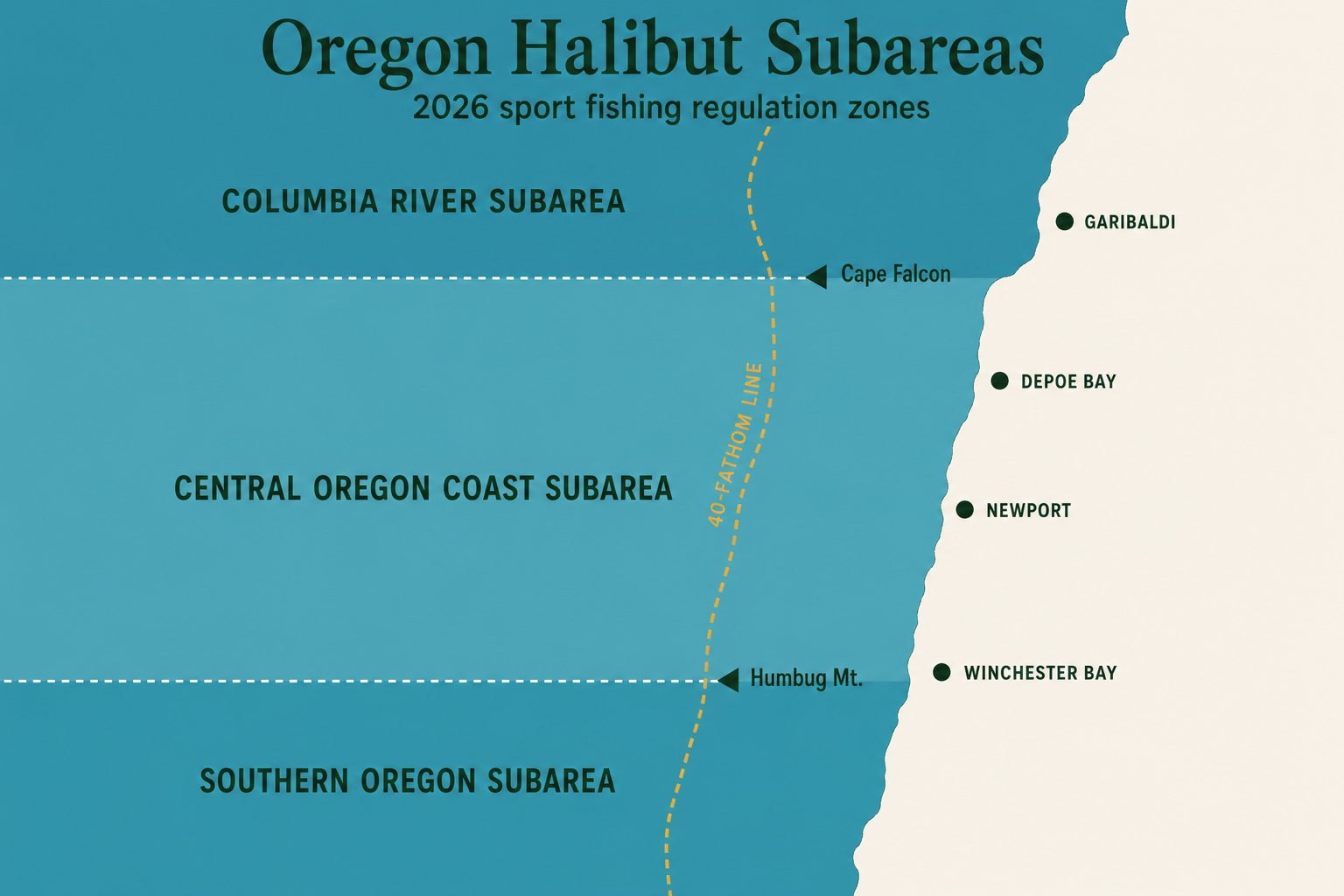
- Central Oregon Coast subarea (Cape Falcon to Humbug Mt.): Spring all-depth open May 1 to July 31, summer all-depth open Aug 1 to Oct 31, both 7 days a week. Daily bag: 2 fish. Quota: 209,126 lb spring, 59,709 lb summer.
- Columbia River subarea: Open Thursdays, Fridays, and Sundays April 30 to June 28, with backup August and September dates. Daily bag: 1 fish. Quota: 19,299 lb.
- Southern Oregon subarea: Open 7 days a week through Oct 31. Daily bag: 2 fish.
- Annual limit: 6 fish, no length restriction. Possession: 1 daily limit at sea, 3 daily limits on land.
All seasons are quota-managed and can close early. Check ODFW at myodfw.com/pacific-halibut-sport-regulations before each trip.
Oregon halibut licensing & 2026 costs
Three documents are required to legally fish for halibut in Oregon in 2026: a base angling license, a Combined Angling Tag, and the new Ocean Endorsement. Buy all three at myodfw.com or any ODFW agent (including most coastal tackle shops).
| License or tag | Resident | Non-resident |
|---|---|---|
| Annual Angling License | $50.00 | $138.00 |
| 1-day Angling License | $23.00 | $26.50 |
| Combined Angling Tag required | $69.00 | $89.00 |
| Ocean Endorsement, annual required | $9.00 | $9.00 |
| Ocean Endorsement, daily | $4.00 | $4.00 |
| Youth Combo License (ages 12-17) | $10.00 | $10.00 |
| Annual halibut total | $128.00 | $236.00 |
Notes. All annual licenses run January 1 through December 31, regardless of purchase date. The Youth Combo License at $10 covers anglers ages 12-17 and includes the Ocean Endorsement. Children under 12 do not need a base license but still need a Juvenile Combined Angling Tag to retain a halibut. For one-trip visitors, a 1-day angling license + daily Ocean Endorsement + Combined Angling Tag is the cheapest legal way to fish (~$96 resident, ~$120 non-resident). The Combined Angling Tag must be inked in immediately when you retain a halibut, salmon, steelhead, or sturgeon.
Types of halibut in Oregon waters
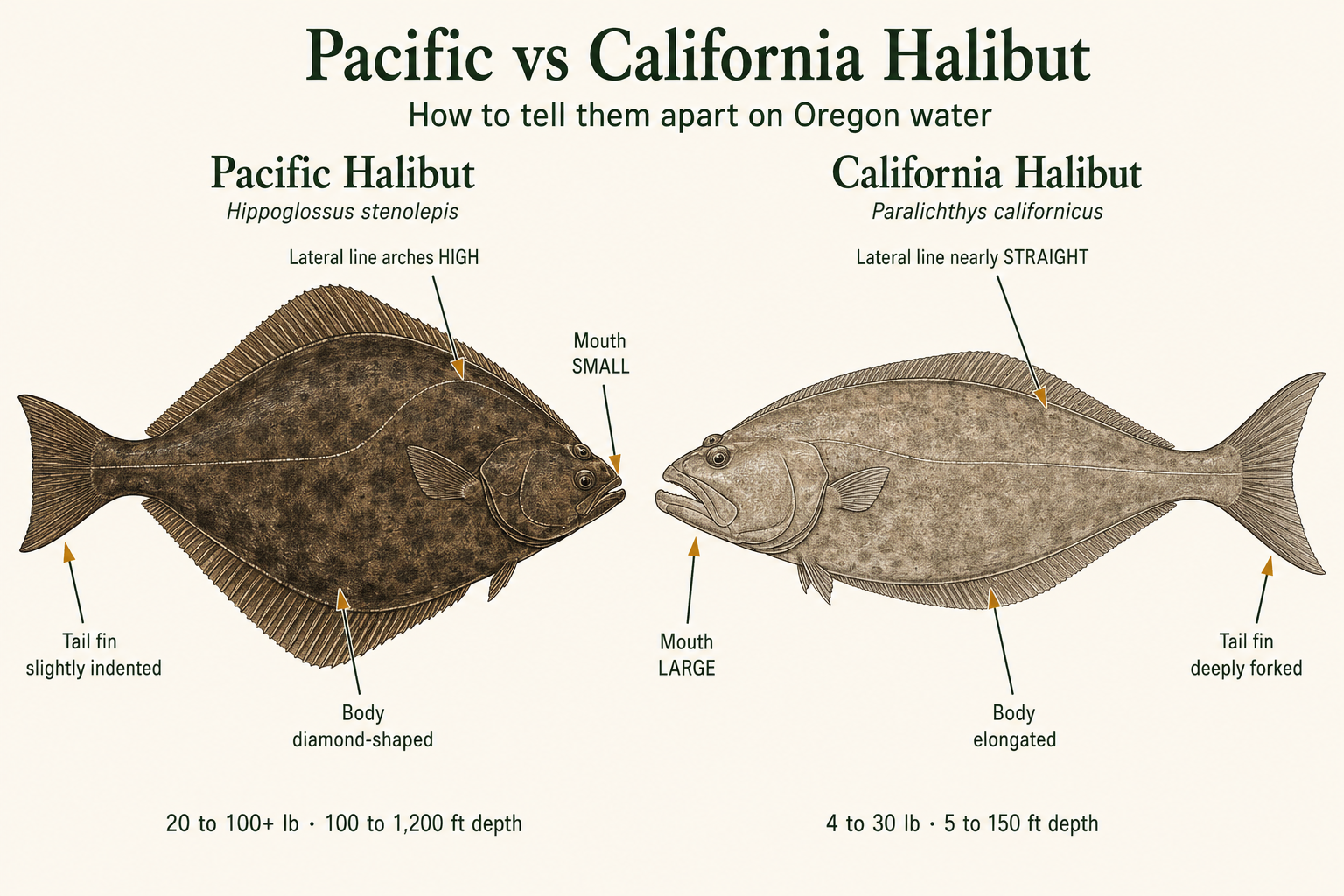
Two halibut species swim off the Oregon coast: Pacific halibut, the giant of the deep that drives the entire all-depth fishery, and California halibut, a smaller, shallower flatfish more common to the south. Knowing which is which matters for gear selection, where you fish, and what the regulations allow you to keep.
1. Pacific halibut (Hippoglossus stenolepis)
Pacific halibut are the most-targeted halibut species on the Oregon coast and the species the seasons and bag limits in this guide refer to. They are large, flat fish with a distinctive diamond-shaped body and a white underside. Their upper side is usually dark brown or gray with mottling that lets them disappear into sandy bottom. Halibut caught off Oregon typically weigh anywhere from 20 to 60 pounds, with boats landing 100-pound-plus fish during good seasons.
Pacific halibut are typically found in deeper water, ranging from about 100 feet to 1,200 feet, though the most consistent fishing happens between 200 and 600 feet. They prefer sandy or muddy bottoms where they lie in wait to ambush prey. Soft, contoured bottom near reef edges is the sweet spot.
Fishing technique
- Bait: Pacific halibut are drawn to oily baits such as fresh herring, salmon bellies, squid, and octopus. Fresh-frozen at minimum, and live or sashimi-grade when available, makes a real difference.
- Gear: A heavy-action saltwater rod paired with a high-capacity reel and 65 to 80 pound braided line. Spreader bars and weighted rigs with circle hooks (7/0 to 10/0) keep the bait pinned to the ocean floor.
- Tactics: Drift fishing or anchored fishing over known halibut grounds is most effective. Pay attention to tidal changes; halibut bite hardest during slack tides when current eases and bait sits still in the strike zone.
2. California halibut (Paralichthys californicus)
California halibut are smaller than Pacific halibut but still rewarding to catch. They have a more elongated body and can change color to match the ocean floor, ranging from brown to gray on their upper side and white on the underside. They are far less common than Pacific halibut on Oregon water and become more abundant south of the Oregon-California border.
California halibut are usually found in shallower water, often between 5 and 150 feet. They prefer sandy or muddy bottoms near the coast, and around bays and estuaries. Coos Bay produces a few each year; most Oregon catches are incidental on bottomfish trips rather than targeted.
Fishing technique
- Bait: Live anchovies, sardines, and smelt are most effective. Artificial swimbaits and white or chartreuse jigs also produce.
- Gear: Medium to heavy spinning or baitcasting rods with 20 to 30 pound monofilament or braid. Lighter weights and smaller hooks (4/0 to 6/0) compared to Pacific halibut.
- Tactics: Slow trolling or drifting near sandy bottoms and kelp beds. Look for areas with structure or drop-offs where halibut may be lurking.
| Trait | Pacific halibut | California halibut |
|---|---|---|
| Typical size | 20 – 60 lb (up to 100+) | 4 – 20 lb (up to 30) |
| Depth range | 100 – 1,200 ft (200 – 600 ft sweet spot) | 5 – 150 ft |
| Body shape | Diamond, broad, lateral line arches over pectoral | Elongated, lateral line straighter |
| Bait | Herring, salmon bellies, squid, octopus | Live anchovies, sardines, swimbaits |
| Rod / line | Heavy saltwater, 65 – 80 lb braid | Medium-heavy, 20 – 30 lb mono / braid |
| Hook size | 7/0 – 10/0 circle | 4/0 – 6/0 circle or J |
| Where to fish off Oregon | Halibut Flat, offshore reefs, soft bottom | Coos Bay, jetties, large estuaries |

Best halibut fishing spots on the Oregon coast
Four ports anchor Oregon’s halibut fishery. Each one runs charters, has a public ramp, and sits within easy reach of historically productive grounds. The right pick depends on which subarea you’re fishing, how far offshore you want to travel, and how reliable the weather window looks for your dates.
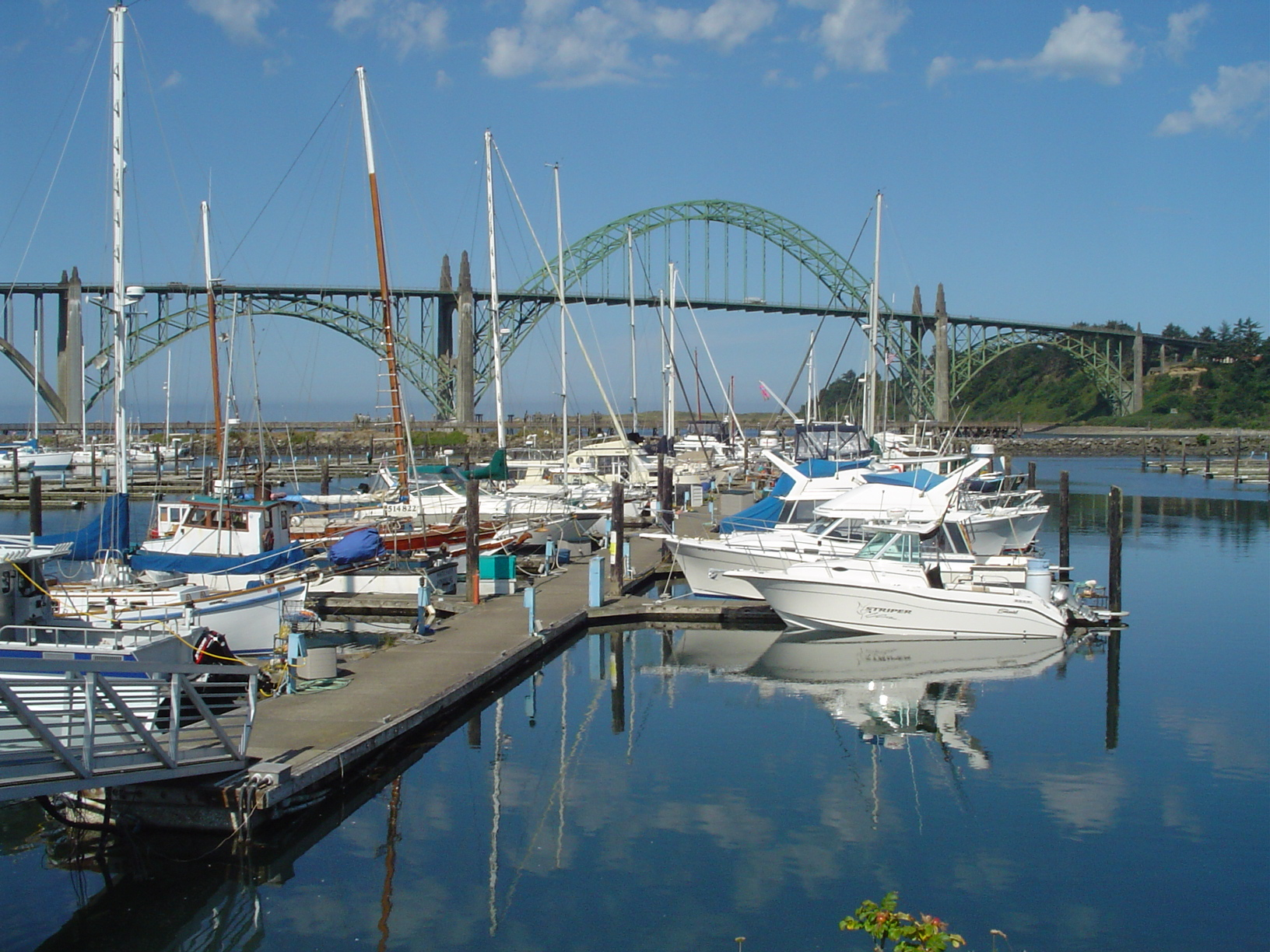
Newport is the most consistent halibut destination on the Oregon coast and the largest charter hub in the central subarea. The deep water and strong current off Yaquina Head create an ideal habitat for halibut. The well-known Halibut Flat, located about 25 miles offshore, is a soft-bottom plateau where anglers regularly find fish during the spring and summer all-depth seasons.
Yaquina Bay is the launching point for most trips, and South Beach has the public ramp and parking for trailered boats. If it’s your first halibut trip, this is the port to start.

Known as the whale-watching capital of the Oregon coast, Depoe Bay is also a fantastic location for halibut fishing. The nearby reefs and rocky structure create the kind of soft-to-hard bottom transitions halibut hunt along, and the harbor’s small footprint (it’s the world’s smallest navigable harbor) makes for fast departures with short runs to productive water.
Charter services are readily available for those who prefer guided trips, and Depoe Bay is a strong choice for combining halibut with bottomfish or whale-watching add-ons.

Garibaldi, located on Tillamook Bay, is another prime spot for halibut fishing. The waters here are rich with marine life, and the relatively calm conditions inside Tillamook Bay make it a great choice for both novice and experienced anglers. From the Garibaldi marina, captains run north and west to historically productive halibut grounds, often combining the trip with crabbing on the way back in.
If you’re driving from Portland, this is the closest serious halibut port (about a 90-minute drive), which makes it a popular pick for early-season day trips.

Situated at the mouth of the Umpqua River, Winchester Bay offers excellent halibut fishing opportunities. The underwater canyons and sandy bottoms are prime halibut habitat, and local charters can take you to the best grounds without the longer offshore runs that Newport requires.
Coos Bay, just south, anchors the Southern Oregon subarea and is one of the few places in Oregon where California halibut occasionally turn up inside the bay. It’s the farthest south of the major halibut ports, which can be an advantage when central-coast quotas close early.
| Port | Subarea | Best for | Run offshore |
|---|---|---|---|
| Newport | Central Oregon Coast | Most consistent; first trips; classic Halibut Flat fishery | ~25 miles |
| Depoe Bay | Central Oregon Coast | Short runs; reef structure; combo with bottomfish or whales | 5 – 15 miles |
| Garibaldi | Central Oregon Coast | Closest port to Portland; calm-water entry; crabbing combo | 10 – 25 miles |
| Winchester Bay | Southern Oregon | Underwater canyons; shorter runs in southern subarea | 5 – 20 miles |
| Coos Bay | Southern Oregon | Late-season backup; rare California halibut shots | 10 – 25 miles |
Every Oregon halibut port except Coos Bay sits behind a river or bay bar, and the bars are where most coastal boating accidents happen. The Coast Guard restricts or closes bars whenever ebb current and incoming swell stack into breaking waves. Check the bar status before you leave the dock and never cross on a maximum ebb against a heavy west swell.
- Tillamook Bay (Garibaldi): Long, shallow bar that closes often in winter and during big swells. Rule of thumb: cross in the last hour of flood or first hour of ebb.
- Yaquina Bay (Newport): One of the more forgiving Oregon bars but still closes on strong westerly swells. The Coast Guard station at the South Jetty is the authority.
- Umpqua River (Winchester Bay): Notoriously dangerous on a big ebb. The Triangle is a real hazard. First-time visitors should hire a guide or charter.
- Depoe Bay: Tiny, narrow channel rather than a true bar, but high swells can close the entrance entirely. When it’s closed, it’s closed.
- Coos Bay (Charleston): Largest commercial port on the Oregon coast and the most workable bar in heavy weather, but still subject to closure on extreme conditions.
Check current bar restrictions at the National Weather Service Coastal Forecast and the Coast Guard’s bar information system before every trip. When in doubt, charter.
Tips for successful halibut fishing
1. Timing is everything
Halibut season typically runs May through October on the Oregon coast. The most consistent fishing is during the spring all-depth season (May 1 through July 31 in the Central subarea), when the spawning fish are aggressive and the quota is largest. Within a single trip, slack tide is the prime window; that’s when the current eases enough to keep bait pinned and in the strike zone.
| Month | Garibaldi | Depoe Bay | Newport | Winchester Bay |
|---|---|---|---|---|
| Jan | Closed | Closed | Closed | Closed |
| Feb | Closed | Closed | Closed | Closed |
| Mar | Closed | Closed | Closed | Closed |
| Apr | Closed | Closed | Closed | Closed |
| May | Peak | Peak | Peak | Peak |
| Jun | Peak | Peak | Peak | Peak |
| Jul | Good | Good | Good | Good |
| Aug | Peak | Peak | Peak | Peak |
| Sep | Good | Good | Good | Good |
| Oct | Fair | Fair | Fair | Fair |
| Nov | Closed | Closed | Closed | Closed |
| Dec | Closed | Closed | Closed | Closed |
Note: The Columbia River subarea fishes on a Thursday/Friday/Sunday open-day schedule April 30 to June 28, with backup August and September dates. All seasons are quota-managed and can close early, so check ODFW before a trip.
2. Use the right gear
Sturdy gear is essential. Use a heavy-duty rod and reel with high line capacity. Bait such as herring, squid, and octopus works well for attracting halibut, and weighted rigs of 1 to 3 pounds keep the rig anchored to the ocean floor where the fish hold. Don’t undersize the hooks; circle hooks in 7/0 to 10/0 set themselves cleanly and reduce gut-hooked fish.
3. Know the tides
Halibut bite hardest during slack tides, the brief window between high and low when current slows. Pull up tide charts for your port the night before, and plan the run so you’re on a known piece of structure when slack hits. On a charter, the captain handles this; if you’re running your own boat, build the day around it.
4. Try bottom and deep-sea techniques
Bottom fishing is the most effective technique for halibut, since these fish stay near the floor. Avoid pure sand if you can; look for hard-to-soft bottom transitions with some contour. Drift fishing with light tackle covers more water on flat days, while anchoring or spot-locking puts the bait on a high-percentage spot when the bite turns on. Spearfishing is legal but rare given the depths.
5. Know the regulations
Both residents and non-residents must have a valid Oregon angling license, and as of January 1, 2026, most ocean anglers also need the new Ocean Endorsement. In the Central Oregon Coast and Southern Oregon subareas, the daily bag is 2 Pacific halibut with an annual limit of 6 fish and no length restriction. The Columbia River subarea is 1 fish per day with the same annual limit. Possession is 1 daily limit at sea and 3 daily limits on land. Always confirm in-season changes at myodfw.com.
Oregon’s halibut fishery shares ground with sensitive rockfish populations, and a few rules exist specifically to protect them. Bringing the right gear and knowing what you can’t keep is part of legal halibut fishing.
- Descending device required. A functional descending device must be onboard whenever you fish seaward of the 30-fathom regulatory line, and must be used when releasing any rockfish. The pressure change from deep water can kill released fish without one.
- Yelloweye and quillback rockfish: retention is prohibited. Both are slow-growing and overfished. Release them at depth using your descending device.
- Cabezon: prohibited from January 1 through June 30 each year. Out of halibut season anyway, but worth knowing on combo trips.
- Tag the catch immediately. Every retained Pacific halibut must be inked onto your Combined Angling Tag the moment it comes over the rail. The annual limit is 6 fish with no exceptions.
- Limit bottom contact. When drifting, lift the rig off the bottom periodically to avoid hooking rockfish you can’t keep.
Gear recommendations for halibut fishing
Halibut gear is built for hauling weight against current from deep water. Here’s the short list of what actually works on Oregon trips, with links to our category guides for each.

Recommended halibut fishing charters
To make the most of your halibut trip without buying a small fortune in gear, book with a local charter. The five operators below have track records on the Oregon coast and run dedicated halibut trips during the all-depth season. Expect $325 to $425 per person for a full day in 2026, with most captains requiring a $100 deposit at booking.
1. Newport Marina Store and Charters
Newport · Central CoastNewport Marina runs a range of fishing trips, including dedicated halibut charters during the spring and summer all-depth seasons. Their experienced captains and crew handle gear, bait, and fish cleaning, and the South Beach location makes the morning departure painless.
2. Tradewinds Charters
Depoe Bay · Central CoastTradewinds is a Depoe Bay institution and a strong pick for guided halibut trips. They run both full-day and half-day options and can combine halibut with bottomfish or whale-watching add-ons depending on the date and weather.
3. Garibaldi Charters
Garibaldi · Tillamook BayGaribaldi Charters runs halibut trips with experienced captains who know the Tillamook Bay grounds well. Their boats are well-equipped and the operation is organized; this is a good pick for first-time halibut anglers driving down from Portland.
4. Pacific Charter Services
Winchester Bay · Southern CoastPacific Charter Services runs tailored halibut trips out of Winchester Bay. The Southern Oregon subarea has its own quota and seasons, which sometimes means open water when the central coast has closed for the year.
5. Siggi-G Ocean Charters
Garibaldi · Tillamook BaySiggi-G is a smaller Garibaldi-based operation that offers a personalized halibut trip with knowledgeable guides and quality equipment. A good pick if you’d rather fish with a small group than a packed party boat.
Culinary delights: cooking your catch
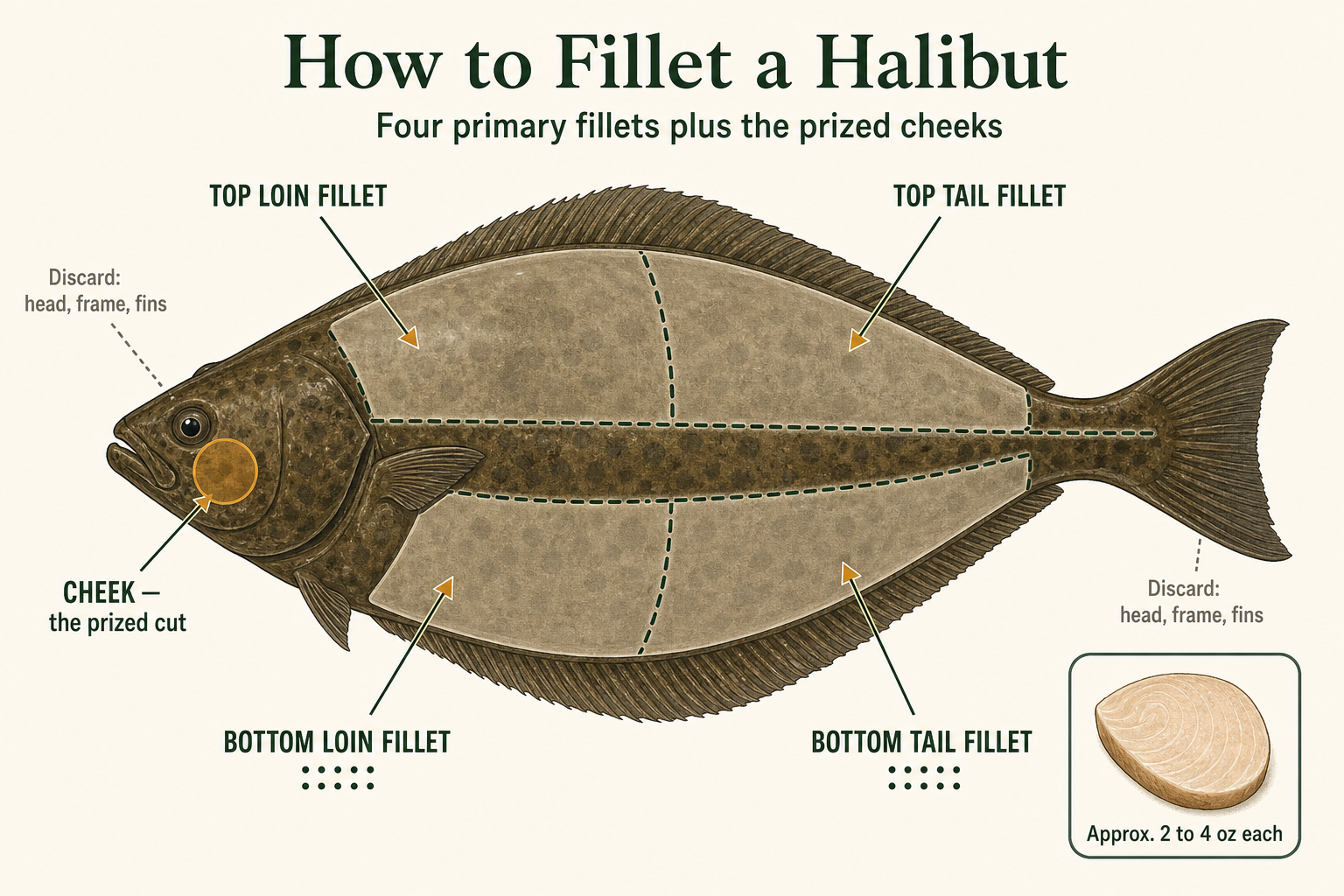
Halibut is a firm, white-fleshed fish with a clean, mild flavor that takes well to almost any preparation. The cheeks (the round muscle behind the eye) are a delicacy and worth saving when you fillet. A few of our favorite ways to cook a fresh Oregon halibut.
Pan-seared marinated Pacific halibut
A simple lemon-garlic-herb marinade and a hot cast-iron sear bring out the clean, sweet flavor of fresh-caught Oregon halibut. On the table in under 40 minutes.
Ingredients
- 4 Pacific halibut fillets, about 6 oz each, skin off
- 1/4 cup extra-virgin olive oil
- 3 tablespoons fresh lemon juice
- 1 teaspoon lemon zest
- 4 cloves garlic, minced
- 2 tablespoons fresh flat-leaf parsley, chopped
- 1 tablespoon fresh thyme leaves
- 1 teaspoon kosher salt
- 1/2 teaspoon black pepper
- 2 tablespoons unsalted butter, for searing
- Lemon wedges and flaky sea salt, to serve
Instructions
- Make the marinade. Whisk together the olive oil, lemon juice, lemon zest, garlic, parsley, thyme, kosher salt, and black pepper in a shallow dish.
- Marinate. Add the fillets and turn to coat. Cover and refrigerate 20 to 30 minutes. Do not exceed 30 minutes; the acid will start to cook the fish and turn the texture mealy.
- Heat the pan. Heat a heavy skillet, ideally cast iron, over medium-high until a drop of water vaporizes on contact.
- Pat dry. Remove the fillets from the marinade and pat the top side of each fillet dry with a paper towel. A dry surface is essential for a deep golden crust.
- Sear. Add the butter to the hot pan and swirl. Place the fillets dry-side down and sear, undisturbed, for 3 to 4 minutes until the edges turn opaque and the bottom is deeply golden.
- Flip and finish. Flip the fillets, lower the heat to medium, and cook 2 to 3 more minutes until an instant-read thermometer reads 130°F at the thickest point for medium, 140°F for fully opaque.
- Rest and serve. Transfer to a plate and let rest 2 minutes. Serve with lemon wedges and a pinch of flaky sea salt.
More halibut recipes worth trying
Halibut fishing on the Oregon coast is one of the great Pacific Northwest adventures, and a clean trip ends with a freezer full of one of the best-eating fish on the West Coast. Whether you charter or run your own boat, the fishery is at its best when you plan around the season, the tides, and the weather window.
If you’re looking for more things to do in Oregon, see our guide to whale watching on the Oregon coast, or check out our list of the best hikes on the Oregon coast.
Live tides for your port
Slack tide drives the bite. Check the daily tide chart for your port the night before, and time the run so you’re on the bottom when current eases. The official NOAA stations cover all five Oregon halibut ports.
Depoe Bay and Winchester Bay don’t have primary NOAA stations. South Beach (Newport) is the standard reference for Depoe Bay; Charleston covers Winchester Bay and Coos Bay.
Frequently asked questions
When does halibut season open on the Oregon coast in 2026?
What is the daily bag limit for Pacific halibut in Oregon?
Do I need an Ocean Endorsement to fish for halibut in Oregon?
What is the best port on the Oregon coast for halibut fishing?
How deep do you fish for halibut off Oregon?
What size rod and reel do I need for Oregon halibut?
What is the best bait for Pacific halibut in Oregon?
How much does an Oregon halibut charter cost?
When is the best time of day to catch halibut?
Can you catch halibut from shore in Oregon?
What is the best month to fish for halibut in Oregon?
Last updated May 2026. Always verify in-season changes at myodfw.com/pacific-halibut-sport-regulations before your trip.