Dive Into
Oregon
From emerald plunge pools in old-growth canyons to cliff-jumping cascades in the Gorge — Oregon’s best swimming holes, ranked, described, and filtered for how you like to swim. Planning a longer trip? See our guide to fun day trips from Portland.
Swimming Holes Across Oregon
Click any marker to see the spot’s name, region, and vibe. Color-coded by region.
I’ve spent a lot of summers finding Oregon’s best swimming holes, and what still surprises me is how different they all feel. Punchbowl Falls on Eagle Creek is the one everyone knows about, and it earns it, as long as you get there before 9 AM. The spots that stay with me though are the ones you hear about from a friend: a glassy pool on the Middle Santiam that takes a short hike to reach, or the water at Opal Creek that looks genuinely fake, a shade of emerald green that shouldn’t exist.
Oregon swimming holes are cold. Even in August, most rivers sit well below 65°F, and alpine lakes like Waldo Lake and Blue Pool are another level of cold entirely. That’s honestly part of it. There’s nothing quite like dropping into clear, freezing water on a hot Willamette Valley afternoon. This guide covers 40+ Oregon swimming holes across six regions, from cliff-jumping spots in the Columbia River Gorge to quiet wilderness pools in southern Oregon. Use the filters below to find what you’re after: family-friendly wading, cliff jumping, clothing-optional spots, or somewhere to just float.
Oregon’s Best Swimming Holes
Eight standouts with everything you need to know — location, vibe, access, and what makes each one worth the trip.

Punchbowl Falls
Two miles into the iconic Eagle Creek Trail, hikers scramble down to a bowl-shaped pool fed by a powerful 36-foot waterfall. The photography-famous plunge pool is big, deep, and cold — one of the most dramatic swimming holes in the Pacific Northwest. Jump from the rim ledges, or wade in from the rocky shore. The 2017 Eagle Creek Fire left visible scars, but the forest has rebounded beautifully with thick underbrush and young saplings.
Three Pools
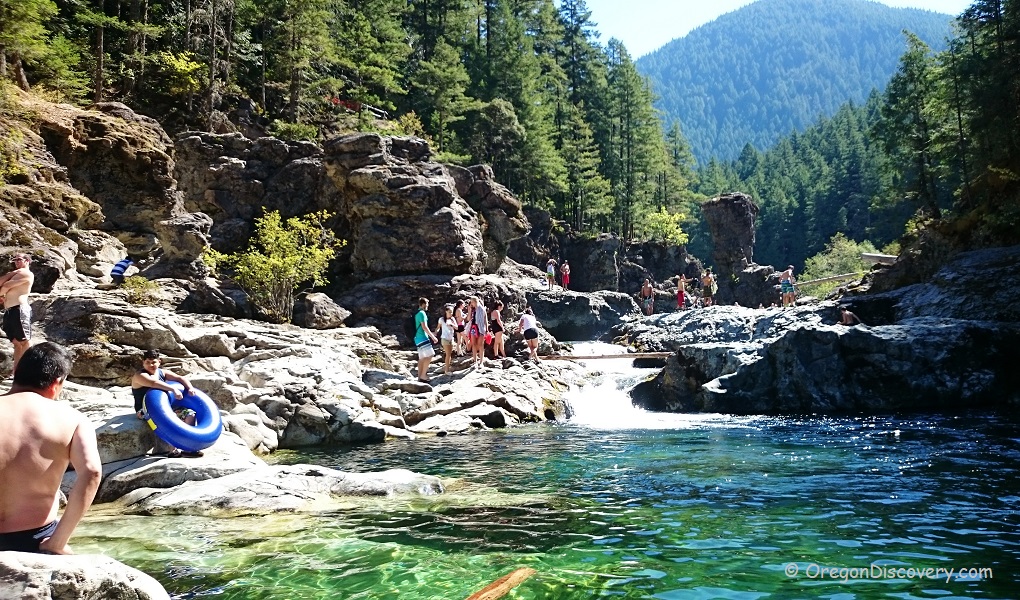
One of Oregon’s most beloved family swimming spots — three distinct pools carved into the Little North Santiam River, connected by short rocky paths. Crystal-clear water, rope swings, and easy wading make it perfect for all ages. Gets very busy on weekends; arrive before 10 AM or go mid-week. Small fee for parking.

Opal Creek
Emerald-colored water so vivid it looks fake. A 7.4-mile round-trip hike (715 ft gain) leads through old-growth forest to a series of deep plunge pools. The water is shockingly cold even in August. Historic mining equipment at Jawbone Flats adds a unique character. Great for kids who love exploration alongside their swim.

Waldo Lake
One of the purest alpine lakes in the world and the headwaters of the Middle Fork Willamette River — explore more in our Oregon Lakes guide. No gas motors allowed — only electric and human-powered craft. The result: almost preternatural silence, broken only by eagles overhead. The water is so clear you can see the bottom 100 feet down. Bring a wetsuit — it stays cold all summer.

Lower Lewis River Falls
A wall of water 200 feet across crashes 43 feet into a turquoise plunge pool big enough to shelter Shamu. Cliff jumpers have a crazy (but not death-wish-crazy) vertical drop from the rim, plus smaller pools etched into the rock wall. Hike east along the river to discover Middle and Upper Lewis River Falls — both stunning in their own right and worth a full day. Old-growth forest lines the entire trail.
Blue Pool (Tamolitch Falls)
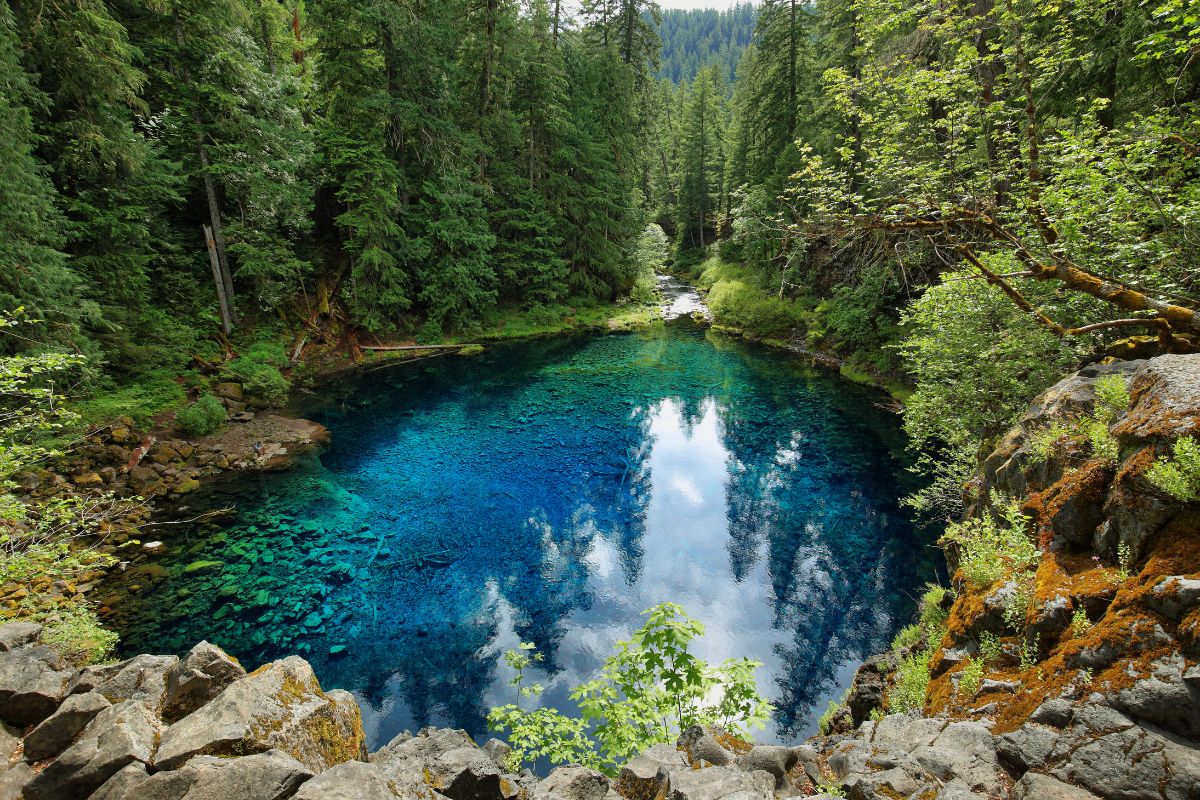
The coldest, clearest water you’ll ever experience flows up through a lava tube into a perfectly still turquoise pool. Full guide → In winter the McKenzie runs dry here — the water literally disappears into the lava; in summer it reappears as this jaw-dropping spring-fed pool. The 4-mile round-trip hike is easy and beautiful, following the McKenzie River Trail through lush old-growth forest. See also our Oregon Waterfalls map.

Moulton Falls Regional Park
387 acres with something for everyone: Instagram-worthy falls surrounded by flat rocks for sunbathing, inviting flat water upstream, two miles of river trails, and a three-story arch bridge that daredevils leap from. Free entry makes it popular — arrive early on summer weekends. One of the most versatile swimming destinations within reach of Portland.

Falls City Falls
An under-the-radar gem with dedicated cliff diving spots, shallow wading areas for kids, and remarkably clean water. Multiple access points to the water make it easy to find your comfort level. A favorite for locals who know where to look — the kind of swimming hole that rewards word-of-mouth discovery over online hype.
All Oregon Swimming Holes
Filter by region, vibe, or access type. 40+ spots sourced from ODFW and local guides. Also see our Oregon Fishing guide for the best spots to fish these same waters.
Showing 40 swimming holes
Scroll right to see all columns
| Name | Region | Description | 👨👩👧 | 🪂 | 👙 | 🧘 | Access | ⭐ | Map |
|---|
Safety at Oregon Swimming Holes
Oregon Swimming FAQs
Can you swim in Fall Creek Falls, Oregon?
Fall Creek Falls is a famous waterfall located in Tennessee — but Oregon has its own excellent Fall Creek swimming area near Lowell, about 30 miles southeast of Eugene. The Fall Creek Recreation Area along the Willamette National Forest offers several outstanding swimming holes, including Big Pool and Bedrock, both accessible right off Fall Creek Road. The water is clear and cold, the rocky beaches are great for sunbathing, and the area is far less crowded than the Santiam corridor. This is one of the best under-the-radar swimming destinations in the Willamette Valley.
Can you swim in waterfalls in Oregon?
Yes — many of Oregon’s most spectacular waterfalls have swimmable plunge pools at their base. Punchbowl Falls on Eagle Creek in the Columbia Gorge drops 36 feet into a deep, bowl-shaped pool that is one of the most iconic swimming holes in the Pacific Northwest. Blue Pool (Tamolitch Falls) on the McKenzie River is technically a collapsed lava tube where water resurges from underground, creating an extraordinarily clear turquoise pool. Falls City Falls in the Willamette Valley and Cavitt Creek Falls near Glide are other swimmable waterfall pools. Always scout the plunge pool depth from the water before jumping, and check river flow levels — high early-season flows can make normally calm pools dangerously turbulent.
What lakes can you swim in in Oregon?
Oregon has hundreds of swimmable lakes ranging from drive-up family reservoirs to remote alpine wilderness lakes. The most popular include Detroit Lake (Oregon’s most-visited reservoir), Lost Lake on the slopes of Mt Hood, Henry Hagg Lake near Forest Grove, and Applegate Lake in Southern Oregon. For alpine swimming, the Cascades offer gems like Waldo Lake (one of the world’s purest lakes), Bobby Lake on the PCT, and the Jefferson Park Lakes below Mt Jefferson. Oregon Dunes’ Cleawox Lake offers a unique swim between sand dunes and old-growth forest. See our complete Oregon Lakes guide for 130+ options.
Is it warm enough to swim in Oregon in June?
June is a transitional month for Oregon swimming. Early June is generally too cold and too high — Cascade snowmelt keeps most rivers running fast and cold, often below 50°F, and water levels can be dangerously elevated. By late June, lower-elevation rivers like the Applegate, the North Umpqua, and the Wilson River begin to calm and warm toward 55–60°F, which is swimmable for those comfortable with cold water. Most locals consider mid-July through mid-September the true Oregon swimming season. Alpine lakes in the Cascades rarely become swimmable before late July. If you’re planning a June swim, bring a wetsuit, target lower-elevation spots, and always check current USGS flow data before heading out.
What’s the cleanest lake in Oregon?
Waldo Lake, located near Oakridge in the Willamette National Forest, is widely considered the cleanest lake in Oregon — and one of the purest bodies of water on Earth. Its water contains almost no dissolved minerals, nutrients, or organic matter, resulting in visibility exceeding 100 feet and a striking electric-blue color. Gas motors are banned on the lake, and the surrounding wilderness designation has kept its watershed pristine. Scientists have classified it among the world’s oligotrophic lakes — lakes so nutrient-poor that almost nothing can grow in them. Crater Lake is similarly renowned for purity (fed entirely by rain and snowfall with no inlet streams), though swimming is only allowed at Cleetwood Cove on the north rim. Learn more about PNW National Parks.
Are there good swimming holes near Portland?
Portland has outstanding swimming within 30–90 minutes in nearly every direction. The closest options include High Rocks Park on the Clackamas River (under an hour, multiple cliff jump heights), Rooster Rock State Park (sandy Columbia Gorge beach, 30 minutes east on I-84), and Collins Beach on Sauvie Island (20 minutes from downtown). Drive an hour east for Punchbowl Falls on Eagle Creek, or cross into Washington for Moulton Falls Regional Park and Dougan Falls on the Washougal River. About 90 minutes southeast on Hwy 22, Three Pools on the Little North Santiam is one of the best family swimming destinations in the state. Arrive before 10 AM on summer weekends — popular Gorge spots fill up fast.
Where can you cliff jump in Oregon?
Oregon has some of the best cliff jumping in the Pacific Northwest — many of the same canyons are home to stunning waterfalls covered in our Oregon Waterfalls map. Top spots include Punchbowl Falls (Eagle Creek Trail — 36-foot waterfall rim), High Rocks Park (Clackamas River, multiple heights), Moulton Falls Regional Park (a 3-story arch bridge jump near Vancouver, WA), Dougan Falls (Washougal River), and Falls City Falls (Willamette Valley). Lower Lewis River Falls offers cliff jumping from the rim into a massive turquoise pool. Before jumping anywhere, always enter the water first to check depth — water levels change dramatically from spring to fall, and a safe jump in July can be dangerously shallow by September. Always jump feet-first on unfamiliar spots.
Is it safe to swim in Oregon rivers?
Oregon rivers can be safe and enjoyable — but they demand more respect than pools or lakes. The key risks are cold water shock (most Oregon rivers stay below 65°F even in August), strong currents near waterfalls and channel pinches, and high early-season flows from snowmelt that make June and early July swimming dangerous. Best practices: wait until mid-July, check USGS stream gauge data before every trip, enter water slowly to acclimate, always identify an exit before swimming, and never swim alone. Wear a wetsuit if you’re sensitive to cold. The swimming holes listed on this page are generally considered among Oregon’s safest — but conditions change, and no swimming hole is risk-free.
Do you need a pass or permit to swim in Oregon?
It depends on the location. Many of Oregon’s best swimming holes are on US Forest Service land and require a Northwest Forest Pass ($5/day or $30/year) for trailhead parking — this applies to spots like Punchbowl Falls, Blue Pool, Opal Creek, and most Cascade trailheads. Oregon State Parks like Rooster Rock require a day-use fee (typically $5). Some popular spots like Three Pools charge a small recreation fee through the Willamette National Forest. A few spots — like Moulton Falls Regional Park — are completely free. Always check the specific land management agency’s website before visiting, as permit requirements and reservation systems (like the timed-entry permits for Eagle Creek) can change seasonally.