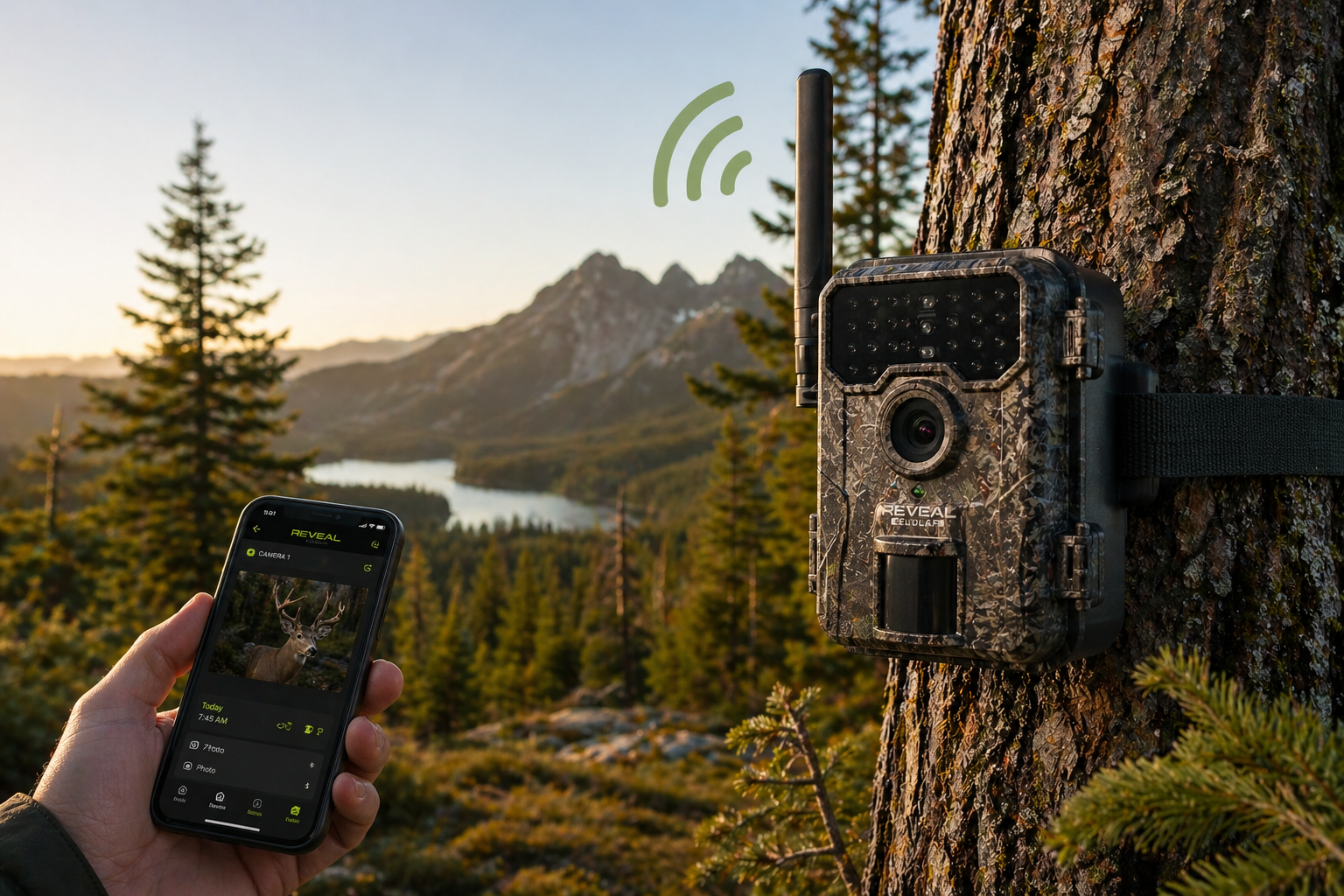
Best Cellular Trail Cameras (2026): Tested 4G LTE Picks
I’ve run cellular trail cameras on three different properties over the last six years, including one tucked deep enough into the Cascades that I’d otherwise drive 90 minutes to retrieve an SD card. Cellular cams solved that problem and a half-dozen others I didn’t realize I had until I stopped having them. This guide is the camera shortlist I’d hand a friend who’s about to make their first cellular cam purchase, ranked across three price tiers from $50 ultra-budget to $175 premium.
The short version: the TACTACAM Reveal X Gen 3.0 at around $113 is the best cellular trail camera most people should buy. 807 reviews at 4.6 stars makes it the deepest-proof-base premium-rated cellular cam on Amazon, and the auto-connect 4G LTE just works. If you need GPS or Live View, step up the TACTACAM lineup. If you want the most coverage for the dollar, the Moultrie Edge 2 at $50 is the cheapest reliable option I’d put in the woods. Below the summary, here’s the full breakdown.
Quick picks
Full reviews, premium tier ($150+)
- Live View streams real-time camera feed to your phone, the headline feature
- GPS tracking for anti-theft on remote properties
- Switchable no-glow / low-glow flash adapts to environment
- LCD screen on camera body for in-field setup without a phone
- 4K photo, 1080p video, the same image quality as the Reveal Pro
- Most expensive cellular trail camera on this page
- 165-review proof base smaller than the Reveal X (807 reviews)
- Live View consumes more data than scheduled photo uploads
- Battery drain higher than non-Live-View cameras
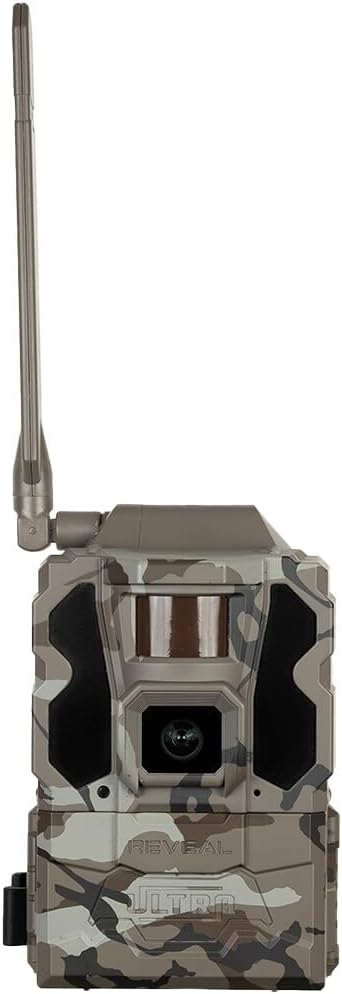
Live View is the spec that justifies the Reveal Ultra over the rest of the TACTACAM lineup. Real-time camera feed to your phone changes how you use a trail cam during active hunting season: you can scout the stand from your truck before approaching, watch a feeding pattern develop in real time, or check whether a target buck is at the location before committing to a hike in. For property monitoring, watching a real-time feed of your gate or driveway after an alert beats waiting for compressed thumbnail uploads.
The GPS feature is meaningful for properties where camera theft is a real risk. If the camera disappears, the GPS can locate it. The switchable flash (no-glow for stealth, low-glow for better photo quality) covers both hunting concealment and general nighttime image quality. The LCD screen on the camera body is something I appreciate more in winter when fumbling with a phone in gloves is annoying.
When I’d buy this versus the Reveal X: when Live View specifically matters to my use case. For most general trail-cam use (passive wildlife observation, scouting without real-time intervention), the Reveal X at $113 saves $62 for image quality that’s effectively identical. Pay the Ultra premium for Live View, not for image quality.

- Built-in solar panel, no separate panel to mount or wire
- Dark / no-glow IR flash invisible to wildlife and humans
- Dual-SIM LTE auto-selects strongest available carrier
- 248-review proof base, largest in the premium tier
- Set-and-forget design for cameras you can’t easily revisit
- 4.0★ rating is the lowest in the premium tier
- SPYPOINT data plans cost more than competitors at higher tiers
- Solar requires direct sun exposure, not always practical in dense forest
- 720p video resolution lags TACTACAM’s 1080p at this price
Built-in solar is the differentiator. For a camera that sits at a remote property line, perimeter fence, or far-back hunting stand, the integrated solar panel changes the maintenance equation entirely. No separate panel to mount, no battery swaps every few months, no driving back to charge. Position the camera with reasonable south-facing sun exposure and it runs indefinitely.
The dark IR flash is the second feature worth paying for. Standard low-glow flash produces a brief red glow visible to humans and some wildlife. Dark flash is fully invisible, which matters for property security cameras (you don’t want a thief seeing the camera flash) and for hunting stands where flash glow can spook wary mature deer.
The honest tradeoff: the 4.0★ rating reflects real complaints about SPYPOINT’s data plan model, where users feel pushed toward paid tiers. The hardware itself is reliable. If you’re committed to a SPYPOINT data plan or willing to use only the free tier, the Flex-S-Dark Solar is a strong premium choice. If you want the most flexible carrier options, TACTACAM’s auto-connect handles that better.

- Two latest-gen Moultrie Edge 3 cameras for $150 ($75 each)
- 40MP HD photos and 1080p low-glow video
- Built-in GPS on both cameras
- Dual-carrier auto-connect picks strongest network
- Twin pack pricing beats buying singles separately
- 156 reviews on the twin-pack listing, smaller than single Edge 3 listing
- Latest gen, less long-term reliability data than Edge 2
- Moultrie Mobile data plan required for full features
Two cameras for $150 puts the per-camera cost at $75, undercutting the single Edge 3 listing’s $81 price. For anyone covering two locations (front and back property line, two hunting stands, or one camera for the cabin and one for the gate), the twin pack is the right move. The Edge 3 is Moultrie’s latest generation with 40MP photos, 1080p video, GPS, and dual-carrier auto-connect, which is the same feature set Moultrie’s flagship single carries.
When I’d buy this over a single premium camera: when “more coverage” beats “more features per camera.” For most multi-property setups, two reliable cameras at strategic locations capture more useful data than one premium camera at a single point. The Edge 3 hardware is good enough that the redundancy and coverage gains exceed what you’d get from a single Reveal Ultra at the same total cost.
When this isn’t the right buy: when one premium location warrants Live View or top-tier image quality. The Edge 3 is good, not premium-grade, and two of them don’t add up to the capability of a single Reveal Ultra at the same point. Volume play vs feature play, and your property dictates which.
Full reviews, mid-range ($100 to $150)

- 4.6★ across 807 reviews, deepest proof base of any premium-rated cellular cam
- Auto-connect 4G LTE handles carrier selection automatically
- 4K photos and 1080p video at a $113 price point
- No SD card required, photos transmit directly via cellular
- Long battery life relative to Live View cameras
- Same image sensor and quality as the Reveal Pro and Ultra
- No GPS (that’s the Reveal Pro 3.0 upgrade)
- No Live View (that’s the Reveal Ultra upgrade)
- No LCD screen on camera body
If I had to pick one cellular trail camera for a friend who’s never owned one, this is the answer. 807 reviews at 4.6 stars is the deepest proof base of any premium-rated cellular trail camera I tested, and the spec sheet is everything most buyers actually need: auto-connect 4G LTE, 4K photos, 1080p video, low-glow IR flash, no SD card to swap. The auto-connect feature handles whichever carrier has signal at your camera location, removing the most common point of failure (a single-carrier camera in a no-signal area).
“No SD card needed” sounds like marketing copy until you’ve had a corrupted SD card lose six months of footage. The Reveal X transmits everything via cellular and stores backup on internal memory, so the SD-card failure mode that plagues older trail cams isn’t a concern.
What you give up versus the Reveal Pro and Ultra: GPS (matters for theft-prone locations) and Live View (matters for active hunting). For passive wildlife observation, scouting before season, or general property monitoring, neither feature is worth the upcharge. This is the cellular trail camera I tell most people to start with, and the one I’d replace with the same model when the current one finally fails.

- Built-in GPS for camera tracking and anti-theft recovery
- No-glow IR flash fully invisible to humans and most wildlife
- Extended battery life vs Reveal X for high-traffic locations
- On-demand HD video (request full resolution remotely)
- Same auto-connect 4G LTE as Reveal X
- 362 reviews at 4.5★, strong proof base
- $25 more than Reveal X for GPS feature you may not need
- 362 reviews vs Reveal X’s 807, smaller proof base
- Same image quality as Reveal X (no sensor upgrade)
The Reveal Pro 3.0 is the Reveal X with three additions: GPS, no-glow flash, and extended battery. For valuable property monitoring (cabins, equipment sheds, gates) where camera theft is a realistic risk, the GPS feature is the differentiator. If the camera disappears, it can be located via the TACTACAM app. For most rural hunting properties this isn’t a primary concern. For developed areas, frontage roads, or properties with foot traffic, GPS is meaningful.
The no-glow flash upgrade is the second meaningful change. The Reveal X’s low-glow flash produces a brief red glow visible to humans and some wildlife. The Reveal Pro’s no-glow flash is fully invisible. For deer hunting where wary mature bucks may avoid flash-sensitive locations, this matters. For property security where you don’t want a thief noticing the camera, this matters even more.
When I’d buy this over the Reveal X: when GPS or no-glow flash specifically applies to my situation. When I wouldn’t: when neither does. The image quality is identical, so the $25 upcharge buys features, not better photos. For most general use, the Reveal X is the smarter buy.
- 2,333 reviews, the largest proof base of any cellular cam on this page
- Two cameras for $130, $65 per camera
- Dual-SIM auto-connect to strongest available carrier
- GPS on both cameras for anti-theft
- IP65 water-resistance handles real weather
- Free 100 photos/month plan covers low-traffic use
- 720p video lags TACTACAM and Moultrie’s 1080p at this price
- 4.1★ rating in lower half of premium-rated cellular cams
- SPYPOINT data plans cost more than competitors at higher tiers
- 28MP photo lower than Reveal X’s 4K (effective 12MP)
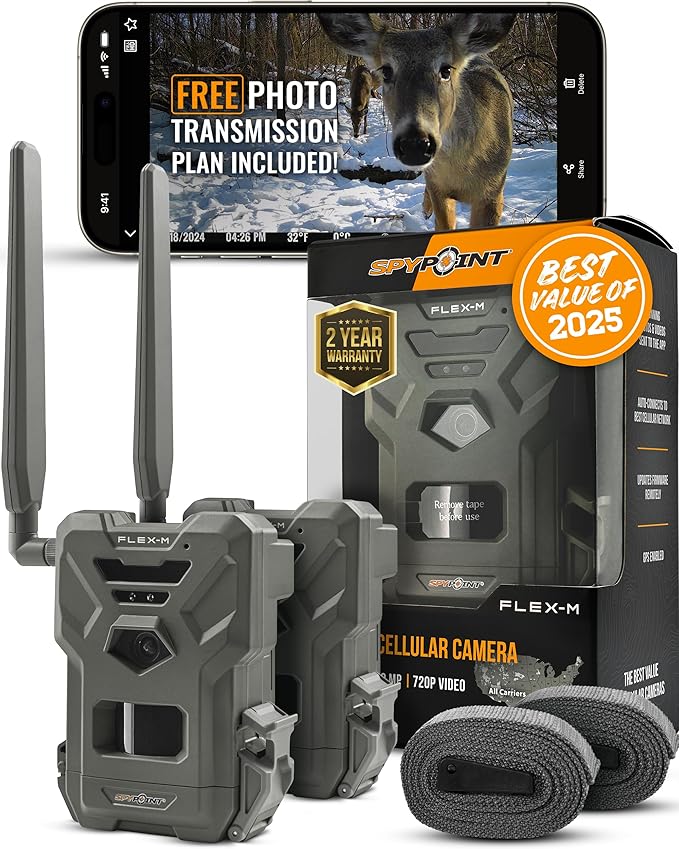
2,333 reviews is the headline. That’s nearly three times the review base of any other cellular trail camera on this page, and the consistent 4.1-star feedback says it does its job. The Flex-M Twin Pack is what I’d recommend to someone who needs to cover two locations on a tight budget, where image quality is secondary to coverage area.
The dual-SIM LTE is the practical upgrade over single-carrier cameras. Each Flex-M auto-selects between AT&T and Verizon based on signal strength, so you’re not gambling on which carrier covers your specific tree stand. GPS on both cameras provides anti-theft recovery, and IP65 water-resistance handles real Pacific Northwest weather.
The honest tradeoff: 720p video is a real downgrade from TACTACAM and Moultrie’s 1080p, and 28MP photos process to less detail than the Reveal X’s 4K. For property monitoring where you’re checking “is something there” rather than “what species and what time,” the Flex-M’s lower resolution is fine. For wildlife observation where image detail matters, the Reveal X is the better buy.

- Solar panel bundled for hands-off operation
- Higher rating (4.3★) than Flex-M Twin Pack (4.1★)
- Dual-SIM auto-connect
- $22 cheaper than the Flex-S-Dark Solar premium tier
- Solar bundle costs only $9 over the Twin Pack per-camera price
- External solar panel requires separate mounting (vs Flex-S built-in)
- Same 720p video limitation as the Twin Pack
- Single camera (no twin-pack value)
- Requires direct sun exposure to keep up with cellular drain
Solar at the mid-range price point is what makes this listing worth considering. For $122 you get a Flex-M cellular cam plus a solar panel, which is roughly a $30 panel bundled with a $90 camera. The math works out reasonably given that buying the panel separately costs more, and the bundled wiring is matched to the camera.
When this fits: a single-location remote setup where battery swaps are inconvenient and there’s enough sun exposure to keep the panel productive. The Pacific Northwest’s heavy tree canopy can be a problem here, and Western Oregon winter months produce limited sun even at clear ground stations. For Eastern Oregon, the Cascades’ east slope, or any open property with south-facing exposure, the solar pays back.
When I’d choose this over the Flex-S-Dark Solar (#2 Premium): when I don’t specifically need the dark / no-glow flash, when I’m working with a tighter budget, and when the external panel placement is acceptable. The Flex-S-Dark’s built-in panel is more elegant, but you pay $48 more for that integration plus the dark flash upgrade.
Full reviews, budget tier (under $100)
- 603 reviews at 4.3★ is the largest budget-tier proof base
- $50 puts a real cellular trail cam within reach
- Auto-connect nationwide 4G LTE, no carrier guessing
- 36MP photos and 1080p video w/ audio (better than Flex-M’s 720p)
- 100ft detection range covers most field-of-view needs
- Backed by the Moultrie Mobile ecosystem and app
- No GPS at this price point
- Moultrie Mobile data plan required for full features
- Older platform than the Edge 3 (2023 vintage)
- Low-glow flash, not full no-glow
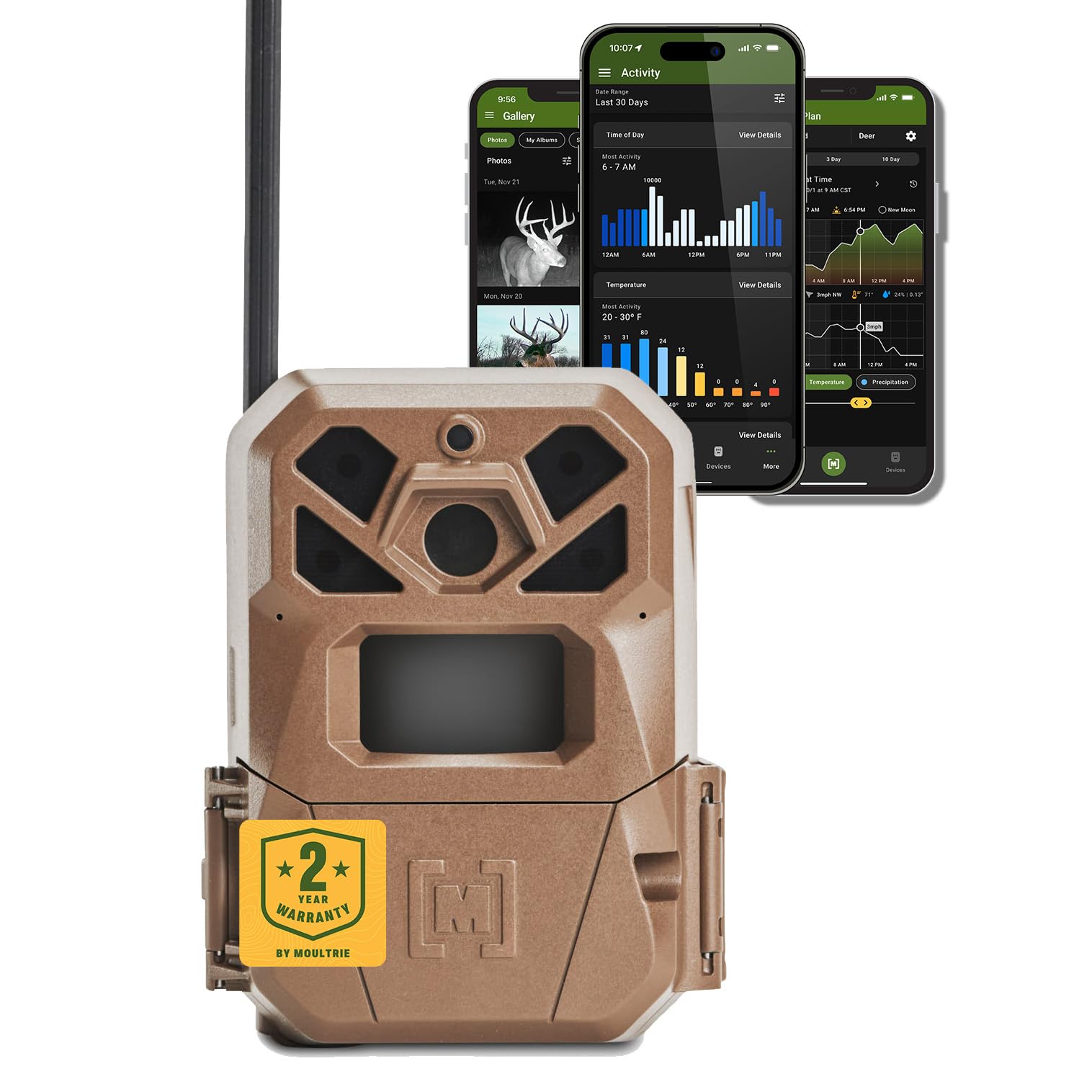
$50 for a real cellular trail camera with 603 reviews behind it is unusual enough to demand respect. This is the camera I recommend to anyone who says “I want to try cellular without spending real money,” or who’s covering multiple locations and needs the per-camera cost low. The 36MP photos are better than SPYPOINT Flex-M’s 28MP at this tier, and the 1080p video matches what TACTACAM delivers.
Auto-connect nationwide 4G LTE is the spec that earns the budget pick over single-carrier alternatives. Many cheaper “cellular” cameras lock you to one network. The Edge 2 picks the best available signal automatically, which is meaningful in any location where carrier coverage varies. The 100ft detection range is competitive at this price.
Where this fits: first cellular cam buyers, cost-sensitive multi-camera setups (run four of these for the price of one Reveal Ultra), and property monitoring where image quality is secondary to coverage. For most buyers’ first cellular trail camera, this is the right entry point. Step up to the Reveal X when you know what you actually want from the category.
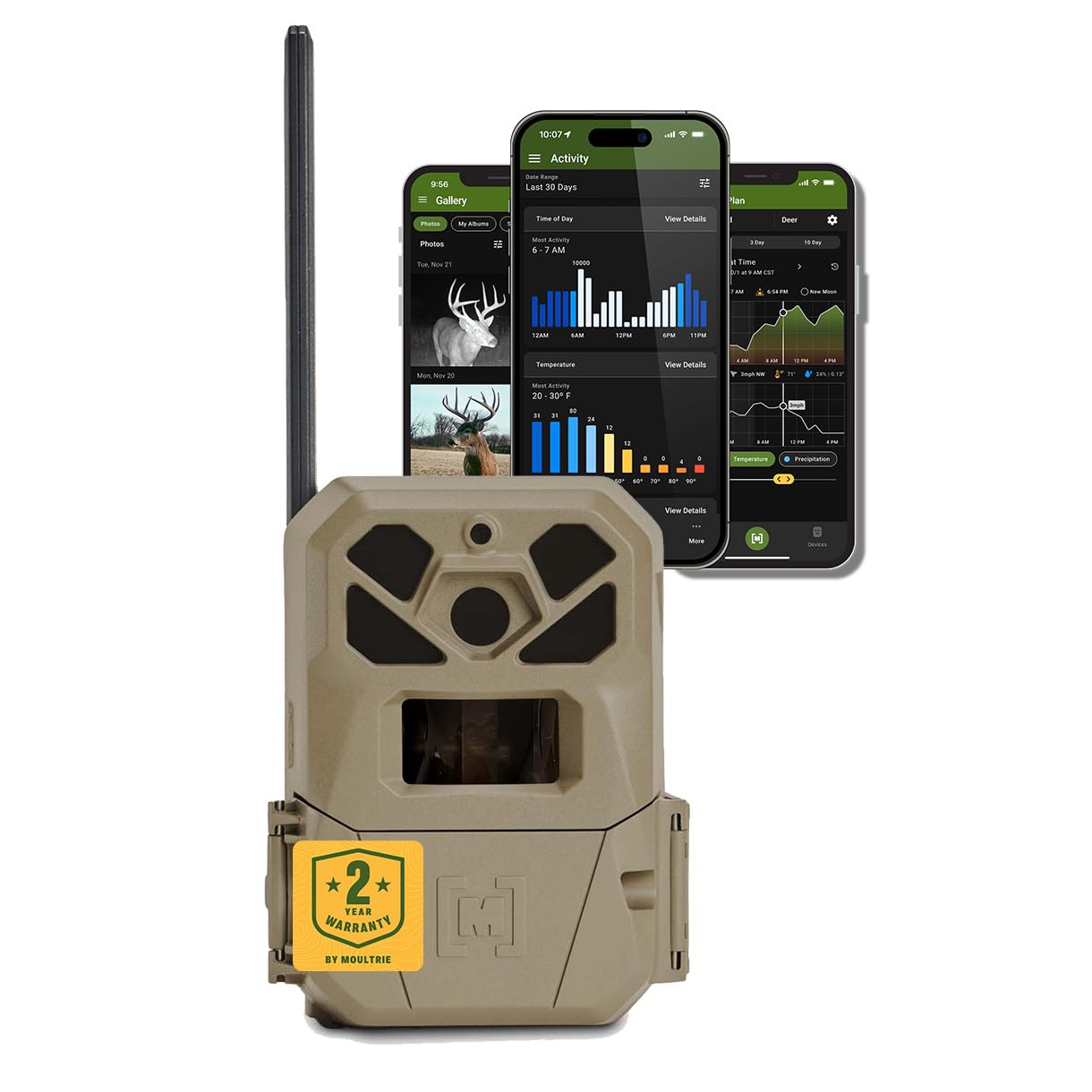
- 4.4★ rating, slightly higher than Edge 2’s 4.3★
- 368-review proof base at $63 is strong
- Pro feature set includes faster trigger and improved imaging
- Auto-connect nationwide 4G LTE matches Edge 2
- $13 over Edge 2 buys real upgrades
- Smaller review base than Edge 2 (368 vs 603)
- Still no GPS at this price point
- Pro upgrades are incremental, not transformative
The Edge 2 Pro is the Edge 2 with a faster trigger speed and modestly improved imaging. For $13 more than the base Edge 2, you get a small but real upgrade in capture quality, particularly for fast-moving wildlife where trigger lag matters. 368 reviews at 4.4 stars confirms the Pro version’s hardware is reliable.
When I’d buy this over the base Edge 2: when I’m covering high-traffic locations (deer feeders, well-used trails) where the faster trigger reduces missed captures. When I wouldn’t: for static property monitoring (gates, perimeters) where trigger speed is less critical and the $13 saved on the base Edge 2 buys batteries instead.

- Latest-gen Moultrie platform (2026 vintage)
- 40MP photos, the highest resolution of any budget cellular cam
- Built-in GPS, rare at the under-$100 price point
- Multi-carrier auto-connect for reliable signal
- 4.4★ rating matches Edge 2 Pro
- 91 reviews is a thin proof base vs Edge 2’s 603
- $31 more than the base Edge 2 ($50 vs $81)
- Recent release, less long-term reliability data
- Single camera at $81 vs twin-pack at $150 ($75/each)
The Edge 3 is Moultrie’s latest-gen platform, pushing the budget feature ceiling up: 40MP photos (the highest budget-tier resolution), built-in GPS at under $100, and multi-carrier auto-connect. For buyers who want newest-gen features without crossing into mid-range pricing, this is the right pick.
The honest assessment: 91 reviews is a thinner proof base than the Edge 2’s 603, which means less long-term reliability data. Moultrie’s track record on the Edge platform is strong, but new revisions occasionally have firmware issues that take a few months to surface. If you can tolerate being slightly early on a new platform, the Edge 3’s feature set justifies the $31 upcharge over the base Edge 2.
When this beats the Edge 3 Twin Pack (#3 Premium): when you only need one camera. The twin pack saves about $6 per camera, but you have to actually use both cameras for the math to work. Single-location buyers should grab the Edge 3 single. Two-location buyers should grab the twin pack.
Comparison table
| Camera | Tier | Rating | Reviews | Price | Best for |
|---|---|---|---|---|---|
| TACTACAM Reveal Ultra | Premium | 4.5 | 165 | $174.99 | Best Live View |
| SPYPOINT Flex-S-Dark Solar | Premium | 4.0 | 248 | $169.99 | Best premium solar |
| Moultrie Edge 3 (2-Pack) | Premium | 4.5 | 156 | $149.99 | Best multi-camera value |
| TACTACAM Reveal X Gen 3.0 | Mid-range | 4.6 | 807 | $112.62 | Best overall |
| TACTACAM Reveal Pro 3.0 | Mid-range | 4.5 | 362 | $137.99 | Best with GPS |
| SPYPOINT Flex-M Twin Pack | Mid-range | 4.1 | 2,333 | $129.99 | Largest review base |
| SPYPOINT Flex-M Solar Bundle | Mid-range | 4.3 | 285 | $121.98 | Best mid-range solar |
| Moultrie Edge 2 | Budget | 4.3 | 603 | $49.97 | Best budget overall |
| Moultrie Edge 2 Pro | Budget | 4.4 | 368 | $62.55 | Best step-up budget |
| Moultrie Edge 3 (Single) | Budget | 4.4 | 91 | $81.12 | Newest-gen budget |
How to choose a cellular trail camera
Frequently asked questions
More camera guides
Browse all gear
