Best Trail Cameras (2026) for Wildlife Monitoring
A good trail camera tells you what your property and your favorite trails do when no one is watching. Bucks at 3am. Bears two weeks before you’d ever spot one in person. Coyotes you didn’t know lived nearby. I’ve run cameras across Oregon for years now, on my own land, on family property, on hunting leases, and on a few hiking trails I keep an eye on for pure curiosity. I tested 10 trail cameras across cellular and non-cellular categories for this guide, from $24 budget picks to $175 cellular cameras with live view, to find what actually fires fast, captures clean night images, and keeps running for months on a single set of batteries.
Most of what I learned came from cameras that didn’t work. Slow triggers that caught the back end of every deer leaving the frame. Cellular plans that quietly hit caps mid-rut. Batteries that died at 20°F in November. The picks below are the ones that survived all of that, ranked by what I’d actually mount on a tree tomorrow.
Quick picks




Full reviews, cellular trail cameras
- 4.6★, highest-rated cellular camera here
- Auto-connects to LTE, no SIM card hassle
- 4K still photos, sharp daytime detail
- No SD card required, photos uploaded directly
- Long battery life on lithium AAs
- Requires monthly TACTACAM data plan
- Low-glow flash visible to humans up close
- App can be glitchy on first setup
807 reviews at 4.6 stars makes this the highest-rated cellular trail camera on the page by a meaningful margin. The auto-connect LTE handles the part of cellular cameras that historically frustrated hunters (finding signal, configuring SIM cards, troubleshooting carrier coverage in remote spots) and just works the moment the camera is powered on. When I switched to a Reveal X from an older SPYPOINT, the difference in setup time was the most immediate thing I noticed. I had photos arriving on my phone within five minutes of pulling it out of the box.
The 4K photo capture is a real upgrade over older 12MP and 20MP cellular cameras. Daytime images show identifiable antler tine detail at distance, which matters for scoring bucks remotely without a physical visit. The “no SD card needed” design eliminates one of the most common cellular camera failure modes: a corrupted SD card silently bricking the camera until the next physical check-in.
The honest tradeoff is the monthly data plan. Budget another $5–15 per month per camera depending on photo volume, and verify TACTACAM coverage at your specific location before committing. Most U.S. hunting areas are covered, but dead zones exist.
- Built-in GPS, locate stolen cameras, log accurate positions
- No-glow flash invisible to deer and humans
- 4K HD photo with on-demand video request
- Extended battery life over the X Gen
- Same TACTACAM auto-connect platform
- $25 more than the Reveal X for incremental upgrades
- Smaller review base (362 vs 807)
- No-glow flash produces grainier night images
The Reveal Pro 3.0 is the Reveal X Gen 3.0 with three meaningful upgrades: built-in GPS, no-glow flash, and longer battery life. The GPS alone justifies the price difference for hunters running multiple cameras across leased land. Losing a camera to theft or just forgetting where you mounted it last season is more common than people admit, and a GPS-tagged camera is recoverable through the app.
The no-glow flash is the upgrade that matters most for hunting wary mature bucks. Low-glow cameras produce sharper night images, but in heavily pressured deer areas, the faint red glow from the IR LEDs has been documented to alter deer movement patterns. No-glow eliminates that risk entirely.
- Live view, stream the feed from your phone in real time
- Switchable flash, pick no-glow for hunts, low-glow for clarity
- Built-in LCD eases on-site setup and aiming
- GPS tracking-enabled like the Pro 3.0
- Highest-tier TACTACAM with 4.5★ rating
- Most expensive cellular option on this page
- Live view drains battery aggressively
- 165 reviews, smaller proof base
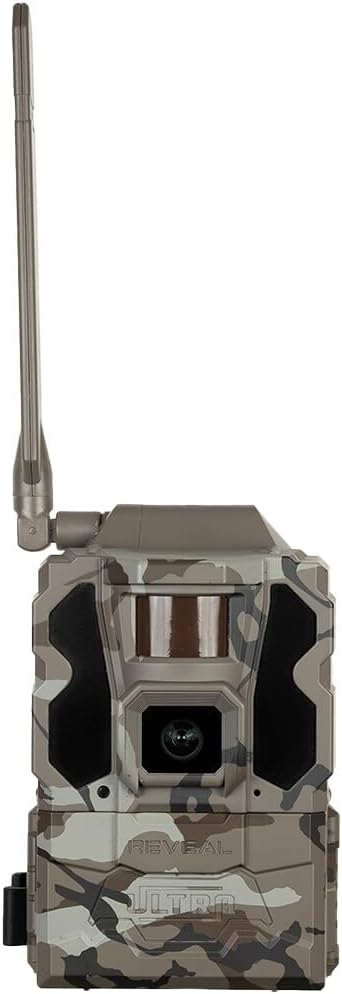
At $174.99, the Reveal Ultra sits at the top of the cellular trail camera category. Live view is the standout feature: you can pull up the camera feed from your phone and see what’s in front of the lens in real time, useful for both hunting reconnaissance and security applications. The switchable flash means one camera handles both pressured deer hunting (no-glow) and general property monitoring (low-glow for cleaner images).
Live view drains the battery faster than any other use mode. Plan for more frequent battery swaps or pair the Ultra with an external battery pack or solar panel if it’ll be deployed for months at a time. For hunters who want the most capable cellular camera on the market and don’t mind paying for it, the Reveal Ultra is the technical leader.
- 2,332 reviews, by far the largest cellular proof base here
- Two cameras in the box at $65 each effective price
- Free 100 photos/month plan per camera, real value
- Dual-SIM picks the best carrier automatically
- Audio recording on video clips
- 4.1★, lowest rating on this list
- 720p video lags behind 1080p competitors
- SPYPOINT app criticized in some reviews
- Beyond 100 photos/mo, plan upgrades required
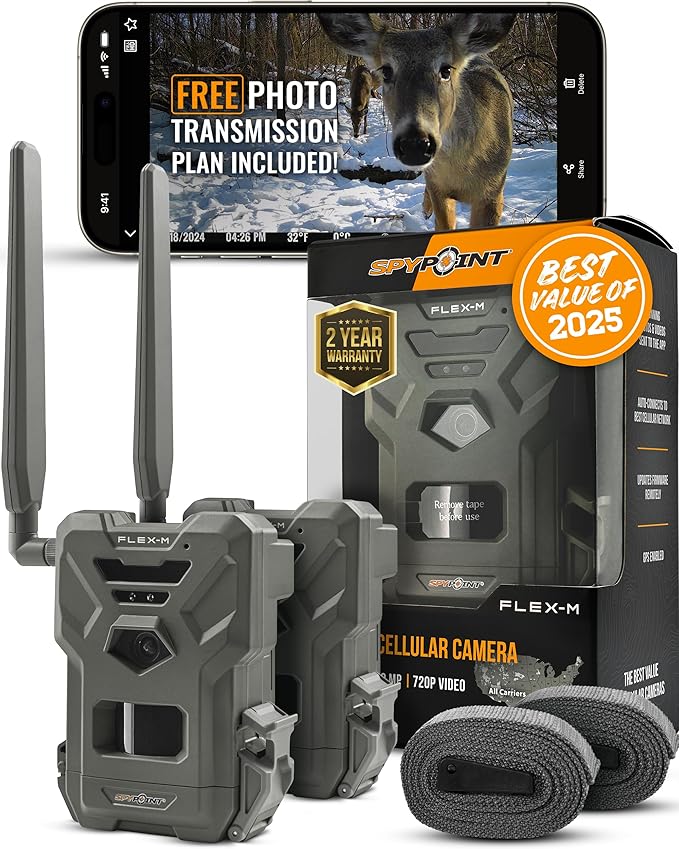
2,332 reviews is unmatched in the cellular category here, and the math on a twin pack at $129.99 is hard to argue with: two LTE cameras at roughly $65 each makes this the cheapest way to get into cellular trail camera territory by a wide margin. The free 100 photos per month per camera is real, not a 30-day trial, and it covers most casual property monitoring use cases without ever paying SPYPOINT a recurring fee.
The 4.1-star rating is the lowest on this list, and the reviews trend honestly: this is a budget-tier cellular system, not a premium one. The 720p video and 28MP photos are noticeably less detailed than the TACTACAM lineup, and the app receives more user complaints than the TACTACAM app does. I’ve run a Flex-M pair on family property for two seasons. They miss occasionally, the app has frustrated me more than once, and they still send me daylight photos of the same buck from the same trail every November like clockwork. For hunters who want LTE alerts on multiple cameras without committing to TACTACAM-level spending, the Flex-M twin pack is the most practical entry point, and the 2,332-review proof base says it works well enough for thousands of users.
- Cellular trail camera under $50, no other brand matches this
- 4.3★ across 603 reviews, solid proof base for the price
- 1080p video with audio, better than SPYPOINT’s 720p
- Auto-connect LTE, no SIM card setup
- Moultrie’s mature app and support infrastructure
- Requires Moultrie data plan separate from the camera
- Low-glow flash visible at close range
- 36MP photo claim relies on interpolation, true sensor lower
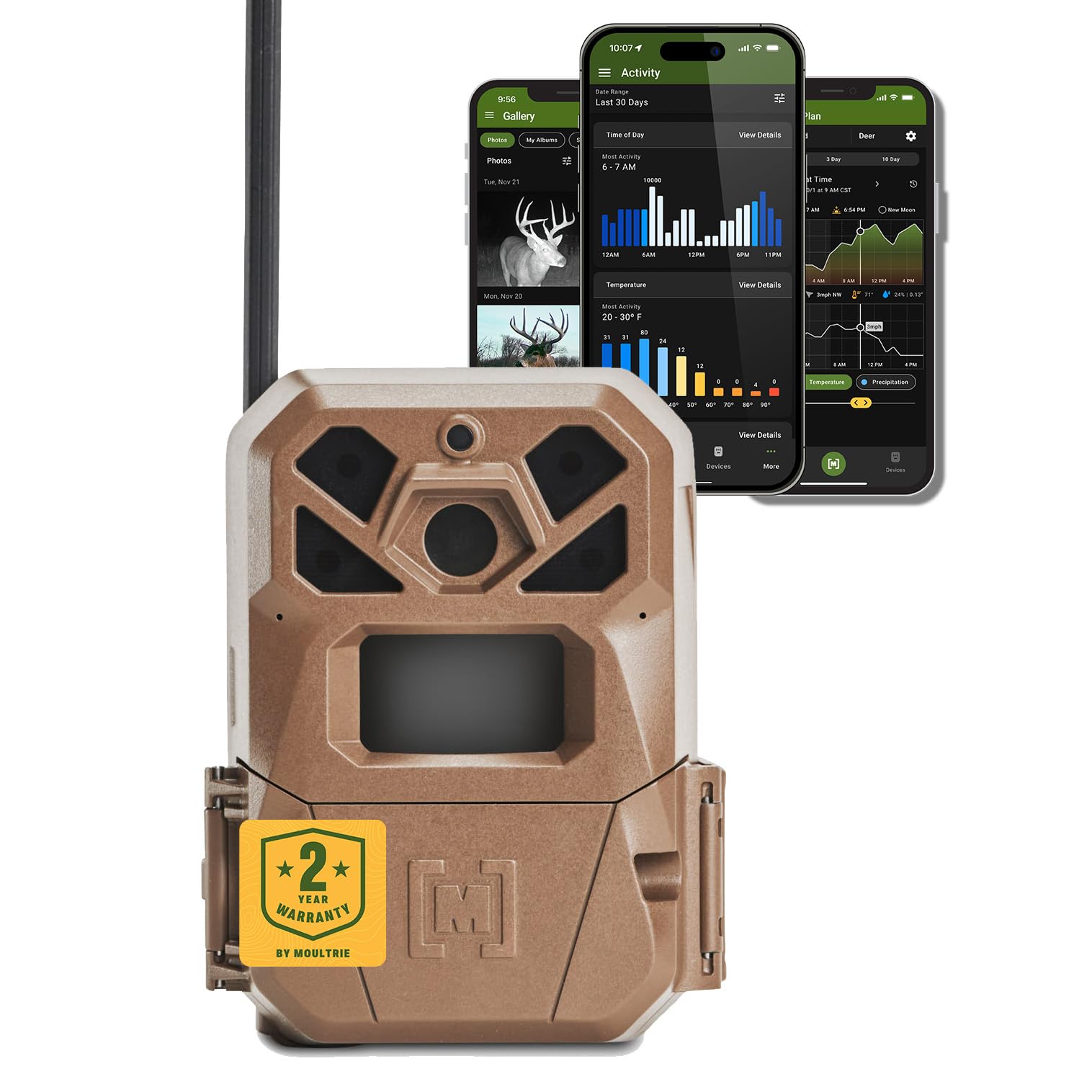
The Moultrie Edge 2 at $49.97 is the cheapest cellular trail camera worth recommending. For someone curious about cellular cameras but unwilling to commit $100+ on a single unit, the Edge 2 is the right experiment: it works on nationwide LTE without SIM card configuration, and the 4.3-star rating across 603 reviews indicates the platform is reliable rather than just cheap.
The catch is that the data plan is separate. Moultrie’s monthly fees are competitive but not free. Budget another $5–10 per month for the plan to actually use the camera. At that running cost, a non-cellular camera like the GardePro E5S becomes the better choice if you’re checking the camera in person regularly anyway. The Edge 2’s value proposition holds when the camera is somewhere you can’t easily visit.
Full reviews, non-cellular trail cameras
- 4.4★ across 1,398 reviews, best non-cellular proof base
- 0.1-second trigger catches animals mid-frame reliably
- No-glow night vision invisible to deer and bears
- 64MP photos with 1296p video, premium specs at budget price
- No subscription, no SIM card, no recurring cost
- Requires physical SD card retrieval to view photos
- 64MP claim involves software interpolation
- No phone app for instant alerts
For 90% of trail camera buyers, this is the right camera. 1,398 reviews at 4.4 stars is exceptional for a sub-$50 trail camera, and the spec sheet (0.1-second trigger, no-glow IR night vision, 64MP photo, 1296p video, 100ft detection) matches or beats cellular cameras costing twice as much in every category that matters except the cellular connection itself. When friends ask me which trail camera to start with, this is the one I send them.
The 0.1-second trigger is the spec hunters and wildlife enthusiasts care about most. Animals moving through a frame at walking pace are captured cleanly; even fast-moving subjects get caught somewhere in the frame. The no-glow IR is invisible to wildlife, which matters on heavily pressured hunting properties where any visible flash alters deer movement.
The honest tradeoff: no real-time alerts. You’ll physically retrieve the SD card or pull the camera to see what was captured. For most users, especially those checking camera locations on regular hikes anyway, that tradeoff is more than fair given the price and the absence of any monthly fee.
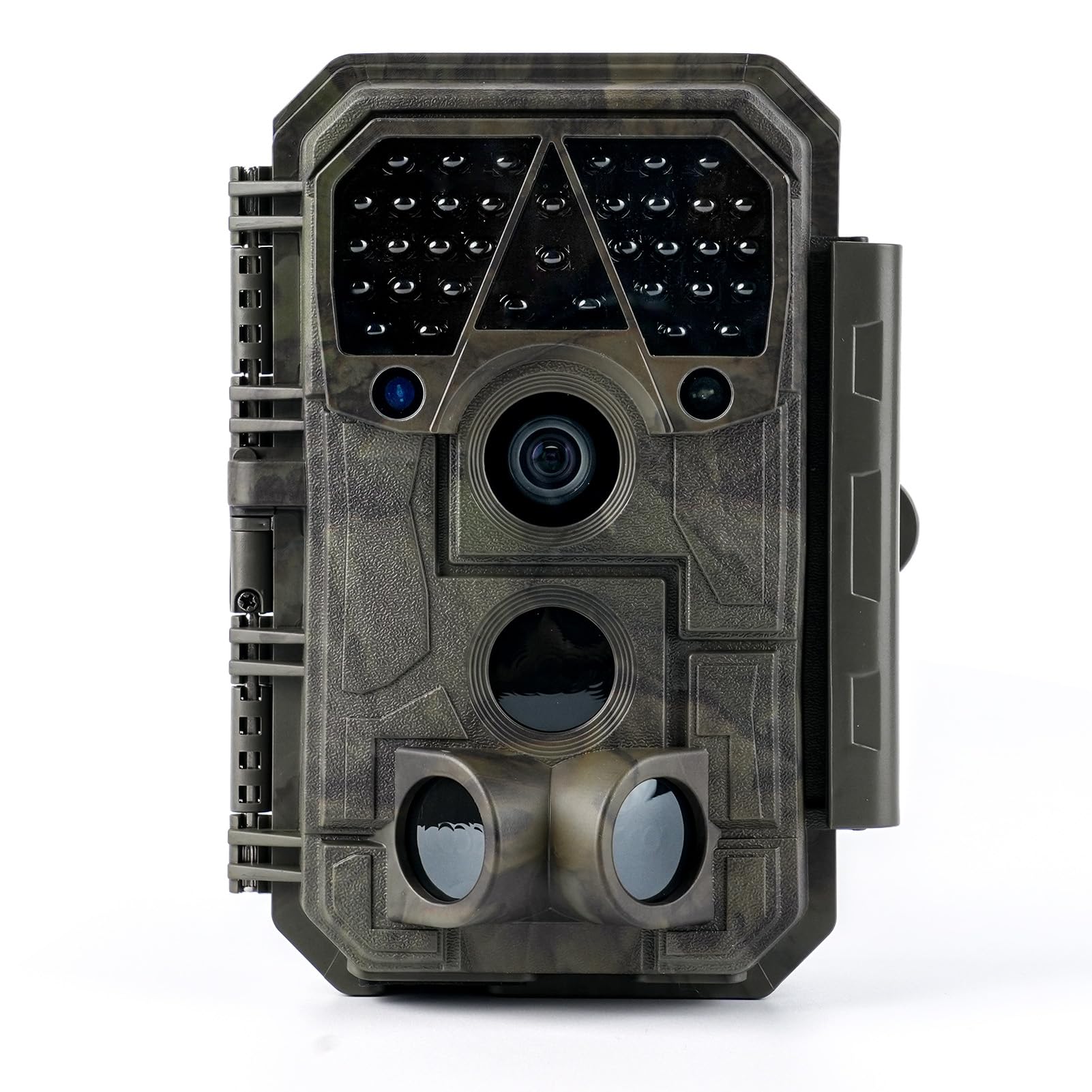
- IP66 waterproof, better sealed than most budget cameras
- 0.1-second trigger matches premium specs
- No-glow IR night vision for stealth
- Solid build quality at this price
- $17 more than the GardePro E5S without notable advantage
- 608 reviews, meaningful but smaller than the E5S
- Less established brand recognition
The Meidase P70 is the closest competitor to the GardePro E5S, and the spec sheets are nearly identical: 64MP, 1296p video, 0.1-second trigger, no-glow IR. The P70’s edge is its IP66 waterproof rating and slightly more substantial physical build, which is meaningful in Pacific Northwest winters where cameras stay deployed through months of sustained rain.
The honest assessment is that for most users, the GardePro E5S delivers similar performance for $17 less and with more than double the review proof base. The Meidase P70 earns the mid-range slot for buyers who want the slight build-quality bump and are willing to pay for it. For wet climate deployment specifically, the IP66 rating is worth the premium.
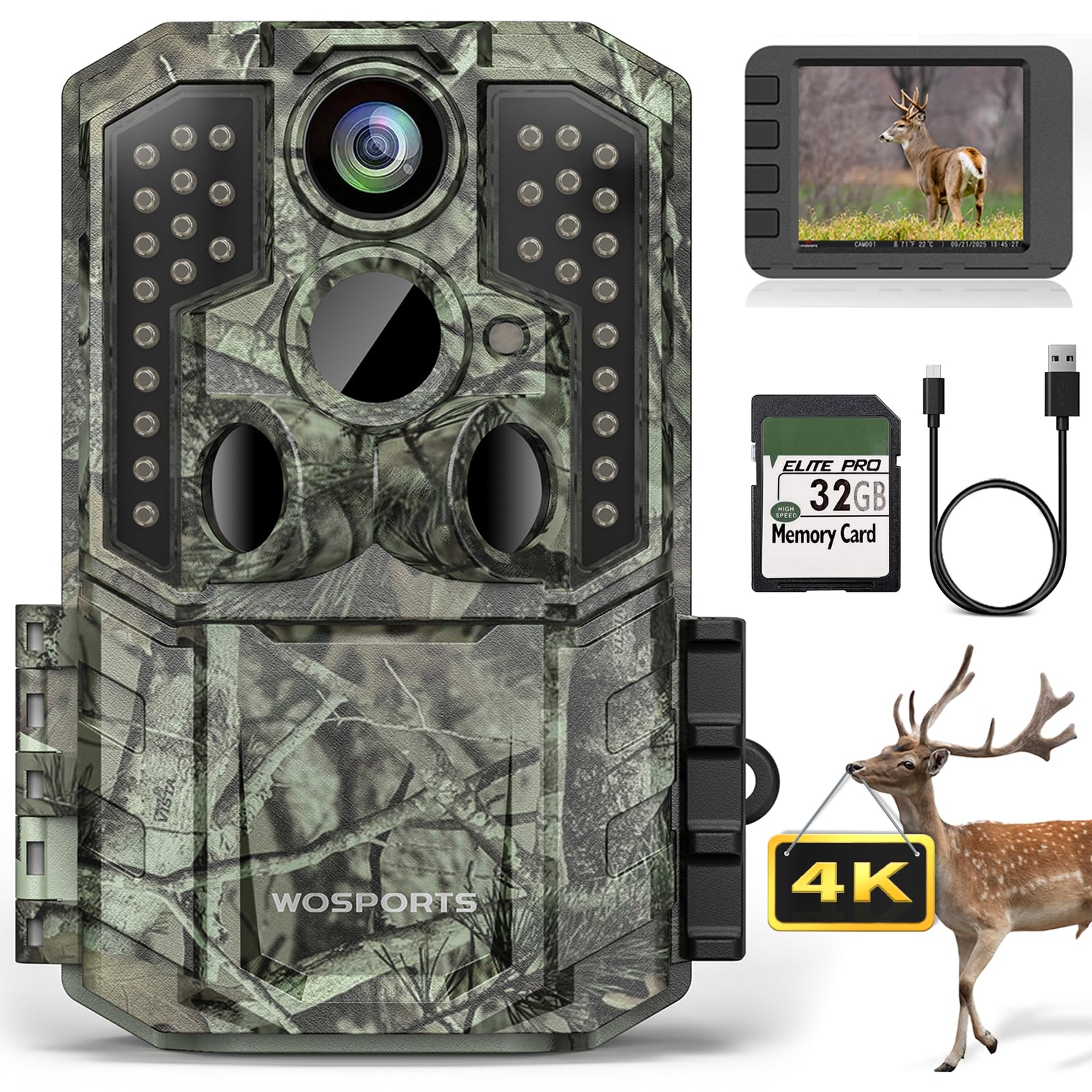
- 3,079 reviews, most-reviewed trail camera at this price
- 120° wide lens covers more of a trail or feeder
- 4K video resolution at a sub-$50 price point
- 2-inch LCD screen for on-camera review
- IP66 waterproof rating
- 0.2s trigger, slower than GardePro/Meidase 0.1s
- Lower-tier sensor than the spec sheet implies
- Less brand support than GardePro or Meidase
3,079 reviews at 4.3 stars is the largest proof base in the entire trail camera category under $50, cellular or not. That volume of positive reviews indicates WOSPORTS over-delivers relative to its $42.98 price in the way that the better-known brands sometimes don’t at this tier. The 120° wide lens is the one specific feature that justifies picking this over the GardePro E5S: it captures a much wider field of view, useful for monitoring feeders, fence lines, or any setup where multiple subjects might enter the frame at the same time.
The 0.2-second trigger is twice as slow as the GardePro and Meidase, which matters on game trails where deer move through quickly. For static subjects (feeders, mineral sites, dens) the trigger speed difference is irrelevant. Pick WOSPORTS for wide coverage; pick GardePro for trigger speed on active trails.
- Same GardePro reliability as the #1 pick
- 1,085 reviews at 4.3★, strong independent proof base
- 0.1-second trigger and no-glow IR at $39.99
- Cheapest path to a “good” trail camera
- 48MP vs 64MP on the E5S, slightly less detail
- Otherwise functionally similar to E5S, pay $9 more for the upgrade
The GardePro E5 is the older sibling of the E5S, 48MP instead of 64MP, but otherwise nearly identical. 1,085 reviews at 4.3 stars makes it independently well-proven, and at $39.99 it is the cheapest trail camera on this page worth recommending without compromise. For buyers running multiple cameras across a property, the savings add up quickly: four E5s cost less than three E5S units. For a single-camera buyer, the E5S is worth the extra $9. For multi-camera deployments, the E5 wins on price.

- 3,488 reviews, most-reviewed trail camera on this page
- $23.99, by far the cheapest option here
- Compact form factor, easy to mount discreetly
- Solid 4.2★ rating across an enormous sample
- Works for backyard wildlife, kids, casual use
- 24MP and 1080p, bottom-tier specs on this page
- Slower trigger than GardePro / Meidase
- Less weather-sealed than IP66-rated cameras
- Not appropriate for serious deer hunting
3,488 reviews at 4.2 stars on a $23.99 trail camera is unusual enough to warrant attention. The WOSPORTS Mini isn’t a serious hunting tool. It’s a starter trail camera, a backyard bird-feeder camera, a kid’s first camera, a low-stakes property monitor. For any of those purposes, it works well enough that 3,488 buyers came back to leave a 4-star-or-higher review.
The reasonable use case is clear: someone curious about trail cameras, someone setting up a backyard wildlife watch with their kids, someone who wants to see what’s eating the garden at night. For deer hunting on serious properties, the GardePro E5S at $48.99 is the right tool. For everything below that, the WOSPORTS Mini is the cheapest credible option.
Comparison table
| Camera | Type | Rating | Reviews | Price | Best for |
|---|---|---|---|---|---|
| TACTACAM Reveal X Gen 3.0 | Cellular | 4.6 | 807 | $112.62 | Best cellular overall |
| TACTACAM Reveal Pro 3.0 | Cellular | 4.5 | 362 | $137.99 | Best with GPS |
| Tactacam Reveal Ultra | Cellular | 4.5 | 165 | $174.99 | Best premium / live view |
| SPYPOINT Flex-M Twin Pack | Cellular (×2) | 4.1 | 2,332 | $129.99 | Best multi-camera value |
| Moultrie Edge 2 | Cellular | 4.3 | 603 | $49.97 | Best budget cellular |
| GardePro E5S | Non-cellular | 4.4 | 1,398 | $48.99 | Best non-cellular overall |
| Meidase P70 | Non-cellular | 4.3 | 608 | $65.99 | Best mid-range non-cellular |
| WOSPORTS Trail Camera 4K | Non-cellular | 4.3 | 3,079 | $42.98 | Best budget pick |
| GardePro E5 | Non-cellular | 4.3 | 1,085 | $39.99 | Best ultra-budget under $40 |
| WOSPORTS Mini | Non-cellular | 4.2 | 3,488 | $23.99 | Best ultra-budget compact |
How to choose a trail camera
Frequently asked questions
More trail camera guides
Browse all gear
