
Dog gear field guide
How to Measure a Dog for a Harness
A harness that fits right is the difference between a dog who loves the trail and a dog who squirms out on the way to the car. Four measurements, a soft tape, and five minutes get you the number that every sizing chart actually cares about.
How to Measure a Dog for a Harness, Fast
- Chest girth is the number that matters. Wrap a soft tape around the widest part of your dog’s rib cage, right behind the front legs. This is the measurement every harness brand sizes against.
- Measure in three places, not one. Chest girth, base of the neck, and back length (shoulder to tail base). Weight is a rough cross-check, not a sizing input.
- Use a soft sewing tape or a piece of string. A stiff carpenter’s tape gives a bad read on a curved rib cage. If the dog is wriggly, string plus a ruler works.
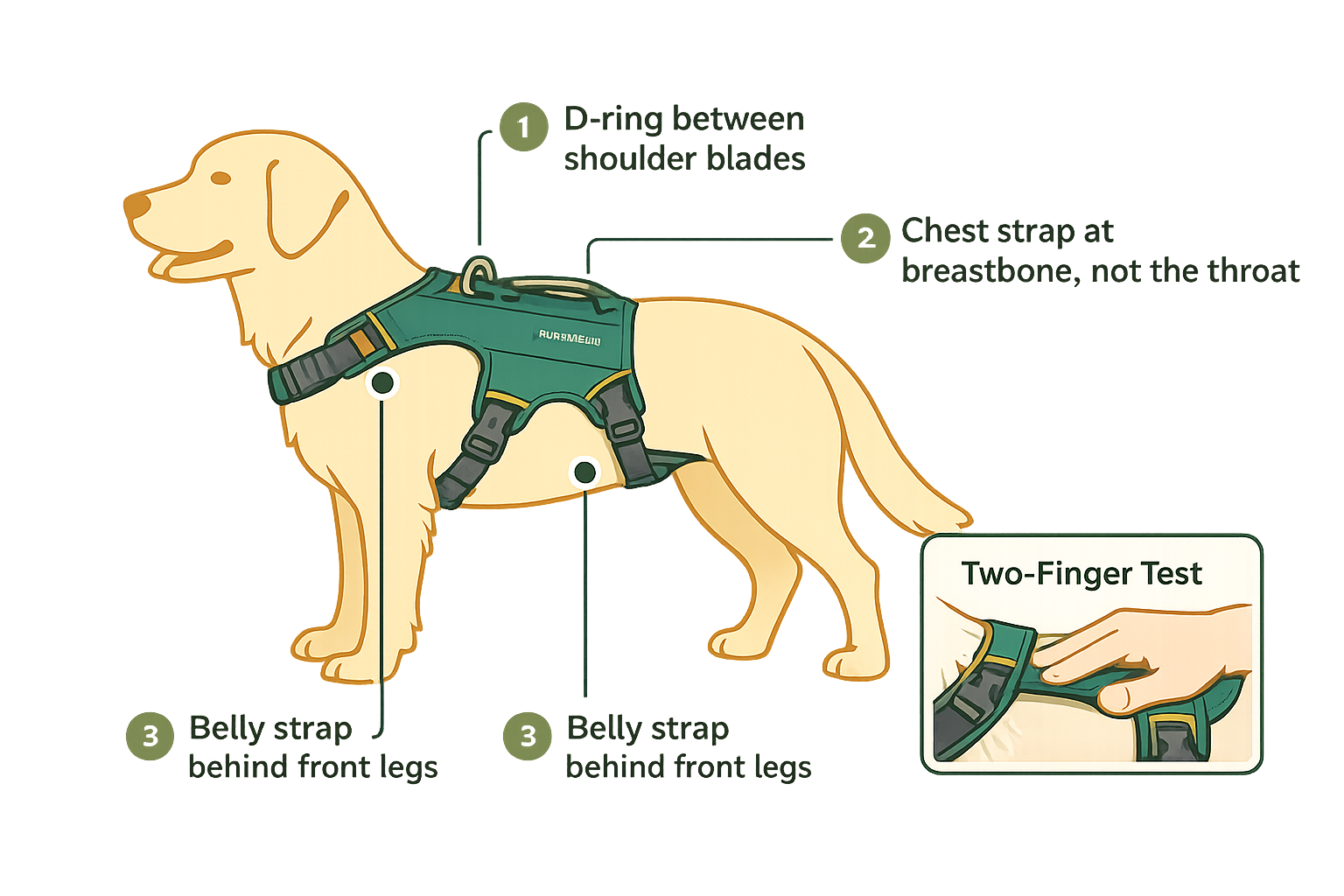
- Fit two fingers, no more. When the harness is on, you should be able to slip two fingers between any strap and the dog. One finger is too tight. Three is too loose.
- Size up at the boundary. If your dog measures between sizes, buy the larger one and adjust the straps in. A too-small harness chafes and restricts the shoulder.
The single fastest way to end up with a harness your dog escapes on mile two of a trail is to eyeball the size or buy by weight alone. Manufacturers design harnesses around chest girth, not pounds, and weight-based sizing is a rough approximation that breaks down the moment you try to fit a deep-chested Greyhound or a broad, short Bulldog. The good news is that learning how to measure a dog for a harness takes about five minutes and one soft tape.
This is the full, practical version of how to measure a dog for a harness, covering which measurements actually matter, how to take them without fighting your dog, how to read a brand’s sizing chart, and what to do when your dog falls between two sizes. If you’ve already got your measurements and just need picks, skip to our roundup of the best dog harnesses for hiking. If you’ve got the harness and need to put it on, see our guide to how to put on a dog harness.
01 Why Fit Matters More Than Brand
A well-fitted cheap harness is safer than a poorly fitted expensive one. When a harness doesn’t fit, three things tend to go wrong: the dog backs out when spooked at a trailhead, the straps chafe the armpits on a long hike, or the harness restricts the shoulder and alters the dog’s gait over time. None of these are rare. All three come from guessing instead of measuring.
The chest-girth measurement is the one every harness brand in the outdoor market (Ruffwear, Kurgo, Non-Stop, OllyDog, Hurtta) sizes against, because it’s the measurement that determines whether the harness actually wraps around the dog at the right diameter. Getting the sizing right means taking four measurements in about five minutes and matching them to the specific brand’s chart, not a generic one.
Don’t buy by weight. Two dogs of the same weight can wear two different harness sizes if one has a deeper chest. Girth is the number that sizes a harness, not the number on the scale.

02 What You Need Before You Measure
Before you start measuring on the actual dog, set up for a calm session. An excited dog who wants to play is an uncooperative tape-measure subject, and a stressed dog gives false readings because tense muscles make the rib cage flare.
Tools
- A soft fabric sewing tape. The flexible kind, the same type used for clothing. Cheap at any craft store. This is the right tool.
- Or: a piece of string plus a rigid ruler. Wrap the string, mark the overlap with a finger, lay it flat against a ruler. Just as accurate if the string doesn’t stretch.
- Pen, paper, phone. Write the numbers down immediately. You’ll forget otherwise.
- A helper and some treats. Not strictly required for a mellow dog, but cuts the measuring time in half for anyone else.
Setup
- Dog standing, not sitting. A sitting dog’s chest compresses and gives a smaller, inaccurate girth number.
- Dog calm, not post-run. Measure before exercise, or after they’ve settled. A panting dog’s chest expands 5 to 10 percent, enough to change a size.
- On a flat surface. A couch or grass will skew the posture. A hallway or a kitchen floor works.
If your dog is wriggly or genuinely doesn’t want to be measured, don’t force it. Wait until they’re sleepy in the evening, or measure while another person feeds them slow treats. A bad measurement from a wrestling match is worse than no measurement at all.
03 Measure 1: Chest Girth, the Important One
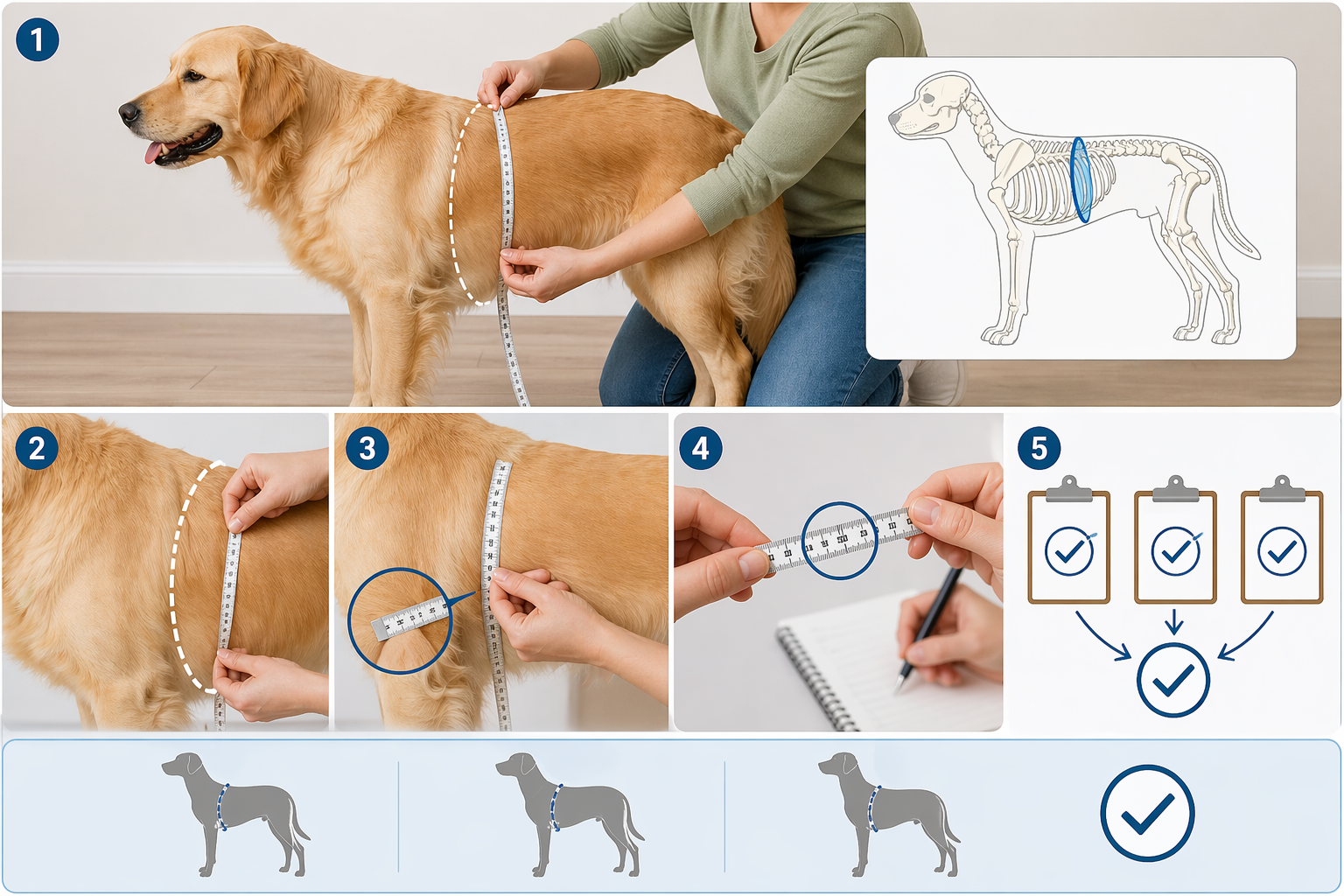
Chest girth is the widest circumference of your dog’s rib cage, measured at the point just behind the front legs. This is the single measurement that decides the harness size. If you only take one number, take this one.
How to take it
- Stand or kneel next to your dog, with the dog standing on all four feet.
- Find the widest part of the rib cage. It’s usually an inch or two behind the armpits, where the chest is deepest.
- Wrap the soft tape all the way around, snug but not compressed. The tape should lie flat against the fur.
- Read the number where the tape meets itself. Write it down in inches or centimeters (some brands use one, some use the other).
- Do it twice. If the two readings are more than half an inch apart, do it a third time and use the median.
Thick-coated dogs (Huskies, Newfoundlands, Samoyeds) need a bit of judgment here. Measure under the coat if possible, pressing the tape down to the body. If the coat is too dense, measure over it and note that you’re working with a “fluffed” number; some brands account for this, most don’t.

04 Measure 2: Base of the Neck
The neck measurement matters less than chest girth for most hiking harnesses, because most outdoor harnesses use a buckled chest strap and don’t have a fixed neck loop. But it matters for step-in harnesses and for over-the-head harnesses with a non-adjustable neck opening.
How to take it
- Find the base of the neck, where the neck meets the shoulders. This is lower than where a collar sits; a collar rides up on the narrower part of the neck.
- Wrap the soft tape around, snug but not tight.
- Read the number and write it down.
If your dog’s harness is going to slide over the head (most Y-front hiking harnesses work this way), compare the neck number to the harness’s listed neck circumference. If the harness opening is significantly smaller than your dog’s neck base, you’ll have to dig the harness over the ears each time, which is uncomfortable for the dog and a slow way to get out the door.

05 Measure 3: Back Length
Back length is the distance from the base of the neck (where the collar sits) to the base of the tail. This measurement only matters for a minority of harnesses: those with a back handle for lifting, a saddlebag attachment for a dog pack, or a long spine panel. It also matters for dog coats and jackets, which is why it’s worth recording even if the harness you’re buying doesn’t need it.
How to take it
- Put your dog in a standing position.
- Start the tape at the base of the neck, right where a collar would sit.
- Lay the tape flat along the spine.
- End the tape at the base of the tail, where the tail meets the body.
- Read and write down the number.
For long-bodied breeds (Dachshunds, Basset Hounds, Corgis), back length is a more important number than girth for picking between similar harnesses, because these breeds often fall into a standard girth range but have back lengths 30 to 50 percent longer than a comparable-girth Labrador.
06 Weight as a Cross-Check, Not a Sizing Input
Every harness sizing chart includes a weight range, and every one of them is a rough approximation. A 40-pound deep-chested Greyhound wears a different size than a 40-pound barrel-chested Staffordshire Bull Terrier. Weight isn’t wrong; it’s just the secondary signal.
Use the weight range as a sanity check after you’ve looked up the chest girth size. If the brand’s sizing chart puts your dog’s chest girth in size M and the M’s weight range is 30 to 55 pounds, and your dog is 42 pounds, M is confirmed. If the girth says M but the weight range for M is 15 to 30 pounds, and your dog is 50 pounds, something is off (either the measurement, or the dog has an unusual build for its weight) and you should re-measure or call the brand.
07 How to Read a Sizing Chart
Every brand publishes its own chart, and they disagree with each other. A size M Ruffwear Front Range is not the same circumference as a size M Kurgo Tru-Fit or a size M Non-Stop Rock Harness. This is part of why learning how to measure a dog for a harness is worth the five minutes: you can re-use your girth number against any brand’s chart without re-measuring.
| Typical hiking harness sizing (approximate) | Chest girth | Weight range | Common breeds |
|---|---|---|---|
| XXS | 13 to 17 in | 5 to 11 lb | Chihuahua, Yorkie, small Dachshund |
| XS | 17 to 22 in | 10 to 22 lb | Miniature Schnauzer, Pug, Shiba |
| S | 22 to 27 in | 20 to 40 lb | Beagle, Corgi, small Cattle Dog |
| M | 27 to 32 in | 35 to 60 lb | Border Collie, Australian Shepherd, Whippet |
| L | 32 to 37 in | 55 to 85 lb | Labrador, Golden, Husky, Pit |
| XL | 37 to 45 in | 80 to 120 lb | German Shepherd, Rottweiler, Boxer |
| XXL | 45+ in | 110+ lb | Great Dane, Mastiff, Saint Bernard |
This table is a rough reference only. Always check the specific brand’s chart before ordering. Ruffwear publishes detailed charts for every model. Kurgo, Non-Stop, and Hurtta do the same. A two-inch girth difference between brands in the same “size M” is normal. Our roundup of the best dog harnesses for hiking includes the specific girth range for each model we tested.
08 What to Do If Your Dog Measures Between Sizes
It’s common. Most dogs don’t land cleanly in the middle of a size range, and a surprising number fall right at the boundary between two. Here’s the decision:
Size up by default
A harness that’s slightly too big can be cinched down on most straps. A harness that’s slightly too small cannot be let out past its design range. The chafe, shoulder restriction, and escape risk are all worse on a too-small harness than the slight sloppiness of a too-big one.
Exceptions where you size down
- You’re in the middle of a dog’s weight-loss period. The girth will shrink. Size for the endpoint.
- The harness has a very limited adjustment range. Some low-profile running harnesses only have 1 to 2 inches of adjustment; if sizing up puts you past the minimum circumference, size down.
- Puppies actively growing. Buy for the current size and plan to replace in six to twelve months, rather than buying a big harness that won’t fit for months.
If you can, try two sizes
Brands like Ruffwear and Kurgo ship with generous return policies. Ordering both sizes and returning one is a legitimate strategy for a dog right at the boundary. Most owners who do this find one size clearly fits better within 60 seconds of putting it on.
09 Common Mistakes When Measuring a Dog for a Harness
The most common ways people go wrong when figuring out how to measure a dog for a harness:
- Measuring with the dog sitting. Compresses the chest and gives a smaller, misleading number. Always measure standing.
- Measuring right after exercise. A panting dog’s chest expands. Wait until breathing is normal.
- Pulling the tape tight. You want snug-and-flat, not compressed. A too-tight read means a too-small harness.
- Measuring over a thick coat without noting it. Fine for reference, problematic for a precise fit. Press the tape through the coat when possible.
- Using a rigid metal tape. It can’t follow the curve of a rib cage cleanly. Soft fabric tape or string-and-ruler, not a tape measure from the toolbox.
- Trusting a generic sizing chart instead of the specific brand’s chart. Every brand’s sizing is slightly different. Check the actual chart for the actual harness.
- Skipping the re-measurement on puppies. Puppies grow fast. Re-measure every six to eight weeks until they hit adult size.
- Buying based on weight alone. This is the biggest one. Weight is a cross-check, not the primary input.
Popular Hiking Dog Harnesses on Amazon
Once you have your dog’s chest girth and neck measurements, here are six well-reviewed hiking harnesses across sizing ranges and price points. Match your girth number to each product’s sizing chart before ordering, not to our range notes below.
As an Amazon Associate, Oregon Tails earns from qualifying purchases. Prices and availability are set by Amazon and change frequently; confirm the current listing before ordering. No brand pays for placement here.
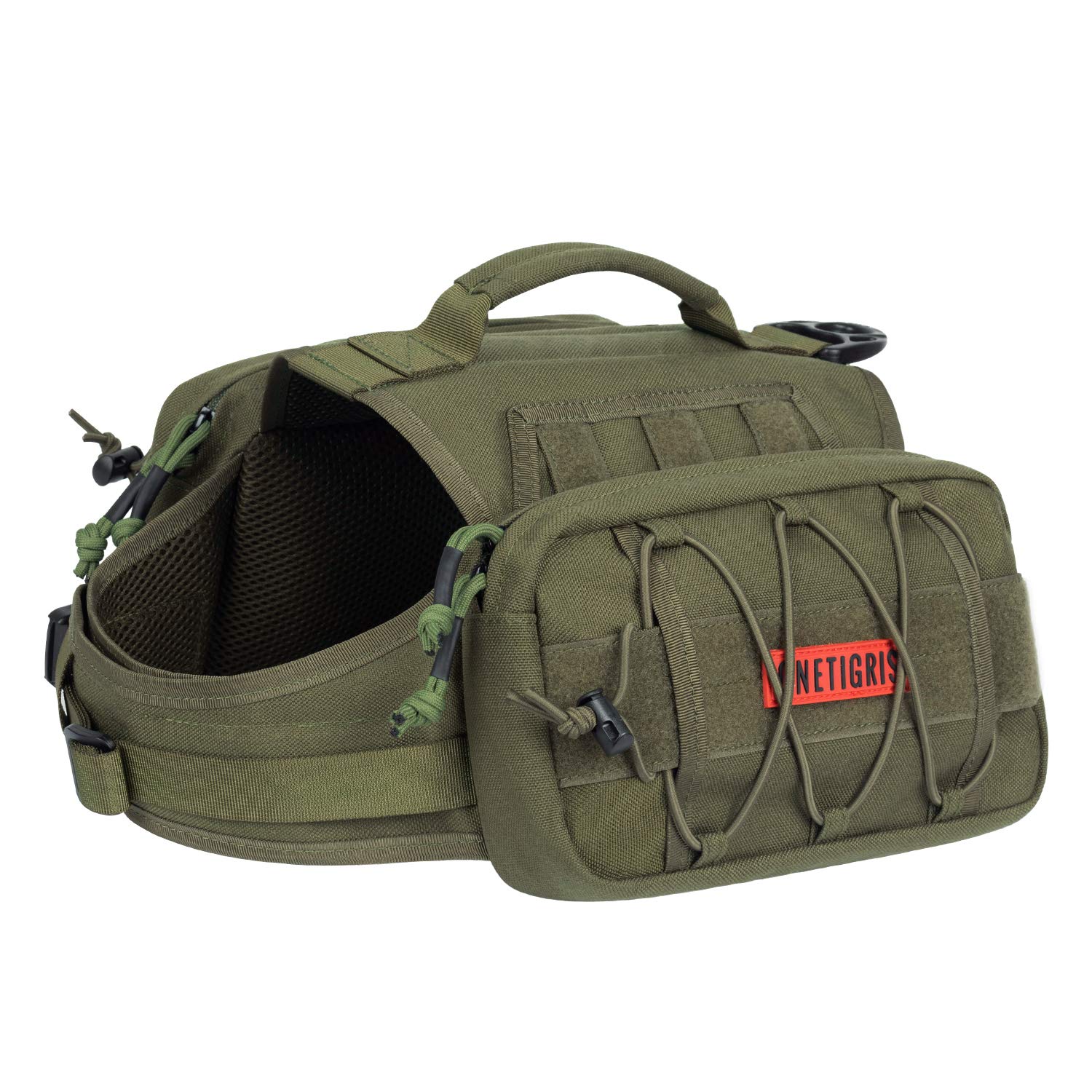
Fits medium & large · 25–31 in girth
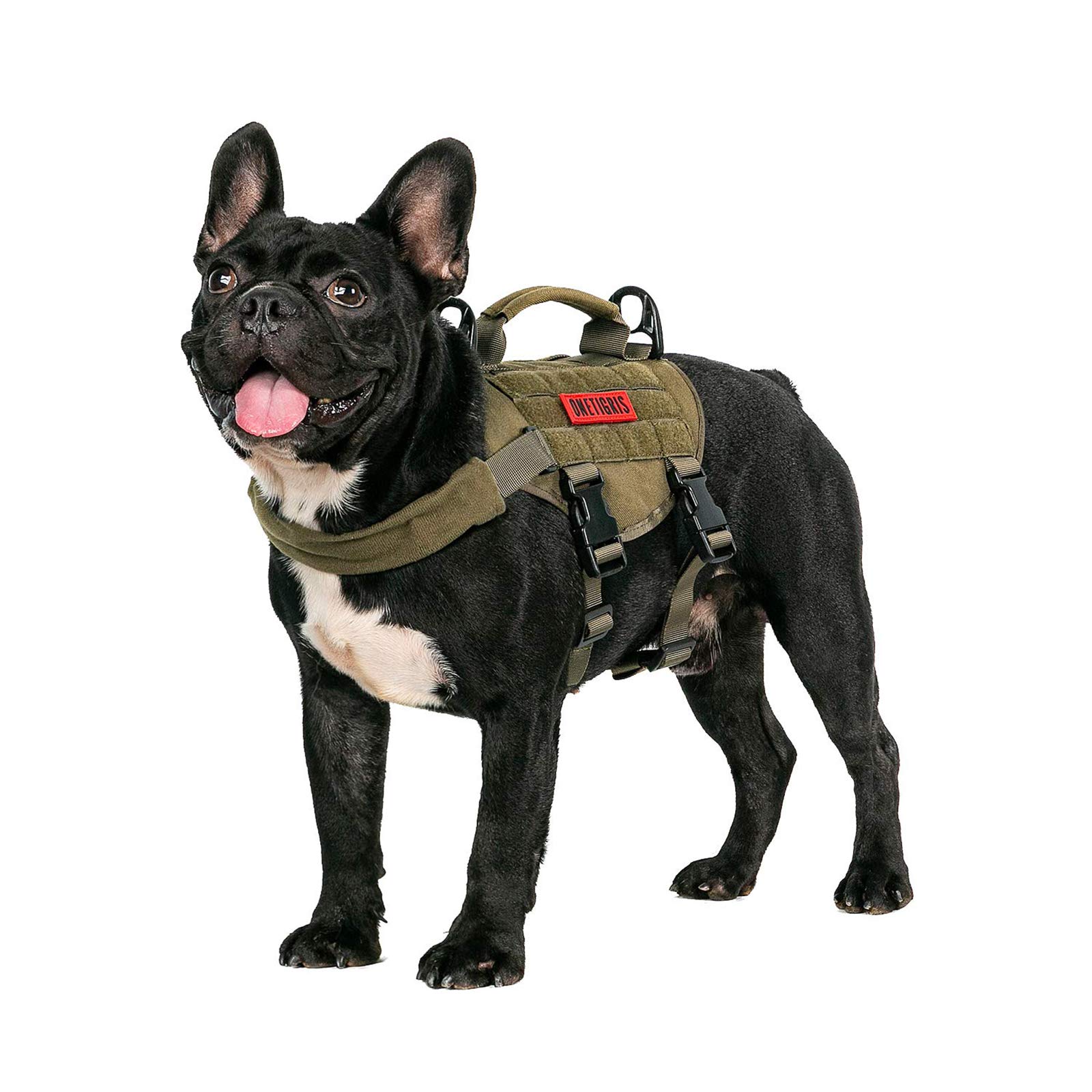
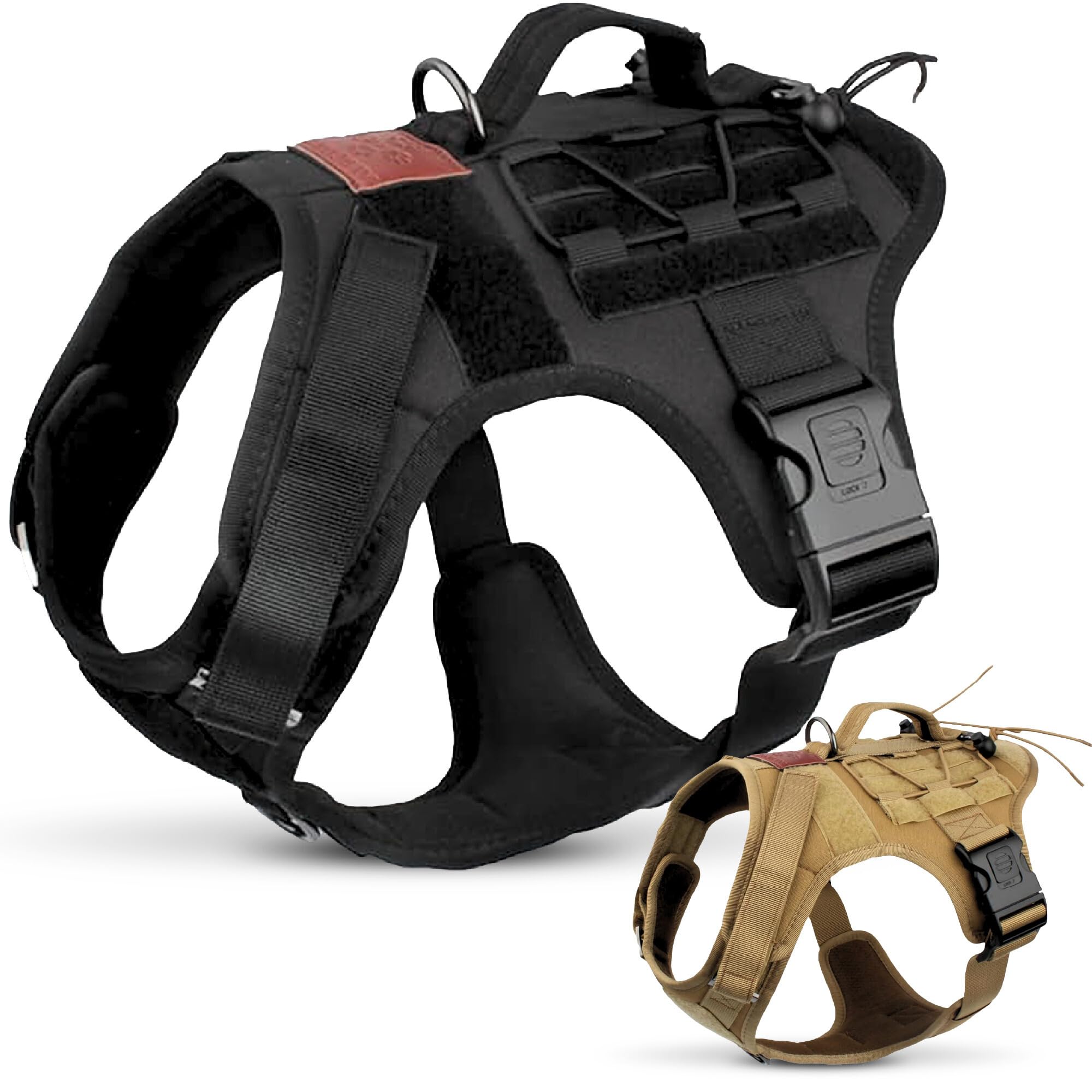
ONETIGRIS Dog Backpack Hiking Harness with Side Pockets
Check on Amazon

How to Measure a Dog for a Harness: FAQ
Quick answers to the questions that come up most often about how to measure a dog for a harness. If something’s not covered here, the section above it probably walks through it.
What’s the most important measurement for a dog harness?
Chest girth. Wrap a soft tape around the widest part of the rib cage, right behind the front legs. This is the measurement every hiking harness brand sizes against. If you only take one number, take this one, and record it in both inches and centimeters since brands use both.
Should I measure my dog with a tape measure or a string?
Either works. A soft fabric sewing tape is the cleanest tool because it stays flat against the body and reads directly. A piece of non-stretchy string plus a rigid ruler is just as accurate: wrap the string, mark the overlap with a finger, then lay the string flat against the ruler to read the length. Avoid a rigid metal tape measure from a toolbox, which doesn’t curve around a rib cage cleanly.
Can I size a dog harness based on weight alone?
No, at least not reliably. Two dogs of the same weight can wear different harness sizes if their chest depth differs. A 40-pound Greyhound and a 40-pound Bulldog wear completely different harnesses. Weight is a useful cross-check once you have a chest girth measurement, but it shouldn’t be the primary input. If the girth and weight disagree on a sizing chart, trust the girth.
What if my dog is between two sizes?
Size up. A harness that’s slightly too big can be cinched down with the adjustment straps; a harness that’s slightly too small will chafe, restrict the shoulder, and is more likely to be escaped. The exceptions are puppies still growing (buy for current size), active weight-loss periods (buy for goal size), and harnesses with very limited adjustment range where sizing up puts you past the minimum circumference.
How do I know if a harness fits correctly once it’s on?
The two-finger test. Once the harness is buckled and adjusted, you should be able to slip two fingers flat between any strap and the dog’s body. One finger means too tight. Three or more means too loose. Also check that the dog can sit, stand, and walk without the harness sliding forward, backward, or twisting, and that no strap is pressing into the armpit.
How often should I re-measure my dog?
For adult dogs at a stable weight, once is usually enough unless their body condition changes. For puppies, re-measure every six to eight weeks until they reach adult size. For any dog who’s gained or lost significant weight, re-measure before ordering new gear. A harness that fit perfectly a year ago may need resizing if the dog has put on or dropped more than about 10 percent of body weight.
Do I measure over or under thick fur?
Under, when possible. Press the soft tape through the coat to the body for the most accurate girth number. On very thick double-coated breeds like Huskies, Newfoundlands, or Samoyeds, that can be difficult, in which case measure over the coat and note it. Some brands explicitly design for thick-coated dogs; most don’t, so a “fluffed” measurement may land you in a slightly oversized harness that needs the straps cinched in.
Is measuring at home accurate enough, or should I go to a pet store?
At-home measurements are as accurate as anything you’ll get at a store if you follow the basics: standing dog, calm breathing, soft tape, behind the front legs, snug but not tight, measured twice. Pet stores are useful for trying on a specific harness before committing, but they don’t have better tools. The value of a store visit is confirming fit, not taking a better measurement.
