Headlamps field guide
How Many Lumens for a Headlamp
Lumen numbers are the most-marketed and most-misused spec on a headlamp. The honest answer for most people is between 200 and 400. The reasons it can be lower or higher are not what the box copy implies.
Walk into any outdoor retailer and the headlamp wall is a pile of three-digit numbers. 200. 400. 750. 1,200. The implication is that bigger is better and the only question is how much you can afford. Both halves of that implication are wrong.
This guide covers what a lumen actually measures, the four other specs that determine whether a headlamp is right for you, and a practical lumen-by-activity chart that gets most people to the right buy in under five minutes. If you are looking for specific model recommendations, the headlamps category page covers the actual buying picks.
1. What a lumen actually is
A lumen is the standard unit of luminous flux, which is a fancy way of saying “total visible light emitted by a source per second, weighted to the sensitivity of the human eye.” A 100-watt incandescent bulb puts out about 1,600 lumens. A standard candle puts out about 12.
Three things follow from that definition that the marketing on the box does not tell you:
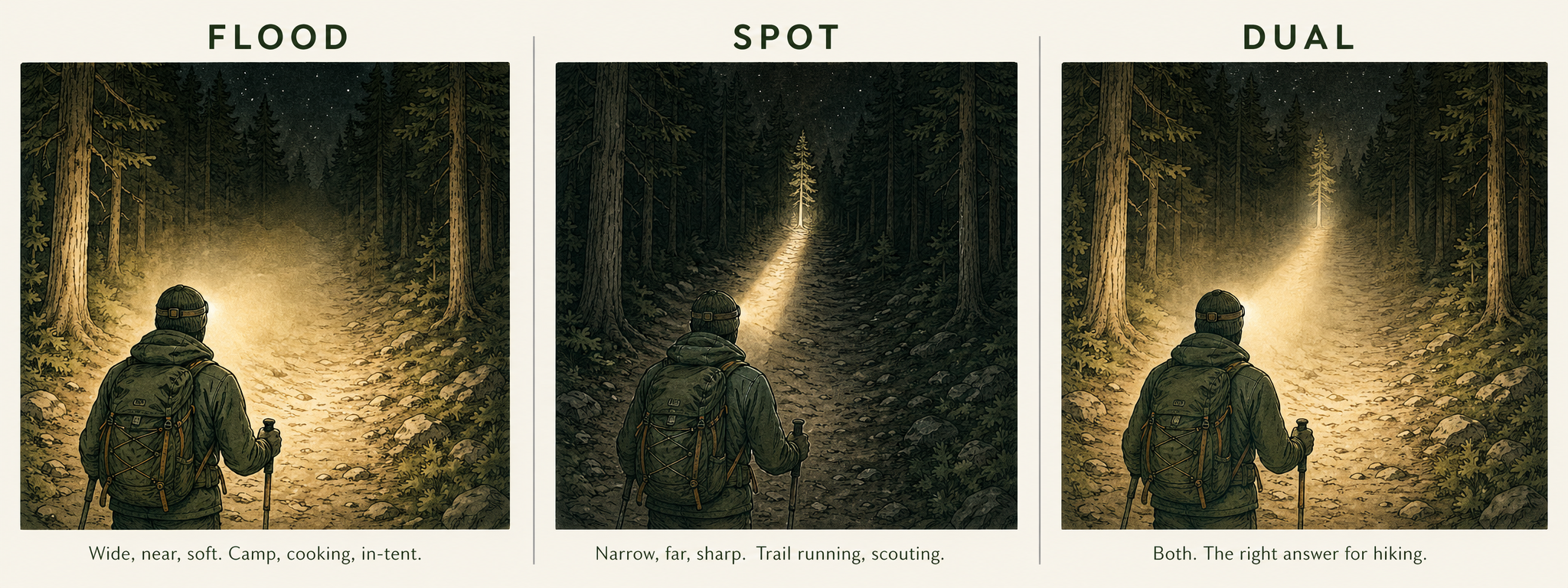
- Lumens measure quantity, not direction. The same 400 lumens spread across a wide flood beam will light up your campsite gently. The same 400 lumens focused into a tight spot beam will throw a narrow shaft of light 100 yards down a trail. The eye perceives these as completely different lights.
- Lumens are measured at the LED, not at your eye. Some of the light is lost to the reflector, the lens, and the body of the lamp. A 500-lumen headlamp with a poor reflector can deliver less usable brightness than a 300-lumen lamp with great optics.
- Peak lumens and sustained lumens are different. Most headlamps quote a “max” number that the lamp can hit for 30 to 60 seconds before throttling down to manage heat. The number that matters for you is the brightness it can sustain, and that number is rarely on the front of the box.
2. The five specs that matter (lumens is one)
If you only look at lumens, you will buy the wrong headlamp half the time. The full spec set has five components and they are roughly equal in importance.
| Spec | What it tells you | What good looks like |
|---|---|---|
| Lumens (max) | Peak brightness in best case | 200-500 for most users |
| Beam type | Where the light goes | Dual-beam (flood + spot) |
| Runtime at usable brightness | How long it lasts at the setting you’ll use | 4+ hours at 200 lumens |
| Beam distance | How far the light reaches usefully | 50-100 m for hiking |
| Weight and battery type | Comfort and field practicality | Under 100 g, USB-C rechargeable |
A headlamp with 1,000 peak lumens, a single narrow spot beam, 90 minutes of runtime, and a CR123 lithium battery is impressive on paper and useless to most people. A headlamp with 350 peak lumens, dual flood-and-spot, 8 hours of runtime at the brightness you actually use, and USB-C charging is the right buy for almost everyone.
3. Lumens by activity, the practical chart
The single most useful table in this guide. Find the activity, find the range, buy in that range. The values reflect what the activity actually requires, not what manufacturers want you to spend.
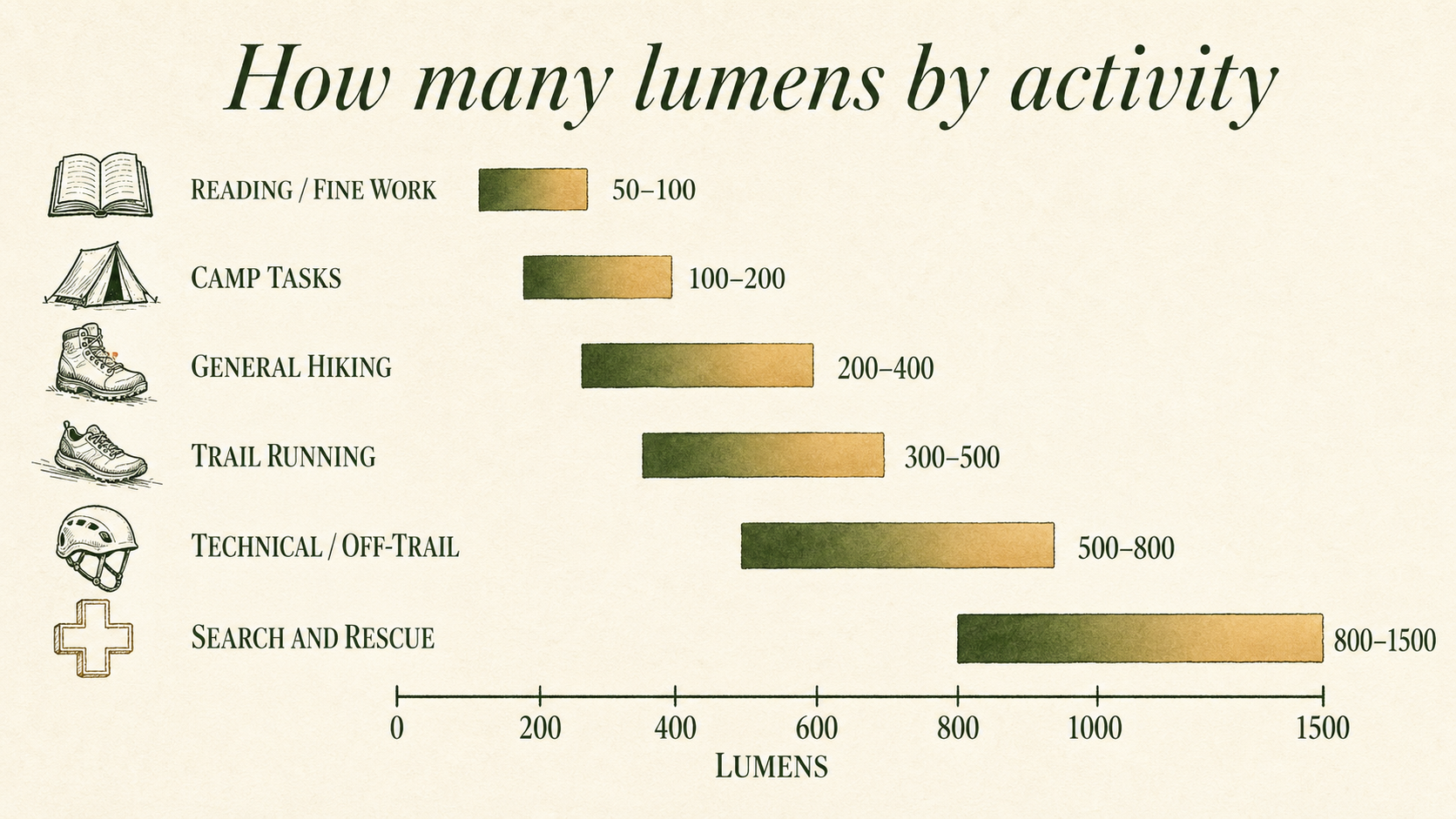
| Activity | Lumen range | Notes |
|---|---|---|
| Reading, fine work, sleeping bag | 50-100 | Red light is even better, preserves night vision |
| Camp tasks, cooking, dog walking | 100-200 | Flood beam preferred for nearby work |
| General hiking on established trail | 200-400 | Dual-beam ideal, runtime matters more than peak |
| Trail running, fastpacking | 300-500 | Spot beam needed, look for stable headstrap |
| Technical climbing, off-trail night travel | 500-800 | Hands-free precision and throw distance both matter |
| Search and rescue, working at distance | 800-1,500+ | Battery pack often required; not lightweight |
| Emergency household use, power outages | 100-300 | Long runtime at low setting matters more than peak |
| Auto repair, mechanic work | 300-500 | Mid-range output, color temperature for accurate work |
If you do multiple activities, buy for your worst case and run the headlamp on a lower setting for everything else. A 400-lumen lamp on its 100-lumen setting at camp is silent, has long runtime, and saves your night vision. Buying a 100-lumen lamp because most of your use is camp and then trying to night-hike with it is the failure case.
4. Beam type: flood, spot, and dual
This is the spec most buyers ignore and most regret. The beam pattern controls where the lumens land. Three patterns exist and each is right for specific activities.
Flood beam
A wide, soft cone of light, usually 60 to 120 degrees across, that lights up everything close to you evenly. This is the right beam for cooking dinner, setting up a tent, reading, working in a small space, walking around camp, and any task where the action is within 10 to 20 feet. A 200-lumen flood feels softer and more pleasant than a 200-lumen spot, even though they output the same total light.
Spot beam
A tight, focused column of light, usually 10 to 30 degrees across, that throws light far at the cost of width. This is the right beam for trail running, scouting trail ahead, technical climbing, route-finding off-trail, and any situation where you need to see something 50 to 200 feet away. The trade-off is that everything just outside the beam is in darkness, which feels claustrophobic at camp.
Dual-beam (flood + spot)
Two LEDs, sometimes more, in a single lamp body, with separate buttons or a single switch that toggles between modes. The right answer for hiking specifically, because hiking switches between “where am I going” (spot) and “where is my pack pocket” (flood) constantly. Most quality 200 to 500 lumen headlamps from Black Diamond, Petzl, BioLite, and Fenix are dual-beam.
5. Runtime and battery realities
Manufacturer runtime claims are technically true and practically misleading. Two specific numbers you have to read past the front of the box to find.
What the marketing claim usually means
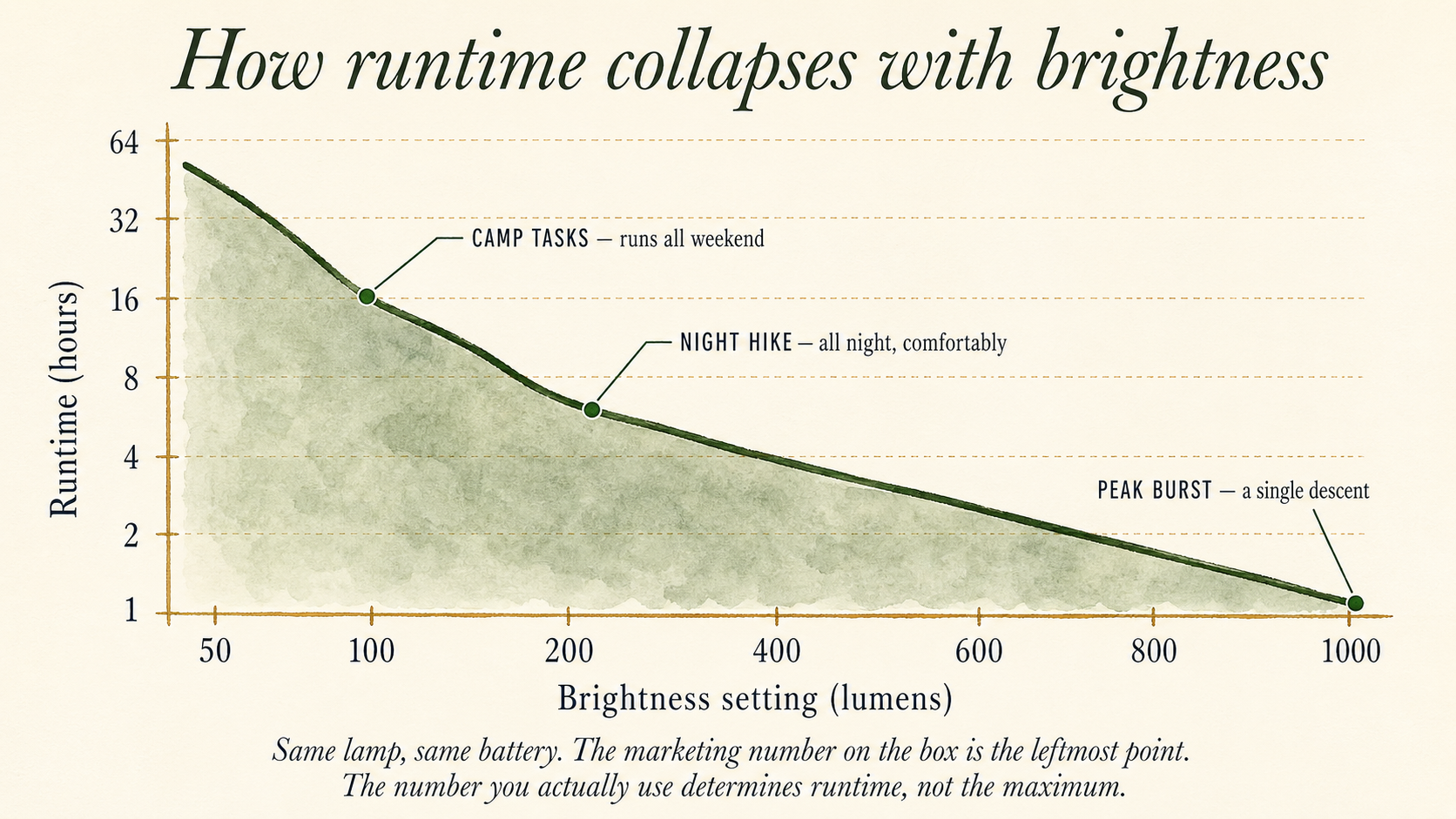
“40 hours of runtime” is almost always measured at the lowest brightness setting, which is typically 5 to 20 lumens. That setting is fine for reading in your sleeping bag and useless for everything else. The number is technically true. The number is also functionally a lie of omission.
What the spec sheet usually shows
Quality manufacturers (Petzl, Black Diamond, Fenix, Nitecore) publish a runtime curve or a multi-row spec sheet showing runtime at each output level. The number you actually want is runtime at “high” or “medium” setting, which is the brightness you will use 90 percent of the time on a hike or run.
| Activity / setting | Typical brightness used | Minimum runtime needed |
|---|---|---|
| Camping for one night | 30-100 lumens | 4-6 hours at that setting |
| Backpacking trip, multi-day | 50-200 lumens | 8-12 hours at that setting (carry spare battery) |
| Night hike, 2-4 hours | 200-400 lumens | 4+ hours at high setting |
| Trail run, 2-4 hours | 300-500 lumens | 4+ hours at high or include backup |
| Emergency household use | 100-300 lumens | 20+ hours at low; replaceable batteries preferred |
Rechargeable vs replaceable batteries
USB-C rechargeable lamps are the right answer for most regular outdoor users. Lighter, no battery hunting, easy to top up off any phone charger. The exception is emergency preparedness or expedition use, where a lamp that takes standard AAA or AA batteries is more reliable: you can buy them anywhere in the world, they store for a decade, and they keep working when your power has been out for three days. Some lamps offer both, which is the right hybrid.
6. When more lumens genuinely helps
The case for high-output headlamps is not made up. There are real activities where 600+ lumens is the right buy. Four of them.
Trail running on technical singletrack
Speed compresses the time you have to react to a root, rock, or drop. At 8-minute-mile pace you have about a second to see and process whatever is 12 feet ahead. A 200-lumen headlamp on twisty Pacific Northwest trail is borderline; 400 to 500 is the standard for night running.
Search and rescue, ski patrol, professional work
You have to see far, in conditions that are usually wet and blowing snow or rain. The atmosphere itself absorbs light, and reflective surfaces (snow, water) wash out moderate beams. 800 to 1,500 lumens with a strong spot is professional-grade equipment for a reason.
Technical climbing at night
Belaying a partner 30 meters up requires throwing light a real distance. Reading a route on a multi-pitch in the dark requires hands-free precision at distance. The standard alpine lamp is 400 to 600 lumens with a tight spot beam and a long runtime.
Cycling or e-bike commuting on unlit roads
This is the surprising one. Bike-specific lights are different equipment, but a high-output headlamp is a useful supplement. Speed is high, sight distance needs to be 100 yards or more for highway shoulders, and the bar-mounted bike light leaves your handlebar movement unable to scan side trails. 500+ lumens helps here.
7. When more lumens hurts you
The cases where high-lumen headlamps are actively a worse choice are more common than the cases where they help.
Camping
A 1,000 lumen lamp at camp is a tiny floodlight pointed at your tent partner’s eyes. It blows out night vision for everyone in the area, draws every moth in three counties, and runs through batteries pretending you might use it at full output. Camp use wants 100 to 200 flood and a red mode.
General hiking
The actual usable brightness on a graded trail at 2 mph is well under 200 lumens. Buying a 1,000 lumen lamp for general hiking means carrying weight for output you do not use, a battery pack instead of a coin cell, and a runtime curve that fails earlier when you do need brightness.
Reading or in-tent use
Anything over 50 to 100 lumens in an enclosed space bounces off tent fabric and creates eye strain. The right setting is the dimmest one that lets you read.
Night-vision-dependent activities
Astronomy, wildlife photography, sensitive military or hunting work, and any task where you need your eyes adapted to darkness all want red light at low brightness. White light at any output destroys 20 minutes of accumulated dark adaptation in two seconds. The headlamp’s lumen number is irrelevant if the white-light mode is the only mode.
8. Reading a headlamp spec sheet
The spec sheet for a quality headlamp from Petzl, Black Diamond, Fenix, or Nitecore will look complicated at first. The five lines that actually matter are:
- Maximum lumens (and is it sustained or burst). Look for the word “regulated” or “boost.” Boost output drops within 60 seconds. Regulated output holds for the runtime spec.
- Lumens at each preset (low, medium, high). The medium setting is what you will use 80 percent of the time. That number is the practical brightness of the lamp.
- Runtime at each preset. Read the runtime at the medium and high settings, not the low setting. Headline runtime claims almost always quote the lowest setting.
- Beam pattern (flood, spot, dual). Sometimes called “wide / focused” or shown as a beam-shape diagram. Dual is the most flexible.
- Battery type and recharge method. USB-C rechargeable for everyday use, AAA-compatible for emergency preparedness, dual-fuel for both.
Specs that sound impressive but matter less
- IP67 vs IPX4. Yes, both are waterproof enough for rain. IP67 means submersible. Unless you are kayaking with the lamp on, IPX4 is fine.
- Beam distance in meters. Useful for trail running and rescue, less useful for camp. The number is calculated under ideal conditions and real-world reach is shorter.
- Color temperature. Most are 5,000 to 6,500K (cool white). Warm white is rare and slightly more pleasant in fog. Not a deal-breaker either way.
9. Common mistakes
Buying for the highest peak number
Peak output is the marketing spec. Sustained output at the brightness you actually use is the spec that matters. A 1,000-lumen burst that drops to 300 sustained is a 300-lumen headlamp.
Skipping the beam type spec
400 lumens of flood and 400 lumens of spot are completely different lights. Buying purely on lumens, with no attention to whether the beam matches your activity, is the most common buyer regret in this category.
Trusting the runtime claim on the front of the box
“Up to 100 hours of runtime” almost always means at 5 lumens. The runtime that matters is the one at the brightness you plan to use, which is in the spec sheet, not the marketing copy.
Underbuying for emergency and overbuying for camping
The one that lives in your house for power outages should have replaceable batteries and long low-setting runtime. The one that lives in your camping kit should have a soft flood and a red mode. People often invert these and end up frustrated when both fail at their actual job.
Skipping the red light mode
A red light mode costs nothing, weighs nothing, and is essential for camping, astronomy, and any night-vision-dependent task. A headlamp without one is missing the easiest feature in the category.
Ignoring weight
Above 150 grams a headlamp starts to bounce on a run and feel heavy on a long hike. The 60 to 100 gram range is the sweet spot for most outdoor use. The heaviest lamps often correspond to the highest lumen ratings, which is another reason why “more is not always better.”
Picking the right headlamp
Now that you know the lumen range you actually need, the buying guides below sort headlamps by use case so you can match the right model to your activity.
Best headlamps overall
The lamps we have actually used. Sorted by activity, lumen range, and price.

Best headlamps for hiking
Dual-beam picks in the 200-400 lumen sweet spot for trail use.
Best rechargeable headlamps
USB-C and built-in battery options that balance runtime against charge convenience.

Best running headlamps
Spot-beam picks at 300-500 lumens with anti-bounce headstraps for trail running.
Common questions about headlamp lumens
For most people, 200 to 400 lumens covers everything. Camp tasks like cooking and reading need 100 to 200. General hiking on trail needs 200 to 400. Trail running needs 300 to 500. Technical work, search and rescue, or off-trail night travel needs 500 to 1,000 or more. Buying past 500 lumens for camp use is wasted money and shorter runtime.
Yes, for the majority of uses. 200 lumens lights up your immediate work area, the inside of a tent, the path 10 to 20 feet ahead at walking pace, and most car or household tasks. It is bright enough that staring directly at the LED will hurt. The activities where 200 lumens is not enough are trail running at speed, navigating off-trail at night, or any work that needs to throw light 50+ feet away.
For 90 percent of users, yes. 1000 lumen headlamps exist for a real reason: they are lifesaving on a search-and-rescue call, on a technical climb at night, or on a fast trail run on tight singletrack. For camping, dog walking, household power outages, or general hiking, 1000 lumens is wasted heat and battery drain. The quality 200 to 400 lumen headlamp at the same price point will serve you better.
200 to 400 lumens for general hiking, with the high end of the range becoming necessary on technical or off-trail terrain. The other things that matter as much as lumens are a dual-beam (flood plus spot) configuration, a red-light mode for preserving night vision, and a runtime of at least 4 hours at the brightness you actually plan to use.
300 to 500 lumens, with a strong spot beam, is the standard for trail running. Speed is the differentiator: at running pace you need to see further ahead than a hiker, which requires more raw output and a tighter beam. Below 300 lumens you will outrun your light. Above 500 lumens and most runners trade off weight, runtime, and battery cost for output they do not use.
No. More lumens means more battery drain, more heat, more weight, and usually shorter runtime at full brightness. A 1,000 lumen headlamp running at full output may only last 60 to 90 minutes. The same lamp dimmed to 200 lumens runs 8+ hours. The right answer is the headlamp whose middle setting matches your most common use, not the headlamp with the highest peak number.
A lumen is a measurement of total light output emitted by a light source per second. A higher lumen number means more total light. What it does not tell you is where that light goes. A wide-flood beam at 400 lumens spreads the light across a large area at low intensity. A tight-spot beam at the same 400 lumens concentrates that light into a far-reaching narrow column. Lumens measure quantity, not focus or distance.
