Best Smartwatch For Hiking (2026): Multi-Day Battery, Offline Maps, and Ruggedness That Holds Up
A hiking smartwatch isn’t the same as a fitness watch. The trail-specific features that matter: GPS accuracy under tree cover, multi-day battery, offline maps, ruggedness, and barometric altitude: aren’t standard on every smartwatch sold as “outdoor.” The 10 watches below all deliver them, organized in three price tiers so you can match the right tool to the right trip.
The Best Premium pick is the Garmin Instinct 3 45mm Solar at $379, with solar charging that meaningfully extends battery on multi-day trips, MIL-STD-810 ruggedness, multi-band GNSS, and a built-in flashlight. The Best Value pick is the Garmin vívoactive 5 at $178.49, which has the deepest proof base of any smartwatch on this page (10,253 reviews), full GPS tracking, and 11-day battery: the smartest money pick of the entire roundup.
Quick picks
Full reviews, premium tier ($300+)
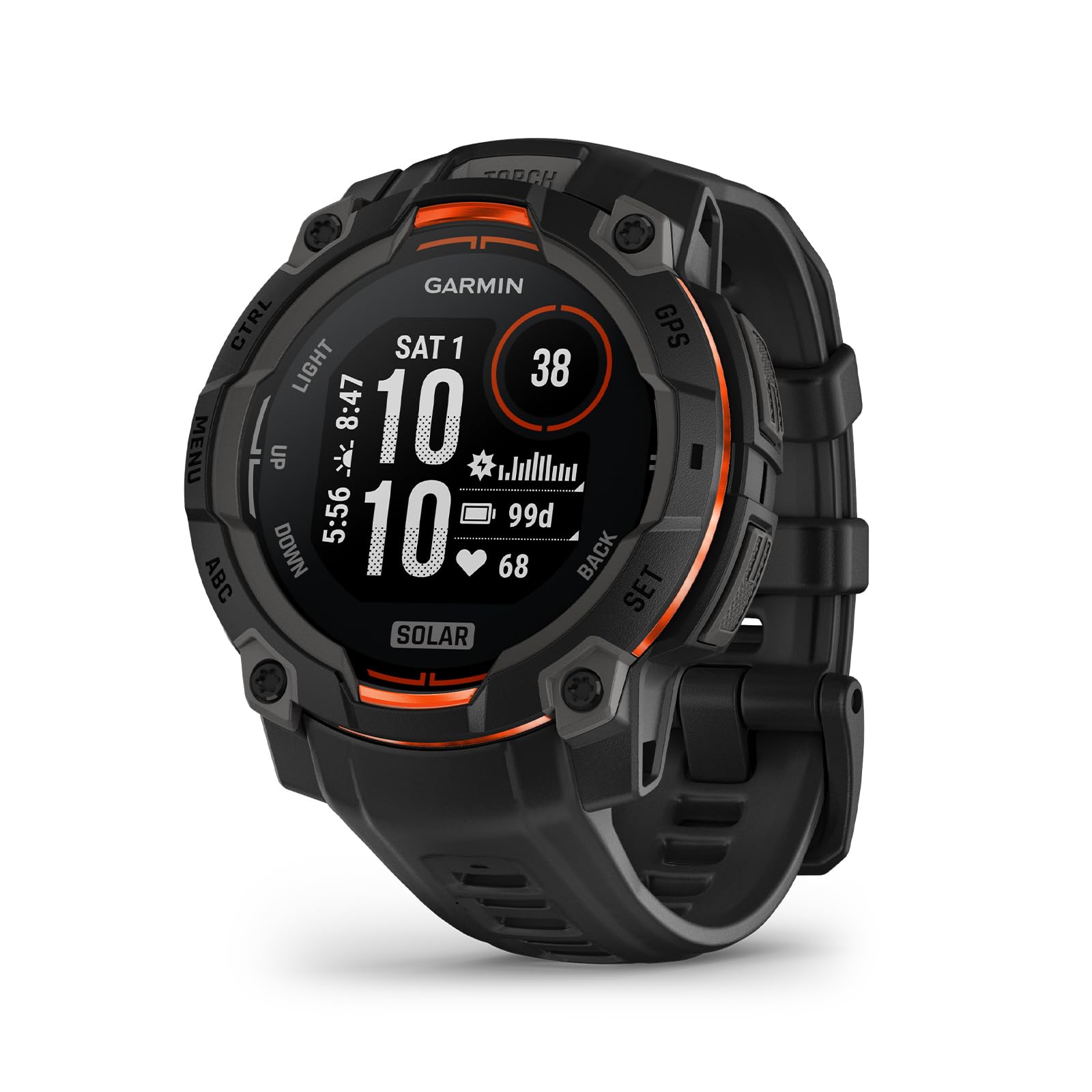
- Solar charging meaningfully extends battery on multi-day trips, indefinitely in 50,000-lux conditions
- Built-in flashlight is genuinely useful for tent rummaging, alpine starts, and night descents
- MIL-STD-810 case with metal-reinforced bezel shrugs off rock contact and drops
- Multi-band GNSS holds an accurate track in tight tree cover and steep canyons
- MIP display is sun-readable and sips power, unlike AMOLED watches
- MIP display feels dated next to AMOLED options like the vívoactive 6 or T-Rex 3
- No native offline topographic maps: shows track and breadcrumbs only
- $379 is a real premium over the Instinct 2 at $224.99
The Instinct 3 Solar is for the hiker who disappears for long weekends, starts before sunrise, or just wants the watch to be one less thing to manage. It feels more like a trail tool than a lifestyle smartwatch: rugged, readable in sun, hard to kill, and built around battery confidence. The flashlight is not a gimmick if you camp, dig through a pack in the dark, or finish hikes later than planned. I would skip it if you mainly do casual day hikes and want a bright color screen, but for backpacking, rough weather, and multi-day trips, it is the most complete hiking-first watch here.
Choose this over the COROS NOMAD if you care more about durability, solar charging, Garmin’s app ecosystem, and simple breadcrumb navigation than full map detail. Go with the NOMAD instead if you want the watch itself to act more like a wrist-mounted map. The Instinct 3 is not the prettiest watch on the list, and it is not trying to be. It is the one I would trust most when the hike is longer, wetter, colder, or less predictable than expected.

- Full preloaded global topographic maps with turn-by-turn navigation: the standout on this page
- 22-day smartwatch battery is competitive with Garmin’s MIP-display flagships
- Voice notes let you record campsite or wrong-turn observations without pulling out a phone
- Real-time weather alerts on the wrist help you stay ahead of incoming Cascades conditions
- 1.3″ MIP touchscreen is responsive and sun-readable
- 193-review proof base is the thinnest in the premium tier
- COROS app and ecosystem aren’t as polished as Garmin Connect
- Smaller third-party accessory and watch face library than Garmin
The COROS NOMAD is for hikers who think about route-finding first. It makes the most sense if you follow GPX tracks, hike unfamiliar trail systems, travel with your watch, or want more map context without pulling out your phone at every junction. Compared with the Garmin Instinct watches, it feels less like a bombproof outdoor watch and more like a navigation watch built for people who actually use maps. That is a real advantage if wrong turns, faint trails, or complicated junctions are part of your hiking life.
I would not make this the default pick for someone who just wants reliable GPS tracking and a familiar app ecosystem, because Garmin still feels more polished overall. But if offline topo maps and turn-by-turn guidance are the reason you are shopping, this is the watch that best answers that problem. It is especially strong for route planners, solo hikers, and people who want navigation confidence without stepping all the way up into the most expensive Garmin mapping watches.
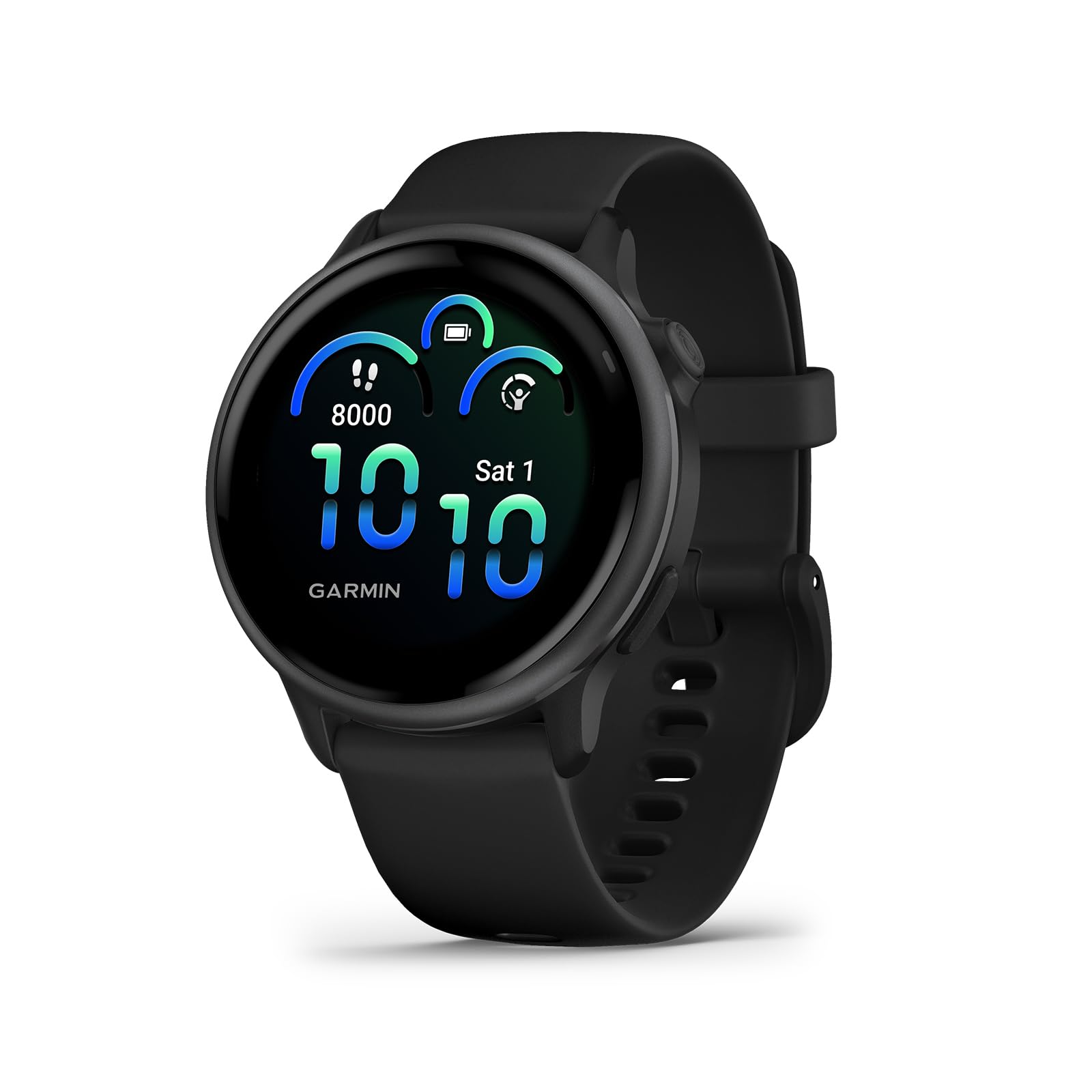
- AMOLED display is bright, sharp, and easier to read in shade than MIP screens
- Slimmer profile than the Instinct line for daily wear and dressier outfits
- Full Garmin Connect health, fitness, and sleep tracking
- 11-day smartwatch battery is generous for an AMOLED watch
- 2,388 reviews at 4.5 stars confirms the platform is solid
- No MIL-STD-810 ruggedness: won’t take the abuse the Instinct line absorbs
- No offline topographic maps
- $122 more than the vívoactive 5 with broadly similar features
- Single-band GPS instead of multi-band
The vívoactive 6 is for the hiker who wants one watch for trail days, gym days, workdays, and everything in between. It does not feel like a rugged backcountry watch, and that is the point. It is slimmer, brighter, and easier to wear every day than the Instinct line. The AMOLED screen is a big quality-of-life upgrade if you care about readability, menus, notifications, and a watch that looks more modern on your wrist.
The tradeoff is that it is more fitness smartwatch than expedition tool. I would not choose it for hard backpacking, heavy abuse, or trips where offline maps and multi-day GPS battery are the priority. For day hikers who also track sleep, workouts, heart rate, and general health metrics, it is a very comfortable pick. The bigger question is whether it is worth paying more than the vívoactive 5. For most buyers, the older model is still the better value.
Full reviews, mid tier ($200 to $300)
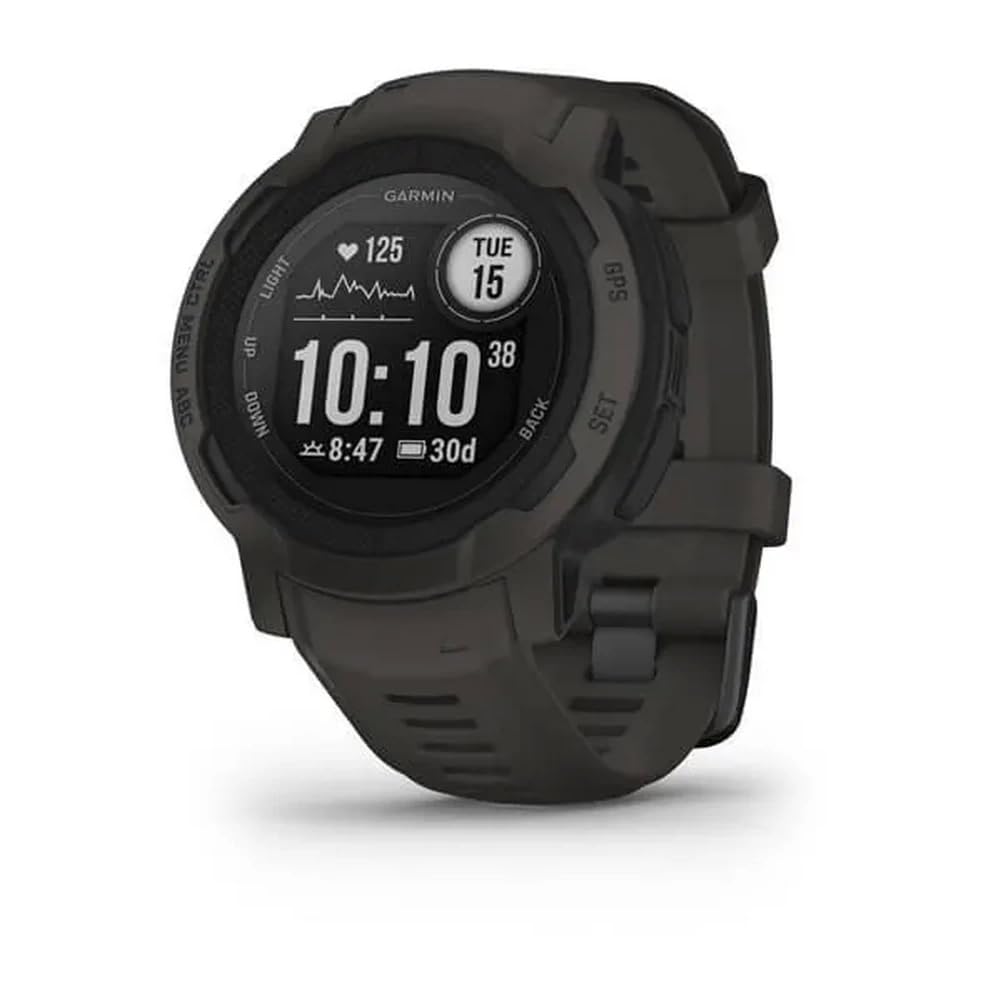
- MIL-STD-810 build with 100m water resistance handles real trail abuse
- 28-day smartwatch battery is the longest in the mid tier
- Multi-GNSS holds tracks accurately in tight tree cover and canyons
- TracBack routing retraces your inbound path step-by-step if you need to bail
- 1,269 reviews at 4.6 stars across multiple years of use
- No solar charging like the Instinct 3: caps multi-day expedition usefulness
- No built-in flashlight
- MIP display is dated next to AMOLED options at this price (T-Rex 3)
- No offline topographic maps
The Instinct 2 is the practical Garmin pick for hikers who want rugged reliability without paying for the newest model. It is not flashy, but it covers the stuff that matters on most real hikes: dependable GPS, long battery life, physical buttons, weather-resistant construction, and simple navigation tools. It is a great fit for day hikers, weekend backpackers, hunters, anglers, and anyone who is rough on gear but does not need a full-color screen.
This is the watch I would recommend to someone who wants the Instinct 3 concept but does not need solar charging or the flashlight. It is less exciting on paper, but that is part of the appeal. You save money and still get a watch that feels purpose-built for trails instead of repurposed from the gym. Skip it if offline maps or a bright AMOLED display are non-negotiable. Otherwise, it is one of the easiest recommendations on the page.

- 1.5″ AMOLED display is brighter and sharper than the Instinct 2’s MIP screen
- Dual-band GPS holds tracks in tree cover and canyons
- Native offline topographic maps at this price: a feature Garmin charges $300+ for
- 27-day smartwatch battery matches the Instinct 2 with a richer display
- 2,193 reviews at 4.5 stars across multiple use cases
- Zepp app and ecosystem aren’t as polished as Garmin Connect
- 48mm case is large for smaller wrists
- Smaller third-party accessory and watch face library than Garmin
The Amazfit T-Rex 3 is for buyers who want a lot of outdoor watch for the money and are not locked into Garmin. It gives you the rugged look, a bright AMOLED screen, strong battery life, and offline maps in one package. That mix makes it especially appealing for hikers who want something more visual and feature-rich than the Instinct 2 without jumping to a much more expensive Garmin mapping watch.
The catch is ecosystem polish. Garmin still feels better if you care about long-term platform support, activity history, accessories, and training features that all live neatly in one place. But judged as a hiking watch on the wrist, the T-Rex 3 is hard to dismiss. It is a strong fit for day hikers and backpackers who want maps, battery, and a modern display, and who are comfortable choosing value over brand familiarity.
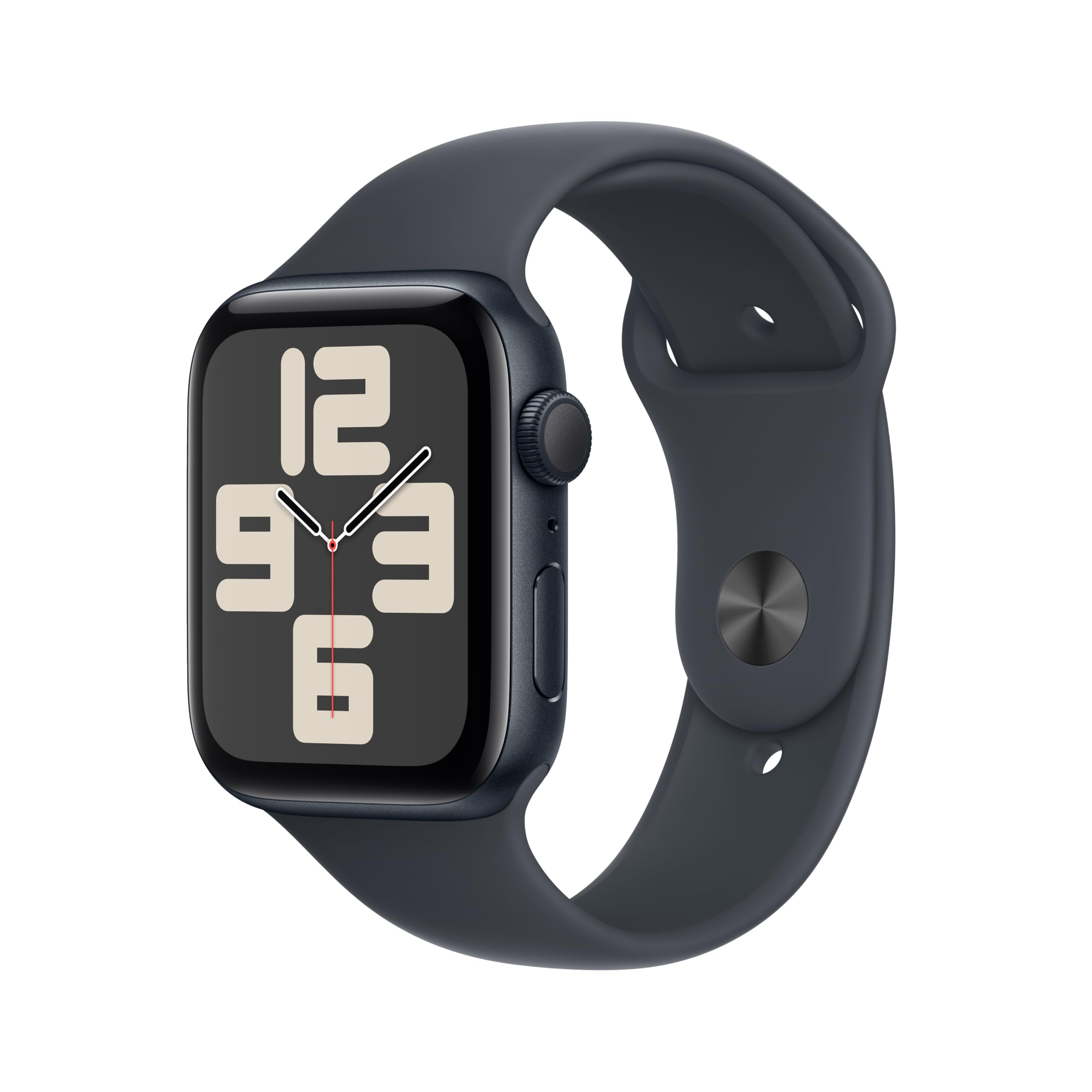
- Retina OLED is the most beautiful display on the page: sharp, vivid, easy to read
- Crash Detection is a real safety feature for solo hikers
- Tight iPhone integration: notifications, music, navigation apps via paired phone
- Compass app, GPS, fitness, and sleep tracking are all polished
- 4.8-star average across 1,019 reviews: the highest rating on the page
- ~18-hour battery isn’t enough for a full day of GPS tracking on the trail
- No native offline topographic maps (works via paired phone apps only)
- Aluminum case isn’t built for the abuse the Instinct line absorbs
- No barometric altimeter: altitude is GPS-derived (less accurate)
- iPhone-only: no Android support
The Apple Watch SE is for iPhone users who hike, not for hikers who need a dedicated backcountry watch. That distinction matters. Around town and on local day hikes, it is excellent: comfortable, easy to use, great for notifications, strong for fitness tracking, and simple to live with every day. If your hikes are usually a few hours long and your phone is nearby, it can be all the watch you need.
I would not buy it as my main hiking watch for remote routes, backpacking, or navigation-heavy trips. Battery life is the limiting factor, and it does not have the same rugged case, physical-button confidence, or offline topo experience as the more trail-focused options here. It belongs on this list because plenty of hikers are also everyday smartwatch users. Just be honest about your use case: for local trails it is convenient, for serious backcountry travel it is not the safest choice.
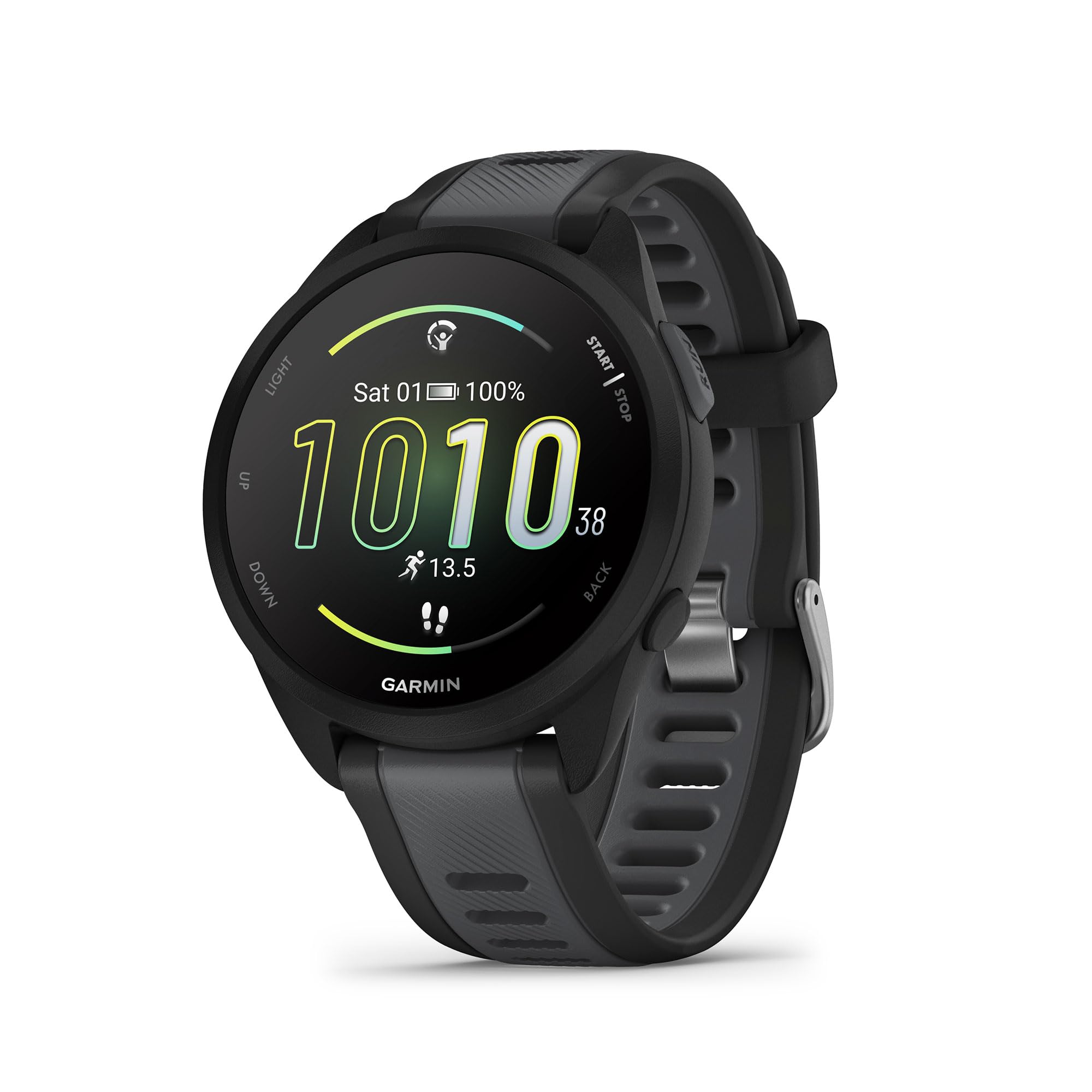
- AMOLED display at $199 is excellent value
- Garmin’s full training metrics: recovery insights, race predictor, training readiness
- 3,606 reviews at 4.7 stars is the deepest proof base in the mid tier
- 11-day smartwatch battery is generous for a sub-$200 AMOLED watch
- Full Garmin Connect ecosystem with women’s health tracking
- No MIL-STD-810 ruggedness: built for road, not trail abuse
- Single-band GPS only, less accurate under heavy canopy
- No offline topographic maps
- Battery in tracking mode is shorter than the Instinct line
The Forerunner 165 is the watch for runners who hike, not hikers who occasionally run. That is actually useful for the right person. If your week includes road runs, trail runs, workouts, and the occasional day hike, this gives you Garmin’s training tools and a sharp AMOLED display without spending premium money. It is lighter and more comfortable than a rugged outdoor watch, which makes it easier to wear all day.
Where it falls short is hiking-specific toughness and navigation. It is not the watch I would choose for scrambling, backpacking, or rough trail abuse. The Instinct 2 is better if hiking is the main job. But if running metrics, recovery insights, and daily comfort matter more than rugged hardware, the Forerunner 165 makes a lot of sense. Think of it as a fitness watch that can handle hikes, not a backcountry watch that can handle workouts.
Full reviews, value tier (under $200)
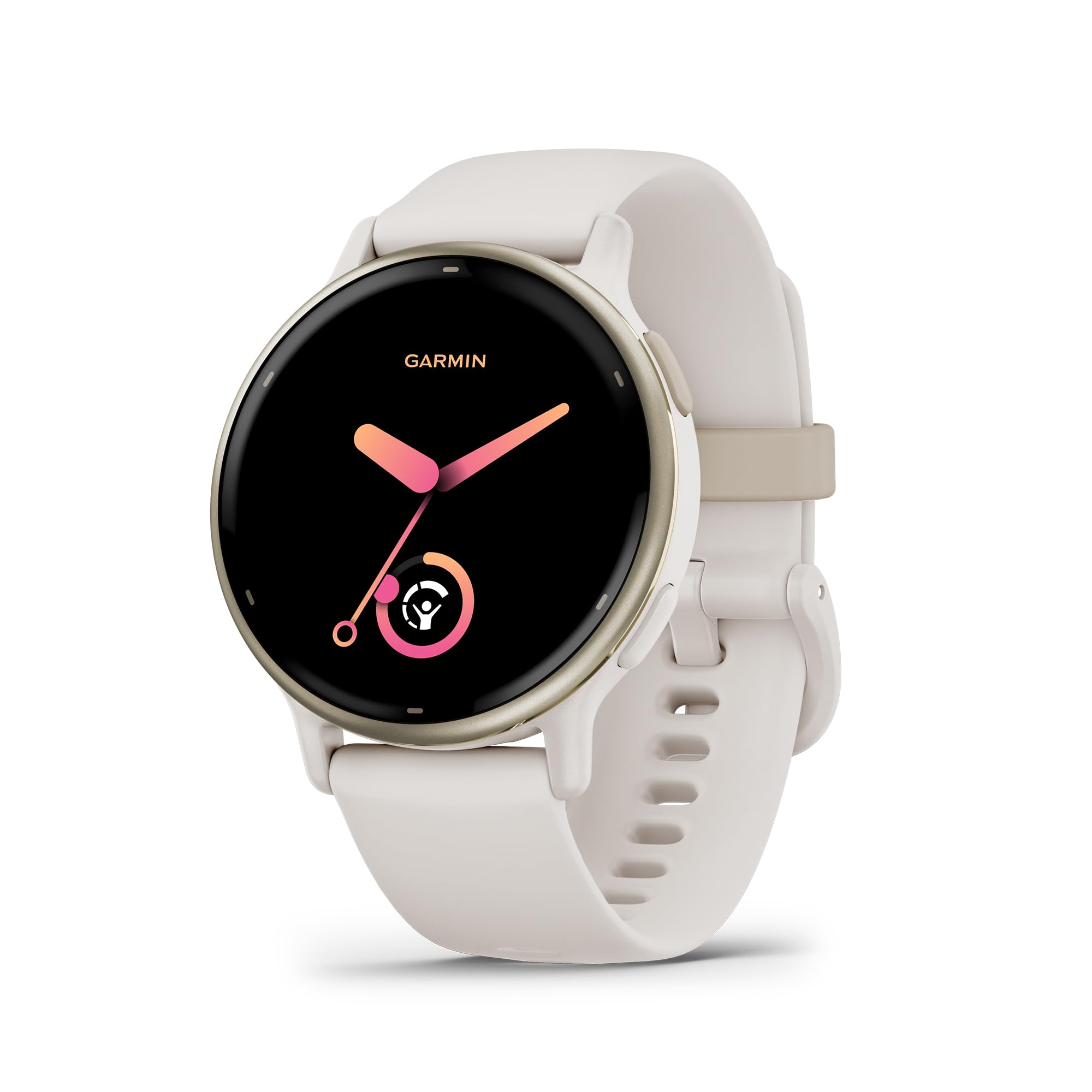
- 10,253 reviews at 4.4 stars is the deepest proof base on this page
- Sharp AMOLED display rivals premium-tier watches
- 11-day smartwatch battery is generous for an AMOLED watch
- Full Garmin Connect ecosystem at a sub-$200 price
- $122 cheaper than the vívoactive 6 with broadly the same feature set
- No MIL-STD-810 ruggedness: built for daily wear, not trail abuse
- No barometric altimeter: altitude is GPS-derived (less accurate)
- No offline topographic maps
- Single-band GPS only
The vívoactive 5 is the value pick because it gives most day hikers what they actually use, without charging for features they probably will not. You get a bright AMOLED screen, dependable GPS tracking, strong health and fitness tools, and enough battery for normal hiking weeks. It is comfortable enough to wear daily, which matters because the best watch is usually the one that is already on your wrist when plans change.
This is not the right watch for people who need onboard topo maps, rugged military-style protection, or multi-day GPS confidence away from a charger. But for maintained trails, weekend hikes, travel, fitness tracking, and everyday wear, it hits a sweet spot. I would choose it over the vívoactive 6 for most people because the real-world hiking experience is very similar, while the price is much easier to justify.
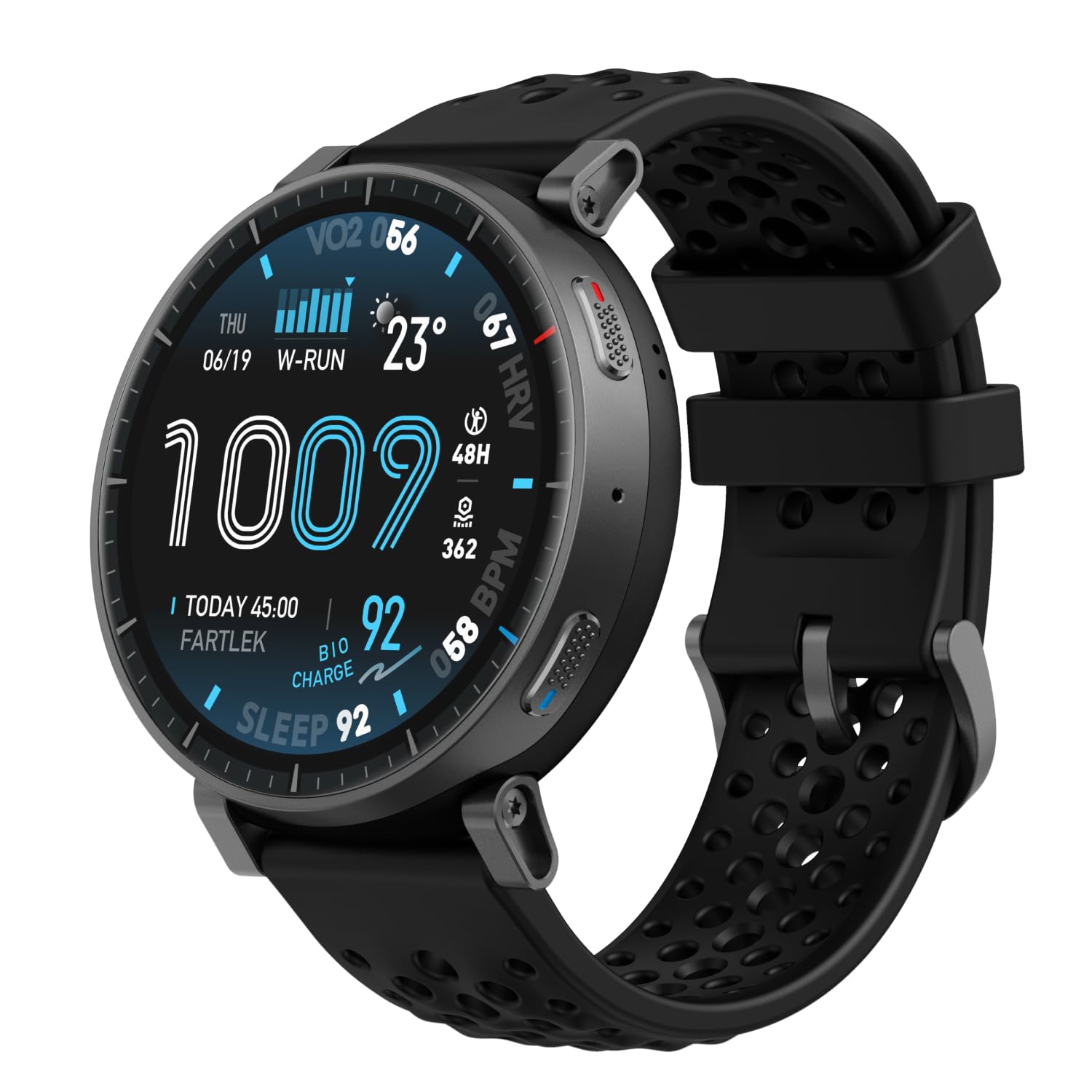
- Cheapest watch on the page with native offline topographic maps
- Large 1.5″ AMOLED display is bright and easy to read
- 25-day smartwatch battery is competitive with rugged watches twice the price
- 4GB onboard storage for music and route data
- 5 ATM water resistance handles rain, swimming, and shallow water
- Only 350 reviews: thinner proof base than vívoactive 5 (10,253)
- Single-band GPS instead of dual-band
- 5 ATM is fine for rain but not for the trail abuse rugged watches absorb
- Zepp app and ecosystem aren’t as polished as Garmin Connect
The Amazfit Active Max is for the budget shopper who still wants offline maps. That is the whole appeal. Most watches at this price are fitness watches that can record a hike, but this one gives you a more useful navigation setup for trails where phone service is spotty. It also has the kind of battery life that makes it easier to travel, camp, or hike for a few days without constantly thinking about a charger.
I would still point most Garmin loyalists toward the vívoactive 5 because the app experience and long-term proof feel safer. But if maps are the feature you care about and you want to stay under $200, the Active Max is the more interesting pick. It is best for hikers who want a big, readable screen and practical navigation tools without paying premium outdoor-watch prices.

- Sapphire crystal AMOLED: typically a premium-tier feature: at $169.99
- Native offline maps with 4GB of storage for music and routes
- Slimmer 1.32″ form factor than the Active Max for smaller wrists
- 4.7-star average from early reviews points to Amazfit’s typical software polish
- Only 73 reviews: the thinnest proof base of any pick on this page
- 12-day battery is shorter than the Active Max’s 25 days
- Single-band GPS only
- Newer release without years of long-term reliability data
The Amazfit Active 3 is the slimmer value option for someone who wants maps and an AMOLED display but does not want a huge rugged watch. It makes sense for smaller wrists, everyday wear, travel, gym use, and day hikes where comfort matters as much as outdoor features. The sapphire-style positioning also gives it a more polished feel than you expect at this price.
The reason it is not ranked higher is confidence. It has a smaller proof base than the safer picks, so I would be more cautious if you want a watch you can buy once and use hard for years. Choose it if the design, slimmer size, and feature mix are exactly what you want. Choose the Active Max if battery and screen size matter more, or the vívoactive 5 if you want the safer mainstream recommendation.
Comparison table
| Watch | Tier | Display | Battery | Offline maps | Rating | Reviews | Price |
|---|---|---|---|---|---|---|---|
| Garmin Instinct 3 Solar | Premium | MIP+Solar | Indefinite | No | 4.6 | 694 | $379.00 |
| COROS NOMAD | Premium | 1.3″ MIP touch | 22 days | Yes (global topo) | 4.5 | 193 | $349.00 |
| Garmin vívoactive 6 | Premium | AMOLED | 11 days | No | 4.5 | 2,388 | $299.99 |
| Garmin Instinct 2 | Mid | MIP transflective | 28 days | No | 4.6 | 1,269 | $224.99 |
| Amazfit T-Rex 3 | Mid | 1.5″ AMOLED | 27 days | Yes | 4.5 | 2,193 | $279.99 |
| Apple Watch SE 2nd Gen | Mid | Retina OLED | ~18 hours | No | 4.8 | 1,019 | $279.00 |
| Garmin Forerunner 165 | Mid | AMOLED | 11 days | No | 4.7 | 3,606 | $199.00 |
| Garmin vívoactive 5 | Value | AMOLED | 11 days | No | 4.4 | 10,253 | $178.49 |
| Amazfit Active Max | Value | 1.5″ AMOLED | 25 days | Yes | 4.7 | 350 | $169.99 |
| Amazfit Active 3 | Value | 1.32″ AMOLED sapphire | 12 days | Yes | 4.7 | 73 | $169.99 |
How to choose a smartwatch for hiking
Match the watch to the trip type
The single biggest mistake is buying a fitness smartwatch and expecting it to perform on multi-day backcountry trips, or buying an expedition watch when 90% of your hiking is day trips. For day hikes near civilization, the vívoactive 5 or Apple Watch SE is plenty. For weekend backpacking, step up to the Instinct 2 or T-Rex 3. For thru-hiking or long remote routes where you can’t easily charge, the Instinct 3 Solar earns its premium.

Battery life matters more than you think
Battery numbers are quoted in two modes: smartwatch (passive use, no GPS) and GPS tracking (continuous active GPS). The latter is what matters on the trail and is dramatically shorter: typically 15 to 30 hours on most watches. For a 12-hour Cascade summit day with GPS on the whole time, almost any watch on this page works. For a 4-day Pacific Crest Trail section, you want 25+ days of smartwatch battery so the watch survives between charges.

Offline maps are a real safety feature, not a luxury
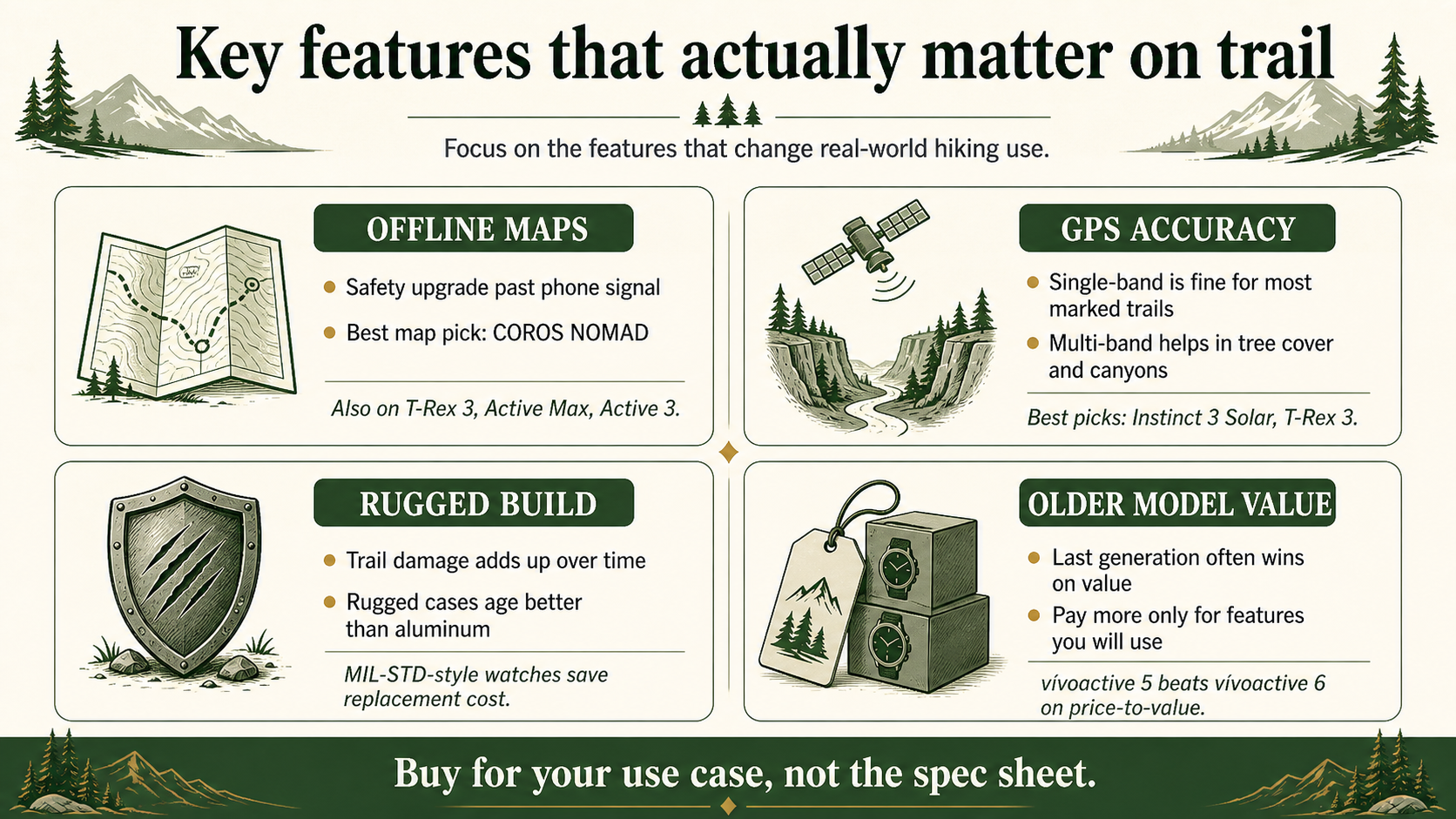
If you hike past phone signal: which means almost any Pacific Northwest trail more than 20 minutes off a paved road: offline maps on your wrist are a meaningful safety upgrade. The COROS NOMAD has the best maps on this page (full global topo with turn-by-turn). The T-Rex 3, Active Max, and Active 3 all include offline maps at lower price points. Garmin’s vívoactive and Forerunner lines do not: they show your track and breadcrumbs only.
Know what GPS accuracy you actually need
Single-band GPS is fine for most day hiking on marked trails. Multi-band GNSS (also called dual-band or L1+L5) is meaningfully more accurate in tight tree cover, deep canyons, and against rock walls: places where single-band drifts 10 to 30 meters off your actual position. The Instinct 3 Solar and T-Rex 3 are the multi-band picks. If you do a lot of off-trail hiking, that matters.
Ruggedness has a cost: pay it once or pay it twice
An aluminum smartwatch case will scratch and dent on the trail. The Apple Watch SE looks great on day one and tired by year three of regular hiking. Watches built to MIL-STD-810: the Garmin Instinct line, the Amazfit T-Rex 3: handle rock contact, drops, and scrapes without showing it. If you hike a lot, the rugged option saves you a second purchase down the road.
Don’t pay extra for the newest model unless you need to
The vívoactive 6 ($299.99) is a small refinement of the vívoactive 5 ($178.49): same display, same battery, same general feature set. The vívoactive 5 has 10,253 reviews of long-term proof; the vívoactive 6 has 2,388. Unless a specific new feature matters to you, last generation usually wins on price-to-value.
Frequently asked questions
More smartwatch and tech guides
Browse all gear
