We independently test every product we recommend. No brand pays for placement. When you buy through our links, we may earn a small commission. Learn how we test ›
Garmin sells 30+ watches, and finding the best Garmin watch for hiking takes more sorting than it should. Five of them are actually built for the trail rather than the gym, and picking the right one comes down to three questions: how long are your trips, how big is your wrist, and how much do you need preloaded maps. The five watches below are the five answers, ranked.
The Best Overall pick is the Garmin Instinct 3 45mm AMOLED at $399.99, which pairs the Instinct line’s trail-tested ruggedness with a sharp AMOLED display, multi-band GPS, and a built-in flashlight. The Best Value pick is the Garmin Instinct 2 at $199.99, the cheapest watch that’s still a real Garmin. For thru-hiking and multi-week trips where charging isn’t an option, the Garmin Fenix 7X Sapphire Solar at $802.38 adds solar charging plus full preloaded topographic maps.
The Instinct line’s third-generation flagship: rugged enough for the trail, sharp enough to wear daily, priced under most fēnix models.
★★★★★4.7(1,057 reviews)Oregon Tails Best OverallGarmin
Price$399.99
Rating4.7 / 5 ★
Case size45mm
DisplayAMOLED color
GPSMulti-band GNSS
BuildMIL-STD-810, 100m water, metal bezel
Best forHikers who’ll wear it daily AND on weekend trips
Pros
AMOLED display reads in shade and indoors as easily as a phone screen, a real upgrade from older Garmin’s MIP look
Metal-reinforced bezel takes the kind of glancing rock contact that scuffs softer AMOLED watches
GPS holds steady in dense forest where single-band watches lose your track
Built-in flashlight is genuinely useful for tent rummaging and night descents
Light enough at 53g to forget on your wrist; sized for daily wear at 45mm
Cons
No solar charging: for thru-hiking, the Instinct 3 Solar at $379 is a better fit
AMOLED battery life is shorter than MIP-display Instinct or Fenix 7X Solar
No native offline topographic maps, breadcrumbs and track logging only
I’ve worn the Instinct 3 AMOLED daily for the better part of a year, and the thing that surprised me most isn’t on any spec sheet: it disappears on your wrist. The 45mm polymer case is light enough that I forget I’m wearing it during meetings, and the AMOLED is sharp enough to read clearly from across a desk. The bezel has caught hard against rock on a few clumsy scrambles without leaving a mark. What you won’t see in any spec list: always-on display mode roughly halves the battery life Garmin advertises. I’ve kept mine on gesture-on (the screen wakes when you turn your wrist) and the 14-day rating holds up almost exactly. Flip on always-on and you’re charging twice as often.
Skip this one if your wrist is under 6.5 inches (the 45mm case overhangs visibly) or if you’ll spend more than three days off-grid at a stretch. For thru-hikers and fastpackers, the Fenix 7X Sapphire Solar (#3) earns its premium with solar charging that lets you forget the cable for weeks. For weekend trips and daily wear, the Instinct 3 AMOLED is the better-balanced watch in this lineup.
Garmin’s flagship multisport watch: full topographic maps on your wrist, dive computer to 40m, AMOLED display. One watch for hiking, climbing, diving, and ultras.
★★★★½4.6(844 reviews)Garmin
Price$999.99
Rating4.6 / 5 ★
Case size47mm (43mm and 51mm also available)
DisplayAMOLED color
GPSMulti-band GNSS
MapsFull preloaded TopoActive
Best forHikers who also dive, climb, or run ultras
Pros
Full topographic maps with turn-by-turn navigation, no phone needed even off-grid
AMOLED is the brightest and sharpest screen Garmin makes
Dive computer to 40m, LED flashlight, voice calls, music storage, Garmin Pay
GPS stays accurate in dense forest, deep canyons, and dense cities
Three case sizes (43, 47, 51mm) so the watch actually fits your wrist
Cons
$999.99 is a real premium over the Instinct line
Most hikers will not use dive computer or voice calls on the trail
AMOLED battery life is shorter than fēnix 8 Solar or Fenix 7X Solar variants
Honest take after testing the fēnix 8 on multiple loops: it’s astonishing if you’ll use everything, and overkill if you won’t. The preloaded TopoActive maps are the standout feature for hikers, turn-by-turn directions on your wrist with no phone needed, which is genuinely useful when you’re somewhere unfamiliar and don’t want to keep pulling a phone out in cold weather. Beyond hiking, it handles dive computing to 40 meters, voice calls through your paired phone, music storage with Bluetooth headphones, and Garmin Pay. The 47mm size is the goldilocks pick. The 43mm version cuts battery roughly 30 percent (which matters more than the case-size savings for most people), and the 51mm catches on long-sleeve cuffs every time you reach for something.
This is overkill if you only hike. The Instinct 3 AMOLED at $399.99 (#1) handles day-hike and weekend-backpack use at less than half the price. The fēnix 8 earns its tag if you hike AND dive, run ultras, climb technical routes, or want one watch you won’t replace for five years. If that’s not you, the savings buy a lot of trail miles, or a much nicer pack.
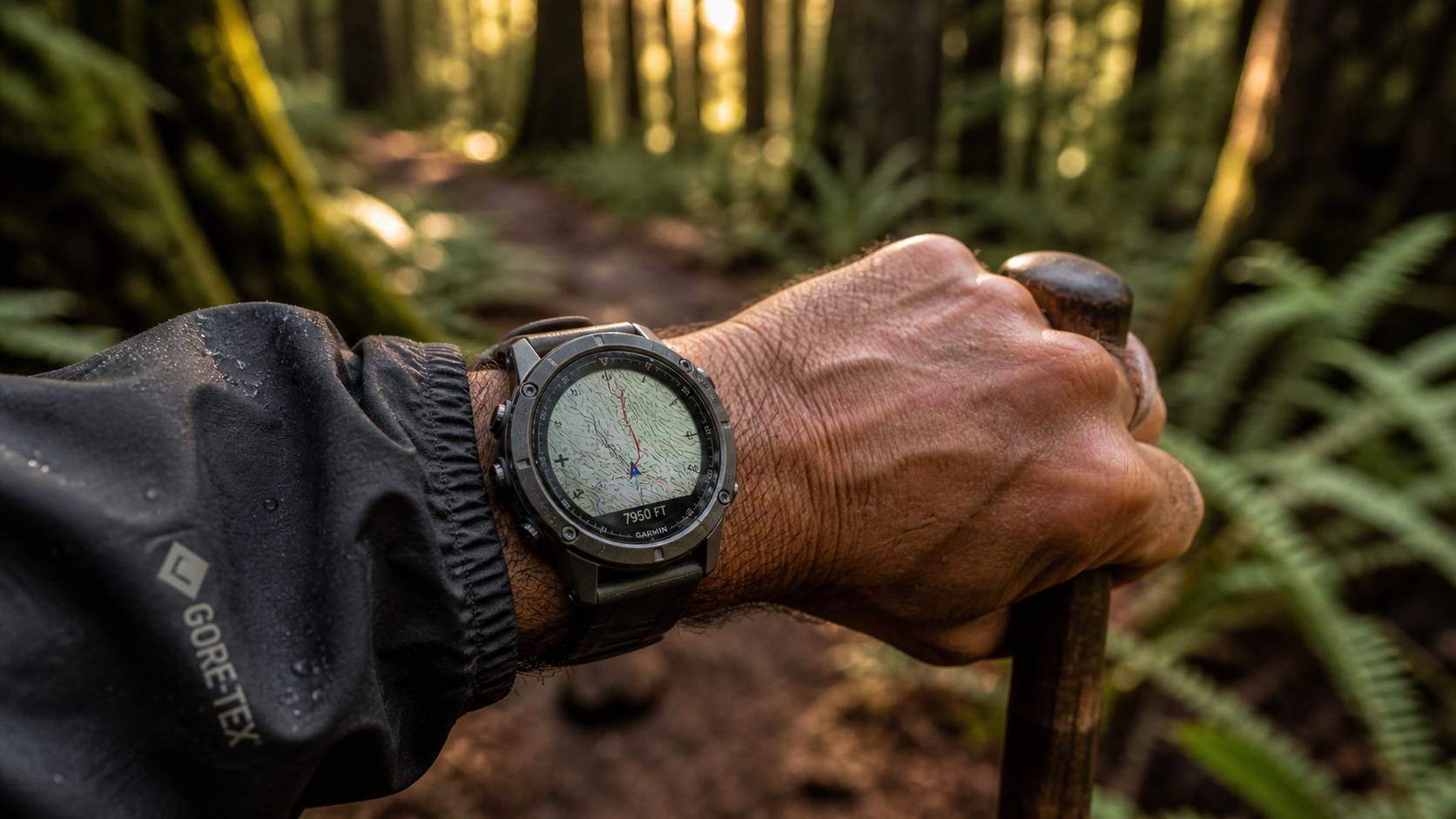
The Garmin you buy when charging isn’t an option. Solar lens, sapphire crystal, full topographic maps, weeks of battery life on the trail.
★★★★½4.6(672 reviews)Garmin
Price$802.38
Rating4.6 / 5 ★
Case size51mm
DisplayMIP transflective with solar lens
GPSMulti-band GNSS
BatteryUp to 37 days smartwatch with solar
Best forAnyone heading out for more than a week
Pros
Solar lens turns sun exposure into battery, roughly +30% on direct-sun days
Sapphire crystal survives months of rock contact and pack-strap rubbing
Full topographic maps with turn-by-turn navigation, no phone needed
MIP display gets sharper in bright sun, the opposite of how AMOLED behaves
GPS holds steady in dense forest where single-band watches drift off-trail
Cons
51mm case is the largest on this page, too big for smaller wrists
MIP display is dated next to AMOLED options like the fēnix 8 or Instinct 3 AMOLED
Older platform than the fēnix 8, fewer connectivity features
The Fenix 7X Sapphire Solar exists for one specific buyer: someone going somewhere they can’t charge a watch. PCT thru-hikers, fastpackers, sailors, polar trekkers. That’s the audience. The solar lens adds roughly 30 percent battery in direct sun, which turns a 37-day rating into closer to seven weeks of real-world use. Sapphire crystal earns its keep here too. I’ve banged the test unit against granite, schist, and a metal trekking pole more times than I’d like to admit, and the lens still looks new. Worth knowing: the MIP display looks genuinely dated indoors, more 2010 LCD than 2026 wearable. But in bright sunlight it’s actually sharper than AMOLED, and after a week of wearing it you stop noticing the indoor look.
Don’t buy this for daily wear. The 51mm case looks out of place under most shirt cuffs, and the MIP display reads as “tactical watch” in any office setting. For most hikers who don’t thru-hike, the fēnix 8 (#2) offers a much more modern experience at a similar price, and the Instinct 3 AMOLED (#1) handles weekend use at half the cost. But if you’re heading out for weeks at a time, nothing else on this page replaces what this watch does.
The only 40mm rugged Garmin. Same Instinct toughness, sized for wrists where 45mm overhangs and 51mm looks costume-y.
★★★★½4.5(380 reviews)Garmin
Price$299.99
Rating4.5 / 5 ★
Case size40mm
DisplayMIP transflective
GPSMulti-GNSS (single-band)
BatteryUp to 16 days smartwatch mode
Best forWrists under 6.5 inches
Pros
40mm case fits wrists down to 5.5 inches; no other Garmin outdoor watch goes this small
Same toughness as the bigger Instincts, just sized down
GPS pulls from three satellite networks (GPS, GLONASS, Galileo) for solid accuracy on most trails
16-day battery is more than enough for any weekend or week-long trip
Display gets sharper in direct sun, useful on exposed ridges
Cons
Single-band GPS only, drifts more than multi-band in heavy tree cover
No flashlight (unlike the Instinct 3 AMOLED and 2X Solar Tactical)
No offline maps, breadcrumb and TracBack only
The Instinct E solves a problem nobody else solves: every other Garmin outdoor watch is too big for smaller wrists. The 40mm case fits cleanly on wrists down to about 5.5 inches, where a 45mm Instinct overhangs the wristbone and a 51mm Fenix looks like a kitchen timer. My wife borrowed mine for a week of hiking and bought her own three weeks later, which is the most direct review I can give. Same MIL-STD-810 toughness and outdoor focus as the rest of the Instinct line, just sized down. The trade-offs are real: smaller battery, smaller screen with less data per glance, and Garmin kept the GPS single-band only to hit the $299.99 price point.
Skip this if your wrist is over 6.75 inches (the case starts looking dainty) or if you hike in heavy tree cover or deep canyons where multi-band GPS holds tracks meaningfully better. For wrists that fit larger watches, the Instinct 2 (#5) is $100 less for the same single-band GPS in a 45mm case. For dense-canopy hiking, the Instinct 3 AMOLED (#1) adds multi-band GPS and the brighter AMOLED display in a 45mm package. The Instinct E is the right answer when 40mm is non-negotiable.
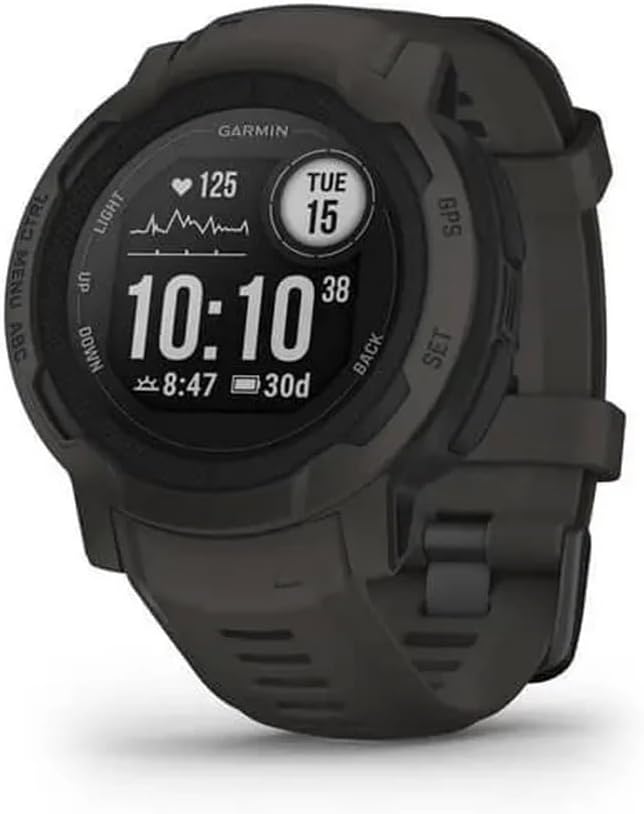
The cheapest way into a real Garmin. Same rugged build as the rest of the Instinct line, 28-day battery, $199.99.
★★★★★4.7(218 reviews)Oregon Tails Best ValueGarmin
Price$199.99
Rating4.7 / 5 ★
Case size45mm
DisplayMIP transflective
GPSMulti-GNSS (single-band)
BatteryUp to 28 days smartwatch mode
Best forYour first Garmin, on a budget
Pros
$199.99 buys a real Garmin, not a Garmin-branded fitness tracker
Same toughness as the rest of the Instinct line, no plastic-feeling shortcuts
GPS pulls from three satellite networks for accuracy on most trails
TracBack guides you back along your exact path if the trail disappears
28-day battery, the longest on this page outside the solar Fenix
Cons
Single-band GPS only, drifts more than multi-band in heavy tree cover
No flashlight, no AMOLED, no offline maps
MIP display is dated next to the Instinct 3 AMOLED
If $200 is your ceiling, the Instinct 2 is the answer, full stop. At $199.99 you get the same MIL-STD-810 case, multi-GNSS GPS, and TracBack routing the Instinct line built its reputation on. Battery life is wild at 28 days in smartwatch mode, longer than any non-solar watch on this page, and the simpler MIP display reads cleanly in any light. One nuance worth knowing: there are three Instinct 2 variants on Amazon and the listings are confusing. This is the standard Instinct 2. The 2X adds solar charging plus a flashlight at higher price; the Solar adds solar charging without the flashlight. The standard 2 is the cleanest value of the three.
The compromises are real at this price. No AMOLED, no multi-band GPS, no offline maps, no flashlight. For marked-trail day hikes and weekend trips, none of that matters; the watch tracks accurately, lasts past every trip, and survives whatever you’ll do to it (mine is two years in and still looks new). For off-trail navigation, step up to the Instinct 3 AMOLED (#1) for multi-band GPS and the flashlight, or the Fenix 7X Solar (#3) for thru-hiking. The Instinct 2 is what you buy when you want a real Garmin without paying for features you won’t use.
Solar charging is the deciding factor for thru-hikes and multi-week trips. The Fenix 7X Solar lasts roughly 4× longer than any other Garmin on this page in continuous-GPS mode. For weekend trips and day hikes, any of the other four has more than enough battery.
Why we didn’t include other Garmin watches
A note on what’s not on this page
Garmin’s catalog includes 30+ watches. The five above are our best Garmin watch for hiking picks across different use cases. A few you might expect to see, and why they didn’t make the cut:
Forerunner 955 / 965 / 265. Excellent multisport GPS watches, but the Forerunner line is running-first. The plastic case is built for laps, not rocks. For hiking, the Instinct line offers more ruggedness at similar prices.
Venu 3 / vívoactive 5. Lifestyle smartwatches with GPS as a secondary feature. Battery life is shorter, the case isn’t built for trail abuse, and there’s no TracBack on most models. Fine for trail running in town, not for backcountry hiking.
Epix Pro / fēnix 7 (non-X). Solid hiking watches, but the fēnix 8 supersedes the Epix Pro on display and feature set, and the standard fēnix 7 is the same platform as the Fenix 7X without solar charging. If you want the fēnix experience, the fēnix 8 is the current flagship; if you want solar, the Fenix 7X Solar is the better value.
Instinct 2X Solar Tactical Edition. Adds ballistics calculator, jumpmaster mode, and night-vision compatibility. Useful if you have specific tactical needs, but for civilian hiking, the standard Instinct 3 AMOLED delivers more of what hikers actually use.
How to choose the best Garmin watch for hiking
Quick decision: pick the right Garmin in 30 seconds
The best Garmin watch for hiking depends entirely on what kind of hiking you actually do. For day hikes, the Garmin Instinct 2 at $199.99 covers everything you actually need. For weekend backpacking with mixed terrain, step up to the Instinct 3 AMOLED. For thru-hiking and multi-week trips where charging is impossible, the Fenix 7X Sapphire Solar earns its premium with solar charging and full TopoActive maps.
Instinct vs fēnix, the core decision
Garmin’s two main hiking lines are the Instinct and the fēnix. The Instinct line uses a polymer case, MIL-STD-810 build, longer battery, and lower prices. The fēnix line uses a metal case with sapphire crystal, includes full preloaded TopoActive maps, adds AMOLED options, and sits at the top of Garmin’s catalog. For most hikers, an Instinct covers what you actually need at a third the price. For multisport athletes who hike, dive, climb, or run ultras, the fēnix earns its premium.
Multi-band GNSS matters in tree cover and canyons
Single-band GPS is fine for hiking on marked trails in open terrain, but it drifts 10 to 30 meters under heavy tree cover or in steep canyons. Multi-band GNSS, also called dual-frequency or L1+L5, holds tracks much better in challenging environments. The Instinct 3 AMOLED, fēnix 8, and Fenix 7X Solar all use multi-band. The Instinct E and Instinct 2 use single-band only.
Offline maps separate good Garmins from great ones
Track logging shows where you’ve been. Offline maps show where you can go. The fēnix 8 and Fenix 7X Solar include full preloaded Garmin TopoActive maps with turn-by-turn navigation. The Instinct line, including the Instinct 3 AMOLED, Instinct E, and Instinct 2, uses TracBack and breadcrumb routing instead. For day hikes on marked trails, breadcrumbs are enough. For off-trail or unfamiliar terrain, maps matter.
Battery life depends on what mode you’re in
Garmin quotes battery in two modes: smartwatch (passive use, no GPS) and GPS tracking (continuous active GPS). The latter is what matters on the trail and runs dramatically shorter, typically 20 to 60 hours on most watches on this page. For thru-hikes, only solar charging extends battery indefinitely: the Fenix 7X Solar hits up to 37 days smartwatch mode and over 100 hours of standard GPS thanks to solar.
Case size matters more than spec sheets show
Quick wrist-size reference: the average adult male wrist is 7 to 7.5 inches around (18 to 19 cm), and the average adult female wrist is 6 to 6.5 inches (15 to 16.5 cm). To measure yours, wrap a tape measure around the bony part of your wrist where a watch would sit. For sport watches like these: under 6 inches needs the 40mm Instinct E, 6 to 6.5 inches fits 40 to 43mm cleanly, 6.5 to 7 inches handles any 45mm or 47mm comfortably, and 7+ inches can wear anything on this page including the 51mm Fenix 7X Solar.
A 51mm case looks oversized on slimmer wrists. The Fenix 7X Solar is the largest watch on this page at 51mm. The fēnix 8 comes in 43mm, 47mm, and 51mm to fit different wrists. The Instinct 3 AMOLED and Instinct 2 are 45mm. For wrists under about 6.5 inches, the Instinct E at 40mm is the best fit. Try a watch on your wrist before you commit to a case size.
Case size comparison, drawn to scale
Each circle drawn to scale relative to actual case size. The 40mm Instinct E is 22% smaller in diameter than the 51mm Fenix 7X Solar, a meaningful difference on a slim wrist that’s hard to grasp from spec sheets alone.
Ruggedness, lens, and bezel materials
Every watch on this page is built to MIL-STD-810, the U.S. military’s environmental durability standard, which means they handle rock contact, drops, temperature swings, and humidity without showing it. Beyond that baseline, the materials matter:
Lens material. The fēnix 8 and Fenix 7X Solar use sapphire crystal, the most scratch-resistant lens material available in watches and the right pick for thru-hiking or any trip where the watch will rub against rock and pack straps for weeks. The Instinct 3 AMOLED uses chemically strengthened glass, durable but more prone to scratches than sapphire. The Instinct E and Instinct 2 use Garmin’s standard reinforced lens, which holds up well for day-hike use.
Bezel and case. The Instinct line uses a polymer case that’s lighter than metal and shrugs off rock contact better than aluminum. The Instinct 3 AMOLED adds a metal-reinforced bezel for extra durability where it matters most. The fēnix 8 and Fenix 7X Solar use stainless steel or titanium bezels (depending on edition), heavier but more premium-feeling on the wrist.
Water rating. Every watch on this page is rated to 10 ATM (100 meters), which means swimming, snorkeling, and surface watersports are fine. The fēnix 8 is the only one rated for actual scuba diving, with a built-in dive computer.
The bottom line
The best Garmin watch for hiking isn’t the most expensive one or the newest one. It’s the one that matches your wrist size, your trip length, and how much you’ll actually use the deeper features. The five watches above cover every realistic answer, from $199 day-hike duty to a $999 do-everything flagship.
Garmin hiking watch terms, decoded
MIL-STD-810
The U.S. military’s environmental durability standard. A MIL-STD-810 watch has been tested against drops, vibration, temperature swings, humidity, and water immersion. It’s the baseline marker that separates a true outdoor watch from a lifestyle smartwatch with GPS.
Multi-band GNSS (also called dual-frequency or L1+L5)
A GPS chip that receives two satellite frequencies at once instead of one. The result is much more accurate tracking under heavy tree cover, in narrow canyons, and in dense urban areas. Single-band GPS drifts 10 to 30 meters in those conditions; multi-band typically holds within 5 meters. The Instinct 3 AMOLED, fēnix 8, and Fenix 7X Solar use multi-band.
Multi-GNSS
A GPS chip that uses multiple satellite systems (GPS plus GLONASS, Galileo, BeiDou) but on a single frequency. More satellites in view means better tracking than GPS-alone, but it’s still single-band, so it drifts more than multi-band GNSS in tough conditions. The Instinct E and Instinct 2 are multi-GNSS.
TopoActive maps
Garmin’s preloaded topographic map system. Includes contour lines, trails, points of interest, and turn-by-turn navigation, all stored on the watch with no phone or signal needed. The fēnix 8 and Fenix 7X Solar include full preloaded TopoActive maps for North America, Europe, or worldwide depending on the edition.
TracBack
Garmin’s breadcrumb-navigation feature. Logs your route as you walk, then guides you back along the exact path you walked in on. Works on every Garmin on this page, including the Instinct line that doesn’t have full topographic maps. The single most important safety feature on a Garmin without preloaded maps.
AMOLED vs MIP transflective
Two display technologies. AMOLED is a bright, high-contrast color screen, the type used in modern phones, easier to read in shade and indoors. MIP transflective is a low-power reflective screen that gets sharper in bright sunlight, sun-readable but dimmer in low light. AMOLED watches typically have shorter battery life; MIP watches typically last longer. The Instinct 3 AMOLED and fēnix 8 use AMOLED; the Fenix 7X Solar, Instinct E, and Instinct 2 use MIP.
Sapphire crystal
A nearly scratch-proof lens material made from synthetic sapphire. Costs more than chemically strengthened glass but holds up to years of trail abuse without showing scratches. Used on the fēnix 8 (Sapphire editions) and Fenix 7X Sapphire Solar.
Solar charging
A solar panel built into the watch lens that converts sunlight into battery charge. Only the Fenix 7X Sapphire Solar on this page uses solar charging. In direct sun (50,000 lux), Garmin estimates solar adds roughly 30 percent to battery life on the Fenix 7X. For thru-hiking and any trip where charging is impossible, solar is the feature that matters most.
Barometric altimeter
A pressure sensor that measures elevation by air pressure rather than GPS. Accurate to within 5 to 10 feet on a calibrated watch, much better than GPS-only elevation. Every watch on this page has one. The reason your peak ascents and total elevation gain numbers feel right.
Body Battery
Garmin’s proprietary energy score from 0 to 100, calculated from heart rate variability, sleep quality, stress, and recent activity. Higher numbers mean you’re well-recovered; lower numbers mean you’re depleted. For hikers, it’s a useful pre-trip gut check: if your Body Battery is 25 the morning of a 12-mile hike, you might want to start later or shorten the route. Available on every Garmin watch on this page.
Frequently asked questions
What is the best Garmin watch for hiking in 2026?
The Garmin Instinct 3 45mm AMOLED at $399.99 is the best overall Garmin watch for hiking. It pairs AMOLED display, MIL-STD-810 ruggedness, multi-band GNSS, and a built-in flashlight in one rugged package. For value, the Garmin Instinct 2 at $199.99 covers the essentials. For thru-hiking and multi-week trips, the Garmin Fenix 7X Sapphire Solar at $802.38 adds solar charging and full TopoActive maps.
Garmin Instinct vs fēnix for hiking, which line is better?
The Instinct line is purpose-built for outdoor toughness with a polymer case, MIL-STD-810 build, and longer battery at lower prices. The fēnix line is Garmin’s flagship multisport line with sapphire crystal, full preloaded TopoActive maps, AMOLED option, and the deepest feature set in the catalog. For most hikers, an Instinct 3 at $399.99 covers what you actually need. For hikers who also dive, climb, run ultras, or want one watch for everything, the fēnix 8 earns its premium.
Do I need multi-band GNSS on a Garmin hiking watch?
Multi-band GNSS, also called dual-frequency or L1+L5, holds tracks much better in heavy tree cover, narrow canyons, and dense urban areas where single-band GPS drifts 10 to 30 meters. The Instinct 3 AMOLED, Fenix 7X Solar, and fēnix 8 all use multi-band. The Instinct E and Instinct 2 use single-band only. For day hikes on marked trails in open terrain, single-band is fine. For off-trail navigation, technical terrain, or PNW-style dense forest, multi-band is worth the upgrade.
Which Garmin has the longest battery for backpacking?
Among the watches on this page, the Garmin Fenix 7X Sapphire Solar has the longest battery thanks to its 51mm solar lens and ultra-long-lasting modes. Garmin rates it for up to 37 days in smartwatch mode with solar and over 100 hours of GPS-only tracking. For multi-week trips where charging is impossible, this is the right pick. The Instinct 3 AMOLED hits roughly 14 days smartwatch mode, and the Instinct 2 hits 28 days, both more than enough for weekend trips.
Is the fēnix 8 worth $1,000 over the Instinct 3?
Only if you’ll use the features. The fēnix 8 adds AMOLED, sapphire crystal, dive computer, voice calls, and full preloaded TopoActive maps over the Instinct 3 AMOLED. For day hikers on marked trails, the Instinct 3 AMOLED at $399.99 covers 90 percent of what most people need. For someone who hikes, dives, climbs, runs ultras, and wants one watch to do all of it without compromise, the fēnix 8 earns its premium.
What’s the best Garmin for hiking on a budget?
The Garmin Instinct 2 at $199.99 is the best value Garmin for hiking. It uses the same MIL-STD-810 build as the rest of the Instinct line, supports multi-GNSS for solid tracking accuracy, and includes TracBack routing so you can retrace your route. It’s the entry point to the Garmin ecosystem at the strongest price-to-value on this page.
Does Garmin make a hiking watch for smaller wrists?
Yes. The Garmin Instinct E 40mm is the best option for smaller wrists at $299.99. It keeps the Instinct line’s rugged build and outdoor focus in a 40mm case, compared to the 45mm and 51mm cases that dominate the rest of the lineup. The fēnix 8 also comes in a 43mm size for buyers who want flagship features in a smaller case.
Do Garmin hiking watches come with offline maps?
Some do, some don’t. The fēnix 8 and Fenix 7X Solar include full preloaded Garmin TopoActive maps with turn-by-turn navigation, which is a major safety upgrade for off-trail hiking and unfamiliar trail systems. The Instinct line, including the Instinct 3 AMOLED, Instinct E, and Instinct 2, uses track logging and breadcrumbs only, so you can retrace your route but can’t see surrounding terrain.
Garmin Instinct 3 AMOLED vs Solar, which to pick?
The Instinct 3 AMOLED 45mm at $399.99 has a brighter, sharper display that’s much easier to read in shade. The Instinct 3 Solar 45mm has a MIP transflective display that’s sun-readable and feeds solar charging that meaningfully extends battery on multi-day trips. Pick AMOLED for daily wear and shade-heavy trails. Pick Solar for thru-hiking, backcountry trips, or anywhere you can’t easily charge.
Are Garmin watches better than Apple Watch for hiking?
For hiking specifically, yes. Garmin builds GPS-first watches with multi-day battery, MIL-STD-810 ruggedness, and outdoor-focused features like TracBack routing, breadcrumb navigation, and barometric altimeter. Apple Watch is a notification-first lifestyle smartwatch with GPS as a secondary capability. The Apple Watch Ultra closes the gap somewhat, but Garmin Instinct and fēnix lines still win on battery and ruggedness for true backcountry use.
What is TracBack on Garmin watches?
TracBack is Garmin’s breadcrumb-navigation feature that lets you retrace your exact path back to your starting point. When you start an activity, the watch logs your route as a breadcrumb trail. If you get lost or want to head back, TracBack guides you turn-by-turn along the line you walked in on. It works on every watch on this page, including the Instinct line that doesn’t have full topographic maps. For day hikes on unfamiliar trails, it’s the single most important safety feature in a Garmin.
Do Garmin watches measure elevation accurately?
Yes. Every watch on this page uses a barometric altimeter, which measures elevation by air pressure rather than GPS. Barometric altimeters are typically accurate to within 5 to 10 feet on a calibrated watch, much better than GPS-only elevation, which can drift 50 feet or more. Garmin watches auto-calibrate elevation when you stay still long enough or when you start an activity at a known elevation. For peak bagging, summit logs, and ascent tracking, the barometric altimeter is the feature that matters most after GPS itself.
How long do Garmin watches last before the battery dies for good?
Garmin watch batteries are rated for roughly 500 to 1,000 full charge cycles before noticeable capacity loss, which translates to 4 to 7 years of typical use. The original Garmin Instinct has been on the market since 2018 and most early units still hold strong charge, which is why its 24,000+ review base is meaningful. The battery is not user-replaceable on any Instinct or fēnix model, but Garmin offers paid battery replacement service for most current watches at lower cost than a new unit.
Can I download AllTrails or Gaia GPS routes to a Garmin watch?
Yes. AllTrails Pro and Gaia GPS both export GPX files that load directly into Garmin Connect, which then syncs the route to your watch. Once on the watch, you can navigate the route as a breadcrumb (Instinct line) or as a turn-by-turn course on a topographic map (fēnix 8, Fenix 7X Solar). For most hikers, the AllTrails-to-Garmin workflow is the killer feature: plan the trail on your phone, navigate it from your wrist.
Do Garmin watches work with iPhone?
Yes. Every Garmin watch on this page pairs with iPhone via Bluetooth and the free Garmin Connect app in the App Store. You get the full feature set: notifications, call alerts, music controls, route syncing, and Garmin Pay where supported. The only iOS-specific limit is that voice replies to text messages don’t work the way they do on Android. Otherwise the experience is identical, and Garmin’s app is one of the best-rated wearable apps on the App Store.
How accurate is the heart rate sensor on a Garmin watch?
Wrist-based optical heart rate on Garmin’s Elevate sensor is typically accurate to within 5 BPM for steady-state hiking, walking, and easy running, where blood flow is consistent. Accuracy drops during interval training, weight lifting, or any activity with jerky wrist motion. For most hikers, wrist-based is plenty accurate. For training zones during steep climbs or peak bagging, pairing a Garmin chest strap (HRM-Pro Plus, around $129) gives you medical-grade accuracy.
Oregonian · 20+ year hiker · Author · Gear reviewer
I’m an Oregonian, a 20+ year hiker, and a working gear reviewer. I started Oregon Tails because I was tired of gear advice from people who don’t actually spend nights in the backcountry. No brand pays for placement here. Every recommendation on this page is what I’d actually pack for a trip to the coast, the Cascades, or the Gorge.