Best Garmin Watches For Women (2026): Smaller Cases, Women’s Health Metrics, and Designer Colorways
Finding the best Garmin watches for women takes more sorting than it should, because Garmin doesn’t actually make different watches for women, with one exception: the Lily line. What Garmin does make is smaller cases (the “S” suffix models), women-targeted colorways, and a Garmin Connect app with full menstrual cycle and pregnancy tracking. The 13 watches below prioritize cases that fit smaller wrists, color options designed to look intentional rather than oversized, and the women’s health metrics that actually matter.
The Best Lifestyle pick is the Garmin Venu 3S Slate at $374, a 41mm AMOLED watch with a stainless steel bezel that wears well with anything from gym clothes to a dress. The Best Running pick is the Garmin Forerunner 265S Light Pink at $349.99, the only AMOLED running flagship Garmin makes in a 41mm “S” case, with the same training readiness and race predictor algorithms as the full-size 265. The Best Style pick is the Garmin Lily 2 Active at $249.99, the only watch in Garmin’s lineup actually designed and marketed specifically for women, with a 38mm etched metal bezel and built-in GPS.
Quick picks
Full reviews, premium tier ($400+)
- 2025 platform with multi-band GPS (a Venu series first), ECG, and Elevate Gen 5 sensor
- Full metal case construction is a meaningful upgrade over the Venu 3’s polymer body with metal bezel
- Built-in LED flashlight with white and red modes is genuinely useful for early-morning runs and dark trails
- Brightest AMOLED in any Venu, easier to read in direct sun than the Venu 3
- Lunar Gold with Bone band is one of Garmin’s most refined small-case finishes
- $549.99 is $175 more than the Venu 3S, which is still actively maintained
- 10-day battery is shorter than the Venu 3S at 11 days
- Two side buttons instead of three on the Venu 3, requires more touchscreen interaction
- No onboard maps, only breadcrumb navigation and saved locations
- All-metal case adds weight (42g case vs 40g on Venu 3 41mm)
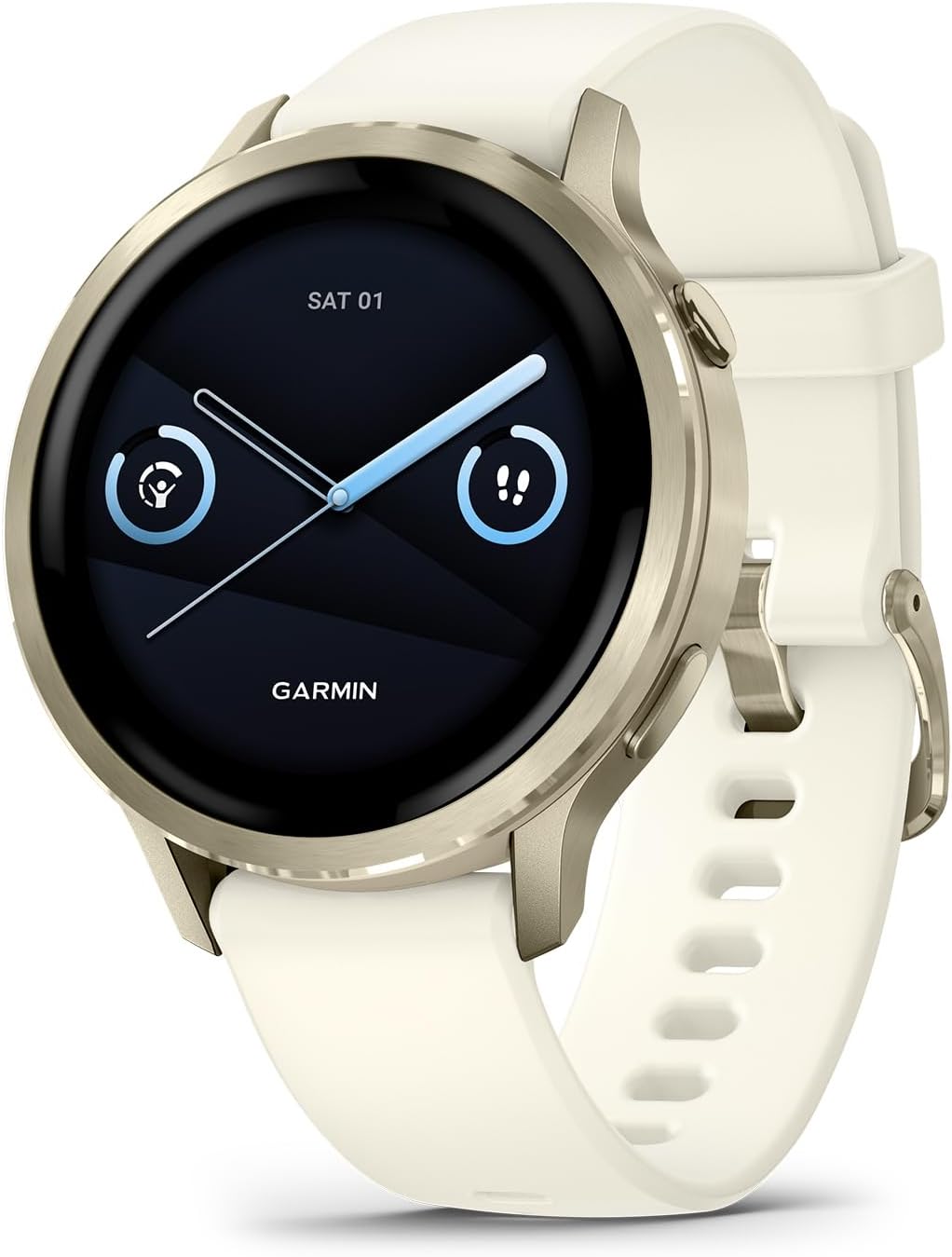
The Venu 4 41mm Lunar Gold is Garmin’s newest premium lifestyle smartwatch in a 41mm case, released September 2025 as the direct successor to the Venu 3S. The hardware story is real: multi-band GPS (a Venu series first), ECG via the Elevate Gen 5 sensor, a built-in LED flashlight, and a full metal case instead of the Venu 3’s polymer body. The Lunar Gold finish with bone-colored band is one of Garmin’s most refined small-case colorways and reads more like jewelry than a fitness tracker. The honest catches: at $549.99 it’s $175 more than the Venu 3S which is still actively maintained, Garmin trimmed a side button (two instead of three), and battery dropped slightly (10 days vs 11 days on the Venu 3S). The trade-offs aren’t free.
When this beats the Venu 3S Slate (#1 Mid): when you want the newest 2025 platform with multi-band GPS, ECG, a flashlight, and a full metal case in 41mm. When the Venu 3S wins: when $175 in savings matters more than the latest hardware. The Venu 3S is still an excellent recommendation for most buyers.
- 2025 platform with multi-band GPS, Elevate Gen 5 sensor, and the brightest Forerunner AMOLED to date
- Same training readiness, race predictor, and recovery algorithms as the $749 Forerunner 970
- 42g aluminum case is light and fits 5.5-inch and larger wrists comfortably
- Raspberry colorway with Bone/Mango translucent band is genuinely distinctive, not a corporate “feminine” afterthought
- Built-in speaker and microphone for calls when paired with a phone
- $549.99 is $200 more than the Forerunner 265S, which has many of the same training algorithms
- No built-in mapping (the Forerunner 970 adds this for $200 more)
- No flashlight (the Forerunner 970 has one)
- ECG support requires pairing with the HRM-600 chest strap, not standalone
- 287 reviews is a relatively small sample size at this point in the platform’s lifecycle
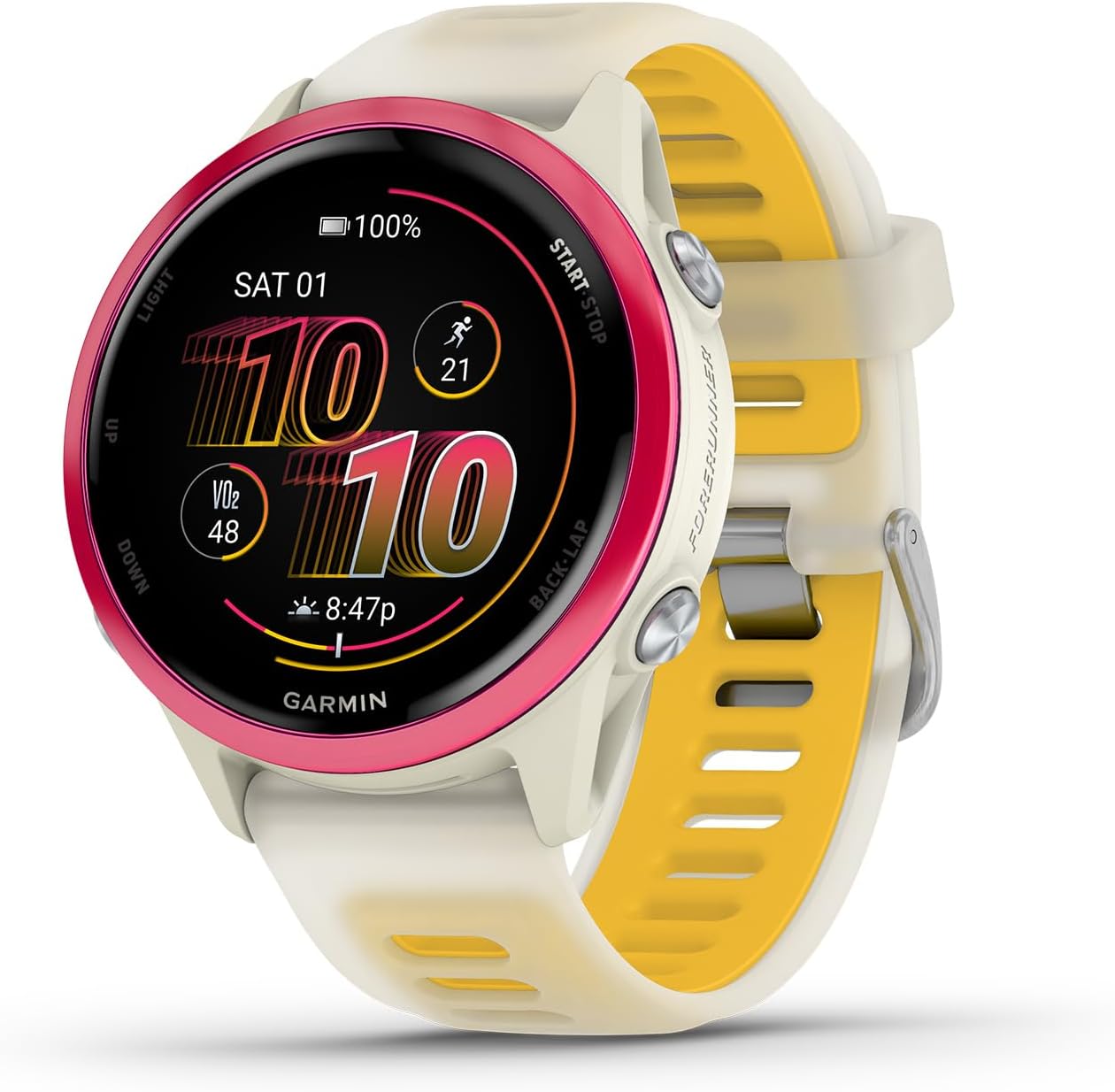
The Forerunner 570 42mm Raspberry is Garmin’s mid-tier 2025 running flagship in a smaller case, released May 2025. It sits between the Forerunner 265S at $349.99 and the Forerunner 970 at $749.99, with the same Elevate Gen 5 sensor and multi-band GPS as the 970, the brightest Forerunner AMOLED to date, and training readiness, but without the 970’s built-in mapping and flashlight. The Raspberry Aluminum case with Translucent Bone/Mango band is one of the most distinctive Forerunner colors Garmin has released, easily the most fashion-forward running watch in the current lineup. The honest catch: $549.99 is $200 more than the Forerunner 265S, which still gets active firmware updates and has most of the same training algorithms in a 41mm case.
When this beats the Forerunner 265S (#2 Mid): when you want the newest 2025 Forerunner platform with multi-band GPS, the brightest AMOLED in the line, and the Raspberry colorway speaks to you. When the 265S wins: when $200 in savings matters and you can live with the previous-generation platform that’s still actively supported.

- Multi-band GNSS holds tracks accurately under tree cover and around tall buildings
- Full-color topographic maps with route planning and turn-by-turn directions
- 23-day smartwatch battery is the longest in the running flagship category
- Whitestone color is one of Garmin’s deliberate women-targeted flagship options
- Triathlon multisport tracking, swim metrics, and bike pairing all included
- 47mm case is genuinely too big for many women’s wrists
- MIP display looks dimmer indoors than AMOLED options like the Forerunner 265S
- Premium price for features most buyers never use
I’ve worn the Forerunner 955 Whitestone for a few months while training for an Olympic-distance triathlon, and the honest take is this: it’s a phenomenal triathlon watch with one real catch. The 47mm case is genuinely large for most women’s wrists. The Whitestone color shows trail dust the way a white running shoe does, but it cleans up. What you actually buy this for: multi-band GNSS that holds tracks where single-band watches drift, full topographic maps, and 23-day smartwatch battery that means you charge it twice a month, not twice a week.
When this beats the Forerunner 265S (#2 Mid): when you need triathlon multisport, multi-band GPS, or topographic maps. When the 265S wins: when 41mm case size matters more than feature depth, plus you save $110.

- AMOLED touchscreen is brilliant in any light, brighter than the Forerunner 955’s MIP display
- Full Garmin Connect health metrics including stress, body battery, sleep, women’s health
- Multi-band GNSS for accurate tracking in challenging environments
- Topographic maps, route planning, and multi-sport profiles all included
- Stainless steel bezel construction matches the lifestyle smartwatch aesthetic
- 47mm case is large for smaller wrists, mine included after a while
- AMOLED battery life is shorter than MIP-based watches like the Forerunner 955
- Premium price puts this above casual buyer territory
My wife wore the epix Gen 2 for two weeks before handing it back, specifically because of the size. 47mm AMOLED is brilliant on the right wrist and overkill on a smaller one. If you have a wrist over 6.75 inches and want the best display Garmin makes alongside multi-band GPS and full topographic maps, this is the answer. The AMOLED is genuinely brighter than any MIP display, including the Forerunner 955. Battery life takes the hit: 16 days vs the 955’s 23, but you’re not staring at a dim screen indoors.
When this beats the Venu 3S (#1 Mid): when you want adventure features, multi-band GPS, and the bigger 47mm screen. When the Venu 3S wins: when you want a 41mm case for smaller wrists at $74 less.
- 43.8mm case fits smaller wrists meaningfully better than the 47mm flagships
- Running power, vertical oscillation, and ground contact balance all included
- Triathlon brick mode, multisport switching, and ClimbPro for hilly courses
- 500-song onboard music storage, Garmin Pay, and smartphone notifications built in
- Available in four colorways: Magma Red, Whitestone, Black, and Neo Tropic
- 2020 platform; the last major firmware update was December 2024 and Garmin appears to have wound down active development
- 7-day smartwatch battery is short compared to the 955’s 23 days
- No multi-band GNSS, single-band only
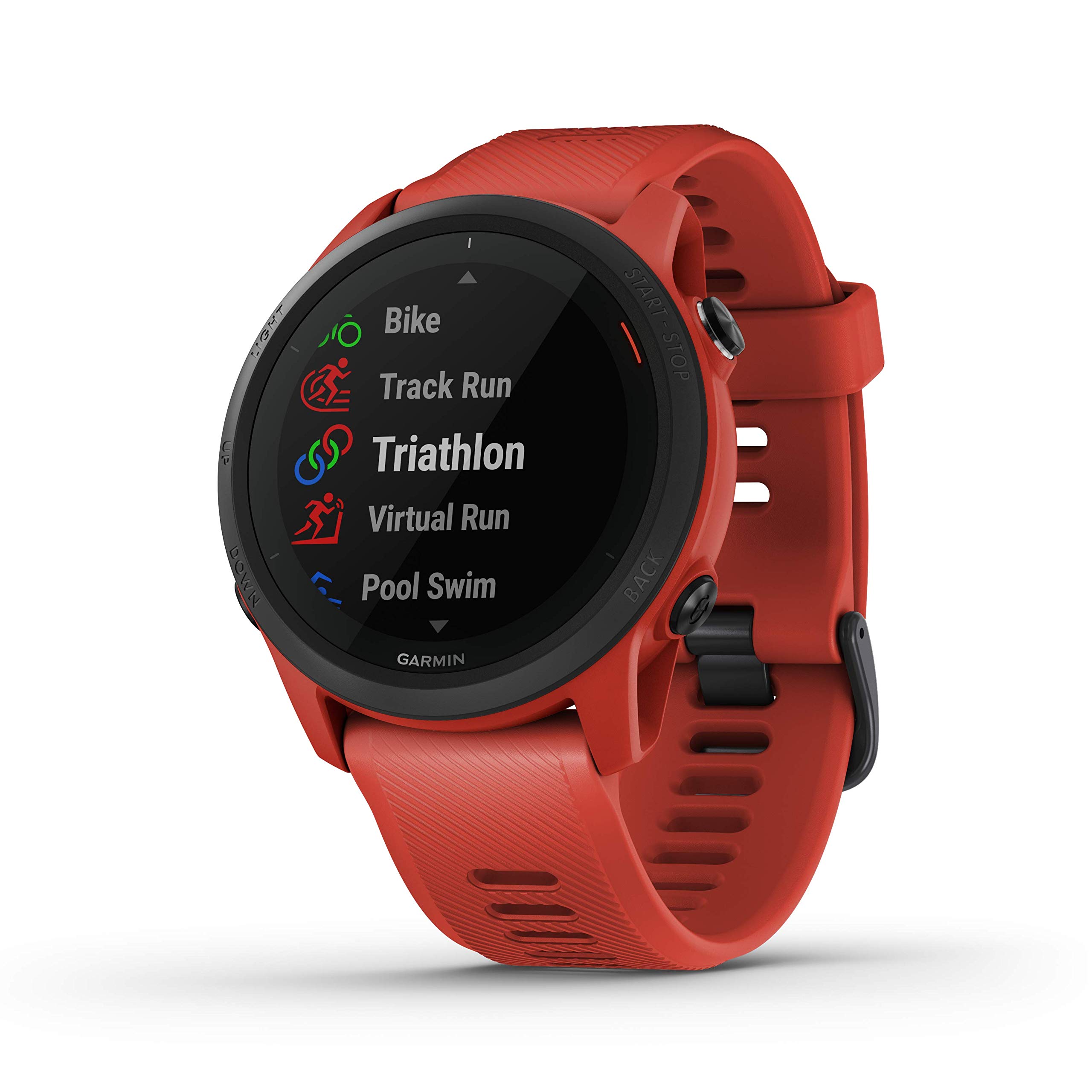
The Forerunner 745 is the smaller, lighter alternative to Garmin’s 2020-era Forerunner 945 flagship: 43.8mm instead of 47mm, full triathlon and training features, and a $100 cheaper launch price. Five years on, it still fits more wrists than the 47mm 955, and the Magma Red is one of Garmin’s more striking finishes for a running watch. The honest disclosure: this is a 2020 platform, and Garmin appears to have wound down major firmware updates for it. The last release was December 2024, while Garmin’s current running flagships (Forerunner 955, 965, 970) have all received active updates throughout 2025. On sale, the 745 is a genuine value buy for premium running features in a smaller case. If you want a watch that’ll keep getting Garmin’s newer training algorithms for the next several years, the Forerunner 265S is the better long-term pick.
When this beats the Forerunner 265S (#2 Mid): when you find it discounted and want triathlon features (brick mode, multisport switching) on a smaller wrist. When the 265S wins (most cases): newer platform that’s still getting active firmware updates, AMOLED display, and $50 less.
Full reviews, mid tier ($250 to $400)
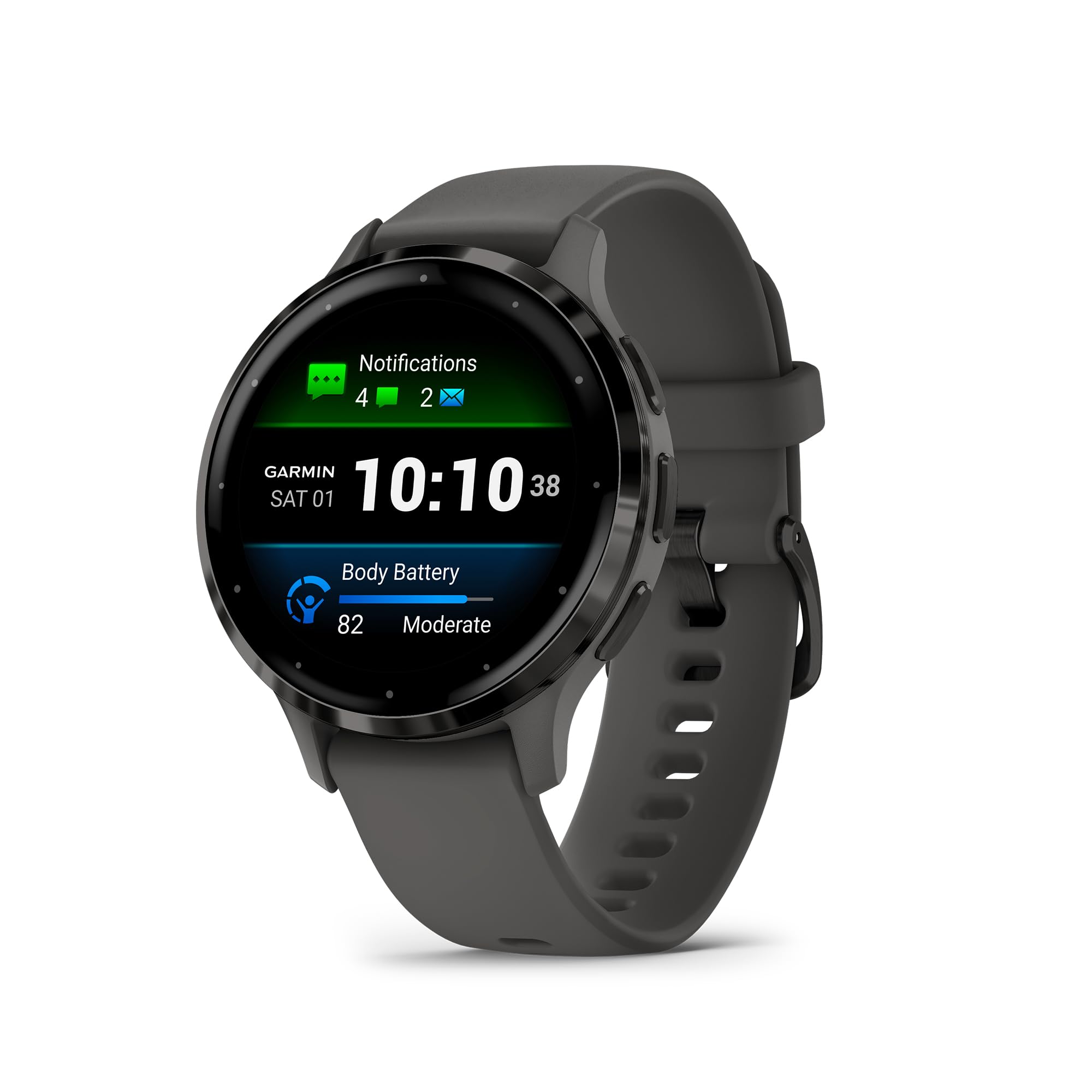
- 41mm case is genuinely sized for smaller wrists, no overhang or chunky feel
- AMOLED touchscreen is bright, vivid, responsive, and easy to read in any light
- Stainless steel bezel makes this look like a real watch, not a fitness tracker
- Full Garmin Connect women’s health: menstrual cycle, pregnancy mode, sleep, stress, body battery
- Phone-call support via paired phone (Bluetooth)
- Wears with anything from gym clothes to a dress without looking out of place
- Lifestyle focus means less running-specific depth than the Forerunner 265S
- Single-band GPS, less accurate under heavy canopy than multi-band
- $374 is real money compared to the Venu Sq at $239.98
- Always-on AMOLED roughly halves the 11-day battery rating
The Venu 3S has been on my wife’s wrist for over a year now, which is the real review. The 41mm case is genuinely sized for smaller wrists, and the stainless steel bezel pulls the watch out of fitness-tracker territory into something you’d wear with a dress. The AMOLED is sharp, the touchscreen is responsive, and the menstrual cycle and sleep tracking just work in the background without nagging. What you should actually know: keep always-on display off and the 11-day battery rating holds; turn it on and you’re charging closer to every 5 days. Phone-call support through paired Bluetooth is the underrated feature, the kind of thing you won’t think you need until you have it.
When this beats the Forerunner 265S (#2 Mid): when lifestyle priorities (premium materials, phone calls, broader health metrics) matter more than running-specific training depth. When the 265S wins: when you’re a serious runner who wants race predictor and training readiness. For most women buyers who don’t run competitively, the Venu 3S is the right answer.

- 41mm case is the only AMOLED running flagship in this size
- Same advanced training metrics as the full-size Forerunner 265 in a smaller case
- Training readiness algorithm tells you when to push hard vs recover
- Race predictor estimates 5K through marathon times based on recent training
- Light Pink reads more rose-blush than candy-pink in person
- 15-day battery is impressive for an AMOLED watch
- Running-specific focus means less broad health metric depth than Venu 3S
- Single-band GPS, not multi-band
- No phone-call support (Forerunner line generally doesn’t include this)
- Plastic body construction (vs Venu 3S stainless steel bezel)
I’ve put the Forerunner 265S Light Pink through real training cycles: half-marathon prep, recovery weeks, base mileage. The training readiness algorithm is the standout. It gives you a 1-100 score each morning based on your sleep, recovery, training load, and HRV, and after a few weeks of data, it’s accurate enough to actually trust. The Light Pink is more rose-blush than candy-pink in person, which sells better in real life than the Amazon photos suggest. 41mm AMOLED on a smaller wrist is the right combination, and at $349.99, this is the only AMOLED running flagship Garmin makes in a 41mm case.
When this beats the Venu 3S (#1 Mid): when you’re primarily a runner who wants training-load analysis. When the Venu 3S wins: when lifestyle wear and broader health metrics matter more than running specificity.
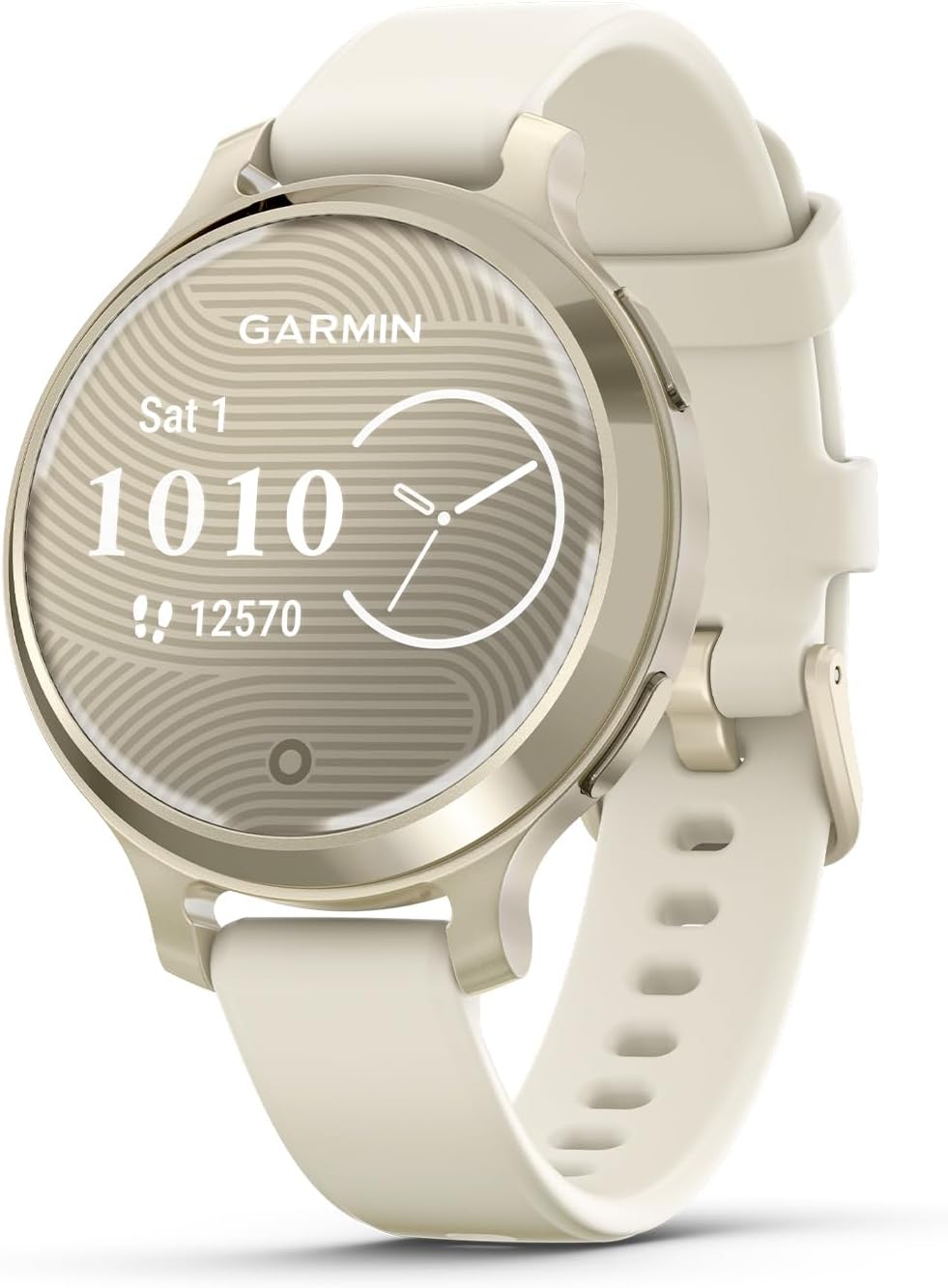
- The only Garmin in this lineup actually designed and marketed specifically for women
- Etched patterned bezel makes the watch look like jewelry when the display is off
- 38mm case at 29 grams is the lightest, smallest GPS Garmin available
- Built-in GPS finally lets you leave your phone at home, the original Lily’s biggest gap
- 9-day battery rating holds up in practice; once-a-week charge cycle, not every other day
- Step counting and sleep tracking accuracy match more expensive Forerunner models
- Full Garmin Connect women’s health: menstrual cycle, pregnancy, Body Battery, HRV Status
- Monochrome LCD display, not the vivid AMOLED of the Venu 3S or Forerunner 265S
- No always-on display option (you have to raise your wrist or tap to see the time)
- Smaller 1-inch display constrains how much workout data shows at once
- Bluetooth pairing can be inconsistent with iPhones, the most common gripe with this watch
- Limited watch face customization compared to other Garmin lines
The Lily 2 Active is the only watch on this page that Garmin actually designs and markets specifically for women, and the version that finally fixes the Lily line’s central problem: no built-in GPS. At 38mm with an etched metal bezel that genuinely looks like jewelry when the display is off, this is the lightest, smallest GPS Garmin available. The trade-offs versus the Forerunner 265S or Venu 3S are real: the LCD display is monochrome instead of AMOLED, there’s no always-on display option, and the smaller 1-inch screen limits workout data density. What you get instead is genuine wearability, the kind of watch you’d put on for a wedding or a work meeting without thinking twice. Body Battery, HRV Status, Sleep Score, women’s health tracking, and Garmin Coach adaptive training plans are all included.
The 9-day battery rating means a once-a-week charge cycle rather than every other day. Step counting and sleep tracking are as accurate as the higher-end Forerunner picks, since the same scoring engine runs underneath. The honest caveat: Bluetooth pairing can be inconsistent with iPhones, which is the most common gripe with this watch. Once paired, day-to-day reliability is solid, but the initial setup is fussier than it should be.
When this beats the Venu 3S Slate (#1 Mid): when fashion-forward jewelry-style design matters more than AMOLED brightness and broader fitness depth, plus you save $124. When the Venu 3S wins: when you want a sharper display and more comprehensive fitness tracking in a watch that still passes for daily wear.
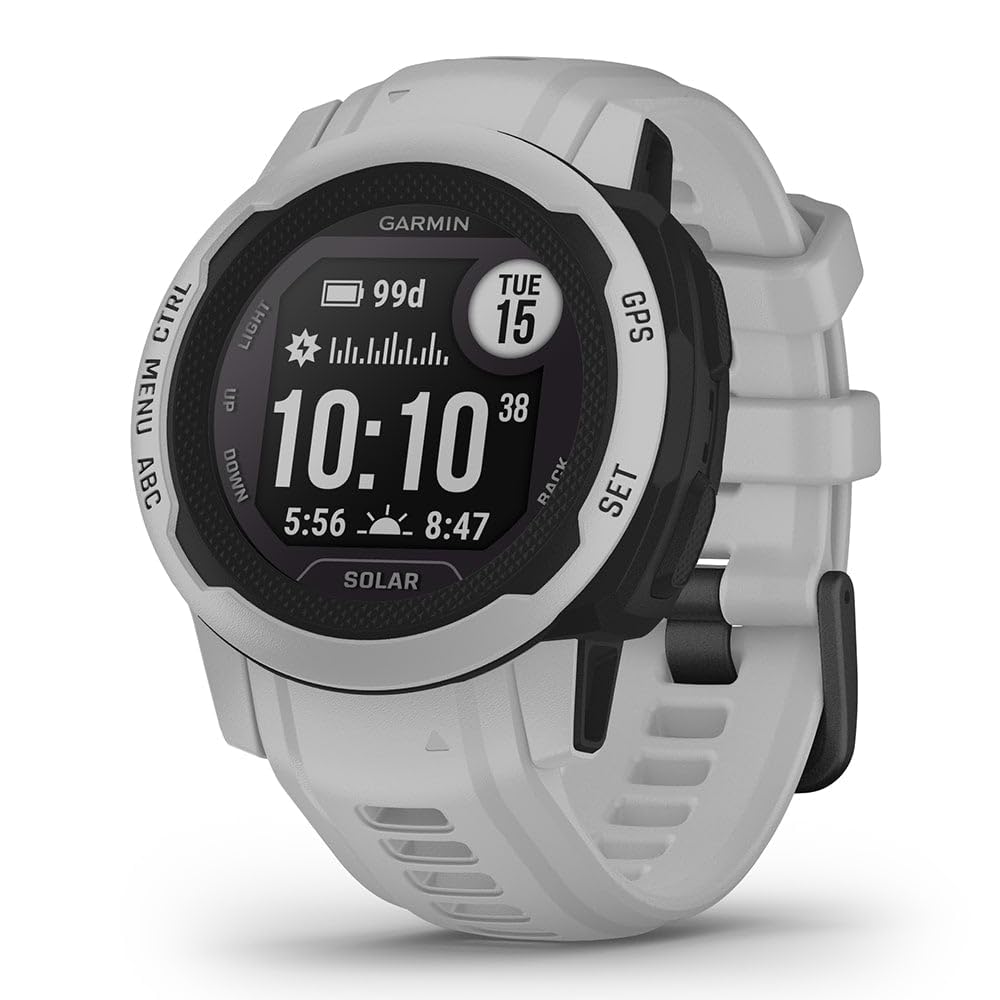
- 40mm case is genuinely small, fits smaller wrists comfortably
- Multi-band GNSS handles dense canopy and challenging environments accurately
- Solar charging extends battery life in direct sunlight
- Rugged construction handles rain, dust, and impacts better than AMOLED competitors
- Button controls work with gloves and wet conditions, no touchscreen frustration
- Smaller battery cell than the full-size Instinct 2 (21 vs 28 days smartwatch)
- No training readiness or race predictor (those are Forerunner-line features)
- MIP black-and-white display feels dated next to AMOLED options
- No music storage, no phone-call support
The Instinct 2S Solar is the watch I’d hand someone with a smaller wrist who wants a rugged outdoor Garmin. 40mm is the smallest rugged case Garmin makes, the multi-band GNSS handles dense canopy meaningfully better than single-band, and solar charging adds real battery life on long trips. The honest caveat: the smaller battery cell cuts smartwatch life to 21 days versus the full-size Instinct 2’s 28, and you give up the training readiness and race predictor algorithms that come with the Forerunner picks at this price. If you specifically need rugged + small + solar, nothing else comes close. If any of those three boxes don’t apply, the Forerunner 265S or Venu 3S are better options at similar prices.
When this beats the Venu 3S (#1 Mid): when you need rugged construction, multi-band GPS, and solar charging for outdoor use. When the Venu 3S wins: when lifestyle wear and AMOLED display matter more than ruggedness.

- Onboard music storage means you can leave your phone at home on runs
- Spotify, Amazon Music, and Deezer offline playlists all supported
- 42mm case fits smaller wrists better than 47mm flagships
- Advanced training dynamics: running power, ground contact, vertical oscillation
- 2019 platform; the last major firmware update was December 2024 and Garmin appears to have wound down active development for this watch alongside the FR 745 and FR 945
- 7-day smartwatch battery is shorter than newer Forerunners
- No multi-band GPS, single-band only
- No AMOLED display (MIP color)
The Forerunner 245 Music is the phone-free running watch in this lineup. Onboard music storage means you can leave your phone at home, pair Bluetooth headphones, and run for hours without thinking about a phone armband. Spotify, Amazon Music, and Deezer offline playlists all work. The honest disclosure: this is a 2019 platform, and the last major firmware update was December 2024, alongside the Forerunner 745 and 945. Garmin’s current AMOLED Forerunners are still getting active development; this one is not. If you specifically want music storage at $70 less than the Forerunner 255 Music, the 245 still earns its place. If you want a watch that’ll keep getting Garmin’s newer training algorithms over the next several years, look at the Forerunner 265S instead.
When this beats the Forerunner 265S (#2 Mid): when you want onboard music storage at $50 less. When the 265S wins: when AMOLED display, training readiness, and a smaller 41mm case matter more than music storage.
Full reviews, entry tier (under $250)
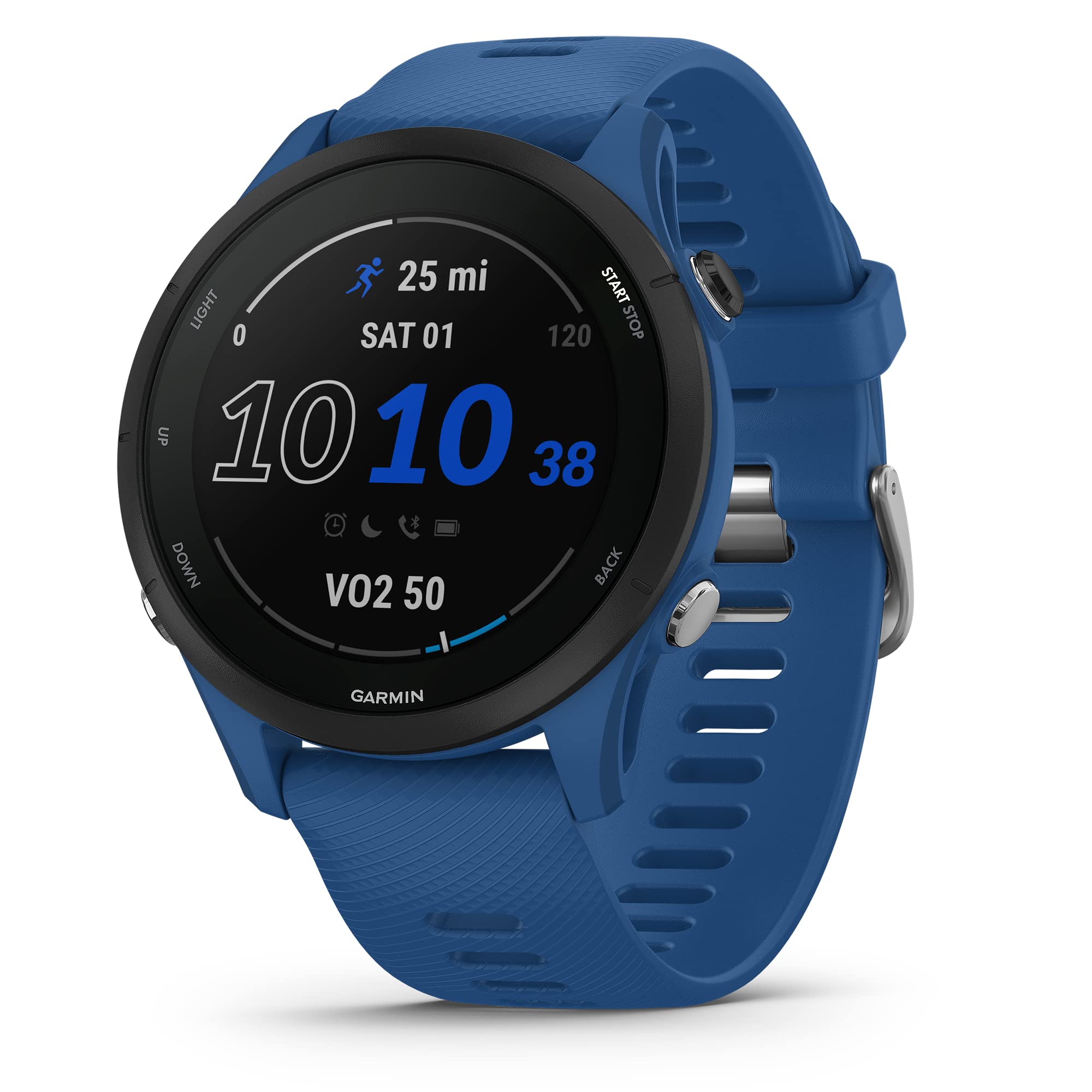
- Pulse Ox and Body Battery sensors carry over from premium Forerunners
- Training readiness, race predictor, and recovery insights at entry pricing
- 14-day smartwatch battery is among the longest in the running category
- Multi-sport tracking includes triathlon, cycling, swimming
- Tidal Blue is a real teal, not the navy you might expect from product photos
- 45.6mm case will overhang on wrists under 6.5 inches
- MIP display is less vibrant than AMOLED Forerunner 265S
- Single-band GPS, not multi-band
- No music storage on this base variant (the 255 Music adds music for $370)
The Forerunner 255 Tidal Blue is the best running watch under $250, period. Same training readiness and race predictor algorithms that usually live in $400+ flagships, 14-day smartwatch battery that beats most premium Forerunners, all at sub-$250. The honest caveat for this page: at 45.6mm, this case is medium-large, not small. If your wrist is under 6.5 inches it’ll feel chunky. If you fit a 45mm men’s watch comfortably, the 255 is a steal at $248. The Tidal Blue is a real teal, not the navy-blue you might expect from product photos.
When this beats the Forerunner 265S (#2 Mid): when you save $100 and don’t need AMOLED or a 41mm case. When the 265S wins: when the 41mm size matters more than savings.
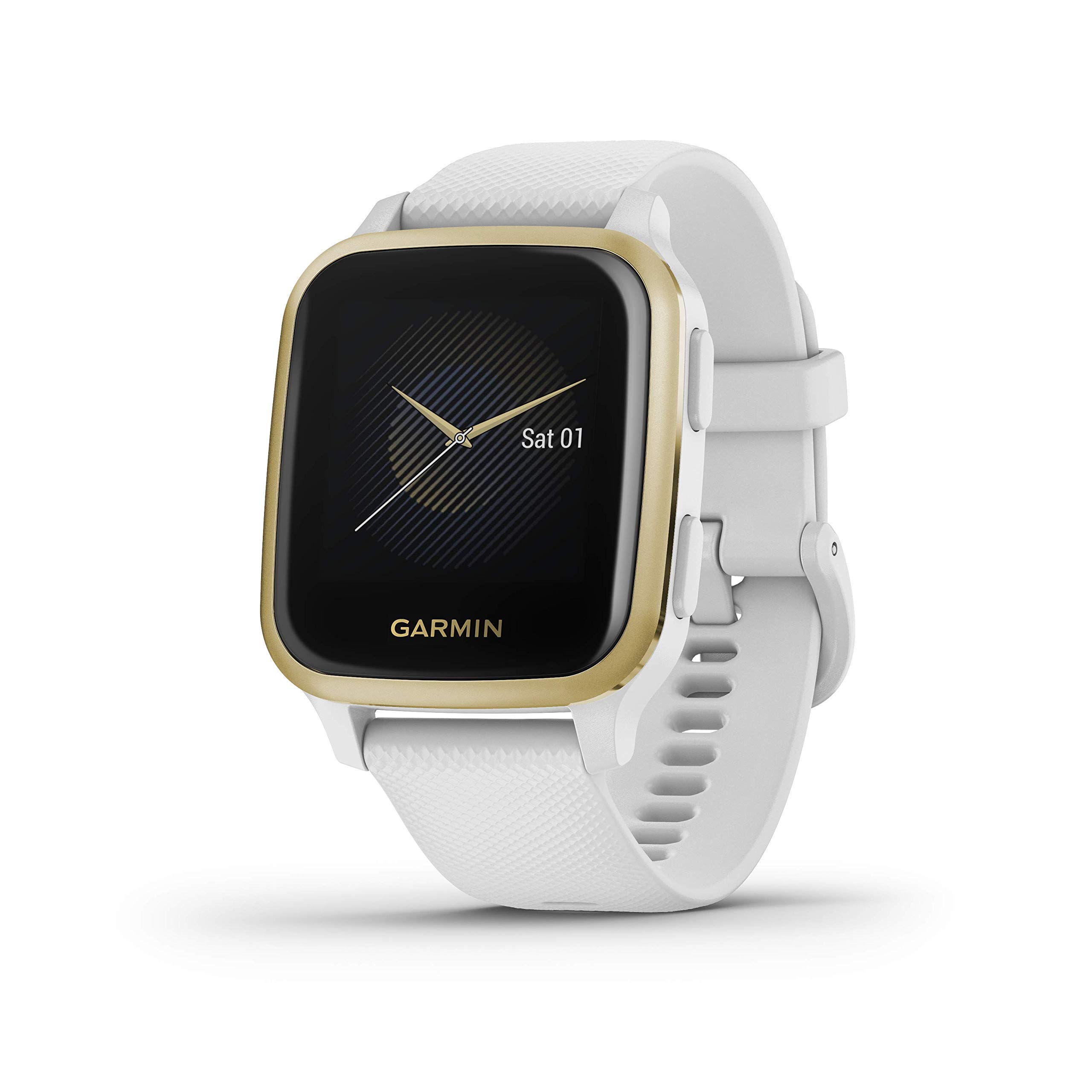
- 40x37mm rectangular case is the only non-round Garmin in current production
- Light Gold and White finish reads more rose-gold than yellow-gold in person
- Rectangular case sits flatter on the wrist than any round watch
- Bright LCD touchscreen is responsive and easy to read
- Full Garmin Connect health metrics including women’s cycle tracking
- LCD display is less vibrant than AMOLED Venu 3S
- 6-day battery is shorter than longer-battery Forerunners
- 2020 platform that’s no longer in Garmin’s active update cycle (Garmin focuses development on the Venu 3 and Venu Sq 2)
- GPS is single-band only
The Venu Sq is the rebel of this lineup: the only rectangular case Garmin currently makes, with a 40x37mm footprint that sits flatter on the wrist than any round watch. The Light Gold and White finish reads more rose-gold than yellow-gold in person. The catches: this is a 2020 platform with an LCD touchscreen (not AMOLED), 6-day battery (shorter than longer-battery Forerunners), and single-band GPS. For a fashion-first rectangular smartwatch under $250, those trade-offs are worth it. For training depth or AMOLED brightness, look elsewhere.
When this beats the Forerunner 255 Tidal Blue (#1 Entry): when you want lifestyle styling and the smallest possible case. When the 255 wins: when running metrics matter more than aesthetics.
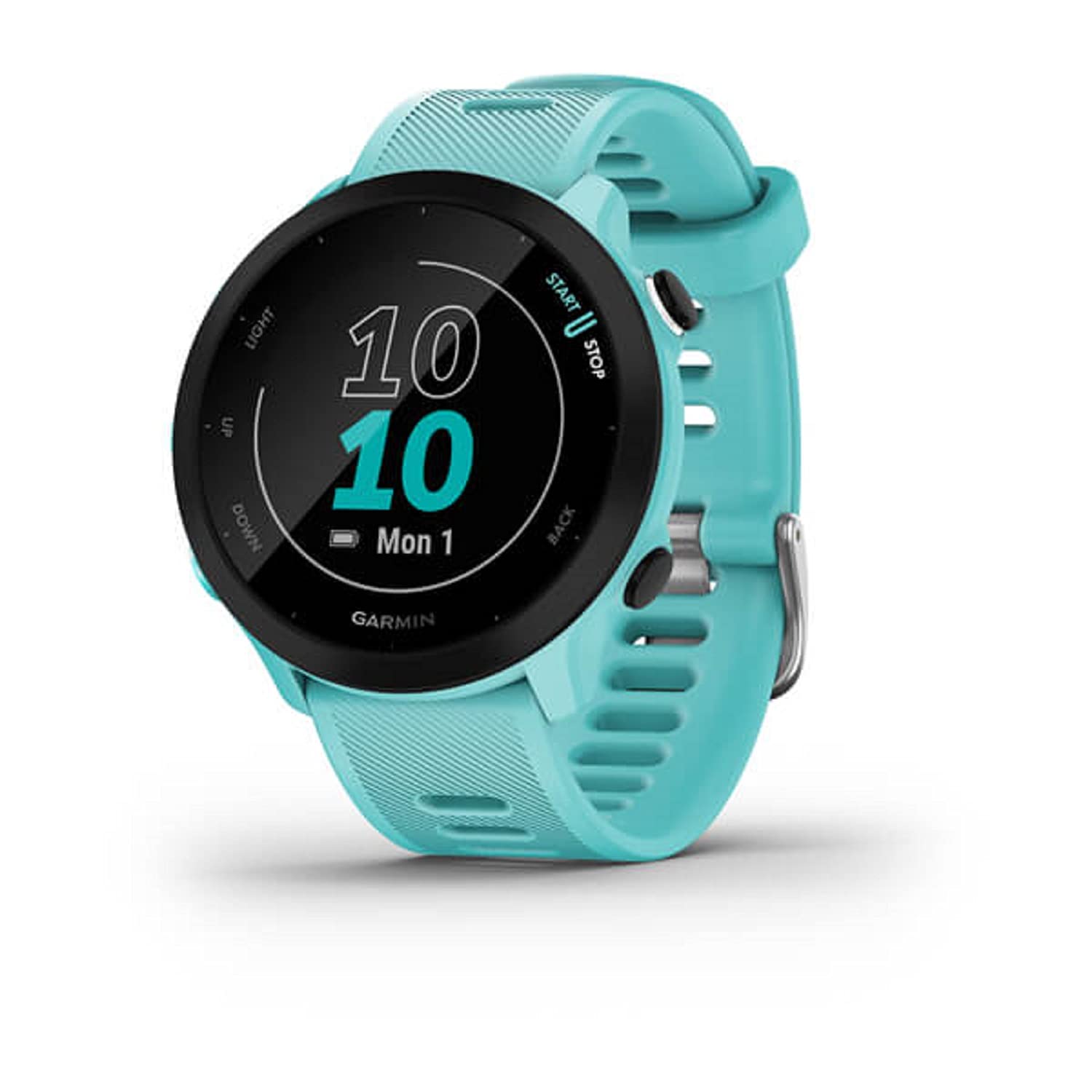
- Cheapest Garmin GPS watch currently sold, $70+ less than the next-cheapest entry pick
- 2-week smartwatch battery is the longest in the entry tier
- Daily suggested workouts feature is genuinely useful for new runners
- Aqua is a soft turquoise that wears as a daily watch, not just gym duty
- Garmin Coach adaptive training plans included free, no subscription
- Black-and-white MIP display feels dated next to AMOLED options
- No advanced training metrics like training readiness or race predictor
- Single-band GPS, not multi-band
- No music storage; phone-free music runs require the Forerunner 245 Music or 255 Music
$169 is the cheapest Garmin GPS watch sold, and the Forerunner 55 Aqua is what you actually get for that money: a real Garmin running watch with daily suggested workouts, full GPS tracking, and a 2-week battery that’s longer than any AMOLED watch on this page. What you give up: AMOLED display (this is black-and-white MIP), advanced training metrics (no training readiness, no race predictor), and multi-band GPS. For a beginner runner, none of that matters. The 55 tracks runs accurately, charges every 14 days, and shows you’re improving over time. The Aqua color is a soft turquoise that wears well as a daily watch, not just gym duty.
When this beats the Venu Sq (#2 Entry): when you want a longer battery, a lower price, and a real running watch instead of a lifestyle smartwatch. When the Venu Sq wins: when lifestyle styling and AMOLED-adjacent looks matter more than battery and training depth.
Comparison table
| Watch | Tier | Case | Display | Rating | Reviews | Price |
|---|---|---|---|---|---|---|
| Venu 4 41mm Lunar Gold | Premium | 41mm | AMOLED | 4.6 | 1,042 | $549.99 |
| Forerunner 570 42mm Raspberry | Premium | 42mm | AMOLED | 4.6 | 287 | $549.99 |
| Forerunner 955 Whitestone | Premium | 47mm | MIP color | 4.6 | 1,093 | $459.99 |
| epix Gen 2 | Premium | 47mm | AMOLED | 4.6 | 1,196 | $448.99 |
| Forerunner 745 Magma Red | Premium | 43.8mm | MIP color | 4.6 | 921 | $399.99 |
| Venu 3S Slate | Mid | 41mm | AMOLED | 4.5 | 6,036 | $374.00 |
| Forerunner 265S Light Pink | Mid | 41mm | AMOLED | 4.7 | 2,644 | $349.99 |
| Lily 2 Active | Mid | 38mm | LCD mono | 4.6 | 644 | $249.99 |
| Instinct 2S Solar | Mid | 40mm | MIP+Solar | 4.2 | 100 | $320.30 |
| Forerunner 245 Music | Mid | 42mm | MIP color | 4.6 | 5,073 | $299.99 |
| Forerunner 255 Tidal Blue | Entry | 45.6mm | MIP color | 4.7 | 4,033 | $248.00 |
| Venu Sq Light Gold | Entry | 40x37mm | LCD touch | 4.4 | 7,842 | $239.98 |
| Forerunner 55 Aqua | Entry | 42mm | MIP B&W | 4.5 | 5,791 | $169.00 |
Why we didn’t include other Garmins
Garmin’s catalog includes 30+ watches. The 13 above are our best Garmin watches for women picks across price tiers and use cases. A few you might expect to see, and why they didn’t make the cut:
Forerunner 970: Garmin’s current top running flagship, released December 2025 at $749.99. Built-in mapping, an LED flashlight, titanium bezel, sapphire crystal, and the brightest AMOLED in any Forerunner. The reason it’s not on the main list is straightforward: it’s only available in 47mm. There’s no smaller variant. For most women’s wrists, the 47mm case overhangs in a way that makes the watch uncomfortable for daily wear. If you have a 7+ inch wrist or you specifically want the absolute newest Forerunner with mapping, it’s an excellent watch. The Forerunner 570 42mm is the smaller-case alternative with most of the same features minus mapping and flashlight at $200 less.
Venu 4 45mm: Same watch as our #1 Premium pick, just in the larger 45mm case. 12-day battery instead of 10, slightly larger 1.4-inch AMOLED screen. The 45mm version fits 7+ inch wrists comfortably. For smaller wrists, the 41mm Venu 4 is the better pick.
Forerunner 165: Newer than the 245, AMOLED display, but at 43mm it’s slightly larger than the Forerunner 265S and lacks the 265S’s training readiness algorithm. Decent watch, but the 265S is the better pick for women specifically because of the 41mm “S” case.
Forerunner 965: The full-size 965 is excellent but at 47mm and $599, it’s outside what most women shopping for “their” Garmin actually want. The 265S delivers the same training algorithms in a 41mm AMOLED case at $250 less.
Vivomove Trend and the Vivomove line: Hybrid analog/digital watches with a more traditional aesthetic. Genuinely beautiful watches, but the small digital display below the analog hands is too limited for serious training data and lacks the AMOLED experience of the Venu 3S.
Fenix 7S: The “S” version of Garmin’s adventure flagship at 42mm is a real option for women hikers, but it starts at $699 and overlaps heavily with the cheaper Instinct 2S Solar for outdoor use. We covered the full Fenix line on our best Garmin watch for hiking page; for most women buyers, the Instinct 2S Solar at $320.30 is the better value.
How to choose the best Garmin watch for women
Garmin watch terms, decoded
- AMOLED display
- A self-lit screen where each pixel produces its own light, resulting in deep blacks, vivid colors, and high brightness. Visible from any angle and very readable in low light, but drains battery faster than MIP. Used in: Venu 3S, Forerunner 265S, epix Gen 2.
- MIP display (Memory-in-Pixel)
- A reflective screen that uses ambient light to display data. Looks dimmer indoors than AMOLED, but is sharper and more readable in direct sunlight. Battery-efficient. Used in: Forerunner 955, 745, 245, 255, 55.
- Multi-band GNSS
- GPS that listens to two satellite frequencies simultaneously, holding tracks accurately under tree cover and around tall buildings. Single-band watches drift in those conditions. Multi-band watches on this page: Forerunner 955, epix Gen 2, Instinct 2S Solar.
- Training readiness
- A 1 to 100 score Garmin calculates each morning from your sleep, recovery, training load, and HRV (heart rate variability). It tells you whether your body is actually ready for a hard workout. Available on: Forerunner 265S, 255, 955, 745.
- Race predictor
- Estimates your finish times for 5K, 10K, half-marathon, and marathon distances based on recent training data. Updates as you train. Available on: Forerunner 265S, 255, 955.
- The “S” suffix
- Garmin’s “S” models (Venu 3S, Forerunner 265S, Instinct 2S, Fenix 7S) have smaller cases (40-41mm) designed for smaller wrists. Same hardware and software as the larger non-S versions, just sized down. Battery life is sometimes shorter due to the smaller battery cell.
- Garmin Connect
- The companion app where all your watch data lives. Free, no subscription required. Includes menstrual cycle tracking, pregnancy mode, sleep analysis, stress monitoring, body battery score, and training analytics. Works with every current Garmin watch.
- Body battery
- A 0 to 100 daily energy score Garmin calculates from heart rate variability, sleep, stress, and activity. Goes up with rest, down with exertion. Useful as a “should I push it today” gut-check.
- Garmin Pay
- Contactless payments from your watch using a stored credit or debit card. Works at any payment terminal that accepts contactless. Available on most current Forerunners, Venu, fēnix, and epix watches; not on the Forerunner 55 or Forerunner 245.
- Connect IQ
- Garmin’s app and watch face store. Free and paid options for custom watch faces, data fields during workouts, and third-party app integrations like Strava and Komoot. Works with all watches on this page.
Frequently asked questions
More tech guides
Browse all gear
