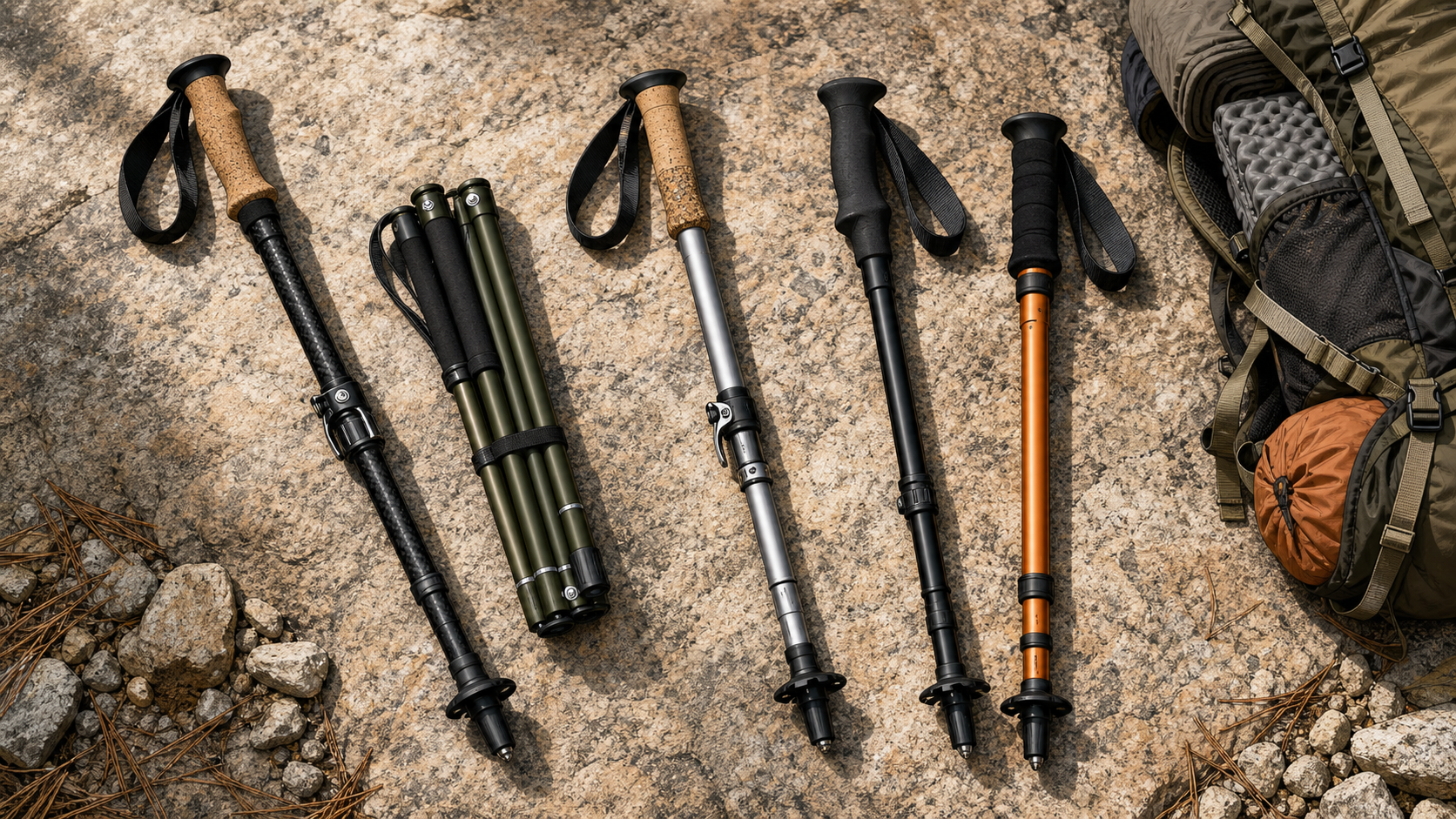
Best Trekking Poles for Backpacking 2026
Backpacking poles face demands that day hiking poles do not. A 40-pound pack puts more force through the shaft and lock on every descent plant. Multi-day trips accumulate hand sweat across cork or foam grips. Routes mix technical terrain with established trails where material choice becomes a safety consideration. This roundup covers 9 picks across three sections: ultralight and carbon for gram-counting hikers, heavy-duty aluminum for maximum load reliability, and budget picks for first backpacking pairs.
For day hiking poles see best trekking poles. For technique guidance see how to use trekking poles.
Quick picks



Full reviews of the best trekking poles for backpacking
Best ultralight and carbon backpacking poles
Carbon fiber saves meaningful weight on multi-day backpacking trips where the difference compounds across days. The three picks span premium cork-grip carbon, the lightest folding option, and the most affordable carbon entry in this roundup.
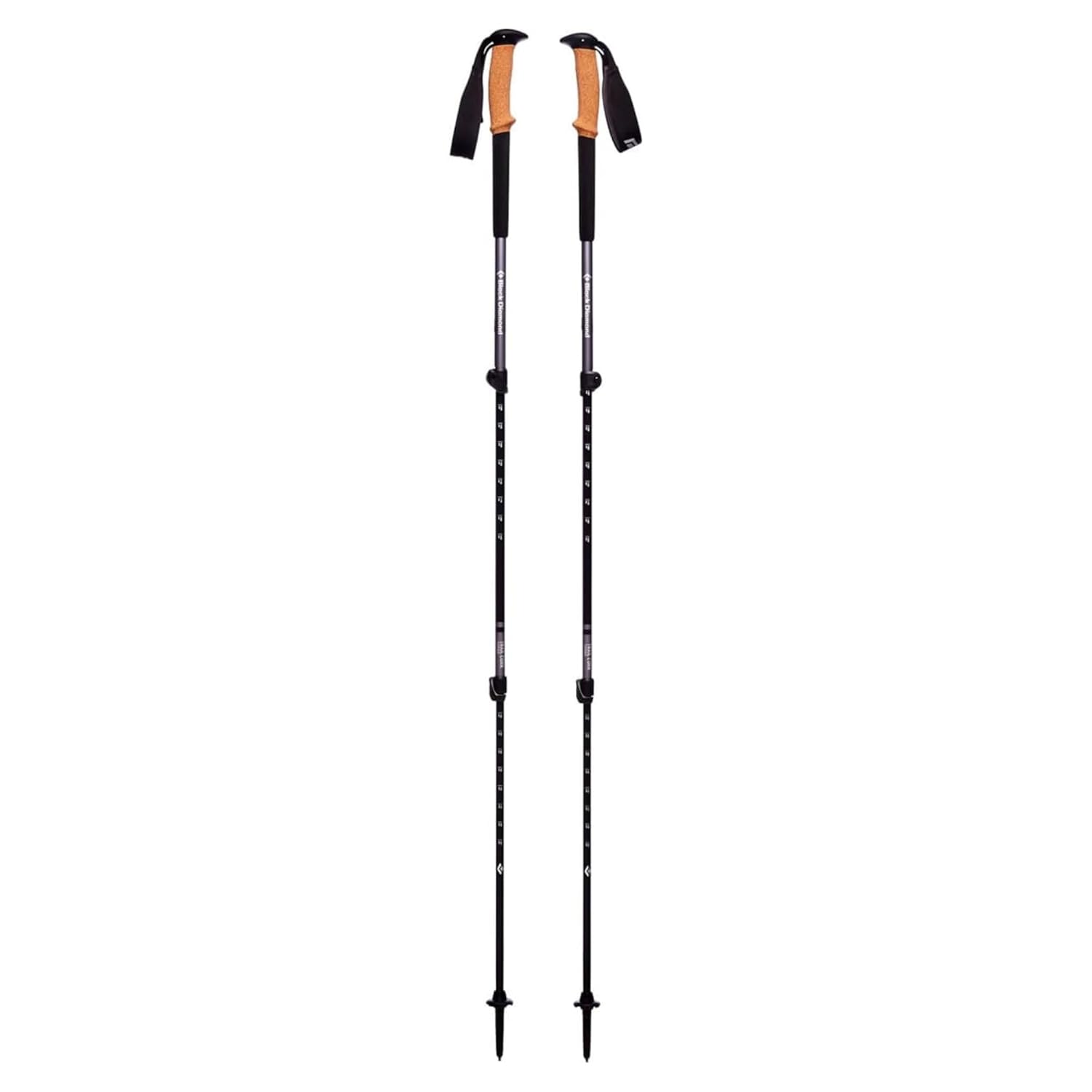
Black Diamond Alpine Carbon Cork Trekking Poles
- Carbon fiber saves meaningful weight over aluminum on multi-day trips
- Natural cork grip absorbs sweat and shapes to the hand over time
- Flicklock Pro lever lock carries over from the benchmark Trail poles
- 5,200+ total reviews across variants validates years of backcountry use
- Carbon damping reduces vibration impact over long miles with a loaded pack
- Carbon shatters under lateral impact rather than bending like aluminum
- Highest price in this roundup reflects carbon and cork construction
- Not the right choice for rocky technical terrain with frequent pole-rock contact
The Black Diamond Alpine Carbon Cork is the premium backpacking pole for hikers who have broken in a first pair of aluminum poles and are ready to invest in weight reduction for multi-day trips. Carbon fiber at this length saves meaningful weight over aluminum – a difference felt most on day three of a five-day trip when cumulative fatigue compounds. Natural cork grip is the other material upgrade: cork absorbs hand sweat rather than becoming waterlogged like foam on hot summer backpacking days.
The Flicklock Pro lever lock carries over from Black Diamond’s standard Trail poles, which means the same cam-based reliability that holds length under sustained downhill load with a light day pack also holds under a 40-pound backpacking load. Carbon’s failure mode – shattering rather than bending under lateral impact – means this pole is best suited to established trail backpacking rather than rocky technical terrain where pole-rock contact is frequent.
Who this is for: experienced backpackers who regularly carry heavy loads for multiple days and are ready to pay the carbon premium for weight savings. The right upgrade from aluminum poles for hikers who know they will use poles heavily for years. For rocky or technical terrain, the LEKI Makalu Lite or BD Trail aluminum poles are safer choices.
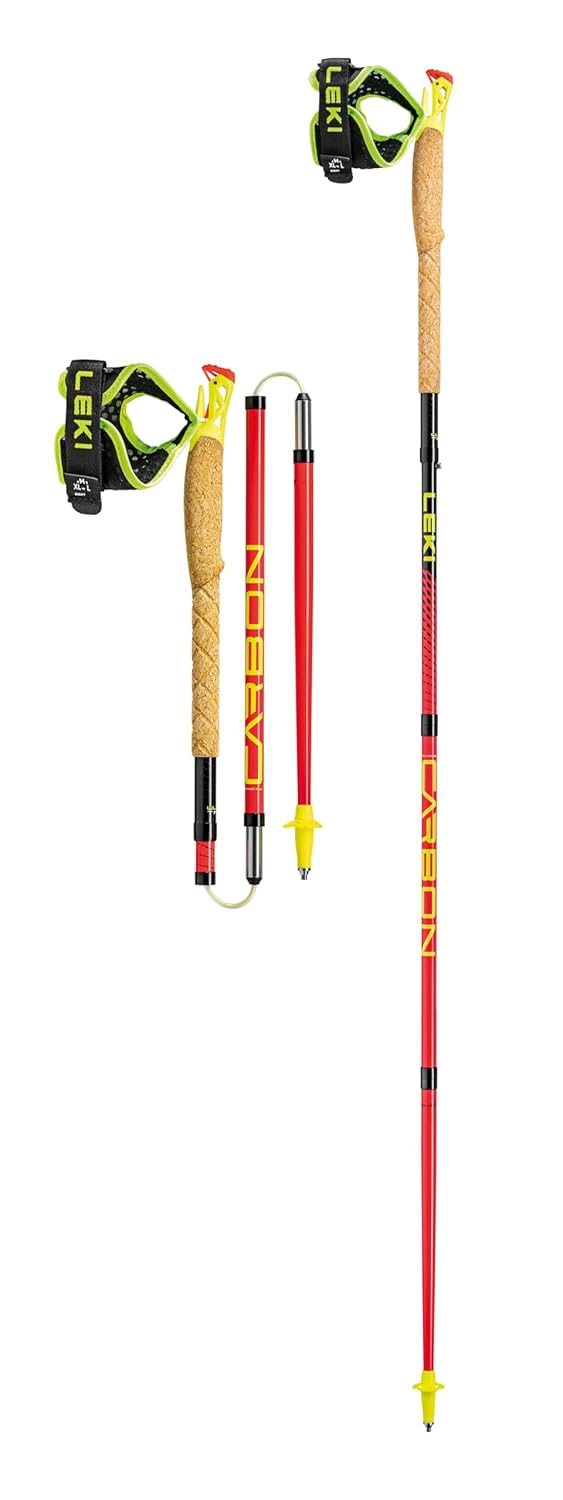
LEKI Ultratrail FX.One Trekking Poles
- 4.8 stars, highest rating in this roundup
- Sub-200g per pole, lightest option for gram-counting backpackers
- Z-fold packs to approximately 13 to 15 inches for pack attachment or shelter staking
- Aergon Air ventilated grip manages sweat at high output
- LEKI German manufacturing standards in a backpacking-specific folding design
- Fixed length means committing to one setting for the full trip
- Premium price reflects carbon folding construction
- Carbon failure mode same as all carbon poles on rocky terrain
The LEKI Ultratrail FX.One is the highest-rated pole in this roundup at 4.8 stars and the right choice for fastpackers and ultralight backpackers who want the lightest possible pole with the fastest deployment. At sub-200g per pole it is meaningfully lighter than aluminum options and lighter than most carbon telescoping alternatives. The Z-fold mechanism collapses to 13 to 15 inches – short enough to attach to a hipbelt pocket on a loaded pack or slide into the side pocket of an ultralight frameless pack.
The Z-fold design means fixed length, which requires selecting the correct pole length at purchase rather than adjusting mid-trip. For backpackers who set length before a trip and leave it there, this is not a limitation. For hikers who regularly adjust between flat, climb, and descent, a telescoping adjustable pole covers more situations. The Aergon Air ventilated grip manages sweat better at the high output of fastpacking than standard foam.
Who this is for: fastpackers and ultralight backpackers who count grams and want the lightest, most packable pole in this roundup. The correct choice when pack weight is the primary optimization target. For backpackers who prefer adjustable length on varied terrain, the BD Alpine Carbon Cork or LEKI Makalu Lite cover similar mileage demands with telescoping adjustment.
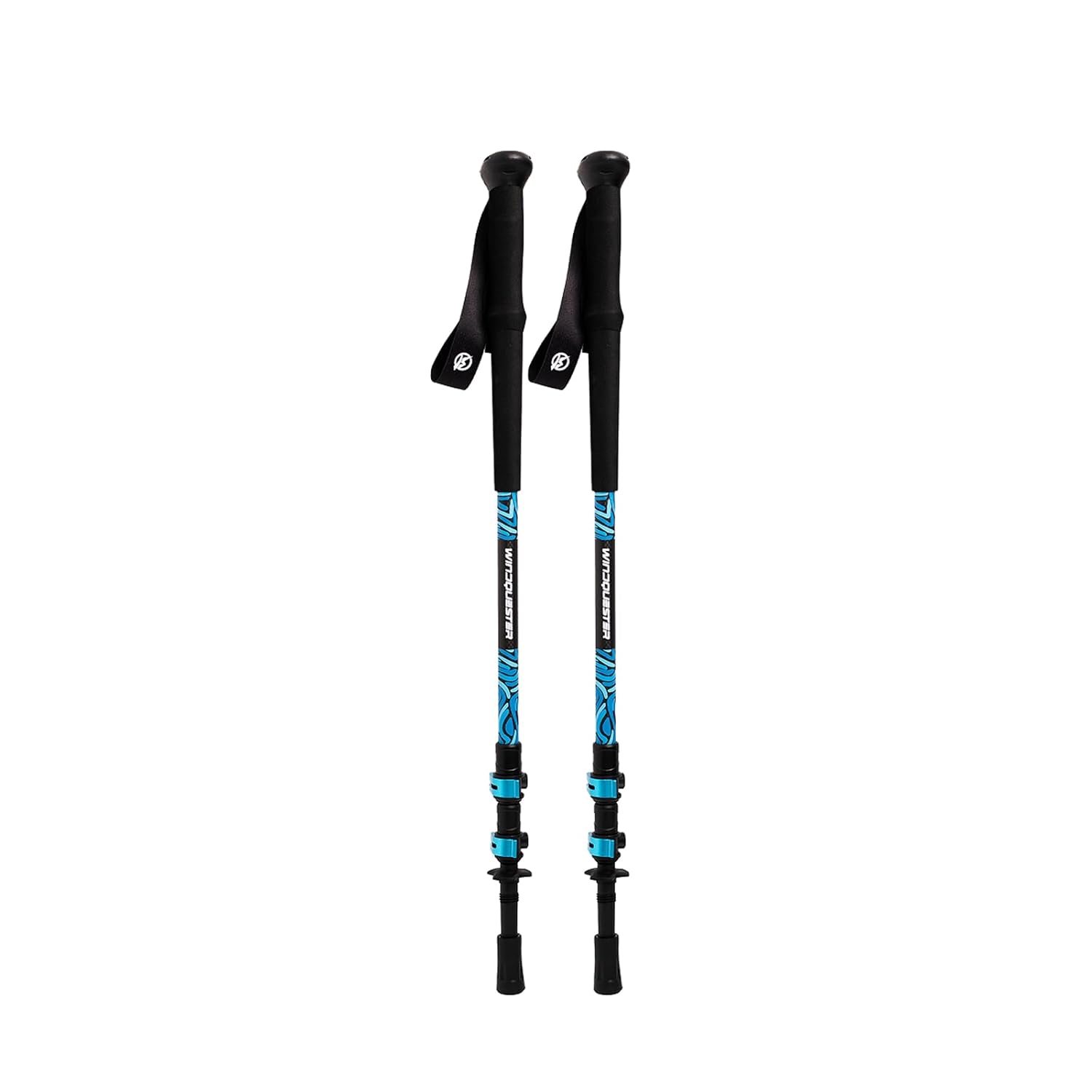
Windquester Strider X Carbon Fiber Trekking Poles
- Carbon fiber at under $90 is the lowest carbon price in this roundup
- 4.8 stars matches the LEKI Ultratrail FX.One for top rating
- Lever lock mechanism rather than twist lock for length reliability
- Significant weight savings over aluminum budget poles at similar price
- Good entry point to carbon backpacking poles without premium investment
- Only 18 reviews as a newer product – less validation than established picks
- Windquester is a newer brand without the track record of BD or LEKI
- Carbon failure mode the same as premium carbon poles on rocky terrain
The Windquester Strider X is the most affordable carbon fiber option in this roundup and carries the same 4.8-star rating as the LEKI Ultratrail FX.One at $130 less. At $89.99 it brings carbon fiber swing weight reduction to a price point where most backpackers are choosing aluminum. The lever lock rather than twist lock is the critical feature at this price: most carbon poles at under $100 use twist locks that unwind under sustained downhill load.
The 18-review count is the main caveat. As a newer product, there is less validation across diverse backpacking conditions than the BD and LEKI poles in this roundup. The 4.8-star average is strong, but a small sample means less visibility into edge-case performance on extended trips in variable conditions. For backpackers willing to try a newer brand for meaningful cost savings, this is the most compelling budget carbon option currently available.
Who this is for: backpackers who want carbon fiber weight savings at the lowest possible price and are comfortable with a newer brand at a limited review count. The right pick when budget is the primary constraint and carbon is preferred over aluminum. For backpackers who want established brand backing and more extensive validation, the BD Alpine Carbon Cork at $239.95 is the proven alternative.
Best aluminum trekking poles for heavy loads
Aluminum bends under lateral impact rather than shattering, which is the relevant failure mode when a pole contacts rock with a heavy pack behind it. The three picks cover the aluminum backpacking benchmark, Black Diamond’s Flicklock reliability, and the lightest LEKI aluminum option.
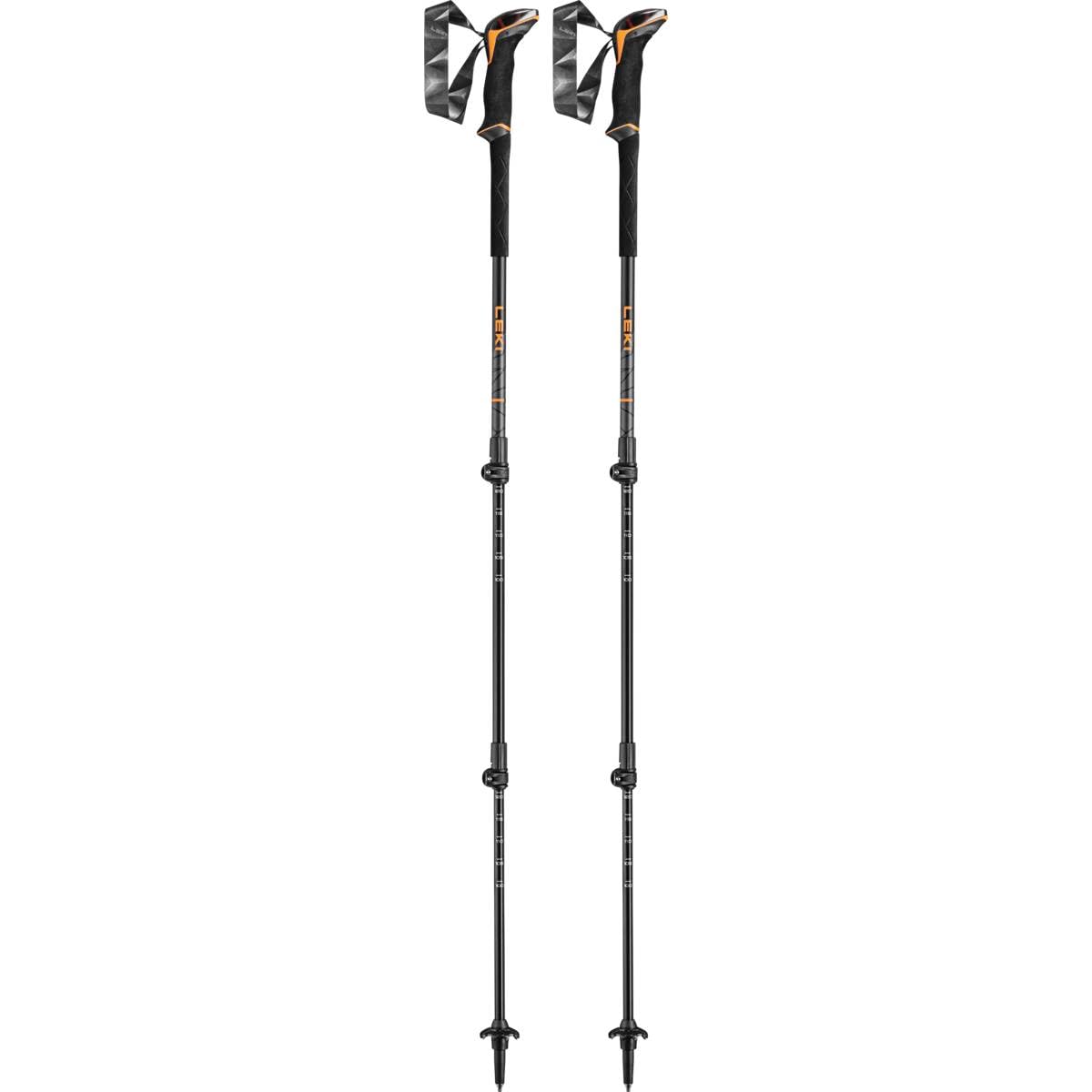
LEKI Makalu Lite Trekking Poles
- Reinforced aluminum shaft rated for heavier pack loads than standard hiking poles
- Speedlock Plus holds length setting under sustained downhill with a 40-pound pack
- Cork composite grip manages sweat better than foam on multi-day summer trips
- 3-section collapses short for attachment to a loaded backpacking pack
- LEKI German manufacturing designed for sustained heavy active use
- Heavier than carbon alternatives at this use case
- Higher price than standard hiking poles reflects heavy-duty construction
- Cork composite rather than natural cork at this price point
Backpacking poles face a different load profile than day hiking poles. A 40-pound pack puts significantly more force through the shaft and lock mechanism on every downhill plant. The LEKI Makalu Lite is built around that load: the aluminum shaft is reinforced compared to standard hiking pole aluminum, and the Speedlock Plus lever lock is rated for the sustained force of a hiker descending with a heavy pack over multiple days. This is the aluminum backpacking benchmark.
The cork composite grip handles multi-day sweat better than standard foam, which becomes waterlogged and heavy by the end of a hot summer day. For backpackers doing extended trips in summer conditions, this matters by day three. The 3-section design collapses short enough to attach to the side of a loaded pack when the trail demands both hands. At $139.85 it sits in the mid-range where the construction is meaningfully heavier-duty than budget aluminum poles.
Who this is for: backpackers who regularly carry 25 to 50-pound loads on multi-day trips and need poles rated for sustained heavy use. The aluminum benchmark for serious backpacking. For hikers willing to trade aluminum durability for carbon weight savings on long trips, the BD Alpine Carbon Cork handles the same demands at a significant price increase.
Black Diamond Trail Trekking Poles
- Flicklock Pro is the most field-proven lever lock under heavy backpacking load
- Aluminum bends under lateral impact rather than shattering – safer on rocky terrain
- 3-section adjustable covers the full range of terrain grade adjustments
- 239 reviews at 4.6 stars across this variant validates backpacking performance
- Replacement parts available from Black Diamond for long-term ownership
- Foam grip less comfortable than cork on extended multi-day trips
- Heavier than carbon alternatives at this price point
- No anti-shock if joint cushioning is a priority for knee issues
The Black Diamond Trail brings the Flicklock Pro lever lock – the cam-and-lever mechanism that defines Black Diamond’s reliability advantage – to backpacking use at $128.88. Under a 40-pound pack on a sustained descent, the Flicklock Pro holds the length setting without the creep that affects twist locks in cold and dirty conditions. Aluminum is the right shaft material for backpackers on rocky terrain: where carbon shatters under lateral impact, aluminum bends and remains usable on the way back to the trailhead.
The foam grip is the main trade-off versus the LEKI Makalu Lite’s cork composite: adequate for most conditions but less comfortable on long summer days where hand sweat accumulates. For backpackers on 3-season trips in temperate conditions, the foam grip is not a meaningful issue. For summer thru-hikers or anyone doing extended trips in hot conditions, the Makalu Lite’s cork grip is worth the additional $11.
Who this is for: backpackers who want Black Diamond Flicklock Pro reliability on rocky terrain where aluminum’s failure mode advantage over carbon is relevant. The right pick for technical terrain backpacking and 4-season use where pole durability under impact matters more than minimum weight.
LEKI Khumbu Lite Trekking Poles
- Lighter swing weight than the Makalu Lite – less arm fatigue on long mileage days
- 4.7 stars is the highest rating of any aluminum pole in this roundup
- Aergon Thermo grip ergonomically shaped to reduce wrist fatigue over miles
- Speedlock Plus reliability matches Flicklock under sustained downhill load
- Best price-to-quality ratio among the aluminum picks at $109.97
- 2-section design collapses longer than 3-section poles for pack attachment
- Not as robust as the Makalu Lite under maximum heavy load
- Aergon grip requires adjustment period for hikers used to round grips
The LEKI Khumbu Lite bridges the gap between the heavier-duty Makalu Lite and a standard day hiking pole. The lighter aluminum construction reduces swing weight compared to the Makalu Lite, which matters on high-mileage backpacking days where the poles are swinging thousands of times. For backpackers carrying 20 to 35-pound loads rather than 40-plus pound loads, the lighter construction is the right trade for swing weight reduction without the cost of carbon.
The Aergon Thermo grip is LEKI’s ergonomic shape: angled to encourage a natural wrist position rather than a straight-down grip on a standard round handle. On multi-day trips where wrist fatigue accumulates, the ergonomic angle reduces the rotation force across miles. The Speedlock Plus lever lock provides the same reliability advantage over twist locks that the Makalu Lite offers. At $109.97 it is the lowest-priced pole in the aluminum section of this roundup.
Who this is for: backpackers with moderate pack weights (20 to 35 lbs) who want the swing weight reduction of a lighter aluminum pole with LEKI’s Speedlock reliability and ergonomic grip. For backpackers with heavier loads on technical terrain, the Makalu Lite’s reinforced construction handles more sustained force.
Best budget backpacking poles
Budget poles make sense for first backpacking pairs and casual overnight use on established trails with moderate loads. All three picks have lever locks rather than twist locks – the most important feature to maintain even at budget pricing.
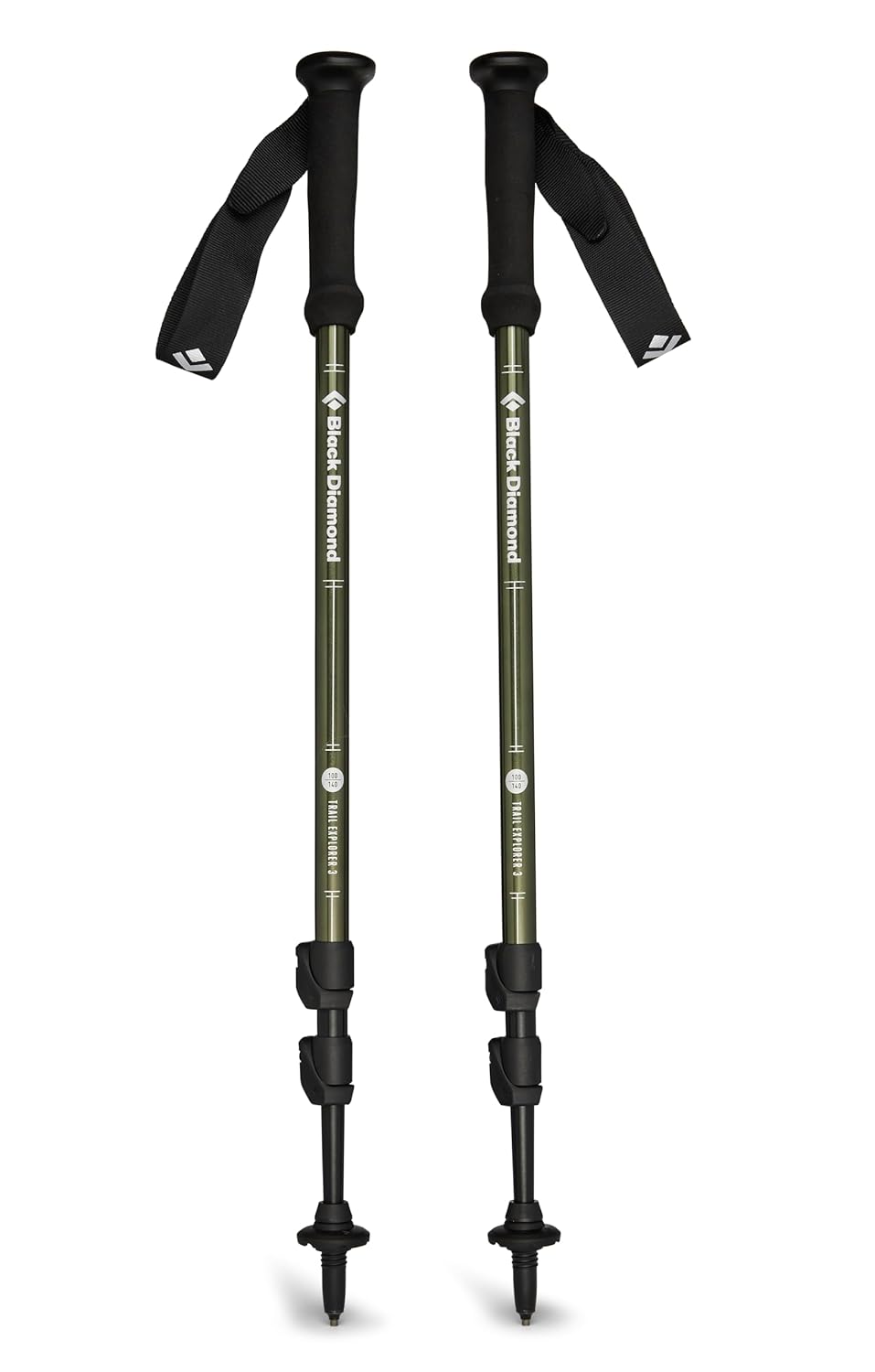
Black Diamond Trail Explorer 3 Trekking Poles
- Flicklock lever lock at under $80 – the same mechanism as the more expensive Trail poles
- 4.7 stars matches the LEKI Khumbu Lite for second-highest rating in this roundup
- 3-section collapses shorter than 2-section poles for pack attachment
- Best entry point to Black Diamond lever-lock quality for backpacking use
- 219 reviews validates consistent performance across backpacking conditions
- Not as robust as the Trail or Makalu Lite under maximum heavy load
- Foam grip only – no cork option at this price
- Newer model with less long-term track record than the established Trail line
The Black Diamond Trail Explorer 3 is the right choice for backpackers buying their first pair of quality poles and wanting the Flicklock lever lock without the premium Trail pricing. At $78.40 it delivers Black Diamond’s most important feature – the cam-based lever lock that holds under sustained downhill load – at the lowest price in the premium section of this roundup. The 3-section design collapses shorter than 2-section alternatives for pack attachment on technical sections.
The 4.7-star rating across 219 reviews is the second-highest in this roundup and provides strong validation for a newer model. For backpackers carrying moderate loads of 20 to 30 pounds on established trails, the Trail Explorer 3 handles the demands without the cost premium of the aluminum picks above it. For sustained heavy backpacking loads of 35 to 50 pounds, the Makalu Lite’s reinforced construction is the better investment.
Who this is for: backpackers buying their first pair of quality poles who want Flicklock reliability at the lowest price available in this roundup. Also a good option for equipping a hiking partner for a group trip. For regular use over multiple seasons with heavy loads, stepping up to the BD Trail or LEKI Makalu Lite is worth making from the start.
TheFitLife Carbon Fiber Trekking Poles
- Carbon fiber swing weight reduction at a budget backpacking price
- Lever lock rather than twist lock for length reliability on descents
- Cork grip option available for better sweat management on multi-day trips
- 3-section design collapses short for pack attachment
- Lowest carbon price in this roundup by a significant margin
- Only 4 reviews in this dataset – low validation for backpacking use
- Budget carbon lock mechanism less robust than BD Flicklock or LEKI Speedlock
- Carbon failure mode same as premium carbon under lateral impact
The TheFitLife Carbon brings carbon fiber to backpacking at $49.98, which is $40 less than the Windquester Strider X and $190 less than the BD Alpine Carbon Cork. At this price carbon fiber swing weight reduction is accessible for backpackers who want lighter poles without any premium investment. The lever lock rather than twist lock is the important specification at this price: twist locks at sub-$50 are common and unacceptable for sustained backpacking use.
The low review count from this dataset is the significant caveat. The actual review count on Amazon may be higher than what our search captured, but validated backpacking performance across diverse conditions and pack weights is limited compared to the established poles in this roundup. For casual overnight backpacking on maintained trails with moderate loads, the TheFitLife Carbon is a reasonable budget entry. For extended multi-day trips with heavy loads, the BD Trail Explorer 3’s aluminum durability is more appropriate.
Who this is for: backpackers who want carbon fiber swing weight reduction at the lowest possible price and are doing casual overnight backpacking rather than extended heavy-load trips. Best suited to lighter pack weights (under 30 lbs) on established trails where carbon’s fragility risk is lower. For heavier loads or extended trips, the aluminum picks in this roundup are safer investments.
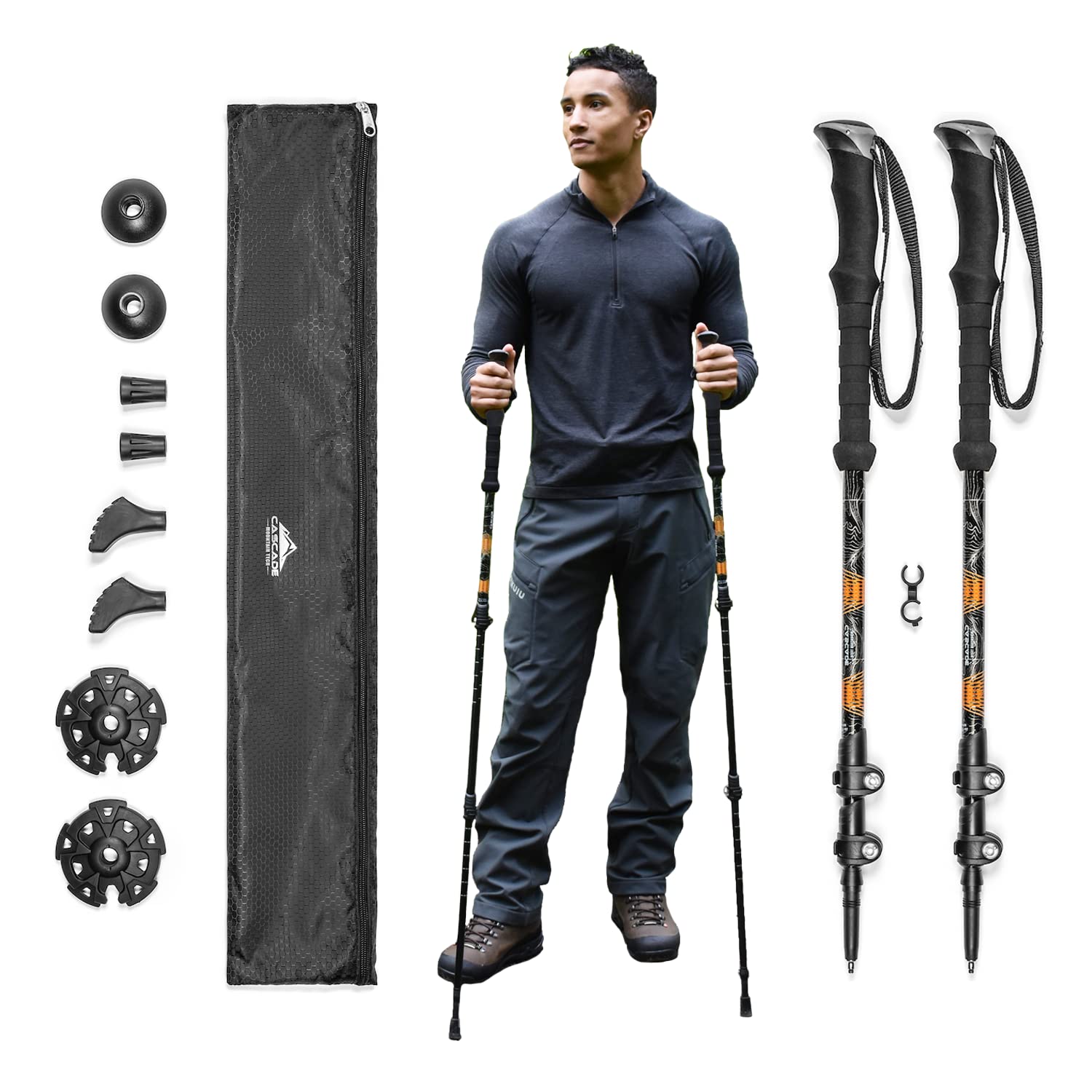
Cascade Mountain Tech Aluminum Trekking Poles
- Lowest price in this roundup at $29.99 with a lever lock
- Extended down-grip allows varied hand positions on steep backpacking ascents
- Aircraft-grade aluminum handles standard trail backpacking without deformation
- 3-section collapses short for pack side attachment
- Right entry point to try backpacking poles before committing to premium
- Only 5 reviews in this dataset – low validation for sustained backpacking use
- Not rated for heavy 40-50 lb pack loads over multiple days
- CMT lever lock less refined than BD Flicklock or LEKI Speedlock Plus
The Cascade Mountain Tech aluminum pole is the lowest-cost entry to backpacking with a lever lock at $29.99. The lever lock is the non-negotiable feature for backpacking use: twist locks unwind under the sustained downhill load of a heavy pack, typically failing on the steepest descents. The CMT lever lock holds the length setting reliably under moderate backpacking loads even if it is less refined than Black Diamond and LEKI mechanisms.
The extended down-grip section is useful on steep backpacking ascents: by gripping lower on the pole shaft rather than adjusting length, hikers can maintain the right arm angle on switchbacks without stopping to readjust. Aircraft-grade aluminum handles standard established-trail backpacking without the flex that cheaper alloys show under sustained load.
Who this is for: backpackers buying a first pair of poles to determine whether poles suit their backpacking style, or anyone equipping a partner for a group trip without a significant investment. For serious backpacking use beyond casual overnight trips, the step up to the BD Trail Explorer 3 at $78.40 delivers meaningfully better lever-lock hardware and brand backing.
Full comparison table: best trekking poles for backpacking
| Pole | Best for | Material | Price | Rating |
|---|---|---|---|---|
| Ultralight and carbon | ||||
| Black Diamond Alpine Carbon Cork Trekking Poles | Best Premium Carbon | Cork grip | $239.95 | 4.6 |
| LEKI Ultratrail FX.One Trekking Poles | Best Carbon Folding | 4.8 stars | $219.95 | 4.8 |
| Windquester Strider X Carbon Fiber Trekking Poles | Best Value Carbon | Under $90 | $89.99 | 4.8 |
| Aluminum for heavy loads | ||||
| LEKI Makalu Lite Trekking Poles | Best Aluminum Backpacking | LEKI | $139.85 | 4.6 |
| Black Diamond Trail Trekking Poles | Best BD Aluminum | Flicklock Pro | $128.88 | 4.6 |
| LEKI Khumbu Lite Trekking Poles | Best Lightweight Aluminum | Aergon grip | $109.97 | 4.7 |
| Budget picks | ||||
| Black Diamond Trail Explorer 3 Trekking Poles | Best Budget Entry | Flicklock | $78.40 | 4.7 |
| TheFitLife Carbon Fiber Trekking Poles | Best Budget Carbon | Carbon fiber | $49.98 | 4.6 |
| Cascade Mountain Tech Aluminum Trekking Poles | Most Affordable | Lever lock | $29.99 | 4.6 |
How to choose trekking poles for backpacking
Lock reliability under heavy load is the most important spec
A trekking pole that collapses mid-descent with a 40-pound pack is more dangerous than no pole at all. Lever locks – Black Diamond’s Flicklock Pro and LEKI’s Speedlock Plus – use a cam mechanism that physically clamps the pole section under load rather than depending on thread friction. Twist locks unwind under sustained downhill force, particularly in cold temperatures where the thread fit changes slightly, and in dirt and grit where material enters the mechanism. Every pole in this roundup uses a lever lock. Twist locks are not appropriate for backpacking use at any price point.
Aluminum versus carbon for backpacking terrain
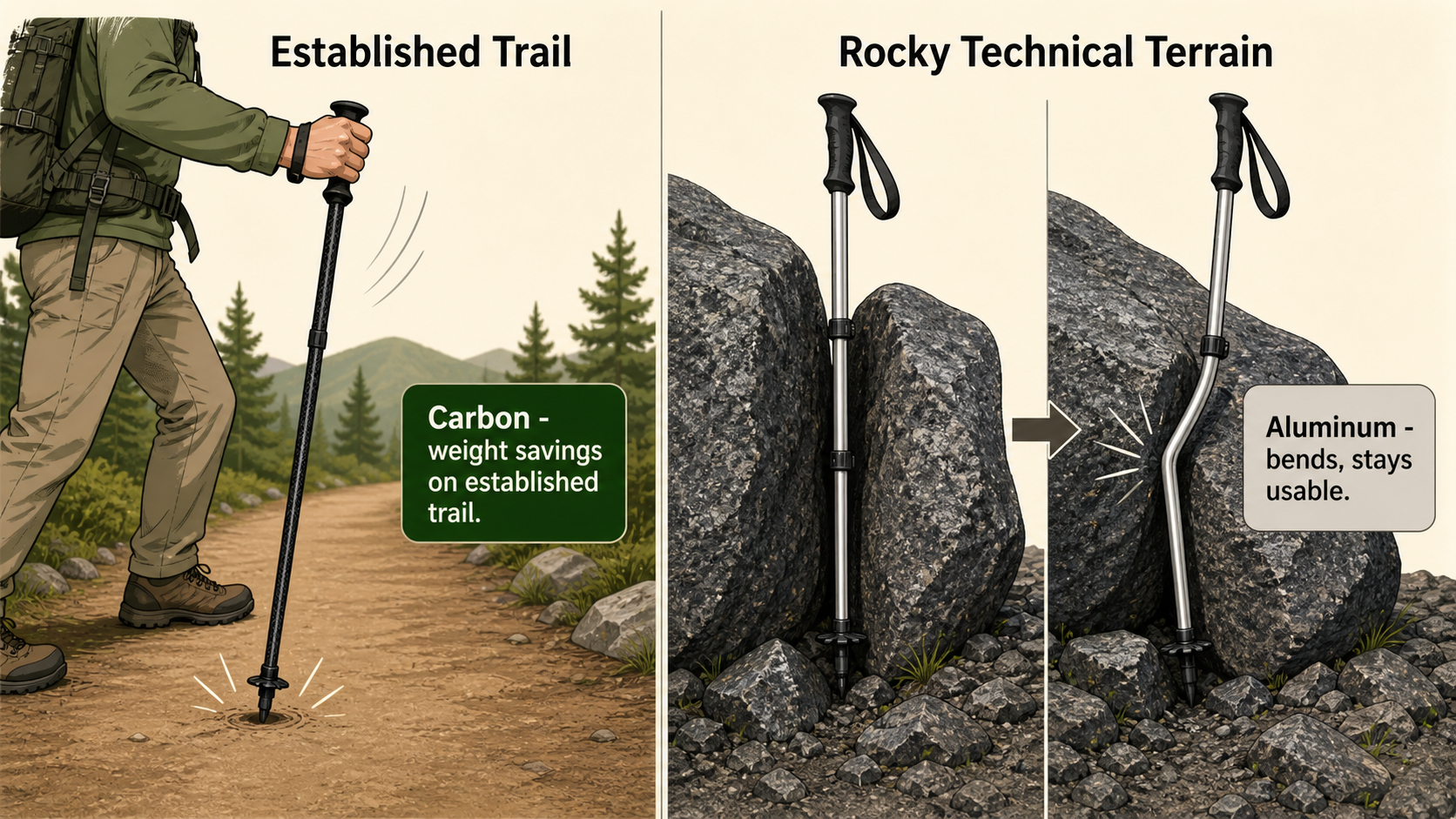
The terrain type determines the right material more than any other factor. On rocky technical terrain where pole-rock contact is frequent – scrambles, boulder fields, creek crossings – aluminum is always the safer choice. Aluminum bends under lateral impact and remains functional on the trail out. Carbon shatters at the contact point. A shattered carbon pole on a remote trail with two days left before the trailhead is a different situation than a bent aluminum pole.
On established trail backpacking where the primary demand is sustained load over multiple days rather than technical terrain impact, carbon’s weight savings become the relevant factor. A pair of carbon poles saves 4 to 6 ounces compared to aluminum equivalents. Over a five-day trip with 15-plus miles per day, the swing weight reduction is noticeable by the last mile of each day. For hikers whose trips mix established trail with technical sections, aluminum is the safer blanket choice.
Grip material for multi-day sweat
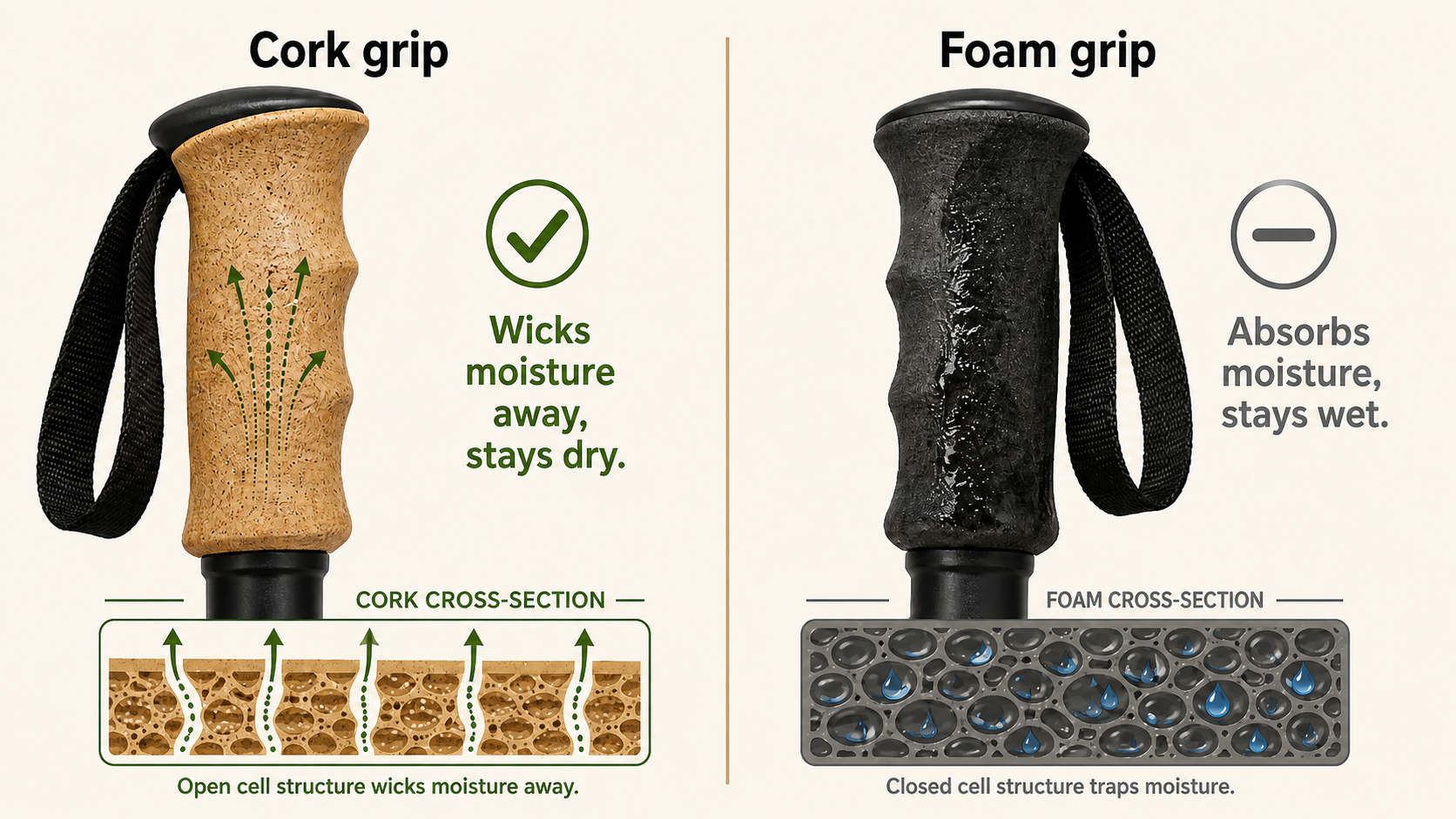
The grip material difference between day hiking and backpacking is the accumulated sweat of multiple days. On a day hike, foam grips absorb some moisture but dry out between uses. On a five-day backpacking trip, foam grips that absorb hand sweat and never fully dry become waterlogged and heavy by the end of each day. Cork and cork composite grips absorb moisture and wick it away from the hand rather than retaining it, which keeps the grip surface drier and more comfortable across extended use. The LEKI Makalu Lite’s cork composite grip and the BD Alpine Carbon Cork’s natural cork grip both reflect this backpacking-specific design priority.
Packability when the trail demands both hands
Backpacking routes often mix trail hiking with scrambling sections, creek crossings, or technical terrain where both hands are needed. The ability to stow poles quickly and securely is more relevant on backpacking trips than on single-terrain day hikes. Folding Z-poles like the LEKI Ultratrail FX.One collapse to 13 to 15 inches for hipbelt pocket stowage in seconds. Telescoping 3-section poles collapse shorter than 2-section poles for side attachment to a loaded pack. Verify that your pack’s side strap and compression system can secure a collapsed pole before your trip.

Shelter staking capability
Many ultralight shelters and tarps use trekking poles as tent poles, which eliminates dedicated tent pole weight from the pack. If your shelter is designed for this use, verify that the pole’s adjustable range covers the shelter’s required height before relying on this setup in the field. Telescoping adjustable poles set to exact heights are more reliable for shelter staking than fixed-length folding poles, which may not match the shelter’s precise requirement. Carbon poles handle shelter compression forces well; aluminum is equally suitable.
How pack weight affects pole selection
Pack weight is the single most useful variable for narrowing down the right pole. Under 25 pounds: any lever-lock pole in this roundup is appropriate. 25 to 35 pounds: mid-range aluminum (LEKI Khumbu Lite, BD Trail) or carbon handles the load comfortably. 35 to 50 pounds: the LEKI Makalu Lite’s reinforced aluminum construction is the right choice for sustained heavy-load use. Over 50 pounds: heavy-duty aluminum, no exceptions. For ultralight backpackers whose base weight is under 10 pounds, carbon folding poles make the most sense as the poles represent a meaningful percentage of carried weight.
Frequently asked questions
What are the best trekking poles for backpacking?
The Black Diamond Alpine Carbon Cork is the best premium carbon backpacking pole with cork grip and Flicklock Pro reliability. The LEKI Makalu Lite is the best aluminum pole for heavy loads over multiple days. For ultralight backpacking, the LEKI Ultratrail FX.One at 4.8 stars leads on rating and packability. For budget backpacking, the BD Trail Explorer 3 delivers Flicklock lever lock at under $80.
Carbon or aluminum trekking poles for backpacking?
Aluminum is the safer choice for rocky technical terrain – it bends under lateral impact rather than shattering. Carbon saves 4 to 6 ounces per pair and reduces swing weight fatigue on high-mileage multi-day trips. For established trail backpacking where pack weight optimization matters, carbon is worth the investment for experienced backpackers. For technical terrain where pole-rock contact is frequent, aluminum is always the right material.
What trekking pole features matter most for backpacking?
Lock reliability under heavy load is the most critical feature – lever locks (Flicklock, Speedlock Plus) are non-negotiable for serious backpacking. Cork or cork composite grips handle multi-day sweat better than foam. Collapsible length matters for pack attachment. For ultralight backpackers, shelter staking capability and folding compact storage are additional priorities.
Can trekking poles be used as tent poles for backpacking?
Many ultralight shelters and tarps are designed to use trekking poles as tent poles, eliminating dedicated pole weight. This works with telescoping adjustable poles where you set the exact height the shelter requires. Verify the shelter’s pole height requirement falls within the pole’s adjustable range before relying on this setup. Carbon and aluminum both handle shelter compression forces well.
How do I attach trekking poles to a backpack?
Collapse the poles to their shortest length, thread the tips through a bottom loop on the pack side, and secure the grip under an upper compression strap. Folding poles collapse to 13 to 15 inches and can fit in a hipbelt pocket or side water bottle pocket. Carry tips pointing downward to prevent the carbide tip from snagging gear or other hikers.
Do I need one pole or two for backpacking?
Two poles are more effective than one for backpacking. They distribute the load from a heavy pack symmetrically across both sides of the body, reduce impact on both knees equally on long descents, and provide four points of contact on steep or loose terrain. If your shelter uses poles, you need two anyway. All products in this roundup are sold as pairs.
How much should I spend on backpacking trekking poles?
For a first backpacking pair, $29.99 to $78.40 covers the CMT Aluminum, TheFitLife Carbon, and BD Trail Explorer 3 with lever locks. For regular multi-day backpacking, $109.97 to $139.85 covers the LEKI Khumbu Lite, BD Trail, and LEKI Makalu Lite. For ultralight carbon, $89.99 to $239.95 covers the Windquester Strider X through the BD Alpine Carbon Cork. Invest proportionally to how frequently you backpack and how heavy your pack load is.
Every pole in this roundup was evaluated against the performance factors that matter specifically for backpacking: lock reliability under heavy sustained load, shaft material failure mode on rocky terrain, grip comfort across multi-day use, packability for mixed terrain, and value relative to backpacking demand.

Will founded Oregon Tails to help hikers and backpackers find gear that works on real trails. Every pole in this roundup was evaluated against lock reliability under heavy load, shaft durability on rocky terrain, and grip performance across multi-day use. No brand pays for placement.