Backpacks · Family

The Best Baby Carrier Backpacks for Hiking

Thirteen framed child carriers ranked on how they carry, how the kid rides, and what they hold. Written for people who want to keep hiking Oregon with a toddler on their back.

Updated September 2026 · 13 carriers ranked · 14 minute read

13
Carriers ranked
6 mo
Typical start age
48.5
Lb total capacity
$120
Lowest pick price

A framed child carrier buys you back the thing having a baby seems to take away, which is the ability to walk a real trail without turning it into a logistics exercise. The catch is that the window is short and the price range runs from around a hundred and twenty dollars to well past four hundred, so picking wrong is expensive in both directions. Below are thirteen carriers ranked, with the honest version of who each one is actually for.

Before you buy anything: a framed carrier is not for newborns. A child needs to sit up unassisted with steady head and neck control first, which usually happens around six months, and many manufacturers also set a 16 pound minimum. If your baby is younger than that, a soft front carrier is the right tool for now. There is a section further down on what to use in the meantime.

Quick picks: the top five

Osprey Poco LT

Best Overall

Osprey Poco LT

$340.00

View on Amazon
Deuter Kid Comfort Active

Best for Long Days

Deuter Kid Comfort Active

$275.00

View on Amazon
ClevrPlus Cross Country

Best Budget Pick

ClevrPlus Cross Country

$119.95

View on Amazon
Kelty Journey PerfectFIT Elite

Best Adjustable Fit

Kelty Journey PerfectFIT Elite

$299.96

View on Amazon
Thule Sapling

Easiest to Clean

Thule Sapling

$319.89

View on Amazon

All 13 baby carrier backpacks, ranked

Best Overall

Osprey · Framed child carrier backpack

$340.00
Osprey Poco LT child carrier backpack for hiking

4.6 stars from 242 ratings on Amazon

Carry comfort9
Child comfort9
Packability10
Sun protection9
Ease of use9
92Oregon Tails score out of 100

The Poco LT is the carrier we would hand to a family buying their first one. It is slim enough that you can walk a trailhead bathroom door without turning sideways, light enough that lifting it onto your back with a squirming toddler already strapped in does not feel like a two person job, and it folds flatter than anything else at this level for the drive home.

Osprey builds it on the same suspension logic as their hiking packs, so the load rides on your hips instead of hanging off your shoulders. That difference stops mattering on a one mile stroll and starts mattering enormously somewhere around mile four, which is roughly where a good Oregon day hike gets interesting.

The sunshade is integrated rather than an accessory you have to remember, which matters more in Oregon than people expect. Shade on the trail is not the problem. The exposed ridge sections and the open gravel bars are.

Pros

  • Folds flatter than any other framed carrier here, which makes trunk storage and air travel genuinely easier
  • Integrated UPF 50 plus sunshade rather than a separate purchase
  • Suspension transfers load to the hips properly, so long days stay comfortable
  • Light enough to lift on and off solo with a child already seated

Cons

  • Storage is modest next to the Poco Premium and the Kelty Elite
  • Around 20 L of storage, and retailers do not agree on the exact figure
  • Slim profile means less padding around the child than the plusher options
Carrier weightAbout 5.1 lb
Child weight range16 to 40 lb
Total load capacity48.5 lb including child, carrier and gear
SunshadeBuilt in, UPF 50 plus
FrameAluminum, freestanding
StorageAbout 20 L, though retailer listings disagree
Minimum age6 months, once the child sits unassisted

Best for Long Days

Deuter · Framed child carrier backpack

$275.00
Deuter Kid Comfort Active child carrier backpack for hiking

4.6 stars from 129 ratings on Amazon

Carry comfort10
Child comfort10
Packability6
Sun protection8
Ease of use8
90Oregon Tails score out of 100

If the Poco LT is the sensible first carrier, the Kid Comfort is what you buy when you already know you are going to be out for six hours and you care more about your lower back than your trunk space. Deuter has been making these longer than almost anyone and the suspension shows it.

The child cockpit is the standout. It is more structured and better padded than most, which matters on the descent when a sleeping toddler goes fully limp and their head starts hunting for something to rest against.

The tradeoff is storage. At 12 L this is the smallest gear capacity in the whole roundup, so a full family day means someone else carries the food.

Pros

  • Among the most comfortable suspensions in the category for the adult carrying it
  • Structured, well padded child cockpit that supports a sleeping kid
  • Adjustable torso length so two adults of different heights can share it
  • Freestanding frame makes loading and unloading manageable alone

Cons

  • 12 L of storage is the smallest capacity of any carrier here
  • Bulkier than the Poco LT and it does not fold as flat, despite the similar weight
  • Sold in several colorways at noticeably different prices, so check a few colors before buying
Carrier weight5 lb 15 oz
Child weight range16 to 40 lb
Total load capacity48.5 lb including child, carrier and gear
SunshadeBuilt in
FrameAluminum, freestanding
Storage12 L
Minimum ageOnce the child sits unassisted with steady head control

Best Lightweight

Osprey · Framed child carrier backpack

$280.00
Osprey Poco SLT child carrier backpack for hiking

4.5 stars from 172 ratings on Amazon

Carry comfort8
Child comfort8
Packability10
Sun protection6
Ease of use9
85Oregon Tails score out of 100

The SLT is the lightest framed carrier in this group and it is the one to buy if most of your carrying happens on short trails, around town, and on trips where the carrier has to go in a car boot or an overhead bin.

It carries more gear than the LT despite weighing less, which sounds contradictory until you handle both. The SLT achieves it by stripping padding rather than volume. That is a real tradeoff and it shows up on long descents.

Think of this as the travel and errands carrier that happens to handle trails well, rather than the trail carrier that happens to travel.

Pros

  • Lightest framed carrier in this roundup
  • 22 L of storage is generous for the weight
  • Patented folding design packs down small for travel
  • Colour coded child harness buckles make loading quicker

Cons

  • Less padding than the LT or the Kid Comfort, which shows on longer days
  • Sunshade is sold separately, so budget for one on top of the price
  • Streamlined build means fewer pockets to organise into
Carrier weight4.72 lb
Child weight rangeUp to 40 lb
Total load capacity48.5 lb including child, carrier and gear
SunshadeSold separately
FrameFolding stainless steel, freestanding
Storage22 L
Minimum ageOnce the child sits unassisted

Best Adjustable Fit

Kelty · Framed child carrier backpack

$299.96
Kelty Journey PerfectFIT Elite child carrier backpack for hiking

4.7 stars from 367 ratings on Amazon

Carry comfort8
Child comfort9
Packability6
Sun protection9
Ease of use10
88Oregon Tails score out of 100

The PerfectFIT suspension is the reason to buy this one. Swapping the carrier between two adults of different heights takes seconds and no tools, which sounds like a minor convenience until you are at a trailhead handing a carrier back and forth every forty minutes because your arms are done.

It also has the most storage in this roundup at 26 L, plus a lined lower compartment meant for the things you do not want touching everything else. Anyone who has carried a soiled outfit off a trail in a grocery bag will understand why that lining is worth money.

It does not match Deuter on pure carrying comfort. It beats it on capacity and on how fast two people can share it.

Pros

  • Fastest suspension adjustment here for sharing between two adults
  • 26 L of storage, the most of any carrier in this roundup
  • Lined lower compartment for wet or dirty gear
  • Hydration reservoir sleeve included
  • Built in sunshade

Cons

  • Heavier than the Osprey models and does not fold as compactly
  • Ventilation is not as good as the mesh backed Deuter and Thule frames
  • Bulky enough that storage at home takes real planning
Carrier weightAbout 7 lb 4 oz, though published figures range to 8 lb 5 oz
Child weight range16 to 40 lb
Total load capacityAbout 48 lb including child and gear
SunshadeBuilt in
FrameAluminum, freestanding
Storage26 L
Minimum ageOnce the child sits unassisted

Easiest to Clean

Thule · Framed child carrier backpack

$319.89
Thule Sapling child carrier backpack for hiking

4.6 stars from 128 ratings on Amazon

Carry comfort8
Child comfort9
Packability6
Sun protection10
Ease of use8
86Oregon Tails score out of 100

The machine washable seat is not a gimmick. Carriers absorb everything a small child produces and most of them can only ever be sponged at, which means by year two they smell like a gym bag. Being able to pull the seat and run it through a wash is the single most practical feature in this roundup.

The sunshade is also the most generous here in terms of actual coverage, which is worth noting for anyone hiking the high desert side of the state where there is no tree cover for hours at a time.

Thule also builds this to be handed down. If you are planning on a second child, the durability argument gets a lot stronger.

Pros

  • Machine washable child seat, genuinely rare in this category
  • Largest effective sunshade coverage of the carriers here
  • Highly adjustable torso and hipbelt fit for different body types
  • Built to last through more than one child

Cons

  • Priced at the upper end without the storage to match the Kelty Elite
  • The sunshade design is fiddly to deploy compared to the Osprey system
  • Velcro based back panel adjustment collects trail grit over time
Carrier weight7 lb
Child weight range16 to 40 lb
Total load capacity48.5 lb including child and gear
SunshadeBuilt in, UPF 50
FrameAluminum, freestanding
Storage22 L
Minimum ageOnce the child sits unassisted

Most Storage

Osprey · Framed child carrier backpack

$449.95
Osprey Poco Premium child carrier backpack for hiking

4.6 stars from 86 ratings on Amazon

Carry comfort10
Child comfort9
Packability4
Sun protection6
Ease of use7
84Oregon Tails score out of 100

This is the full expression of the Poco line and it is aimed at people who treat a day out as a small expedition. The AirSpeed mesh back panel suspends the pack slightly off your back, which is the best ventilation solution in this group and a real consideration for anyone who has finished a summer hike with a soaked shirt in the exact shape of a backpack.

It also holds the most gear here at 36 L. The catch is bulk. At 8 lb 5 oz it is the heaviest carrier in this roundup, and more to the point it is the largest, which makes it awkward in tight spaces and slow to pack away.

Buy it if you are hiking often, carrying a lot, and the carrier lives in a garage rather than a flat. Do not buy it as a first carrier.

Pros

  • Best ventilation of any carrier in this roundup thanks to the suspended mesh back panel
  • The most pockets and organisation of the Osprey line
  • Plush suspension that handles heavy combined loads well
  • Freestanding and stable when loading

Cons

  • Heaviest carrier here before the child goes in
  • The bulkiest carrier here, and slow to pack down
  • Bulky in tight spaces and slow to pack down
  • The largest and least manoeuvrable carrier here in tight spaces
Carrier weight8 lb 5.4 oz
Child weight range16 to 40 lb
Total load capacity48.5 lb including child, carrier and gear
SunshadeBuilt in, UPF 50 plus
FrameAluminum, freestanding
Storage36 L
Minimum ageOnce the child sits unassisted

Best Mid-Price

Kelty · Framed child carrier backpack

$224.96
Kelty Journey PerfectFIT child carrier backpack for hiking

4.7 stars from 202 ratings on Amazon

Carry comfort8
Child comfort8
Packability7
Sun protection5
Ease of use9
82Oregon Tails score out of 100

The base Journey keeps the PerfectFIT suspension, the five point harness and the padded aluminium roll cage, and drops the extras. For a lot of families that is the right trade, because the suspension is the part that actually affects whether you enjoy the hike.

What you give up against the Elite is storage, the lined dirty gear compartment, the hydration sleeve and the built in sunshade. The sunshade is the one to think hardest about, because you will want it and buying it separately narrows the price gap.

It is also lighter than the Elite, which is not nothing when you are lifting the whole assembly over your head.

Pros

  • Same PerfectFIT suspension as the Elite at a lower price
  • Lighter than the Elite version
  • Adjustable foot stirrups let the fit grow with the child
  • Five point harness and padded roll cage

Cons

  • Sunshade is sold separately, which erodes the saving against the Elite
  • 17 L of storage against the Elite's 26 L
  • No hydration reservoir compatibility
  • No lined compartment for wet or dirty gear
Carrier weight6 lb 6 oz
Child weight range16 to 40 lb
Total load capacity48.5 lb including child and gear
SunshadeSold separately
FrameAluminum roll cage, freestanding
Storage17 L
Minimum ageOnce the child sits unassisted

Best Ventilation Upgrade

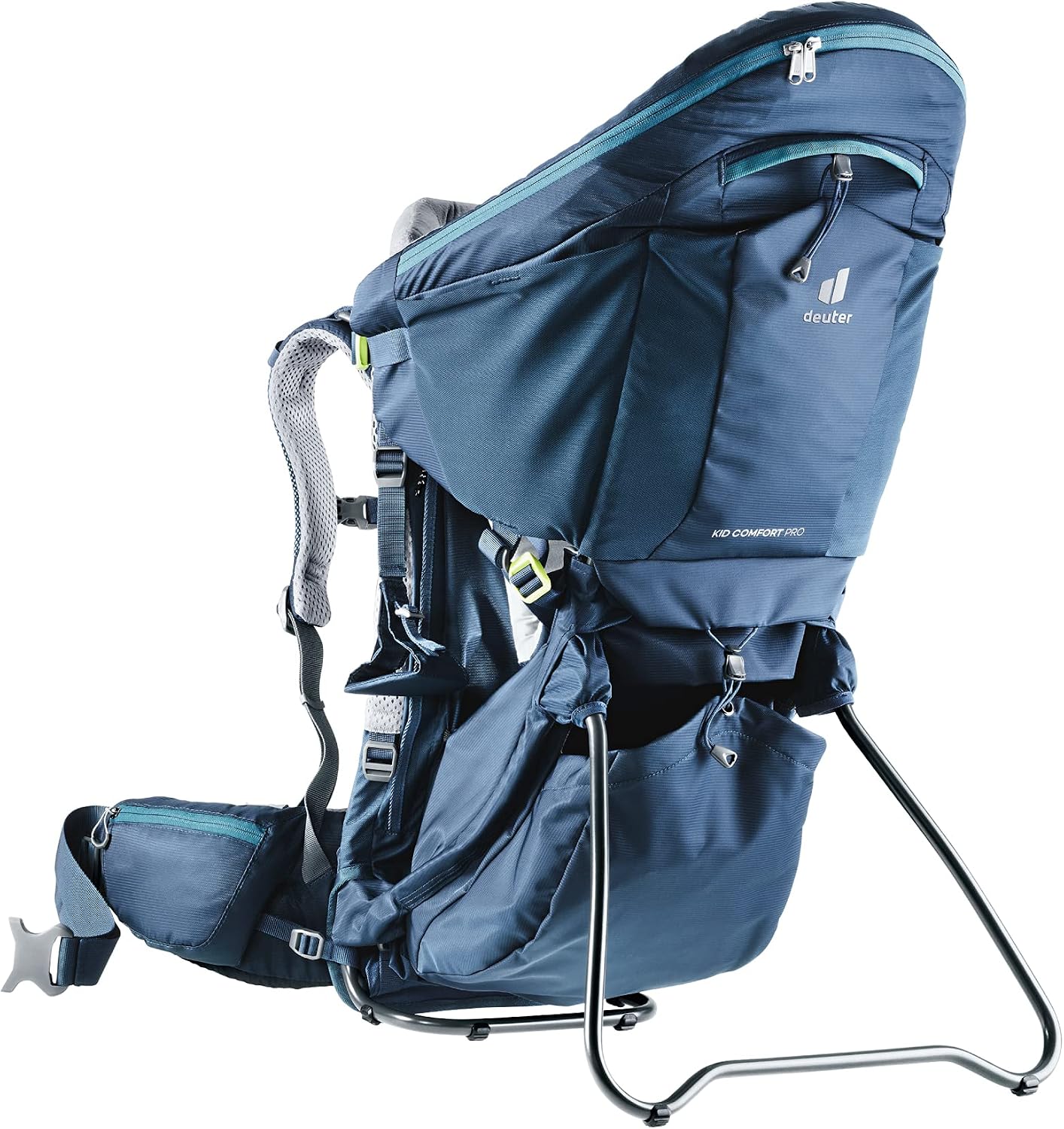
Deuter · Framed child carrier backpack
$292.50
Deuter Kid Comfort Pro child carrier backpack for hiking

5.0 stars from 5 ratings on Amazon

Carry comfort10
Child comfort10
Packability5
Sun protection8
Ease of use8
83Oregon Tails score out of 100

The Pro sits above the Active in Deuter's line and leans further into ventilation and organisation. The Aircomfort back panel is the headline, and for anyone who runs hot or hikes the drier eastern half of the state it is a meaningful upgrade over a foam panel sitting flat against your spine.

We are flagging one thing honestly: this model has very few published customer reviews so far. The underlying Deuter suspension is proven, but the specific configuration does not yet have the track record the Active does.

If you already know you want Deuter and you want the better back panel, this is the one. If you want the safer bet, take the Active.

Pros

  • Aircomfort ventilated back panel, a real improvement in warm weather
  • Deuter's suspension quality carried over from the rest of the line
  • Integrated sunshade
  • 22 L of storage including a removable 10 L daypack

Cons

  • Very thin review history compared with every other established pick here
  • At 8 lb 4 oz it is among the heaviest carriers here before the child goes in
  • Heavier and bulkier than the Osprey travel focused models
Carrier weight8 lb 4 oz
Child weight range16 to 40 lb
Total load capacity48 lb 8 oz including child, carrier and gear
SunshadeBuilt in
FrameAluminum, freestanding
Storage22 L, split between a 12 L frame compartment and a 10 L removable daypack
Minimum ageOnce the child sits unassisted

Best Budget Pick

ClevrPlus · Framed child carrier backpack

$119.95
ClevrPlus Cross Country child carrier backpack for hiking

4.6 stars from 1,918 ratings on Amazon

Carry comfort6
Child comfort6
Packability8
Sun protection8
Ease of use7
71Oregon Tails score out of 100

This is the carrier most families actually buy, and pretending otherwise would be dishonest. It costs roughly a quarter of the Poco Premium and it has by a wide margin the deepest customer feedback of anything in this roundup.

It is not built like the Osprey or Deuter packs. The suspension is simpler, the padding is thinner and the materials are lighter duty. On a two mile loop with a twenty pound toddler you will not care. On a nine mile day you will.

Buy it if you hike occasionally, if you are unsure how much your child will tolerate being carried, or if you want to find out whether this is a phase before committing three hundred dollars. Plenty of people never need more than this.

Pros

  • A fraction of the price of the technical carriers here
  • Removable sunshade included rather than sold separately
  • Kickstand and foldable frame make solo loading straightforward
  • Lots of pockets for the money

Cons

  • A 33 lb child limit against 40 lb on the technical carriers, so most kids outgrow it a year sooner
  • Suspension and padding are noticeably basic on longer hikes
  • Not built to be handed down the way the premium frames are
Carrier weight5 lb 8 oz
Child weight rangeUp to 33 lb, roughly 6 months to 4 years
Total load capacity38.5 lb including child and gear
SunshadeRemovable, included
FrameFoldable frame with kickstand
StorageNot published by ClevrPlus. Large rear compartment plus two bottle pockets
Minimum ageOnce the child sits unassisted

Best Under $150

besrey · Framed child carrier backpack

$149.99
besrey Toddler Hiking Backpack Carrier child carrier backpack for hiking

4.5 stars from 687 ratings on Amazon

Carry comfort6
Child comfort7
Packability7
Sun protection7
Ease of use7
69Oregon Tails score out of 100

The besrey sits between the ClevrPlus tier and the technical brands, with padded shoulder straps that are a step up from the cheapest carriers and a second deepest review base in this roundup.

Very little independent testing exists for this carrier, so our confidence here is lower than for the Osprey, Deuter, Thule and Kelty picks. What we can say is that the customer feedback volume is substantial and consistent.

It is a reasonable middle option if the budget carriers feel too flimsy and the technical ones feel like too much money.

Pros

  • Better padded than the entry level carriers at a similar price
  • Substantial and consistent customer feedback
  • Adjustable shoulder straps for different torso lengths

Cons

  • Manufacturer does not publish full specifications, so key figures are unverified
  • Almost no independent gear testing exists for this model
  • Marketplace brand with a shorter track record than the established names
Carrier weightNot published by besrey
Child weight rangeNot published by besrey
Total load capacityNot published by besrey
SunshadeIncluded, with a rain cover
FrameAluminum, freestanding
StorageNot published. Listing describes a large storage compartment
Minimum ageOnce the child sits unassisted

Best Canopy Included Under $200

WIPHA · Framed child carrier backpack

$199.99
WIPHA Toddler Hiking Carrier child carrier backpack for hiking

4.5 stars from 346 ratings on Amazon

Carry comfort6
Child comfort7
Packability7
Sun protection8
Ease of use7
68Oregon Tails score out of 100

The WIPHA's argument is that the sun canopy comes in the box at a price where two of the technical carriers make you buy it separately. If you are shopping on total cost rather than sticker price, that changes the maths.

Storage is more generous than most carriers at this price, which matters on family hikes where one adult ends up carrying everything.

As with the other newer brands here, published specifications are thin and independent testing is essentially nonexistent, so treat our placement as provisional.

Pros

  • Sun canopy included rather than sold as an accessory
  • More storage than most carriers near this price
  • Freestanding aluminium frame

Cons

  • Newer brand with limited track record
  • Manufacturer does not publish weight or load capacity figures clearly
  • Sold under several near identical model names, which makes comparison shopping confusing
Carrier weightNot published by WIPHA
Child weight rangeNot published for this model. Sibling WIPHA listings quote 16 to 40 lb
Total load capacityNot published by WIPHA
SunshadeIncluded
FrameAluminum, freestanding
StorageNot published. Listing describes large storage plus an insulated pocket
Minimum ageOnce the child sits unassisted

Best Baby Brand Option

Chicco · Framed child carrier backpack

$179.99
Chicco SmartSupport child carrier backpack for hiking

4.4 stars from 138 ratings on Amazon

Carry comfort6
Child comfort7
Packability8
Sun protection5
Ease of use8
67Oregon Tails score out of 100

Chicco is a mainstream baby brand rather than an outdoor one, and that is exactly the appeal for some buyers. If you already own Chicco car seats and strollers and you trust the brand, this is a lower friction purchase than learning a new set of names.

The aluminium frame keeps the weight down and the whole thing is straightforward to operate, which suits occasional use more than committed hiking.

It has the lowest customer rating of the established names in this roundup, so it is a considered pick rather than an obvious one.

Pros

  • Lightweight aluminium frame
  • Familiar mainstream baby brand with wide retail support
  • Simple to operate for occasional users

Cons

  • Lowest customer rating among the recognised brands here
  • Not built around hiking the way the outdoor brands are
  • Chicco does not publish a total load capacity, only a child weight range
Carrier weight6.2 lb
Child weight range17 to 40 lb, roughly 6 to 36 months
Total load capacityNot published by Chicco, which lists only the child weight range
SunshadeBuilt in, UPF 50 plus with pull out visor
FrameLightweight aluminum with kickstand
StorageNot published. Side pockets only, no main gear compartment
Minimum ageOnce the child sits unassisted

Best Full-Feature Osprey

Osprey · Framed child carrier backpack
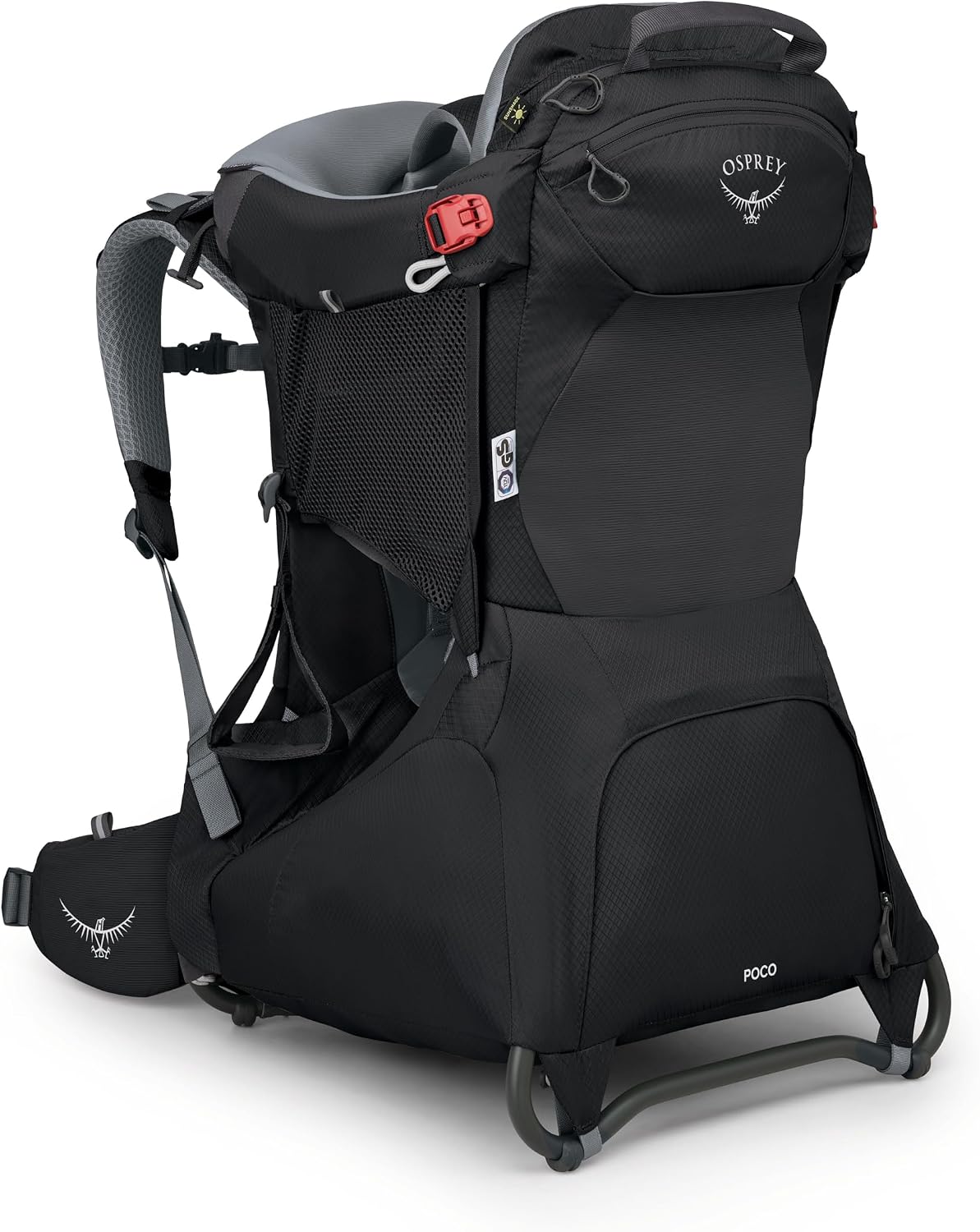
$399.95
Osprey Poco child carrier backpack for hiking

4.6 stars from 80 ratings on Amazon

Carry comfort9
Child comfort9
Packability5
Sun protection9
Ease of use8
81Oregon Tails score out of 100

The standard Poco is the middle of Osprey's line: more storage and padding than the LT, less bulk and cost than the Premium. It also includes the sunshade the Premium makes you buy separately, which is an odd bit of product positioning in your favour.

For a family that hikes regularly but does not travel much with the carrier, this is arguably the most sensible Osprey. The LT wins on packability and the Premium wins on ventilation, and this one sits between them without being clearly worse at anything.

It has the thinnest review base of the Osprey models here, largely because it is the newest listing rather than because of any problem with the carrier.

Pros

  • Built in sunshade, unlike the more expensive Premium
  • More storage and padding than the Poco LT
  • Osprey suspension quality with a freestanding frame
  • Removable drool pad, which is more useful than it sounds

Cons

  • Does not fold down like the LT or SLT
  • Priced close to the Premium without the ventilated back panel
  • Fewer published reviews than the rest of the Osprey line, and heavier than the LT by over two and a half pounds
Carrier weight7 lb 11 oz
Child weight range16 to 40 lb
Total load capacity48.5 lb including child, carrier and gear
SunshadeBuilt in
FrameAluminum, freestanding
Storage20 L
Minimum ageOnce the child sits unassisted

Full comparison table: best baby carrier backpacks for hiking

Full comparison table: best baby carrier backpacks for hiking 2026. Prices and ratings reflect the listings at the time of writing and change often. Where a manufacturer does not publish a figure, or where published figures disagree between retailers, the cell is marked rather than filled with a guess.
CarrierBest forPriceWeightStorageSunshadeScore
Osprey Poco LT Best Overall $340.00 About 5.1 lb About 20 L, though retailer listings disagree Built in, UPF 50 plus 92
Deuter Kid Comfort Active Best for Long Days $275.00 5 lb 15 oz 12 L Built in 90
Osprey Poco SLT Best Lightweight $280.00 4.72 lb 22 L Sold separately 85
Kelty Journey PerfectFIT Elite Best Adjustable Fit $299.96 About 7 lb 4 oz, though published figures range to 8 lb 5 oz 26 L Built in 88
Thule Sapling Easiest to Clean $319.89 7 lb 22 L Built in, UPF 50 86
Osprey Poco Premium Most Storage $449.95 8 lb 5.4 oz 36 L Built in, UPF 50 plus 84
Kelty Journey PerfectFIT Best Mid-Price $224.96 6 lb 6 oz 17 L Sold separately 82
Deuter Kid Comfort Pro Best Ventilation Upgrade $292.50 8 lb 4 oz 22 L, split between a 12 L frame compartment and a 10 L removable daypack Built in 83
ClevrPlus Cross Country Best Budget Pick $119.95 5 lb 8 oz Not published by ClevrPlus. Large rear compartment plus two bottle pockets Removable, included 71
besrey Toddler Hiking Backpack Carrier Best Under $150 $149.99 Not published by besrey Not published. Listing describes a large storage compartment Included, with a rain cover 69
WIPHA Toddler Hiking Carrier Best Canopy Included Under $200 $199.99 Not published by WIPHA Not published. Listing describes large storage plus an insulated pocket Included 68
Chicco SmartSupport Best Baby Brand Option $179.99 6.2 lb Not published. Side pockets only, no main gear compartment Built in, UPF 50 plus with pull out visor 67
Osprey Poco Best Full-Feature Osprey $399.95 7 lb 11 oz 20 L Built in 81
Osprey Poco LT

Osprey Poco LT

Best Overall $340.00 Weight: About 5.1 lb Storage: About 20 L, though retailer listings disagree Sunshade: Built in, UPF 50 plus Score: 92 / 100
View on Amazon
Deuter Kid Comfort Active

Deuter Kid Comfort Active

Best for Long Days $275.00 Weight: 5 lb 15 oz Storage: 12 L Sunshade: Built in Score: 90 / 100
View on Amazon
Osprey Poco SLT

Osprey Poco SLT

Best Lightweight $280.00 Weight: 4.72 lb Storage: 22 L Sunshade: Sold separately Score: 85 / 100
View on Amazon
Kelty Journey PerfectFIT Elite

Kelty Journey PerfectFIT Elite

Best Adjustable Fit $299.96 Weight: About 7 lb 4 oz, though published figures range to 8 lb 5 oz Storage: 26 L Sunshade: Built in Score: 88 / 100
View on Amazon
Thule Sapling

Thule Sapling

Easiest to Clean $319.89 Weight: 7 lb Storage: 22 L Sunshade: Built in, UPF 50 Score: 86 / 100
View on Amazon
Osprey Poco Premium

Osprey Poco Premium

Most Storage $449.95 Weight: 8 lb 5.4 oz Storage: 36 L Sunshade: Built in, UPF 50 plus Score: 84 / 100
View on Amazon
Kelty Journey PerfectFIT

Kelty Journey PerfectFIT

Best Mid-Price $224.96 Weight: 6 lb 6 oz Storage: 17 L Sunshade: Sold separately Score: 82 / 100
View on Amazon
Deuter Kid Comfort Pro

Deuter Kid Comfort Pro

Best Ventilation Upgrade $292.50 Weight: 8 lb 4 oz Storage: 22 L, split between a 12 L frame compartment and a 10 L removable daypack Sunshade: Built in Score: 83 / 100
View on Amazon
ClevrPlus Cross Country

ClevrPlus Cross Country

Best Budget Pick $119.95 Weight: 5 lb 8 oz Storage: Not published by ClevrPlus. Large rear compartment plus two bottle pockets Sunshade: Removable, included Score: 71 / 100
View on Amazon
besrey Toddler Hiking Backpack Carrier

besrey Toddler Hiking Backpack Carrier

Best Under $150 $149.99 Weight: Not published by besrey Storage: Not published. Listing describes a large storage compartment Sunshade: Included, with a rain cover Score: 69 / 100
View on Amazon
WIPHA Toddler Hiking Carrier

WIPHA Toddler Hiking Carrier

Best Canopy Included Under $200 $199.99 Weight: Not published by WIPHA Storage: Not published. Listing describes large storage plus an insulated pocket Sunshade: Included Score: 68 / 100
View on Amazon
Chicco SmartSupport

Chicco SmartSupport

Best Baby Brand Option $179.99 Weight: 6.2 lb Storage: Not published. Side pockets only, no main gear compartment Sunshade: Built in, UPF 50 plus with pull out visor Score: 67 / 100
View on Amazon
Osprey Poco

Osprey Poco

Best Full-Feature Osprey $399.95 Weight: 7 lb 11 oz Storage: 20 L Sunshade: Built in Score: 81 / 100
View on Amazon

When can a baby start riding in a carrier?

This is the question that decides everything else, and most roundups bury it. Here is the honest breakdown by stage.

Birth to about 6 months

Soft carrier only

A framed carrier is not appropriate. Your child cannot yet support their own head and torso against the jolting of uneven ground. Use a soft structured carrier, wrap or sling worn on the front, where your body does the supporting. Keep routes short and flat.

About 6 to 18 months

Framed carrier begins

Once your child sits unassisted with steady head control and meets the manufacturer’s minimum weight, a framed carrier becomes an option. Start with short walks. Expect a lot of stopping. Padding and a well structured cockpit matter most at this stage because they still fall asleep constantly.

18 months to around 4 years

Peak carrier years

This is where a good carrier earns its price. Your child is heavy enough that suspension quality genuinely matters and opinionated enough that the sunshade, the stirrups and the snack access become daily concerns. Watch the total load capacity, since this is when families run out of it.

What to use before six months

Plenty of people arrive here with a four month old and leave disappointed, so it is worth being direct: none of the thirteen carriers above are right for you yet. What you want for now is a soft structured carrier, a wrap or a sling, worn on your front. Your torso provides the head and neck support your baby cannot provide themselves, which is the whole reason a front carrier works at an age when a framed pack does not.

The tradeoff is real. A soft carrier puts the load on your shoulders and upper back rather than your hips, there is no airflow between you and the child, and there is nowhere to put water or a jacket. That is fine for a two mile flat walk and miserable on a climb. Treat the first six months as a season of shorter, easier routes rather than a problem to solve with gear, and buy the framed carrier when your child is actually ready for it.

How we ranked these carriers

Scores are out of 100 and built from five components, each weighted equally: carry comfort for the adult, child comfort, packability, sun protection and ease of use. We weight carry comfort and child comfort as heavily as we do because they are the two things that determine whether a carrier gets used after the first month.

On specifications, we have deliberately left cells blank rather than filled them. Published figures for these carriers disagree between retailers more than in almost any category we cover. Two reputable outlets list storage volumes for the same Osprey model that differ by fourteen litres. Two others list the same Deuter with different maximum loads. Where we could not confirm a figure against the manufacturer, we marked it as not published instead of picking whichever number suited the ranking. If a number matters to your decision, confirm it with the seller before buying.

Brands with deep independent testing, meaning Osprey, Deuter, Thule and Kelty, are ranked with more confidence than the newer marketplace brands, where we are working largely from customer feedback volume and published listings. We have said so on each of those entries rather than presenting equal certainty across the board.

How to choose a baby carrier backpack

1. Work out how often you will really use it

The single most common mistake here is buying a technical carrier for occasional use. The usable window runs roughly from six months to somewhere between two and four years, and it ends whenever your child decides walking is more interesting than riding. If you hike most weekends, spend the money. If you hike four times a year, an entry level carrier does the job and you will not resent it.

2. Read the capacity figure properly

Most quality carriers quote a total load of around 48.5 pounds, and that number includes the carrier, the child and your gear. A seven pound carrier with a thirty pound toddler leaves you about eleven pounds for everything else, which disappears fast once you add three litres of water. Budget carriers often quote lower totals, which shortens how long you can use them.

3. Check whether the sunshade is included

Some carriers include it and some charge extra, and it changes the real price comparison significantly. A child sitting still in a carrier cannot move out of the sun or adjust a hat, so this is not optional equipment.

4. Fit the torso, not the height

Torso length determines fit, and two people of the same height can need different settings. If two adults will share one carrier, prioritise the models that adjust quickly without tools. Handing a carrier back and forth at a trail junction is normal, and doing it with a hex key is not.

5. Think about where it will live

These are bulky objects. The folding models exist because a lot of people store carriers in a flat or fly with them. If yours lives in a garage, ignore packability entirely and buy on comfort.

Baby carrier backpack FAQ

What age can a baby go in a hiking backpack carrier?

Framed carriers are not suitable for newborns. A child needs to sit up unassisted with steady head and neck control before riding in one, which for most babies happens somewhere around six months. Several manufacturers also set a minimum child weight of 16 pounds. Age alone is not the test. A seven month old who cannot yet hold their head steady on uneven ground is not ready, and a large five month old who can sit unsupported still may not be. If you are unsure, ask your pediatrician rather than guessing, and start with short flat walks before committing to a trail.

What do I use before my baby is old enough for a framed carrier?

A soft structured carrier, wrap or sling worn on your front. These hold a much younger baby safely because your body provides the support their neck and torso cannot yet provide themselves. They are not a substitute for a framed carrier on a long hike, since they put the weight on your shoulders and torso rather than your hips and offer no ventilation between you and the child, but for the first six months they are the right tool. Plan on shorter, flatter routes during that period.

Is a hiking baby carrier actually worth it?

It depends entirely on how much you intend to use it. The window is genuinely short, usually from around six months until the child hits the weight limit or simply refuses to sit still, which can be anywhere from two to four years. If you hike most weekends, a technical carrier pays for itself in comfort within a season. If you hike a handful of times a year, an entry level carrier or a secondhand one makes far more sense. Buying a premium frame and using it four times is a common and expensive mistake.

How much weight can a child carrier hold?

Most quality carriers are rated to a total load of around 48.5 pounds, and this is the number people misread most often. That figure includes the child, the carrier itself and everything you have packed. A carrier weighing seven pounds with a thirty pound toddler leaves you roughly eleven pounds for water, food and layers. Budget carriers often have lower total capacities, which shortens the useful lifespan considerably. Always check whether a quoted figure is maximum child weight or maximum total load, because they are not the same thing.

How do I get a child into a backpack carrier on my own?

Use the kickstand. Every freestanding carrier here has one, and the sequence is the same: set the carrier on flat, level ground, open the kickstand and check it has locked, seat the child and fasten the harness completely, then crouch with your back to the carrier, get both arms through the shoulder straps and stand using your legs. Fasten the hipbelt before the sternum strap. Never leave a child in a freestanding carrier unattended, even for a moment, because a loaded carrier tips easily on soft or uneven ground.

Do I need the sunshade, or can I skip it?

Get the sunshade. A child sitting still in a carrier generates no heat of their own and cannot move out of the sun, adjust a hat or tell you they are burning until well after the damage is done. Some carriers include one and some sell it separately, which meaningfully changes the real cost. When you are comparing two carriers a hundred dollars apart, check whether the cheaper one includes a shade before you decide you are saving money.

Are framed carriers comfortable for the adult carrying them?

A well fitted one is far more comfortable than any front carrier at the same load, because the hipbelt transfers most of the weight to your hips rather than hanging it off your shoulders. Fit matters more than brand. Torso length, not height, determines the fit, and the carriers here that adjust quickly between two adults are worth prioritising if two of you will share it. Load a carrier with roughly the weight you expect to carry before deciding it feels good empty in a shop.

How do I clean a child carrier?

Check whether the seat detaches first. The Thule Sapling has a machine washable seat, which is unusual and genuinely useful. For everything else, remove any drool pads and wash those separately, then spot clean the fabric with mild soap and cold water and let it air dry completely before folding it away. Do not put a full framed carrier in a washing machine, and do not put it away damp, because the padding holds moisture and will develop a smell that is very difficult to remove.