Backpack field guide
The Best Lightweight Hiking Backpacks
Ten lightweight hiking packs tested across day hikes, fastpacking days, and overnights in the Cascades and on the Oregon Coast. Ultralight, women’s, budget, and premium picks. No brand pays for placement.
Quick Picks: 10 Best Lightweight Hiking Backpacks
Every pack here weighs under 3.5 lb. Tap any card to jump to the full review or go straight to Amazon.
Find Your Lightweight Hiking Backpack
Answer three questions and get a personalized pick from the list above.
Our pick for you
See Best Price on AmazonReviews: 10 Best Lightweight Hiking Backpacks
Full breakdown of each pick with specs, honest pros and cons, and who each pack is actually for.
Osprey Hikelite 26L
4.7 stars across 366 reviewsThe AirSpeed wire frame lifts the pack body away from your back by about two inches, which keeps you significantly cooler than foam-panel designs on long days. That gap also channels airflow actively rather than just sitting there. On a hot August day on the South Sister approach, this is the difference between a comfortable hike and a miserable one.
Integrated rain cover lives in its own dedicated pocket at the base, which means you are not hunting through the main compartment when a storm rolls in. The padded hipbelt has stash pockets. Trekking pole attachment loops are in the right place. The LidLock helmet clip adds versatility for anyone who also bikes to the trailhead.
At 1.83 lb with the rain cover included, this is the most complete lightweight daypack for 4-season Pacific Northwest hiking. The Stratos 34L (pick 5) is the step up for multi-day use; the Talon 11L (pick 10) is the step down for minimalist days. The Hikelite 26L is the right answer for everything in between.
Pros
- AirSpeed wire frame creates real back ventilation
- Integrated rain cover included, stowed in its own pocket
- Padded hipbelt with stash pockets on both sides
- LidLock helmet clip and trekking pole attachments
Cons
- At $140, noticeably pricier than similar-sized competitors
- Tighter fit through the torso than fuller-suspension Osprey models
- No external hydration sleeve tube exit port on all colorways
| Capacity | 26L |
|---|---|
| Weight | 1.83 lb / 832g |
| Frame | AirSpeed wire frame |
| Hipbelt | Padded with stash pockets |
| Hydration | Compatible (reservoir sleeve) |
| Rain cover | Integrated, included |
| Gender | Unisex |
Osprey Ultralight Stuff Pack 18L
4.6 stars across 969 reviews2.8 oz. That is less than your phone. The Osprey Ultralight Stuff Pack packs into its own internal pouch and compresses to roughly the size of a fist, which means it earns a permanent slot in any travel bag or hiking kit without costing meaningful weight or space.
The 969 Amazon reviews at 4.6 stars confirm this is a broadly useful product, not a niche item. It shows up in travel kits, as summit packs on alpine days when you are leaving gear at a camp, and as a grocery run bag for anyone who wants to stop using plastic. It is not a performance pack. It has no frame, no padding, and no hipbelt. Loads over 15 lb are uncomfortable, and anything over 20 lb is a one-way ticket to shoulder soreness.
For what it is, there is no better version of it at this price. Osprey’s build quality means the fabric holds up where cheaper packable bags delaminate at the seams after a season.
Pros
- Under 3 oz and packs to fist size
- Osprey construction quality, not budget packable quality
- Water-resistant fabric holds up in light rain
- Side water bottle pockets in an otherwise minimal design
Cons
- No frame, padding, or hipbelt
- Single main compartment only
- Not suitable for loads over 15 lb
| Capacity | 18L |
|---|---|
| Weight | 0.18 lb / 80g (under 3 oz) |
| Frame | Frameless |
| Hipbelt | None |
| Hydration | Not compatible |
| Rain cover | None (water-resistant fabric) |
| Packs into | Internal stuff pocket |
ZOMAKE Lightweight Packable 25L
4.6 stars across 511 reviewsAt $18, this pack has no business being as good as it is. Ripstop nylon, side water bottle pockets, a main zip compartment, and a smaller front pocket. The shoulder straps are lightly padded. It packs flat into its own carrying pouch when not in use. At 8 oz, it is light enough to toss into any bag as a reserve pack.
This is the honest answer to the question “what if I just need a daypack for light hiking and do not want to spend a lot?” The 511 reviews at 4.6 stars suggest it reliably delivers on those expectations. It is not the right pack for heavy loads or technical terrain. It is the right pack for a day at the coast, a city walk, a short trail, or anyone who wants a packable backup without spending $50.
Pros
- Under $20 delivered
- Ripstop nylon construction holds up to light use
- Packs flat into its own pouch
- Side water bottle pockets on both sides
Cons
- No frame or structured back panel
- No hipbelt or sternum strap
- Not built for loads over 15 lb or sustained use
| Capacity | 25L |
|---|---|
| Weight | 0.5 lb / 230g |
| Frame | Frameless |
| Hipbelt | None |
| Hydration | Not compatible |
| Rain cover | None (water-resistant nylon) |
| Packs into | Included stuff sack |
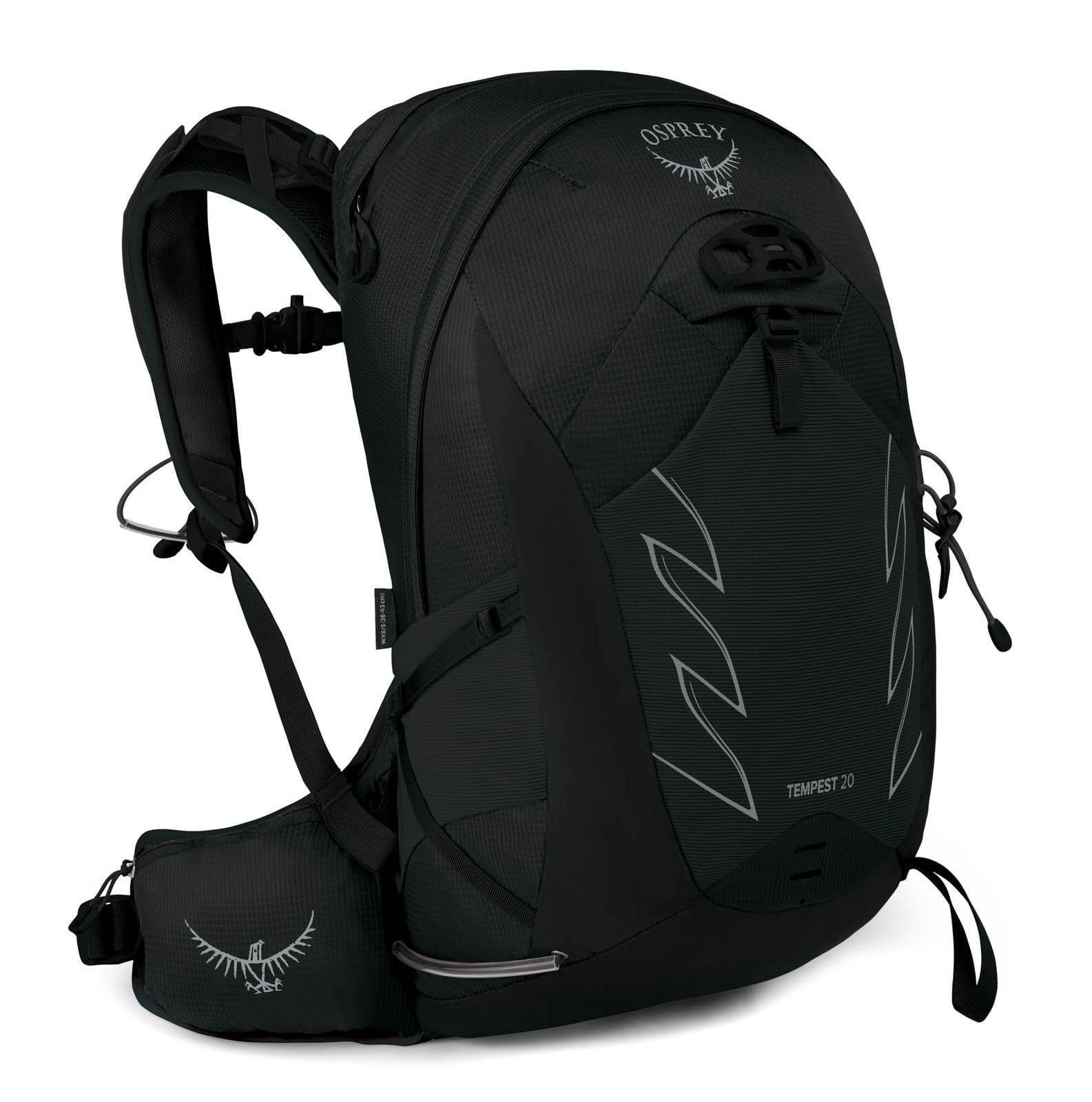
Osprey Tempest 20L Women’s
4.8 stars across 948 reviews4.8 stars across 948 reviews puts the Tempest 20L in a small club. Almost nothing in the lightweight pack category holds that average at that volume. The rating reflects a consistent experience: the women’s harness fits shorter torsos and narrower shoulders without the compromises of a unisex pack trimmed down. The hipbelt is contoured for women’s hips, not a men’s belt made smaller.
The AirScape back panel uses a ridge-foam construction that channels airflow without the full suspended-mesh gap of the Hikelite. Organization is solid: a front stretch mesh pocket, side stretch water bottle pockets, a hydration sleeve, and a hipbelt pocket on each side. The LidLock attachment is there for anyone who bikes to the trailhead. Trekking pole loops are placed correctly.
Rain cover is sold separately, which is the main practical gap at this price. For a $25 Osprey rain cover added to the cart, this is the most complete women’s lightweight hiking daypack available.
Pros
- Women’s harness designed for shorter torsos and narrower shoulders
- Contoured hipbelt with stash pocket on each side
- Hydration sleeve with tube routing
- Stretch mesh pockets front and sides
Cons
- Rain cover sold separately (add $25)
- 20L can feel tight for full-day winter loads with bulky layers
- Premium price for the capacity
| Capacity | 20L |
|---|---|
| Weight | 1.85 lb / 840g |
| Frame | AirScape ridge-foam back panel |
| Hipbelt | Padded with stash pocket |
| Hydration | Compatible (sleeve + tube routing) |
| Rain cover | Sold separately |
| Gender | Women’s specific |
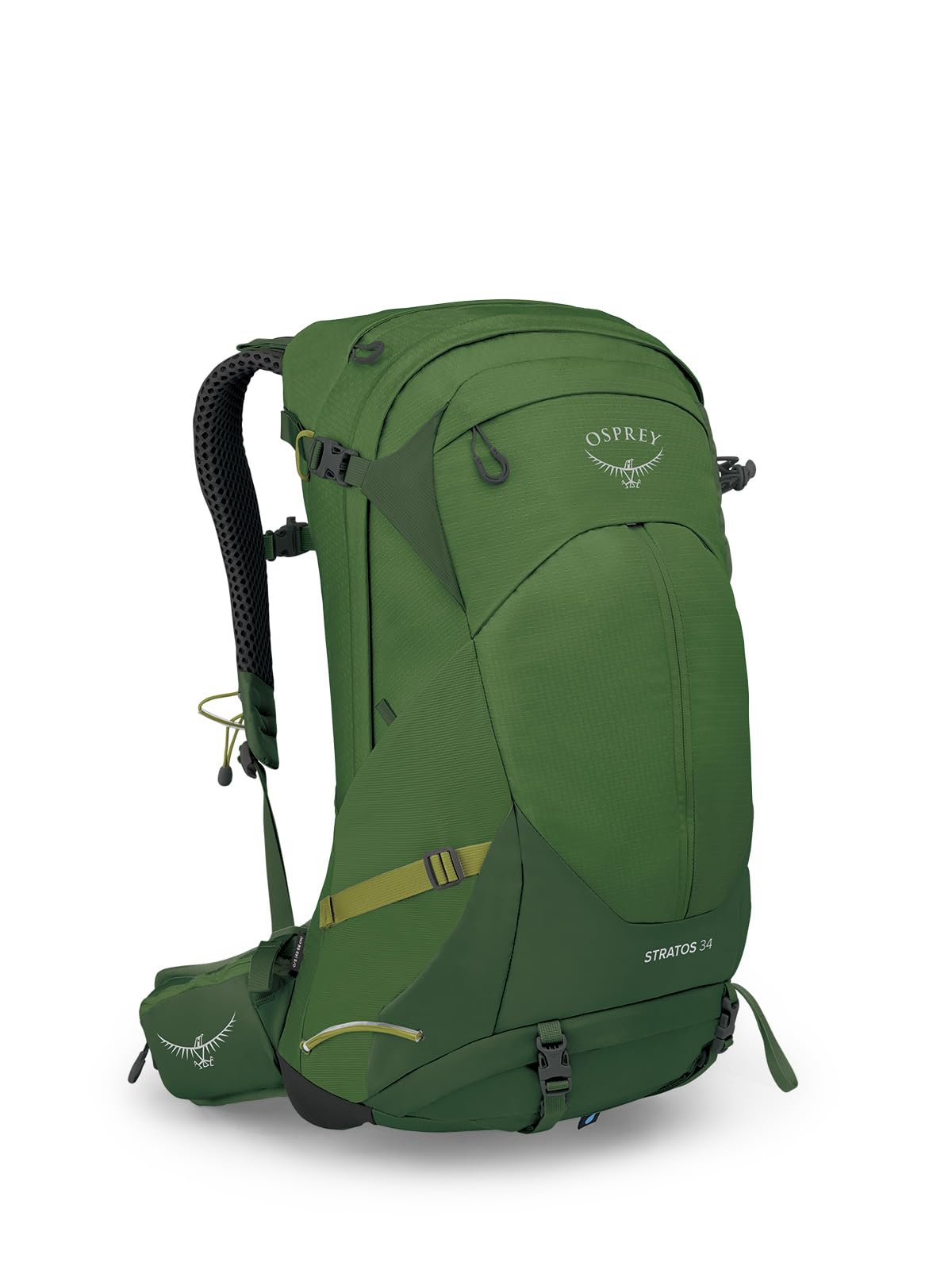
Osprey Stratos 34L Men’s
4.7 stars across 687 reviewsThe AirSpeed trampoline suspension creates a roughly two-inch gap between the pack body and your back, held open by a tensioned mesh panel stretched across a wire frame. This is the best back ventilation in any standard hiking pack in this capacity range. On a 90-degree day in the Columbia River Gorge, the difference is real and measurable in dry versus soaked shirts.
The integrated rain cover is stored in a dedicated base pocket, same as the Hikelite but scaled up. Two hipbelt pockets, trekking pole and ice axe attachments, a front panel zip pocket, and a hydration sleeve with tube routing round out the feature set. This is a fully-equipped pack at 3.4 lb.
The weight puts it at the heavy end of the lightweight category, but everything above it adds capability. For long day hikes in variable weather or fast overnights with minimal kit, the Stratos 34L carries better than any lighter pack in this volume range. The women’s version is the Sirrus 36L.
Pros
- AirSpeed trampoline back panel is the best ventilation in class
- Integrated rain cover in its own base pocket
- Two hipbelt pockets and full harness adjustment
- Ice axe loop, trekking pole attachment, sleeping bag compartment divider
Cons
- At 3.4 lb, among the heavier packs in this roundup
- Trampoline frame carries heavy loads less efficiently than frame-hugging designs
- Men’s cut only, women should look at the Sirrus 36L
| Capacity | 34L |
|---|---|
| Weight | 3.4 lb / 1,542g |
| Frame | AirSpeed trampoline suspension |
| Hipbelt | Padded with stash pockets (both sides) |
| Hydration | Compatible (sleeve + tube routing) |
| Rain cover | Integrated, included |
| Gender | Men’s specific |
Salomon Trailblazer 20
4.6 stars across 331 reviewsSalomon builds race vests for ultramarathons and the Trailblazer is the practical expression of that engineering for everyday use. Under 1 lb, frameless, designed to move with the body rather than swing away from it on technical terrain. If you have ever hiked with a budget daypack and noticed it shifting side to side on switchbacks, this is the structural antidote.
The front zip pocket is accessible while wearing the pack. Side stretch pockets hold a water bottle or snacks without stopping. The hydration sleeve accommodates a standard 1.5L or 2L reservoir. The webbing hipbelt is not padded, which is the right call for a sub-1 lb running pack where hipbelt weight would be counterproductive.
Not the right pack for someone carrying a full-day winter kit with extra layers. The right pack for anyone who moves fast, keeps loads under 12 lb, and wants a pack that disappears on the body.
Pros
- Under 1 lb with trail-running brand engineering
- Streamlined cut stays stable on technical and running terrain
- Front zip pocket accessible while wearing
- Hydration sleeve included
Cons
- Webbing hipbelt only, no padding for loads over 12 lb
- Frameless, uncomfortable with heavier loads
- No rain cover included or integrated
| Capacity | 20L |
|---|---|
| Weight | 0.94 lb / 425g |
| Frame | Frameless |
| Hipbelt | Webbing (no padding) |
| Hydration | Compatible (reservoir sleeve) |
| Rain cover | None |
| Gender | Unisex |
Thule Landmark 40L
4.5 stars across 813 reviewsBuilt for the trip where you fly into Portland, hike for three days, and go back to a hotel. The front-loading suitcase-style panel gives full access to the main compartment without unpacking from the top, which makes airport security and hotel room organization dramatically more practical than any top-loading trail pack.
Integrated rain cover stows in a base pocket. Theft-deterrent zippers on the main panel. Built-in laptop sleeve. Carry-on legal at 40L. The aluminum stay frame provides enough structure for reasonable trail loads without the weight of a full hiking suspension. At 813 reviews this is well-validated for a premium item at this price.
Not the right pack for serious backcountry use where the frame and suspension need to carry 30 lb of gear over technical terrain. The right pack for a week-long trip that mixes airport transit, city days, and hiking days and you only want to check one bag or carry one pack through all of it.
Pros
- Front-loading suitcase panel for practical airport and hotel use
- Theft-deterrent zippers on main compartment
- Integrated rain cover and built-in laptop sleeve
- Carry-on legal dimensions
Cons
- Heaviest pack in this roundup at 3.5 lb
- Not optimized for heavy backcountry loads
- Premium price, one of the most expensive picks here
| Capacity | 40L |
|---|---|
| Weight | 3.5 lb / 1,590g |
| Frame | Internal aluminum stays |
| Hipbelt | Padded contoured |
| Hydration | Not compatible (travel design) |
| Rain cover | Integrated, included |
| Gender | Unisex |
Maelstrom 40L Hiking Backpack
4.6 stars across 429 reviewsUnder $40 with an integrated rain cover, a padded hipbelt, hipbelt pockets, a hydration sleeve, and trekking pole attachments. That combination at that price does not exist from Osprey, Deuter, or Salomon. The Maelstrom closes the gap for anyone who needs a functional overnight pack before committing to a premium option.
At 2.65 lb this is a lightweight pack by the conventional definition, and it carries that weight better than the numbers suggest for loads under 25 lb. For a beginner backpacker on their first overnight, or anyone buying a pack for occasional use rather than regular use, the Maelstrom delivers 80% of what an Osprey delivers at 20% of the cost.
Long-term durability is not at the legacy brand level. The stitching in high-stress areas and the zipper quality reflect the price point. Plan for a few seasons of regular use rather than a decade of it. For occasional use, it will hold up longer.
Pros
- Integrated rain cover at a sub-$40 price point
- Padded hipbelt with stash pockets
- Hydration sleeve and trekking pole attachment included
- Multiple compartments and chest strap
Cons
- Build quality does not match premium brands long-term
- Comfort degrades noticeably with loads over 25 lb
- Some reports of stitching wear after extended heavy use
| Capacity | 40L |
|---|---|
| Weight | 2.65 lb / 1,200g |
| Frame | Internal padded back panel |
| Hipbelt | Padded with stash pocket |
| Hydration | Compatible (reservoir sleeve) |
| Rain cover | Integrated, included |
| Gender | Unisex |
Deuter Speed Lite 25L
4.7 stars across 233 reviewsA real semi-rigid Delrin U-frame at 1.39 lb is the engineering trick the Speed Lite pulls off. The frame provides genuine load transfer to the hips without the weight penalty of a full pack frame. Most packs at this weight are frameless; the Speed Lite carries a 15 to 20 lb load more comfortably than any frameless pack in the roundup.
The streamlined alpine cut is deliberately minimal: ice axe loop, ski-touring attachment, trekking pole loops, hydration sleeve with tube exit. No excessive pockets, no extra weight. This is what mountain guides reach for on approach days and ski touring days when they need capacity and structure without a full expedition pack. The Speed Lite series is Deuter’s most refined lightweight design.
Single main compartment is the main limitation for organization-focused hikers. The rain cover is sold separately, which is genuinely annoying at $125. For technical hiking and alpine use where the frame matters, this is the pick.
Pros
- Real semi-rigid Delrin frame under 1.5 lb
- Streamlined alpine cut with ice axe loop and ski attachment
- Trekking pole attachment and hydration sleeve with tube exit
- Mountain guide favorite design at this weight class
Cons
- Single main compartment limits organization
- Rain cover sold separately
- Fit runs tighter through longer torsos
| Capacity | 25L |
|---|---|
| Weight | 1.39 lb / 630g |
| Frame | Delrin U-frame (semi-rigid) |
| Hipbelt | Padded webbing |
| Hydration | Compatible (sleeve + tube exit) |
| Rain cover | Sold separately |
| Gender | Unisex |
Osprey Talon 11L Men’s
4.5 stars across 406 reviewsMost 10 to 12 liter daypacks skip the hipbelt entirely on the assumption that you are only carrying a water bottle and a jacket. The Talon 11L includes a real padded hipbelt with a stash pocket, which makes a measurable difference on rocky descents where a loose pack throws off balance. For short hikes where you are genuinely going light, this is the only pack at this size with real load transfer.
The AirScape ridge-foam back panel provides airflow without the bulk of a mesh trampoline. LidLock helmet clip is included for trailhead-to-trail bike commuting. Trekking pole attachment works as expected. The stretch front pocket is accessible while wearing without removing the pack.
The 11L capacity is the limiting factor. This is not a pack for multi-hour hikes with extra layers and full hydration. It is the pack for a sub-4-hour trail where you want water, a snack, your phone, and a light shell, and you want the pack to actually stay in place while you move. The women’s equivalent is the Tempest 9L.
Pros
- Real padded hipbelt at 11L, virtually unique in this size class
- AirScape back panel with ventilation channel
- LidLock, trekking pole attachment, stretch front pocket
- Hydration sleeve with tube routing included
Cons
- 11L is too small for full-day hikes with bulky gear
- No rain cover included
- Single main compartment
| Capacity | 11L |
|---|---|
| Weight | 1.31 lb / 595g |
| Frame | AirScape ridge-foam back panel |
| Hipbelt | Padded with stash pocket |
| Hydration | Compatible (sleeve + tube routing) |
| Rain cover | None |
| Gender | Men’s (Tempest 9L for women) |
Full comparison table: best lightweight hiking backpack
All 10 picks sorted side by side. Use the sort buttons to rank by weight, price, or capacity.
| Pack | Best for | Capacity | Weight | Frame | Rain cover | Price | |
|---|---|---|---|---|---|---|---|
 |
Osprey Hikelite 26L | Best overall | 26L | 1.83 lb | AirSpeed wire | Integrated | $140 |
 |
Osprey Stuff Pack 18L | Best ultralight | 18L | 0.18 lb | Frameless | None | $50 |
 |
ZOMAKE Packable 25L | Best budget | 25L | 0.50 lb | Frameless | None | $18 |
 |
Osprey Tempest 20L Women’s | Best for women | 20L | 1.85 lb | AirScape foam | Sold separately | $170 |
 |
Osprey Stratos 34L Men’s | Best multi-day | 34L | 3.4 lb | AirSpeed trampoline | Integrated | $178 |
 |
Salomon Trailblazer 20 | Best fastpacking | 20L | 0.94 lb | Frameless | None | $85 |
 |
Thule Landmark 40L | Best travel hybrid | 40L | 3.5 lb | Aluminum stays | Integrated | $220 |
 |
Maelstrom 40L | Best under $50 | 40L | 2.65 lb | Padded panel | Integrated | $36 |
 |
Deuter Speed Lite 25L | Best with frame | 25L | 1.39 lb | Delrin U-frame | Sold separately | $125 |
 |
Osprey Talon 11L Men’s | Best minimalist | 11L | 1.31 lb | AirScape foam | None | See Amazon |
How we pick the best lightweight hiking backpacks
We test packs on real trails. Day hikes in the Cascades, overnights on the Oregon Coast, and fast hiking days in the Columbia River Gorge. Packs that look good in a warehouse carry differently on switchbacks and in rain. These are the five criteria we weight most heavily.
-
30%Comfort
Carry comfort
Suspension system, hipbelt fit, shoulder strap padding, and how the pack sits against the back over 4+ hours. Ventilation matters on warm days. Load transfer matters on anything over 15 lb.
-
25%Weight
Weight
Actual scale weight with everything included (rain cover, frame, all attachments). Verified against manufacturer specs when manufacturer specs are available.
-
20%Org
Organization
Compartment layout, pocket placement, hydration routing, trekking pole and ice axe attachment. How quickly you can access what you need without removing the pack.
-
15%Dur
Durability
Fabric weight and denier, zipper quality, stitching at stress points, and long-term wear data from review volume. Higher review counts at maintained ratings signal consistent durability.
-
10%Value
Value
Feature set relative to price, not cheapest price. A $140 pack that outperforms a $60 pack by a meaningful margin earns its score. A $60 pack that does what it claims at $60 earns its score too.
How to choose a lightweight hiking backpack
The right lightweight pack depends on three variables: what you carry, how long you hike, and how you move on trail. Here is how to match the pack to the use.
How much capacity do you actually need?
Most hikers overestimate the capacity they need. For a standard day hike with water, food, a layer, and a first aid kit, 18 to 26 liters is sufficient. Going to 30 to 40 liters on a day hike means carrying a larger, heavier pack with most of it empty, which negates the purpose of going lightweight.
Under 4 hours
11 to 20L. Water, snacks, shell jacket, phone. No need for extra pockets or a sleeping bag compartment. Talon 11L or Salomon Trailblazer 20.
Full day (4 to 8 hours)
20 to 30L. Lunch, full water supply, extra layers, first aid. Hikelite 26L, Tempest 20L, or Deuter Speed Lite 25L.
Overnight
30 to 45L with ultralight gear, up to 55L with standard gear. Stratos 34L is the minimum comfortable overnight lightweight pack. Maelstrom 40L for budget overnight.
Does the back panel matter?
For loads under 12 lb, the back panel type makes minimal difference. For loads over 15 lb, it matters a lot. The three systems you will encounter in the lightweight category are foam panel (lightest, most contact with back, warmest), ridge foam with air channel (middle ground, decent airflow), and trampoline mesh (best ventilation, heavier, best for warm weather). The Hikelite and Stratos use the trampoline design. The Tempest and Talon use ridge foam. Frameless packs use a thin pad or nothing.
When do you actually need a frame?
For loads under 15 lb on flat to moderate terrain, a frameless or minimal-frame pack is fine. For loads over 20 lb, a frame transfers weight to your hips and prevents the “sore shoulders at mile 8” experience that every frameless pack produces at that weight. The Deuter Speed Lite is the right call for anyone who wants the lightest possible pack that still has real structure for heavier loads.
What about waterproofing?
There are no fully waterproof lightweight hiking packs in this roundup. All use DWR-treated fabrics that repel light to moderate rain for 20 to 30 minutes. For sustained Pacific Northwest rain, your options are an integrated rain cover (Hikelite, Stratos, Maelstrom, Thule Landmark all include one), a separate pack rain cover, or a roll-top dry bag liner inside the main compartment. The liner approach adds negligible weight and works better than any cover in heavy rain.
Do you need a women’s specific pack?
If you have a shorter torso (roughly under 18 inches from the base of your neck to your hip crest), a women’s specific pack will fit better than a unisex pack adjusted short. The shoulder straps on women’s designs are narrower and angle differently to avoid pressure on the collar bones. The hipbelt is contoured for a wider pelvis. For average to tall torsos, unisex packs fit well. For anything borderline, measure your torso and compare it to the manufacturer’s sizing chart rather than assuming size.
Lightweight hiking backpack FAQ
What weight counts as a lightweight hiking backpack?
Industry convention sets lightweight at under 3 lb (1.4 kg) for a frame pack and ultralight at under 2 lb (900g). Frameless packable options run 4 to 12 oz. The lighter you go, the less load the pack can carry comfortably. Most lightweight hiking backpacks sit in the 1 to 2 lb range, trading padding and accessory pockets for saved weight.
How many liters do I need in a lightweight hiking backpack?
For day hikes, 18 to 26 liters is the standard range. For overnight trips with ultralight gear, 30 to 40 liters. For weekend or multi-day trips, 35 to 50 liters. Going above 50 liters is rare in the lightweight category because the pack itself starts adding too much weight to justify the size.
Are lightweight hiking backpacks waterproof?
Most are water-resistant rather than fully waterproof. The DWR coating on the fabric repels light to moderate rain for 20 to 30 minutes. For sustained rain, you need either an integrated rain cover (the Hikelite, Stratos, Maelstrom, and Thule Landmark all include one), a separate pack cover, or a roll-top liner inside the main compartment. The liner approach works better in heavy rain than any external cover.
Do I need a hipbelt on a lightweight hiking backpack?
For loads under 12 lb, no. The shoulder straps carry the weight comfortably without hip involvement. For loads over 15 lb, a real padded hipbelt transfers roughly 70% of the load to your hips and dramatically reduces shoulder fatigue on long days. Frameless ultralight packs skip the hipbelt to save weight, which is acceptable for short hikes with light loads.
Are Osprey backpacks worth the price for hiking?
For regular hikers, yes. Osprey’s suspension systems, ventilation panels, and All Mighty Guarantee lifetime warranty outperform budget packs over time. The Hikelite, Tempest, Stratos, and Talon lines are genuinely better than sub-$50 packs for carry comfort and long-term durability. For occasional hikers with light loads, a packable in the $20 to $40 range performs fine. The premium pays off when you are on trail frequently or carrying heavier loads.
Can I use a lightweight hiking backpack for travel?
Yes. Many lightweight packs in the 35 to 45 liter range work as carry-on travel bags. The Thule Landmark 40L is purpose-built for this, with a suitcase-style front-loading panel, theft-deterrent zippers, and carry-on legal dimensions. Pure trail packs function for travel but are less convenient in airports and hotels because of their top-loading design and external attachment loops that can catch on conveyor belts.