Backpacking field guide
How Heavy Should a Hiking Backpack Be?
The 20 percent rule everyone repeats is roughly right and quietly misleading. It is also the wrong rule for day hiking. Here are the actual targets, what to do when you exceed them, and why the science says lighter hikers can carry more than the rule suggests.
Search “how heavy should a hiking backpack be” and you will get the same number on every page: 20 percent of your body weight. That number is technically correct, broadly applied, and incomplete in three specific ways: it ignores the difference between day hiking and backpacking, it scales linearly with body weight when actual carrying capacity does not, and it does not tell you what to do when your pack is over the target.
This guide gives you the real answer. Day hike and backpacking targets in pounds, the science-backed scaling model that corrects the percentage rule for lighter and heavier hikers, base-weight benchmarks for traditional and lightweight backpacking, an item-by-item gear weight reference, and a six-question diagnostic for whether your pack is genuinely too heavy or just heavier than someone on the internet says it should be. If you are still picking the pack itself, the companion guide on how to choose a hiking backpack covers fit, capacity, and frame type before any of this matters.
1. Why pack weight matters more than people think
Pack weight is the single most modifiable variable in your hiking experience. The terrain you cannot change. The weather you cannot change. The pack weight you can change today, on your next trip, and on every trip after that. The compounding effect is enormous.
- Energy expenditure scales with pack weight. Every pound of pack weight increases the calories you burn per mile by roughly one to two percent. A 35-pound pack burns about 50 percent more calories per mile than a 15-pound pack on the same hike.
- Injury risk scales faster than weight. Knee, hip, and lower-back injuries on hiking trips correlate strongly with pack weight, and the relationship is nonlinear. A 40-pound pack is not “twice as bad” as a 20-pound pack. Above the body’s comfortable threshold, every additional pound disproportionately increases impact stress on joints and risk of acute injury.
- Pace falls and trip enjoyment falls with it. A heavier pack means a slower pace, more breaks, and more attention spent managing discomfort instead of looking around. This sounds like comfort talk and is actually safety: fatigued hikers make worse decisions, fall more, and get lost more.
The good news: the same compounding works in your favor. A pound saved is a pound saved on every step of every hike for the life of that gear, which is potentially thousands of miles. Reducing base weight by 5 pounds is genuinely transformative.
2. Day hiking vs backpacking, two different rules
The single most consistent mistake in pack-weight advice is treating day hikes and backpacking as the same problem. They are not. Different gear, different time on trail, different consequences for getting it wrong.
Day hiking target
For a day hike of any length, the goal is under 10 percent of body weight including water. A 160-pound hiker carries 12 to 16 pounds. A 120-pound hiker carries 10 to 12 pounds. A 220-pound hiker carries up to 22 pounds. The rule applies regardless of fitness level, because day hikers are not breaking in load distribution and are not adapted to longer trail days. Going over this target on a day hike is almost always a packing error, not a real need.
Backpacking target
For overnight or multi-day trips, the goal is 20 percent of body weight maximum, 15 percent ideal. A 160-pound hiker can carry up to 32 pounds with a 24-pound comfort target. The math is more permissive because the trip itself requires gear that does not exist for day hikes (sleep system, shelter, cooking gear), and because hikers acclimatize to load over the first few days of any longer trip.
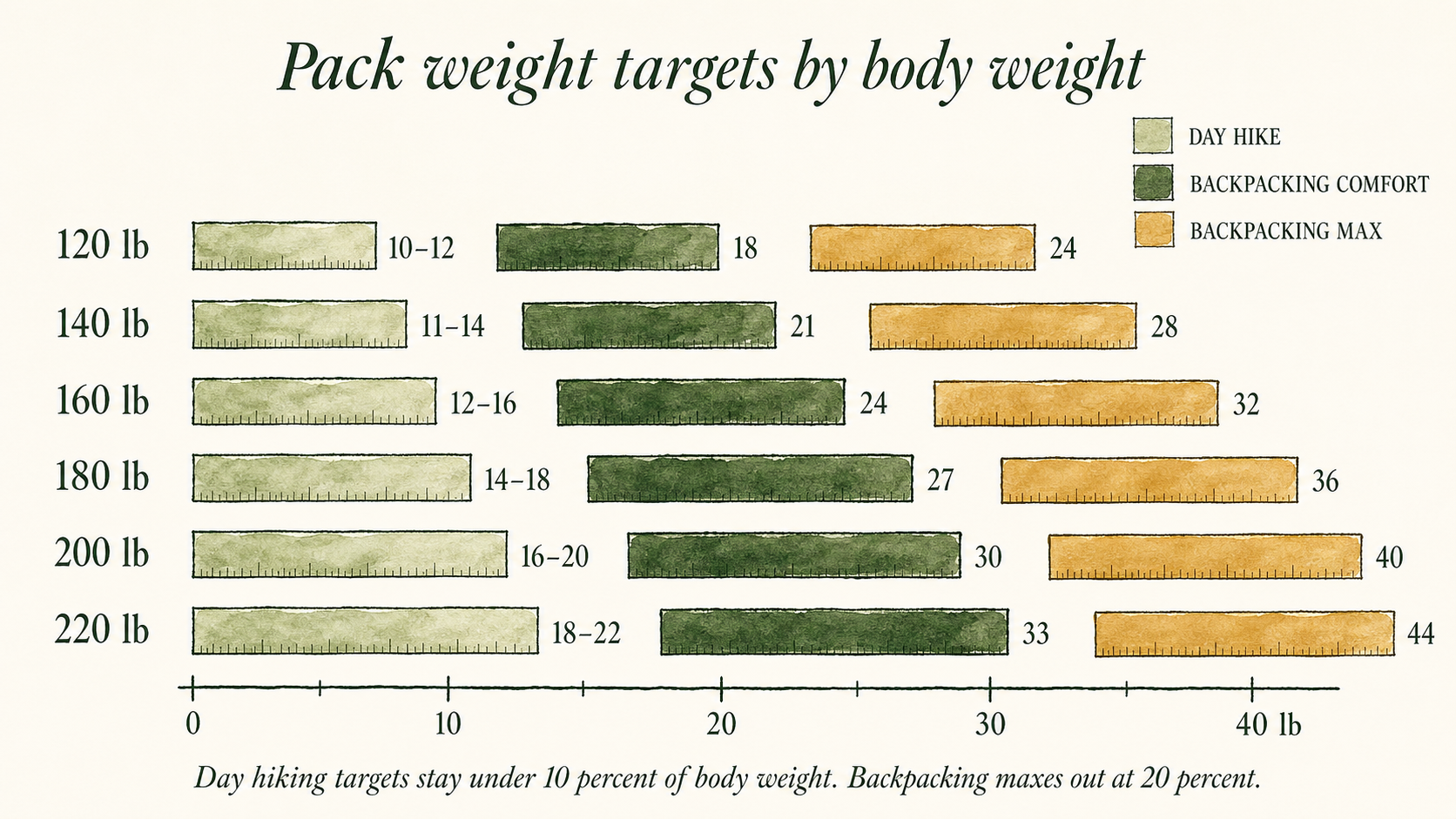
| Body weight | Day hike target | Backpacking comfort | Backpacking max |
|---|---|---|---|
| 120 lb | 10-12 lb | 18 lb | 24 lb |
| 140 lb | 11-14 lb | 21 lb | 28 lb |
| 160 lb | 12-16 lb | 24 lb | 32 lb |
| 180 lb | 14-18 lb | 27 lb | 36 lb |
| 200 lb | 16-20 lb | 30 lb | 40 lb |
| 220 lb | 18-22 lb | 33 lb | 44 lb |
3. The 20 percent rule and the science alternative
The 20 percent rule is repeated everywhere because it is roughly right, easy to remember, and cited by REI, the National Park Service, and most outdoor publications. It is also a simplification of a more accurate model that scales with body weight nonlinearly.
Where the 20 percent rule comes from
The rule traces to military load-carriage research from the mid-twentieth century, which found that infantry soldiers could carry up to about 30 percent of body weight before performance degraded sharply, with comfort and endurance optimized around 15-20 percent. The civilian hiking community adopted the lower number as the default recommendation.
Why the rule is imperfect
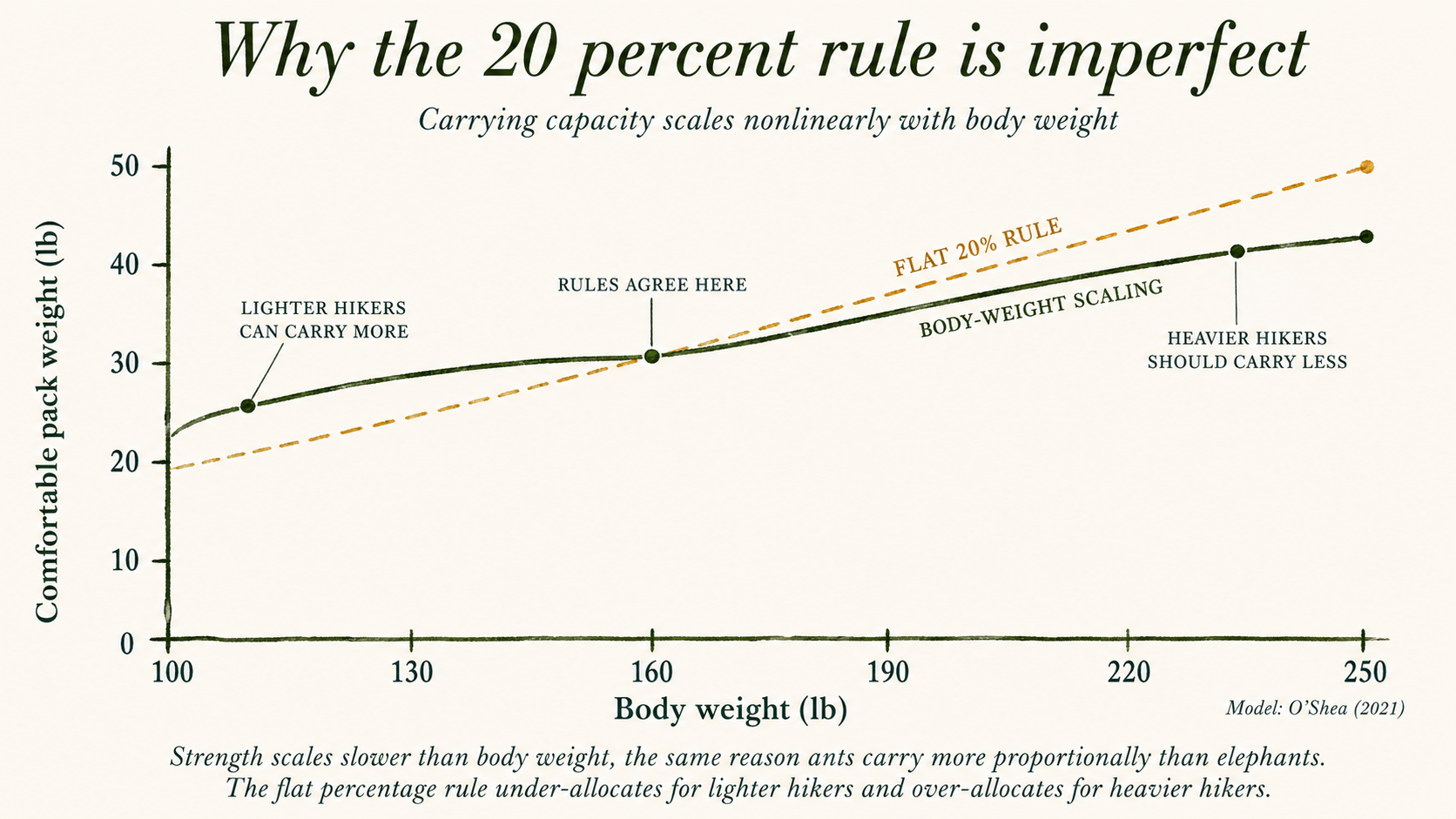
A 2021 paper by physics professor Joshua O’Shea formalized what experienced backpackers already noticed: a flat percentage of body weight overestimates carrying capacity for heavier hikers and underestimates it for lighter hikers. The reason is that as bodies scale up, strength increases more slowly than weight (this is also why ants can carry many times their body weight and elephants cannot). A 110-pound hiker can comfortably carry a higher percentage of their body weight than a 230-pound hiker can, even when both are equally fit.
The practical adjustment
For most hikers between roughly 130 and 200 pounds, the 20 percent rule works. Outside that band, adjust:
- Under 130 lb: can comfortably carry 22 to 25 percent of body weight on a backpacking trip, sometimes more for a fit, trained hiker.
- 130 to 200 lb: the 20 percent rule applies cleanly.
- Over 200 lb: target 17 to 18 percent rather than 20, because joint stress at higher absolute pack weights compounds.
This matters in practice because a 110-pound hiker following the strict 20 percent rule (22 lb max) might leave behind useful gear they could actually carry, and a 240-pound hiker following the rule (48 lb cap) might injure themselves carrying loads their joints cannot sustain.
4. Base weight, pack weight, total weight
Three terms that get used interchangeably and should not be. The distinctions matter because each one is improved differently.
Total weight (or “skin-out weight”)
Everything on you and in your pack: gear, clothes worn, food, water, fuel, even worn shoes. This is the number that determines how hard the hike feels. It is also the number compared to the 20 percent rule.
Pack weight
Everything inside your pack plus the pack itself. Excludes worn clothing and shoes. Roughly 1 to 3 pounds less than total weight depending on what you are wearing.
Base weight
Pack weight minus food, water, and fuel. The “consumables” come and go with each trip. Base weight is what stays the same across all your trips and is therefore the part of your weight you can permanently reduce through gear choices. Base weight is the spec ultralight and lightweight backpackers track because it represents the long-term investment in lighter gear.
| Style | Base weight | Trade-offs |
|---|---|---|
| Traditional backpacking | 25-35 lb | Comfort, durability, lower cost; heavier on trail |
| Lightweight backpacking | 15-20 lb | Mid-priced gear, smart material choices; small comfort sacrifice |
| Ultralight backpacking | 10-15 lb | Higher cost, requires skill, less safety margin |
| Sub-ultralight (SUL) | Under 10 lb | Specialist niche, high cost, narrow comfort window |
5. Item-by-item weight targets
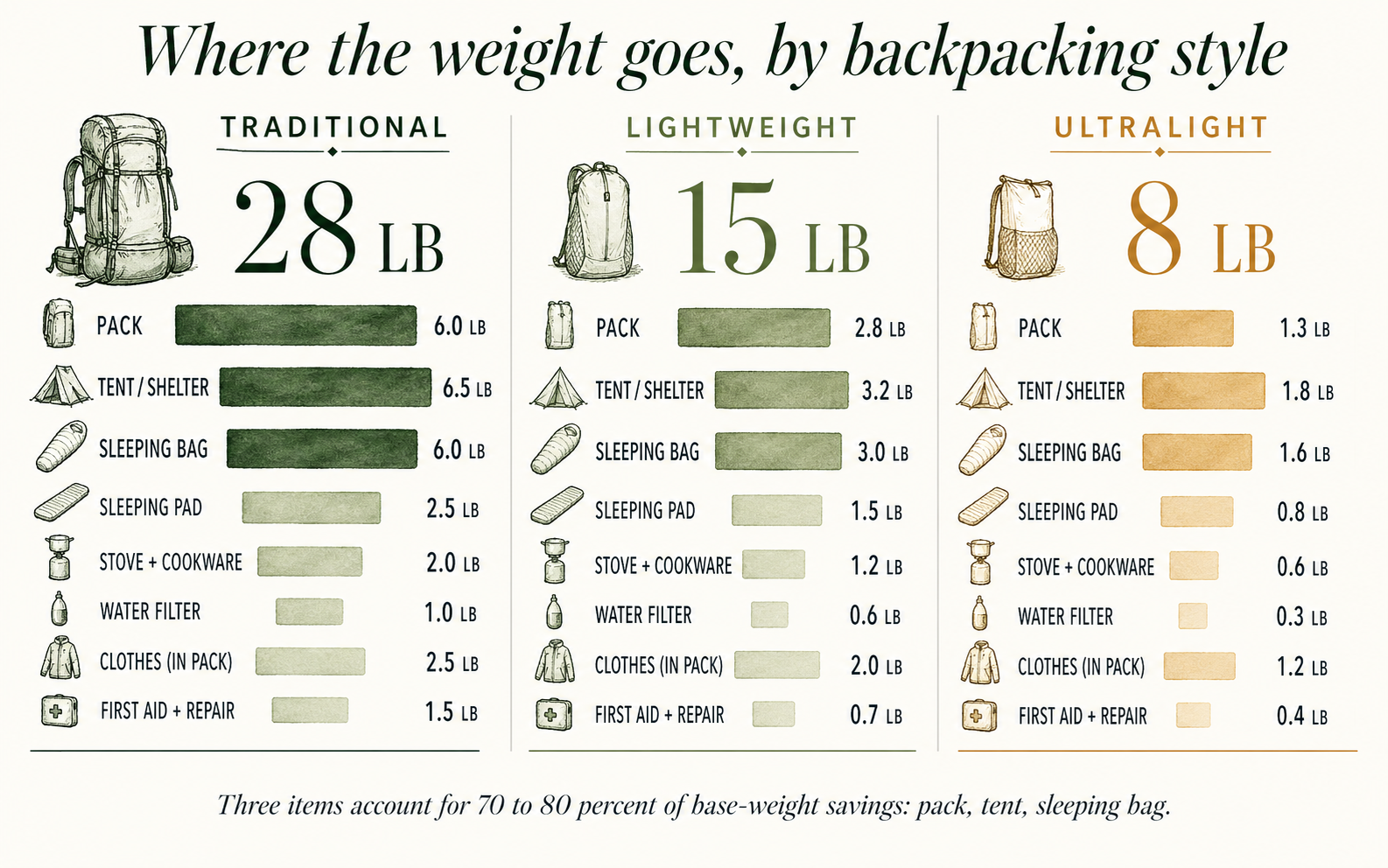
The single most actionable section in this guide. Below are typical weights for the major categories of gear, with traditional, lightweight, and ultralight benchmarks. Measure your equivalents and you will find which categories are pulling your base weight up.
| Category | Traditional | Lightweight | Ultralight |
|---|---|---|---|
| Backpack | 5-6 lb | 2-3 lb | 1-2 lb |
| Tent / shelter | 5-7 lb | 3-4 lb | 1.5-2.5 lb |
| Sleeping bag | 4-5 lb | 2-3 lb | 1.5-2 lb |
| Sleeping pad | 2-3 lb | 1-1.5 lb | 0.5-1 lb |
| Stove + cookware | 2-3 lb | 1-1.5 lb | 0.4-0.8 lb |
| Water filter / treatment | 0.5-1 lb | 0.3-0.5 lb | 0.1-0.3 lb |
| Clothes (in pack) | 4-6 lb | 2-3 lb | 1.5-2 lb |
| First aid + repair | 1 lb | 0.5 lb | 0.3 lb |
| Total base weight | ~28 lb | ~15 lb | ~8 lb |
Consumables, roughly fixed by trip length
- Water: 2.2 lb per liter. Most hikers carry 1 to 3 liters at any moment depending on climate and water source spacing.
- Food: 1.5 to 2.5 lb per day for an active backpacker. Plan calories rather than volume; aim for 100 to 125 calories per ounce of food.
- Stove fuel: 0.05 to 0.1 lb per day for a single-burner canister stove cooking two meals a day.
The pattern in the table is that the gap between traditional and lightweight comes mostly from three big-ticket items: pack, tent, and sleeping bag. Optimizing those three accounts for 70 to 80 percent of total base-weight savings. Most lightweight backpacking budgets are best spent on those three before anything else.
For pack-specific recommendations, see the best lightweight hiking backpack guide. For shelter and sleep system selection, the backpacks category covers the full system.
6. How to weigh your pack accurately
Most hikers guess. The guess is almost always wrong by 3 to 5 pounds in the heavy direction. Two methods give you the actual number in under a minute.
Bathroom scale method
- Step on a regular bathroom scale without the pack and note your weight.
- Pick up the loaded pack, step back on the scale, note the new weight.
- Subtract. The difference is your pack weight.
Accurate to within about 0.5 lb on most home scales. Works for any pack you can lift cleanly.
Luggage scale method
Hook a luggage scale or a digital fish scale to the pack’s haul handle (the small loop at the top), lift the pack vertically off the floor with the scale, read the number. Accurate to within 0.1 lb on a $15 luggage scale. The right method for tracking your weight over time, especially if you are working to cut base weight.
Calculate base weight separately
Weigh your pack with food, water, and fuel removed. That number is base weight, the one to track for long-term gear improvement. Weighing fully loaded gives you total weight. Knowing both lets you separate trip-specific consumables from gear-driven weight.
7. Six signs your pack is too heavy
The percentage rules are guidelines. The body has its own signals, and they matter more than the math. If two or more of these show up on the same trip, the pack is genuinely too heavy regardless of what the percentage says.

- You struggle to lift the pack onto your back without help. A pack you cannot put on solo is too heavy by definition. There will be a moment on trail when no one is around to assist.
- You shorten your stride to compensate. A heavy pack forces a shorter, more cautious gait. If you are taking smaller steps than normal on flat trail, your body is telling you it cannot stride normally with this load.
- Your shoulders or lower back ache within the first hour. A properly fitted pack at the right weight should be comfortable for the first 60 to 90 minutes. Pain inside that window means weight, not fit, is the issue.
- You feel pulled backward when standing still. The center of gravity is too far back, which usually means the pack is overloaded relative to your frame size or the load is poorly distributed.
- You skip activities at camp because you are exhausted. Carrying capacity should leave reserve energy. If you arrive at camp and only have energy to set up, eat, and sleep, the trip itself was past your weight threshold.
- You lose your appetite. Severe physical stress suppresses hunger hormones. A backpacker who skips dinner because they are “not hungry” after a hard day is showing a textbook overstress signal.
8. How to cut weight without losing safety
The wrong way to cut pack weight is to leave behind the items that protect you in an emergency: rain shell, headlamp, navigation, first aid, water treatment. The right way is to make smart material and design choices in the gear you already have, and to be honest about which “comfort” items have actually earned their place over multiple trips.
The five categories of overpacking
- Heavy primary gear: a 6 lb tent when a 3 lb tent exists at a similar price point. A 5 lb pack when a 3 lb pack would carry the same load. This is the most expensive but highest-leverage place to cut.
- Redundancy: two flashlights, a backup pocket knife, a backup water filter, three pairs of socks for a one-night trip. One of each is the right answer unless you are leading a group.
- “Just in case” items: the book you might read, the second pair of pants, the extra fleece for a forecast in the 60s. If you have not used the item on the last three trips, leave it.
- Wrong-tool gear: a 4-person tent for one person, a 70 L pack for a weekend, a winter sleeping bag for summer.
- Comfort items past the trade-off threshold: a pillow, a camp chair, a second water bottle. None of these are wrong individually. Three of them together adds up to 3 lb that could be food.
What you should never cut
- The National Park Service’s 10 Essentials: navigation, sun protection, insulation, illumination, first aid, fire starter, repair kit, nutrition, hydration, emergency shelter.
- Layers for the weather actually possible, not just the forecast. A summer rain shell weighs 8 oz and prevents hypothermia.
- Water and water treatment. Dehydration kills more hikers than any other single cause, and treatment systems are now small enough that there is no excuse.
- A reliable headlamp. Coverage in the lumens guide if you are deciding between models.
What is fair to cut
- One of any duplicate item (knives, lights, water bottles).
- Heavy “civilization” items: full-size books, full-size toiletries, hardback maps when waterproof printable maps exist.
- Camp shoes if you have light, dry hiking shoes that double for camp.
- Cookware beyond a single pot if you are eating freeze-dried meals from the bag.
9. Common mistakes
Treating day hikes and backpacking with the same rule
The 20 percent rule is for backpacking. Day hikers using it end up with 30+ pound day packs that are wildly overpacked. Day hike target is under 10 percent.
Following the 20 percent rule blindly
For most adults it works. For lighter hikers under 130 pounds it is too restrictive. For heavier hikers over 200 pounds it is too permissive. Adjust by 2 to 3 percentage points in either direction.
Cutting safety gear to hit a number
Leaving the rain shell, headlamp, or first aid kit at home to hit a base-weight target is not lightweight backpacking. It is unprepared backpacking. The 10 essentials are the floor, not the optional gear.
Optimizing food and water before base weight
Skimping on water and food to reduce pack weight is dangerous and counterproductive. Water and food are the consumables that keep you upright. Cut base weight first, then optimize calorie density on long trips.
Carrying gear “for someone else” without negotiating
One person ends up with the tent, the stove, the cookware, and the water filter while their partner carries the food. Total system weight may be balanced; individual pack weight is wildly skewed. Split shared gear by weight, not by item count.
Weighing the pack only once
Pack weight changes dramatically over a trip as food and water deplete. Weigh at the trailhead and at the end of day one to see how the load actually moves. Plan the heaviest day with conservative weight expectations.
Comparing your pack weight to influencer ultralight numbers
An ultralight base weight of 8 pounds is achievable, expensive, and not for everyone. Aiming directly for it without the gear, the experience, or the right trip type is how people get hurt. Lightweight (15-20 lb base) is the right target for most committed backpackers; ultralight is a specialty pursuit.
Gear that determines your pack weight
The biggest base-weight savings come from the pack itself, the shelter, and the sleep system. The buying guides below sort the options by use case and weight class.

Best hiking backpacks
Day packs and overnight packs sorted by capacity and use case.

Best lightweight backpacks
Packs that drop 2 to 4 pounds off your base weight without losing capacity.

Best day hiking packs
15 to 30 liter packs sized for the under-10-percent day hike target.
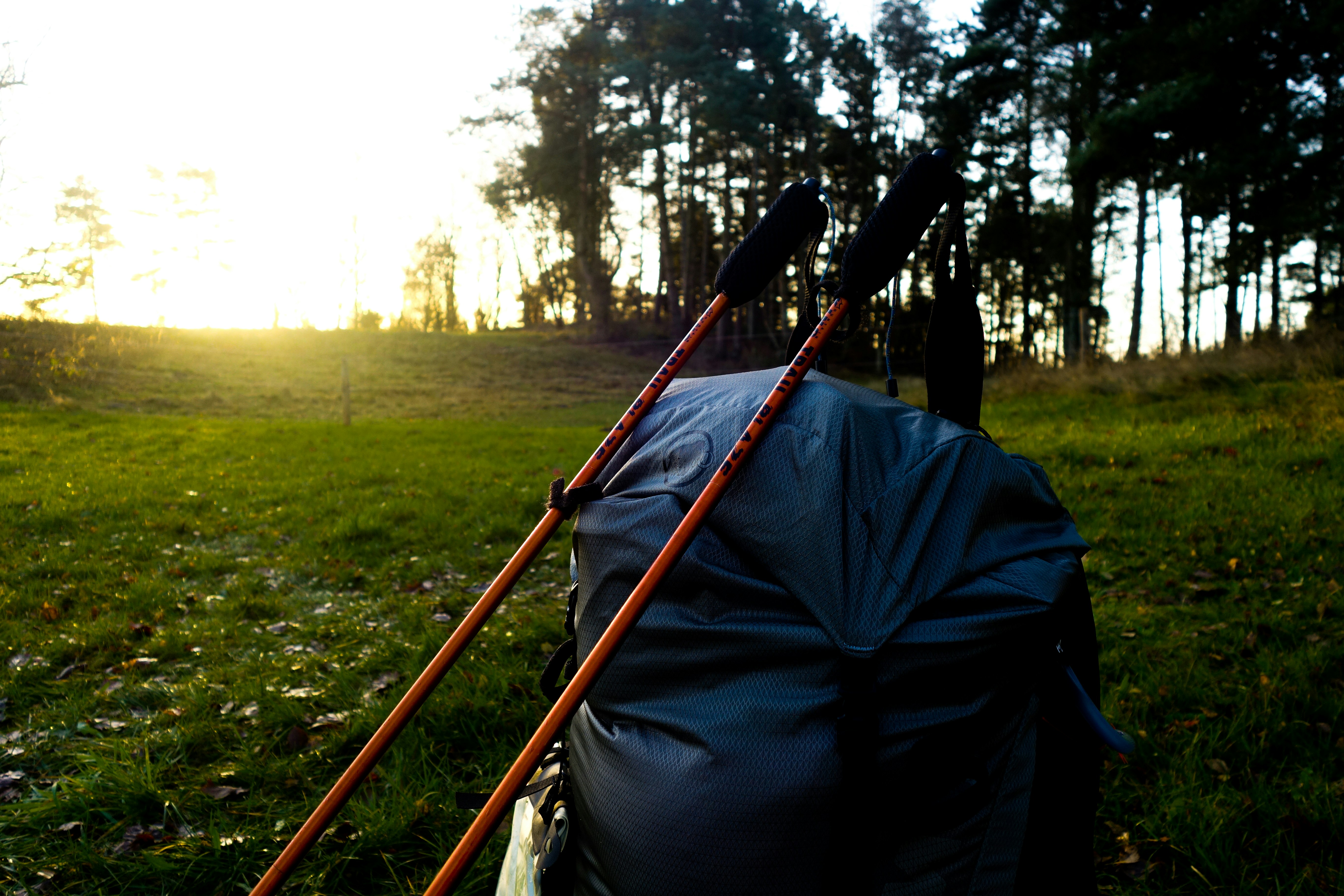
Trekking poles
Reduce effective knee load by 25 percent when carrying a heavier pack.
Common questions about backpack weight
The answer depends on the trip type. For day hiking, aim for under 10 percent of your body weight including water. A 160-pound hiker should target a 12 to 16 pound day pack maximum. For weekend backpacking, target 20 percent of body weight or less, ideally 15 percent. For multi-day backpacking, the same 20 percent cap applies but base weight matters more than total weight because food and water vary by trip length.
It is a useful starting point but not scientifically precise. Physics professor Joshua O’Shea published a more accurate model in 2021 showing that strength scales slower than body weight, meaning lighter hikers can comfortably carry a higher percentage of their weight than heavier hikers can. For most people the 20 percent rule is close enough. For lighter hikers under 130 pounds it underestimates capacity, and for heavier hikers over 220 pounds it overestimates capacity.
Base weight is the weight of your pack with all gear except food, water, and fuel, the consumables that vary by trip length. Backpackers track base weight because it is the part of pack weight you can permanently reduce through gear choices. A traditional backpacker has a 25 to 35 pound base weight. A lightweight backpacker is 15 to 20 pounds. An ultralight backpacker is under 10 pounds. Reducing base weight by one pound saves you that pound on every trip for years.
10 to 20 pounds for most adults, depending on hike length, weather, and the gear required for safety. A short summer day hike on graded trail can be done with 8 to 12 pounds. A full-day hike with the 10 essentials, plenty of water, and weather layers runs 15 to 20 pounds. Above 20 pounds for a day hike usually means overpacking or you are carrying gear someone else should be carrying, like a tent.
For a weekend backpacking trip, 25 to 40 pounds total weight is the typical range, depending on whether you are a traditional or lightweight backpacker. The 20 percent rule sets the upper limit at 30 to 50 pounds for most adults. The actual goal is to keep total weight under that 20 percent cap by reducing base weight, not by skimping on water or food.
Six warning signs. You struggle to lift the pack onto your back without help. You shorten your stride to compensate. Your shoulders or lower back ache within the first hour. You feel pulled backward when standing still. You skip activities at camp because you are too tired. You lose your appetite, a sign of physical overstress. Any two of these on the same trip means the pack is genuinely too heavy and the fix is reducing weight, not pushing through.
Most successful thru-hikers carry 25 to 35 pounds total weight including food and water. Base weight targets are typically 12 to 18 pounds, with ultralight thru-hikers hitting 7 to 10 pounds. The reason thru-hike weights cluster lower than weekend backpacking weights is cumulative miles. Carrying an extra five pounds for two days is unpleasant. Carrying it for two thousand miles is genuinely injurious.
