
Hiking gear explained
Hiking Boots vs Trail Runners
The footwear debate that divides hikers more than any other. The right answer is not one or the other; it is knowing when each wins, and why the choice matters more on some trips than others.
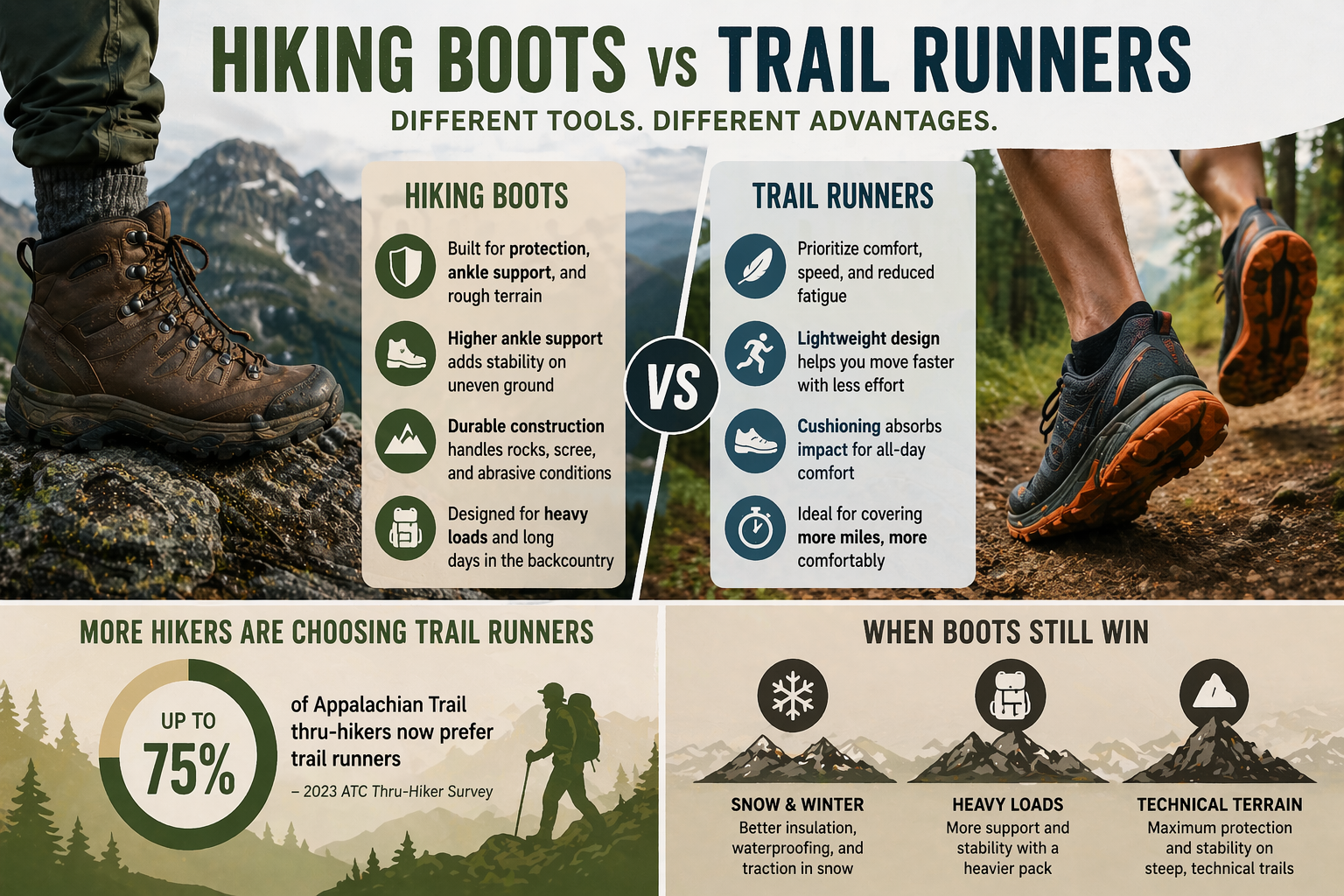
The hiking boots vs trail runners debate has been running for two decades, and it still generates strong opinions from both camps. Longtime boot wearers swear by ankle support and durability. Trail runners and ultralight hikers point to the mounting evidence that lighter footwear is safer and faster. The truth is that both camps are right, in the right context.
The question is not which one is better. It’s which one is better for your specific trip, your pack weight, your terrain, and your feet. Pack weight drives the decision more than most people realize. If you’re still dialing in your load, our guide to how to pack a hiking backpack covers how to get your carry weight down before you choose a shoe. If you’re ready to buy, our guides to the best hiking boots and best trail running shoes for hiking cover the top-ranked options in each category.
1. The Case for Each

- Stiffer midsole supports heavy pack loads
- Higher ankle collar reduces lateral roll risk
- More durable on abrasive rock and scree
- Waterproof options for cold, wet conditions
- Better protection for technical scrambling
- Heavier, typically 1.5 to 3 lbs per pair
- Require 20 to 50 miles of break-in
- Waterproof versions trap heat and sweat
- Less natural foot movement and agility
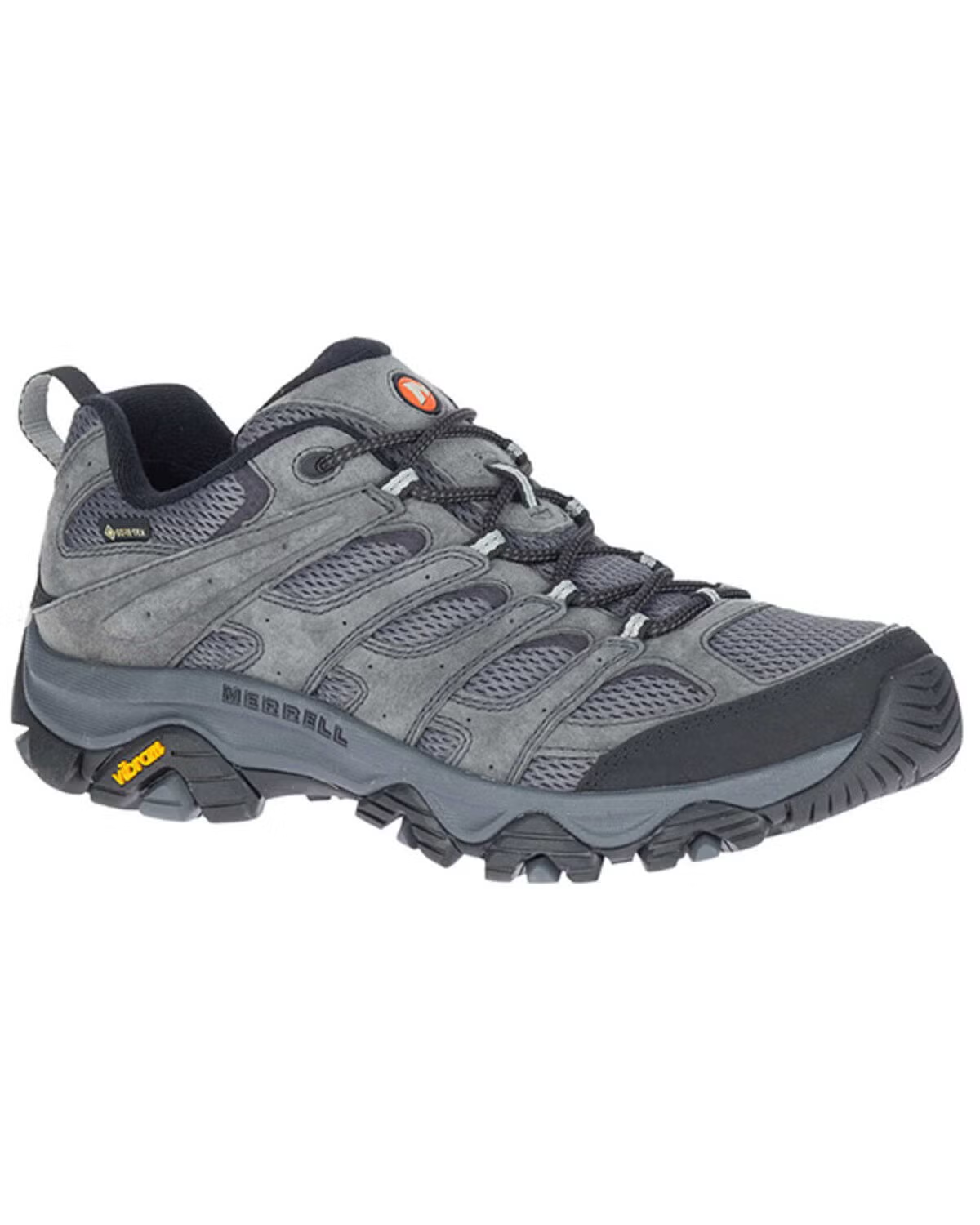
- Lighter, typically 0.8 to 1.5 lbs per pair
- Faster break-in, comfortable almost immediately
- Better ground feel and agility on variable terrain
- Dry quickly after stream crossings
- Natural foot movement reduces fatigue on long days
- Less ankle support under heavy loads
- Wear faster on rough abrasive terrain
- Fewer waterproof options
- Less protective on sustained technical scrambling
2. Key Differences Compared
| Feature | Hiking Boots | Trail Runners |
|---|---|---|
| Weight (per pair) | 1.5 to 3.0 lbs | 0.8 to 1.5 lbs |
| Ankle support | High collar, stiff lateral support | Low cut, relies on foot strength |
| Midsole stiffness | Stiff, better under heavy loads | Flexible, better for natural movement |
| Waterproofing | Common (Gore-Tex, eVent) | Rare, most are breathable mesh |
| Drying speed | Slow (waterproof versions very slow) | Fast, mesh dries in hours |
| Break-in time | 20 to 50 miles | 5 to 10 miles |
| Durability | 500 to 1,000+ miles | 300 to 600 miles |
| Best pack weight | 25 lbs and above | Under 25 lbs |
| Price range | $100 to $300+ | $100 to $200 |
The weight difference matters more than it looks. Each pound on your feet is equivalent to roughly 5 pounds on your back in terms of perceived effort. Switching from a 2.5-pound pair of boots to a 1-pound pair of trail runners is the caloric equivalent of removing 7.5 pounds from your pack over the full day of hiking.
3. Match Your Use Case
Pack weight and terrain type are the two variables that drive the decision more than anything else. Find your situation below.
4. Terrain and Conditions Breakdown
Well-Maintained Forest and Mountain Trails
This is where the debate is genuinely open. On a graded, well-maintained trail with consistent footing, the ankle support advantage of boots largely disappears. Trail runners handle forest paths, switchbacking mountain trails, and compacted dirt surfaces as well as boots, often better, because the lighter weight reduces fatigue over the course of a long day. Most people who switch from boots to trail runners for this type of hiking don’t go back.
Loose Scree, Talus, and Off-Trail Terrain
This is where boots earn their cost. Loose rock requires constant micro-adjustments from the ankle, and a stiff boot with a high collar reduces the energy demand of those adjustments. The stiffer midsole also prevents foot fatigue when stepping from rock to rock over hours of sustained effort. Trail runners work on mild scree, but on sustained loose terrain with any pack weight, boots are the more confident tool.
Stream Crossings
Trail runners are the better option for most stream crossings in warm weather. Waterproof boots keep feet dry on the approach but take hours to dry once they flood. Mesh trail runners get wet instantly but drain and dry within an hour of leaving the water. For cold crossings in early season, waterproof boots keep feet dry on shallow crossings that trail runners won’t.
Winter and Shoulder Season
Stiff leather or insulated hiking boots are the right call for snow travel, post-holing, and conditions that mix ice and mud. They accept microspikes and crampons, which trail runners generally do not. Trail runners in winter conditions outside of dry, groomed trails are the wrong tool for the conditions.
Many experienced hikers keep both in rotation: trail runners for summer day hikes and well-maintained routes, boots for multi-day backpacking trips with a full pack and for anything involving technical terrain or cold-weather conditions.
5. The Waterproof Question
Waterproof boots (Gore-Tex, eVent, or proprietary membranes) are one of the most over-recommended features in hiking footwear. They work well in a specific set of conditions and are a real liability in others.
Waterproof membranes keep moisture out from the outside. They also trap moisture from the inside. On a warm day above 60℉, a waterproof boot will fill with sweat long before any rain soaks through the outer. Non-waterproof trail runners or mesh boots that breathe freely are often more comfortable in warm, wet conditions because the foot stays cooler and the shoe dries faster after any wetting.
Waterproof boots earn their place in cold, wet conditions where the water temperature is low and the air temperature is cold. On a 45℉ shoulder-season trail in persistent drizzle, waterproof boots are the right call. On a 70℉ summer trail that crosses a few streams, they are not.
| Condition | Waterproof Boots | Non-Waterproof / Trail Runners |
|---|---|---|
| Cold rain, below 55℉ | Better, keeps feet warm and dry | Feet get wet and cold, hypothermia risk |
| Warm rain, above 60℉ | Traps sweat, feet wet from inside | Better, breathes and dries faster |
| Shallow stream crossings (below knee) | Feet stay dry | Feet get wet, dry within 1 hour |
| Deep stream crossings (above knee) | Floods and stays wet for hours | Floods and dries within 1 hour |
| Snow travel and post-holing | Significantly better | Inadequate protection |
| Summer day hike with dew on grass | Marginal advantage | Marginal disadvantage, dries quickly |
6. Weight and Break-In
Footwear weight is the most underappreciated variable in hiking comfort. The commonly cited rule is that one pound on your feet equals five pounds on your back in perceived energy expenditure. The number is approximate, but the direction is correct: foot weight is disproportionately tiring.
A typical pair of lightweight trail runners weighs around 550 grams (1.2 lbs). A typical pair of mid-cut hiking boots weighs around 1,100 grams (2.4 lbs). On a 15-mile day, that difference compounds with every step. This is why the ultralight backpacking community moved to trail runners overwhelmingly, and why elite thru-hikers on the PCT and AT almost universally use trail runners rather than boots despite the technical terrain those routes include.
Break-In and Hot Spots
Stiff hiking boots cause blisters on feet that aren’t used to them. The leather and reinforced heel counter need to soften and conform to your specific foot shape before they stop creating pressure points. This process takes real mileage, typically 20 to 50 miles of progressive wear starting with short day hikes. Wearing new boots on a 10-mile hike the first time out is one of the most reliable ways to end a trip early with damaged feet. Fit matters just as much as break-in. See our guide to how hiking boots should fit before you buy.
Trail runners require far less break-in because they are more flexible from the start. Most trail runners feel comfortable within one to three short hikes. You can buy trail runners two weeks before a trip without risk. The same is not true of boots.
Never buy new boots for a long hike without breaking them in first. This applies even to boots from a brand you’ve worn before. Each new model fits slightly differently. A minimum of 5 short hikes (10 to 20 miles total) before any overnight trip is the baseline. For a multi-day route, 30 or more miles of break-in is advisable.
Boots and Trail Runner Picks
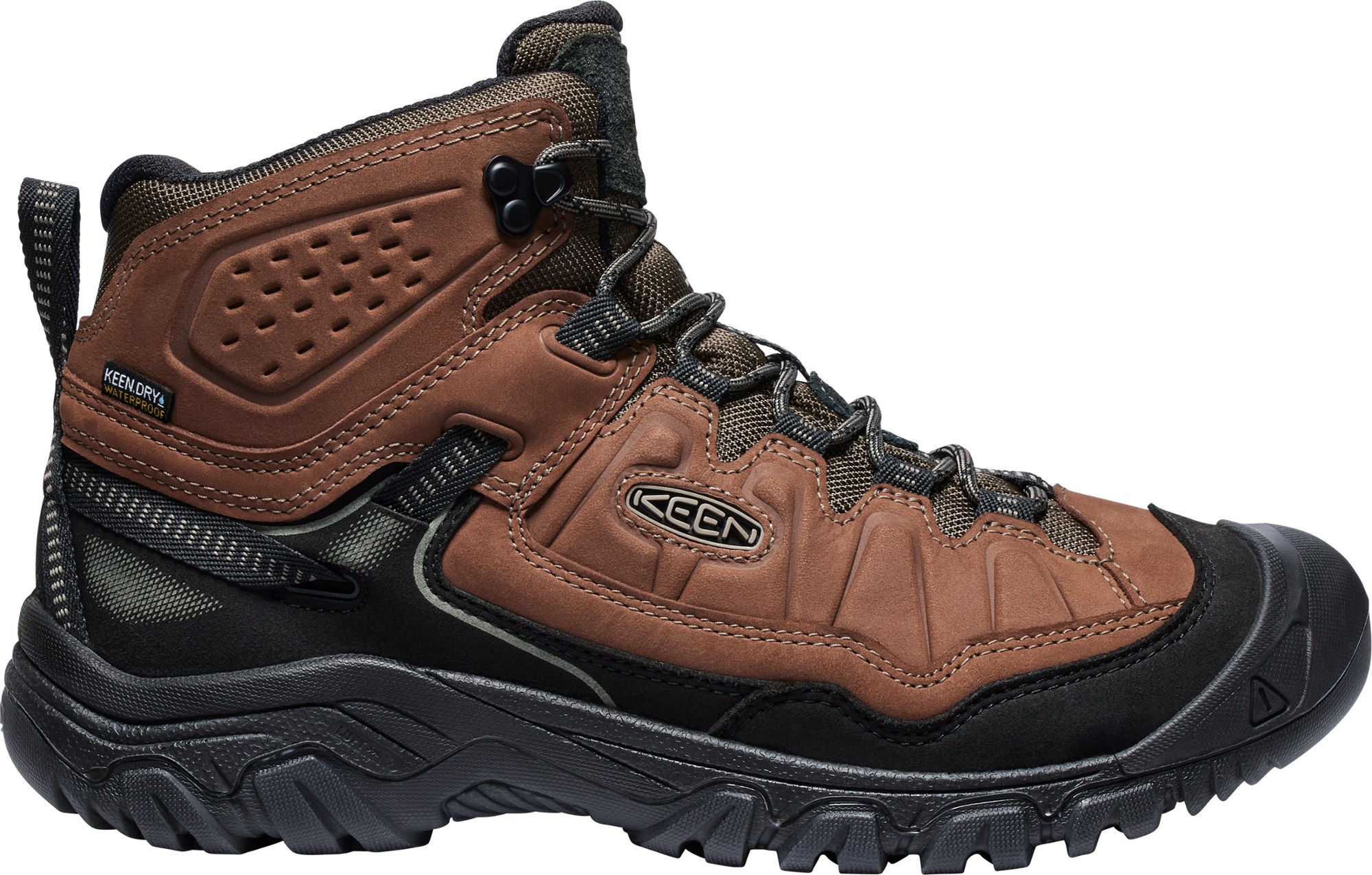
Best Hiking Boots
Top-ranked boots across every category: lightweight, waterproof, wide fit, and budget. Tested on real trail miles.
See picks
Best Trail Running Shoes for Hiking
Trail runners with enough grip, rock protection, and durability for serious hiking. Ranked for hikers, not runners.
See picks
Best Hiking Socks
The right sock matters as much as the right shoe. Merino wool and synthetic options ranked by cushioning and blister resistance.
See picks
How to Choose Hiking Boots
Cut vs mid vs high, leather vs synthetic, waterproof vs non. Everything you need to know before buying a pair of boots.
Read the guideHiking Boots vs Trail Runners FAQs
