
How to Use Binoculars
Six steps cover everything a beginner needs: set your interpupillary distance, calibrate the diopter, adjust eyecups, focus, hold steady, and master the locate-lift technique for finding fast-moving subjects.
Most people who pick up binoculars for the first time see a blurry image with dark edges and assume the pair is poor quality. Nine times out of ten, the pair is fine. The problem is setup. Knowing how to use binoculars correctly takes about ten minutes to learn and makes every pair, cheap or premium, perform the way it is supposed to. This how to use binoculars guide covers all six setup steps plus the field techniques that make a real difference for birding and wildlife watching on Oregon trails.

1. Set the Interpupillary Distance
The interpupillary distance (IPD) is the gap between the two eyepieces, adjusted by hinging the barrels. It needs to match the distance between your pupils or the images from each side will not merge into a single circle and you will see a blurry double view with dark edges.
How to use binoculars to find your IPD: Hold the pair to your eyes with both hands on the barrels and slowly push the barrels closer together or pull them apart. Watch what you see inside. When the two circles of light fully merge into one clean circle with no dark patches on either side, stop. That is your IPD. Most adults fall between 58mm and 72mm. Many binoculars print a millimeter scale on the hinge so you can note your setting and reset quickly if someone else adjusts the pair.
Children typically need a narrower IPD than most binoculars can provide. Many adult full-size pairs do not go narrow enough for children under ten. If the image never fully merges for a young user, a compact pair designed for smaller faces is the better choice.

2. Set the Diopter
The diopter is the separate focusing adjustment, usually a ring or dial on the right eyepiece, that compensates for the difference in vision between your left and right eyes. Almost everyone has some difference in acuity between the two sides. The center focus wheel moves both barrels simultaneously. The diopter adjusts only one side independently. Getting this calibration right is the single most important thing to master when learning how to use binoculars — more than any other adjustment on the pair.
How to Set the Diopter Step by Step
Pick a fixed subject at least 50 yards away with clear detail, such as a sign, a fence post, or the edge of a building. Close or cover your right eye. Using only the center focus wheel, bring the subject to sharp focus through your left eye only. Keep the center wheel where it is. Now switch: close your left eye and look through the right eyepiece only. Turn the diopter ring until the same subject is sharp. Do not touch the center wheel. The reason for this order: you first set the shared focus for your stronger or more typical eye, then independently correct for the difference in your other eye using the diopter. Once both sides are sharp independently, open both eyes. The view should now be sharp and fully merged. You will not need to repeat this unless your vision changes or someone else uses the pair.
Some binoculars have a diopter that clicks or locks into position so it cannot shift accidentally in a bag or pocket. If your pair has this feature, engage the lock after setting. On pairs without a lock, check the diopter setting at the start of each trip.

3. Adjust the Eyecups
Eyecups are the third setup step most people skip entirely when learning how to use binoculars. Getting this wrong is the most common cause of the dark vignette ring (a black circle around the edge of the view) that beginners mistake for poor optics.
Without glasses
Twist or click the eyecups to their fully extended position. Your eye sockets should rest comfortably against the rubber eyecups. This positions your pupil at the correct distance from the eyepiece lens, called the eye relief distance, so you see the complete field of view.
With glasses
Fold or twist the eyecups all the way down to their retracted position. Your glasses bring your eye closer to the lens automatically. If the eyecups are extended while you are wearing glasses, your eyes are too far back and you will see a vignette ring regardless of focus. If you see dark edges with glasses on and eyecups down, the binoculars may have insufficient eye relief for your frame. Look for pairs with at least 15mm of eye relief when buying new glass.
4. How to Focus Binoculars Correctly
Once setup is complete, the rest of how to use binoculars day-to-day comes down to the center focus wheel. Turn it toward you or away from you to shift focus between near and far subjects. Most binoculars need only a small turn of the wheel to move between a bird at 20 feet and one at 200 yards. The feel of the wheel varies by model: some are fast (a quarter turn from near to infinity), others are slower and more precise. Neither is better; it depends on your use case.
Focus for Moving Subjects
Wildlife and birds rarely hold still. Practice continuous focus adjustment by tracking a moving subject, such as a walking dog or a car, and keeping the center wheel turning smoothly as the distance changes. This muscle memory is what separates beginners from experienced users. When you know how to use binoculars well, distance-tracking refocus becomes unconscious.
Minimum Focus Distance
Every pair of binoculars has a minimum focus distance below which it cannot focus. This is usually between 5 and 15 feet. For birding and butterfly watching, pairs that focus down to 5 or 6 feet are noticeably more useful than those that stop at 10 to 15 feet. If you find subjects at close range going blurry no matter how you turn the wheel, you are inside the minimum focus distance. Step back slightly.
5. The Locate-Lift Technique
The locate-lift technique is the most important field skill for anyone who wants to know how to use binoculars effectively for birding or wildlife watching. It solves the most common frustration beginners experience: spending 30 seconds searching through the eyepiece for something they could see clearly with the naked eye.
How It Works
First, spot your subject with your naked eye. Do not look away from it. Note its exact position relative to a fixed anchor point, such as a fork in a branch, the top corner of a rock, or the edge of a bush. Keep your eyes on the subject and raise the binoculars straight to your face. Because your eyes were already pointed at the subject, the binoculars should frame it immediately or require only a tiny adjustment. The key is that you never look away from the subject to check the binoculars first.
Practice Drill
This is the best indoor drill for how to use binoculars: pick a stationary subject like a light switch or a doorknob across the room. Fix your eyes on it. Without looking away, raise the binoculars. The subject should be in frame immediately. Repeat until you can do it consistently in one motion. Then move to outdoor stationary subjects, and finally to slow-moving ones. This drill takes about fifteen minutes and will fundamentally change how you use binoculars in any field situation.
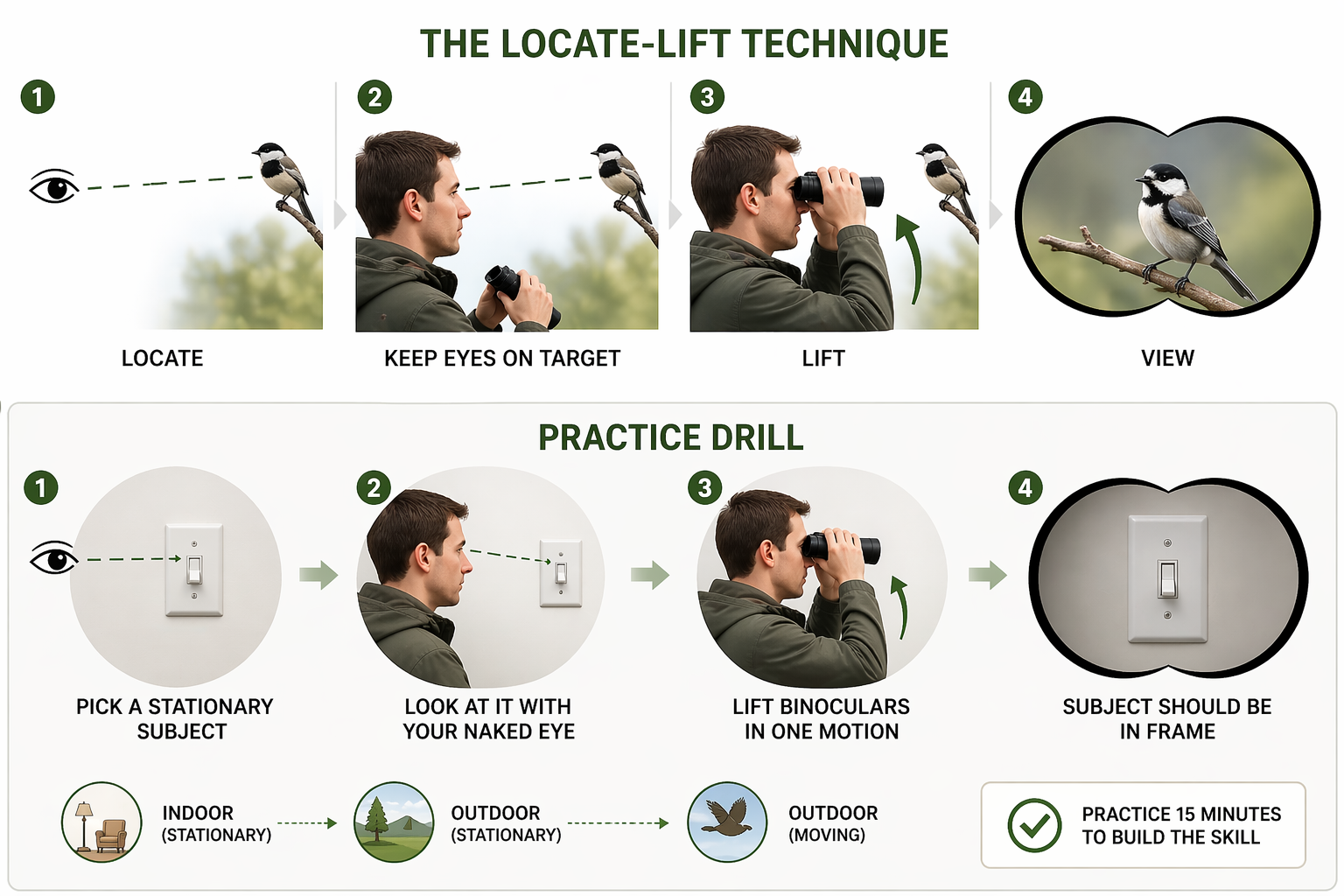
The natural instinct is to look through the binoculars first and then try to find the subject. At 8x or 10x magnification, the field of view is narrow enough that this almost never works. The locate-lift technique bypasses this by using your naked eye, which covers roughly 120 degrees of comfortable binocular vision compared to the 5 to 8 degrees you see through a binocular eyepiece, to do the finding.
6. How to Hold Binoculars Steady
Stability is something beginners rarely think about when learning how to use binoculars, but hand shake is magnified by the same factor as the image. At 8x, mild tremor produces a slightly unsteady view that most people tolerate. At 10x, it becomes noticeably distracting. At 12x and above, handheld use is essentially unusable for fine detail. Here is how to use binoculars as steadily as possible without a tripod. The steadier you are, the more detail you will see at any magnification.
Handheld Technique
Hold the barrels with both hands, wrapping your fingers around the body and resting your thumbs underneath. Pull your elbows in against your chest and upper ribcage. This turns your torso into a brace and reduces shake more than any grip adjustment. Breathe out slowly before focusing on your subject and observe during the pause between breaths.
Using a Rest
For 10x and higher, brace against anything stable: a tree trunk, fence post, car roof, tripod, or the back of a chair. Even resting your forearms on a solid surface dramatically reduces shake. On the Oregon coast for whale watching, brace against a railing or sit with your elbows on your knees. A monopod or lightweight tripod with a binocular adapter is worth carrying if you use 10x or higher regularly.
7. Using Binoculars in Low Light
Dawn and dusk are when most wildlife is most active. Knowing how to use binoculars in low light is a separate skill from daytime use, and it matters more than most beginners expect. Low-light performance depends on two things: the exit pupil of the binoculars and your own eyes.
Exit Pupil and Your Eyes
The exit pupil is the cone of light exiting each eyepiece, calculated by dividing the objective lens diameter by the magnification. An 8×42 has a 5.25mm exit pupil. In dim light, your pupils dilate to 5 to 6mm in most adults. When the exit pupil matches or exceeds your dilated pupil, the binoculars deliver maximum brightness. When the exit pupil is smaller than your dilated pupil (as with compact 8×25 binoculars at 3.1mm), the image will look noticeably darker at dawn and dusk.
Technique for Low Light
Give your eyes five to ten minutes to dark-adapt before trying to find subjects at dawn or dusk. Avoid looking at your phone screen during this window. The Audubon Society recommends arriving at your birding site before first light and allowing full dark adaptation before scanning. Hold the binoculars as steady as possible since shake is more visible against a dim background. Scan slowly. Moving your head in a steady pattern covers more area than fast random movements.
8. Common Mistakes to Avoid
These are the mistakes that come up most often when people are first learning how to use binoculars correctly, and they are all easy to fix once you know what to look for.
- Never setting the diopter. Most people pick up binoculars and go straight to the center wheel. Without a diopter setting, one eye is always slightly out of focus and you compensate without realizing it, causing eye strain over time.
- Searching through the eyepiece. See the locate-lift section above. Looking through the binoculars first and then hunting for the subject is slow and frustrating. Spot with naked eye first, always.
- Wrong eyecup position for glasses. Eyecups extended while wearing glasses will always produce a dark vignette ring. Fold them down completely.
- Holding only with one hand. Two hands with elbows in is dramatically more stable. One-handed use is for pointing, not observing.
- Too much magnification for the use. Beginners often assume more power is better. At 10x and above, hand shake is visible, field of view narrows, and finding subjects becomes harder. 8x is the right starting point for most uses.
- Not refocusing for distance changes. When a bird moves from 20 feet to 100 yards, the focus changes significantly. Keep your finger on the center wheel whenever tracking a moving subject.
Find the Right Pair for Your Use Case
Once you know how to use binoculars correctly, the next step is making sure you have the right pair for your activity. Every pick in these roundups has been tested on Oregon trails and along the coast. No brand pays for placement.

How to Use Binoculars FAQs
Set the diopter first. Close your right eye and use the center wheel to focus on a fixed distant subject through the left eye only. Then close your left eye and use the diopter ring (right eyepiece) to sharpen the same subject without touching the center wheel. After this one-time calibration, use only the center wheel for all future focusing. The diopter corrects for the difference in vision between your eyes so both barrels are sharp simultaneously.
The diopter is a separate adjustment ring, usually on the right eyepiece, that corrects for the difference in acuity between your left and right eyes. The center focus wheel moves both eyepieces at once. The diopter adjusts only one side to fine-tune the balance. You set it once. Many pairs have a lockable diopter so the setting does not shift in a bag. If you know how to use binoculars but still experience eye strain after extended use, an incorrectly set diopter is almost always the cause.
Master the locate-lift technique. Spot the bird with your naked eye and note its position against a fixed landmark. Keep your eyes on it and raise the binoculars straight to your face without looking away. Do not look through the binoculars first and then search for the bird. Practice on stationary subjects until the motion is automatic. For beginners, 8×42 binoculars work best because the wide field of view makes it easier to find and follow birds. Cornell Lab’s All About Birds is a free resource for identifying what you spot once you have the technique down.
A dark vignette ring means your eye is too far from the eyepiece. If you wear glasses, fold or twist the eyecups fully down so your glasses bring your eye closer to the lens. If you do not wear glasses, make sure eyecups are fully extended and pressed gently against your eye sockets. Insufficient eye relief on the binoculars themselves (below 14mm) can also cause this for eyeglass wearers regardless of eyecup position.
Use both hands with elbows pulled in against your chest. This turns your torso into a brace and is far more effective than grip alone. Breathe out slowly before observing. For 10x and above, brace against a tree, fence post, car roof, or use a monopod. Sitting with elbows on knees is one of the most stable handheld positions available. Above 12x, a tripod or window mount is needed for a usable image.
Hold the binoculars to your eyes and hinge the barrels apart or together until you see one single merged circle of light with no dark edges on either side. If you see two overlapping circles, the distance is set too wide or too narrow. Most adults fall between 58mm and 72mm. The number on the hinge scale is your IPD. Note it so you can reset quickly if someone else uses your pair.
