
Exploring Hug Point State Recreation Site
A short beach walk at low tide reveals a 25 foot waterfall pouring onto the sand, two sea caves carved by centuries of surf, and the wagon ruts where 1890s stagecoaches rounded the headland.
Trail Stats
Hug Point State Recreation Site packs more Oregon Coast story per yard than almost anywhere else on Highway 101. A 25 foot seasonal waterfall pours straight onto the sand. Two sea caves carve into the sandstone headland. Tidepools fill at the base of the cliff with starfish, anemones, and small crabs. And running through the rock just above the surf line are the chiseled ruts of an 1890s stagecoach route, the reason the place is called Hug Point in the first place.
The walk itself is short and flat: about 0.7 miles round trip from the parking lot, with a 30 foot drop down to the beach and then easy sand the rest of the way. Most people finish it in 30 to 45 minutes including time at the waterfall and caves. The catch is the tide. Everything past the main beach is locked behind a headland the surf wraps around, so you need a tide of +2 feet or lower to safely round the point.
The wagon road that hugged the cliff
Before Highway 101 ran the length of the coast, the only path between Cannon Beach and Arch Cape was the beach itself. Stagecoaches and freight wagons ran the wet sand at low tide, and at Hug Point they had to hug the rock face to round the headland. Even at low water it was a tight, dangerous stretch. In the 1890s a road crew chiseled a narrow shelf into the sandstone cliff so wagons could keep moving when the tide pushed in too far. The shelf is still there. So are the parallel grooves the wagon wheels carved into the rock, just above where the surf reaches today.
Getting there & parking
Hug Point sits on the west side of Highway 101, roughly 5 miles south of Cannon Beach and 3 miles north of Arch Cape. The pullout is signed but easy to miss at speed. The drive from Portland is about 1 hour 45 minutes via Highway 26 and 101.
Hug Point State Recreation Site, 80424 Oregon Coast Hwy, Arch Cape, OR 97102
Driving directions
From Portland to Hug Point
- From Portland, take US-26 W for about 73 miles toward the coast.
- At the junction with Highway 101 near Cannon Beach, turn south on US-101.
- Drive about 5 miles south of Cannon Beach, past Tolovana Park and Arcadia Beach.
- Look for the signed Hug Point State Recreation Site pullout on the right (west) side of the highway near milepost 35.
- Turn into the day-use lot. Restrooms are at the lot. The trail to the beach starts at the far end.
Parking note: The lot holds about 25 cars and a few overflow spots along the entrance road. It fills on weekends, holidays, and most summer afternoons. Mornings on a falling tide are the easiest time to find a space. There is no overnight parking and no fee.
Trail walkthrough, stage by stage
The route is a beach walk, not a trail. Here is what to expect from the parking lot to the waterfall and back.
Parking lot to the sand
From the day-use lot, a short staircase and dirt path drop about 30 feet to the beach. The path is signed and well-trodden. At the bottom you step out onto a wide stretch of fine sand, with the headland visible to the north. This first stretch is suitable for nearly anyone, including kids and most strollers if the sand is firm.
North toward the headland
Turn north on the beach and walk roughly 0.25 miles toward the rocky point. As you get closer, look up at the cliff base. A narrow horizontal shelf appears in the sandstone, about 6 to 8 feet above the wet sand. That is the 1890s wagon road. You can usually see the parallel ruts where iron-rimmed wheels carved into the soft rock. Touch the surface and you will feel how easily the cliff erodes, which is why the road needed re-cutting almost every winter. The ruts run parallel along the length of the shelf, narrow-gauge by modern standards: about a wagon’s width apart, not a car’s, which makes the original scale of the route easy to picture.
Round the point to the waterfall
Just past the wagon shelf, the cliff bends and Fall Creek pours over the edge in a thin sheet onto the beach. The drop is about 25 feet. In late winter and spring the flow is heavy enough to feel the spray from 20 feet away. By August it can be down to a trickle. A small green ravine opens behind the falls, and you can scramble up partway to see the source if conditions allow. The plunge pool at the base is shallow and gets rinsed out with each tide, so it is not a swimming hole, but kids love poking at the foam line where the freshwater meets the surf.
Stage 4: The sea caves
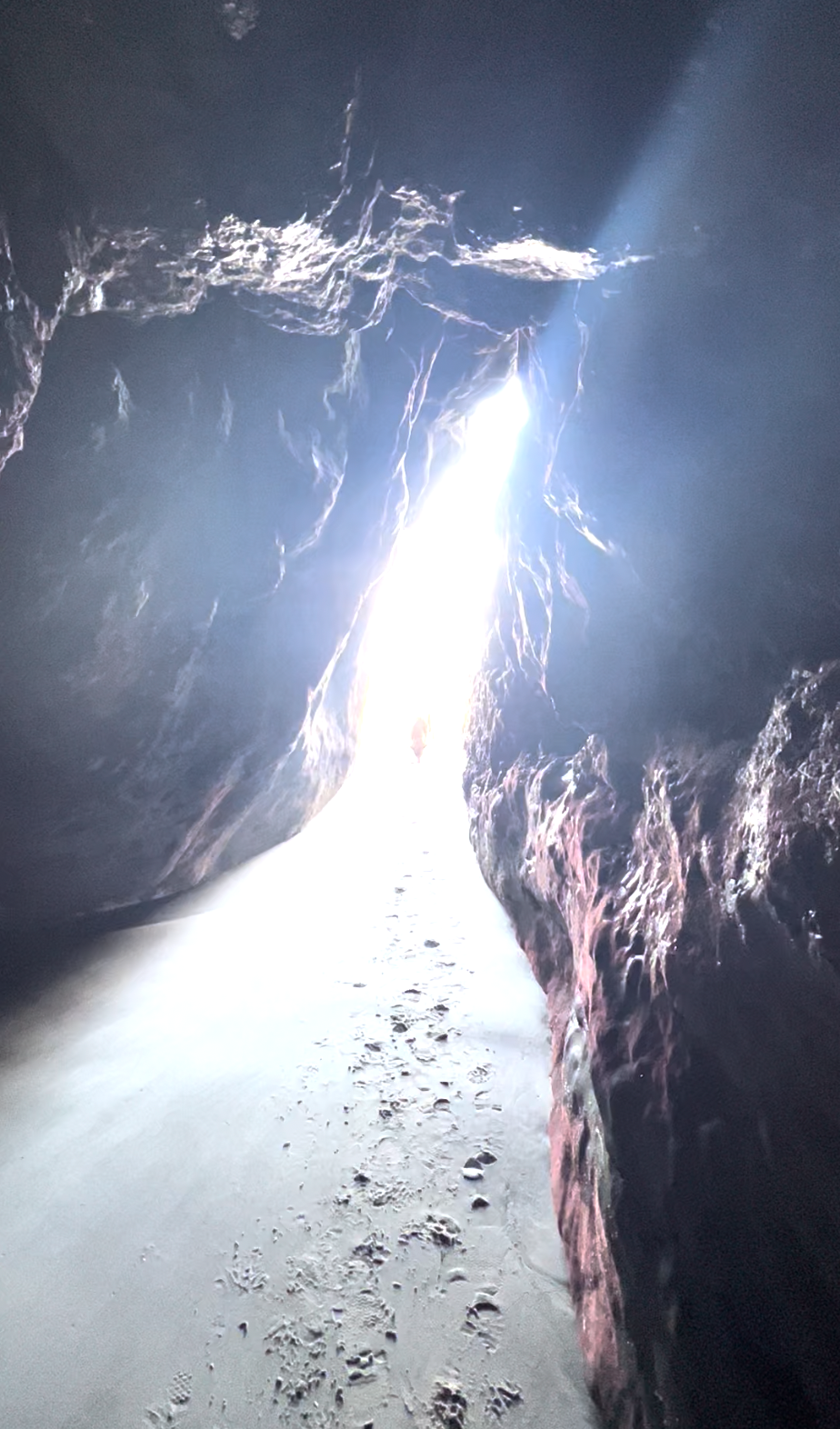
Just past the waterfall, two sea caves cut into the same headland. The first is a tall, narrow passage of textured sandstone walls. The second is a shorter, brighter chamber with light coming through both ends. Both are walk-through, not technical. A headlamp helps you see the rock detail and any small crabs or pools at your feet. Both caves stay dry at low tide but begin filling with a few inches of water as the tide turns. That standing water is your cue to head back to the parking-lot side of the headland.

Best time to visit
Hug Point works year-round, but the experience changes a lot by season. The single biggest factor is when the daytime low tides line up with daylight and dry weather.
| Season | Months | Conditions | Verdict |
|---|---|---|---|
| Spring | Mar to May | Strong waterfall, mild weather, great wildflowers above the cliffs. Some big surf days. | |
| Summer | Jun to Aug | Warmest weather, most reliable midday low tides, busiest crowds. Waterfall flow tapers by August. | |
| Fall | Sep to Oct | Quiet beaches, returning rain rebuilds the falls, dramatic light. Watch for sneaker waves with rising swells. | |
| Winter | Nov to Feb | Biggest waterfall flow of the year. Storm surf, fewer safe tide windows, and most low tides happen at night. |
For the best photos, aim for a morning low tide with overcast skies. Direct midday sun blows out the contrast between the bright sand and the shaded cave walls. Sunset shots from the main beach can be stunning, but only if the tide is still going out, never coming in.
Safety: tides at Hug Point
Check the tide before you go, every time
The waterfall, caves, and wagon ruts all sit at the base of Hug Point itself, the headland on the north end of the cove. The ocean wraps around it at higher tides. People get cut off here every year. Plan your visit so you reach the headland at least 90 minutes before the next high tide, and start back as soon as the tide turns. A tide of +2 feet or lower is the working window. Above that, the surf reaches the cliff base.
Use the NOAA tide chart for Cannon Beach or Tillamook Head, not the generic Oregon Coast forecast. If you are caught by an incoming tide, do not try to swim or wait it out at the cliff. Move back toward the parking lot beach immediately, or in a real emergency, scramble straight up to Highway 101 above. The bluff above Hug Point is steep but survivable on foot.
Sneaker waves are also a real risk on this stretch of coast. Even on a calm day a single rogue swell can travel 50 feet farther up the beach than the rest. Keep kids out of the surf zone and never turn your back on the ocean while photographing the cliffs.
Tidepooling at Hug Point
Hug Point has some of the more accessible tidepools on the north Oregon Coast. They cluster along the rocky base of the headland and inside the first cave, where the rock holds water between tides. At a really low tide, you can find ochre sea stars in shades of orange and purple, green and pink anemones the size of your palm, mossy chitons, hermit crabs, mussels, and the occasional gunnel fish hiding under a fold of seaweed.

Tidepool etiquette matters here. Step only on bare rock, never on living organisms. Touch with one wet finger, never lift animals out of their pool, and put any rocks you flip back exactly as you found them. The pools at Hug Point look bulletproof, but the same hermit crabs and sea stars get visited by thousands of curious hands every summer. If you bring kids, the one-finger rule is the easiest thing to teach.
Drones are not permitted in Oregon State Parks during daytime hours without a permit, so leave the aerial shots for adjacent federal beaches. A polarizing filter on a regular camera or phone does more for tidepool photos than any drone, since it cuts the surface glare and lets you see the colors below the waterline.
Hiking with dogs
Dogs are welcome at Hug Point on a leash. The whole route is sand, easy on most paws, and the surf gives water dogs a payday. Two things to watch: the rocky base of the headland is encrusted in sharp barnacles that can cut pads, and the wet rocks inside the caves get slick. If your dog is barefoot and excitable, keep the leash short on the headland sections and steer them onto the sand wherever possible.
Rinse your dog after, ideally in fresh water before the drive home. Salt and small bits of shell work into paw pads and ear creases and can irritate skin overnight. The lot does not have a dog-rinse station, but most beach access points along Highway 101 between Hug Point and Cannon Beach have one within 10 minutes.
What to pack for Hug Point
This is a short walk on a forgiving beach, so the pack list is light. The big upgrades for Hug Point specifically are footwear that handles wet sand, a headlamp for the caves, and a rain shell for the marine layer.
Nearby trails to combine
Hug Point pairs naturally with other north coast stops. Both of these sit within a 30 minute drive and round out a full day on the coast.
More Oregon Coast hikes
If you have time on the way down or up the coast, these three pair well with a Hug Point morning.
Frequently asked questions
Is Hug Point currently open?
Why is it called Hug Point?
How long is the trail at Hug Point?
Do you need to go at low tide?
Is there a fee to visit Hug Point?
Are dogs allowed at Hug Point?
Can you see the waterfall at high tide?
Are there caves at Hug Point?
How far is Hug Point from Cannon Beach?
Is Hug Point good for kids?
When is the best time to visit Hug Point?
Last updated: May 2026 · Trail conditions and tide windows change daily. Verify with the Oregon State Parks Hug Point page and the NOAA tide chart for Cannon Beach before you go.