Camp gear field guide
The Best Camping Tents
Twenty-two camping tents across six categories: family cabin, backpacking, instant pop-up, inflatable, four-season hot tent, and budget dome. Every pick is a tent we would actually grab off the rack ourselves for that scenario, no brand pays for placement.
Quick Picks: The Top 5 in 30 Seconds
If you are shopping in a hurry, these five cover most family and backpacking buying intent. Tap a card to grab the best price on Amazon.
Find Your Tent
Four questions, one personalized pick from our 22. No email, no signup.
Your match
Answer the questions above
We will recommend the right tent from our 22 picks.
Check price on Amazon →Our 22 Top Best Camping Tent Picks for 2026
Twenty-two tents across six categories. Each pick is a tent we would actually grab off the rack ourselves for that scenario, scored on a 100-point trail score across weather protection, livability, setup, build quality, and value.
Best Family Camping Tents
Five family cabins, ranging from the classic Coleman lineup to the modern HIKERGARDEN and the truly large group KTT. All five fit four to fourteen sleepers depending on variant. The choice between them comes down to brand support, layout, and screened-porch needs.
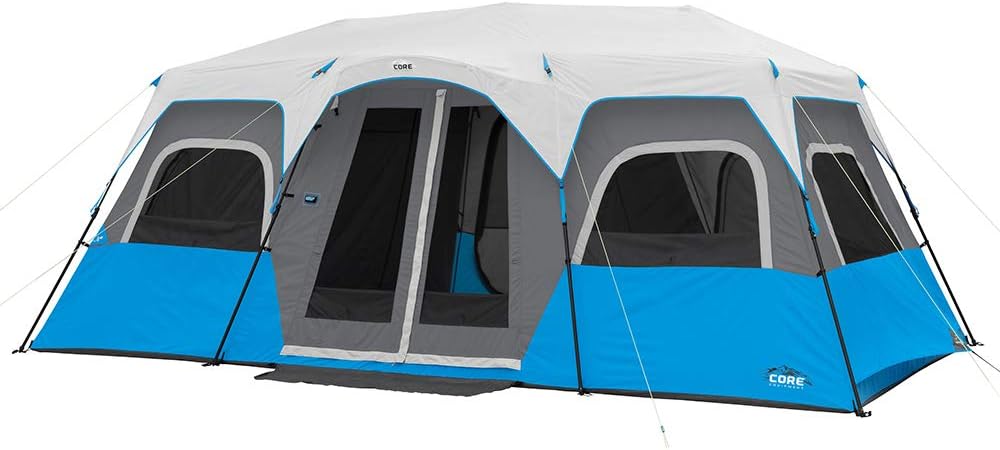
Best Multi-Room Family Tent: Coleman 8-Person LED Cabin
Two rooms, integrated LED lighting, 75-square-foot footprint
Pros
- Genuine two-room layout with hanging divider gives parents and kids real privacy
- Built-in LED ceiling lights run on batteries, no lantern needed inside
- Stand-up height across nearly the full footprint, not just the center
- Coleman WeatherTec sealed-corner floor system handles heavy rain reliably
Cons
- Heavy at over 20 pounds, car camping only
- Fiberglass pole sections in the door arch are the typical Coleman weak point
- Single main door creates traffic bottlenecks with 8 occupants
The Coleman 8-Person LED Cabin earns the multi-room family pick because it actually delivers what families ask for: separate sleeping zones, lights you do not have to remember to bring, and a footprint that fits real adults standing upright. The hanging divider is removable so you can use the tent as one big room when you want to.
The Coleman WeatherTec system, with welded floor corners and inverted seams, has been on Coleman tents for years and works as advertised. The compromise is the fiberglass pole sections in the entryway arch, which Coleman has known issues with and which most reviewers replace once after a few seasons. We do not see this as a dealbreaker at this price.
| Capacity | 8 person, 2 rooms |
|---|---|
| Weight (packed) | 21 lb 8 oz |
| Peak height | 6 ft 8 in |
| Floor dimensions | 13 x 9 ft |
| Packed size | 26 x 9 x 9 in |
| Frame | Steel + fiberglass hybrid |
| Fabric | 75D polyester body, Polyguard |
| Season rating | 3-season |
| Setup time | 15 min |
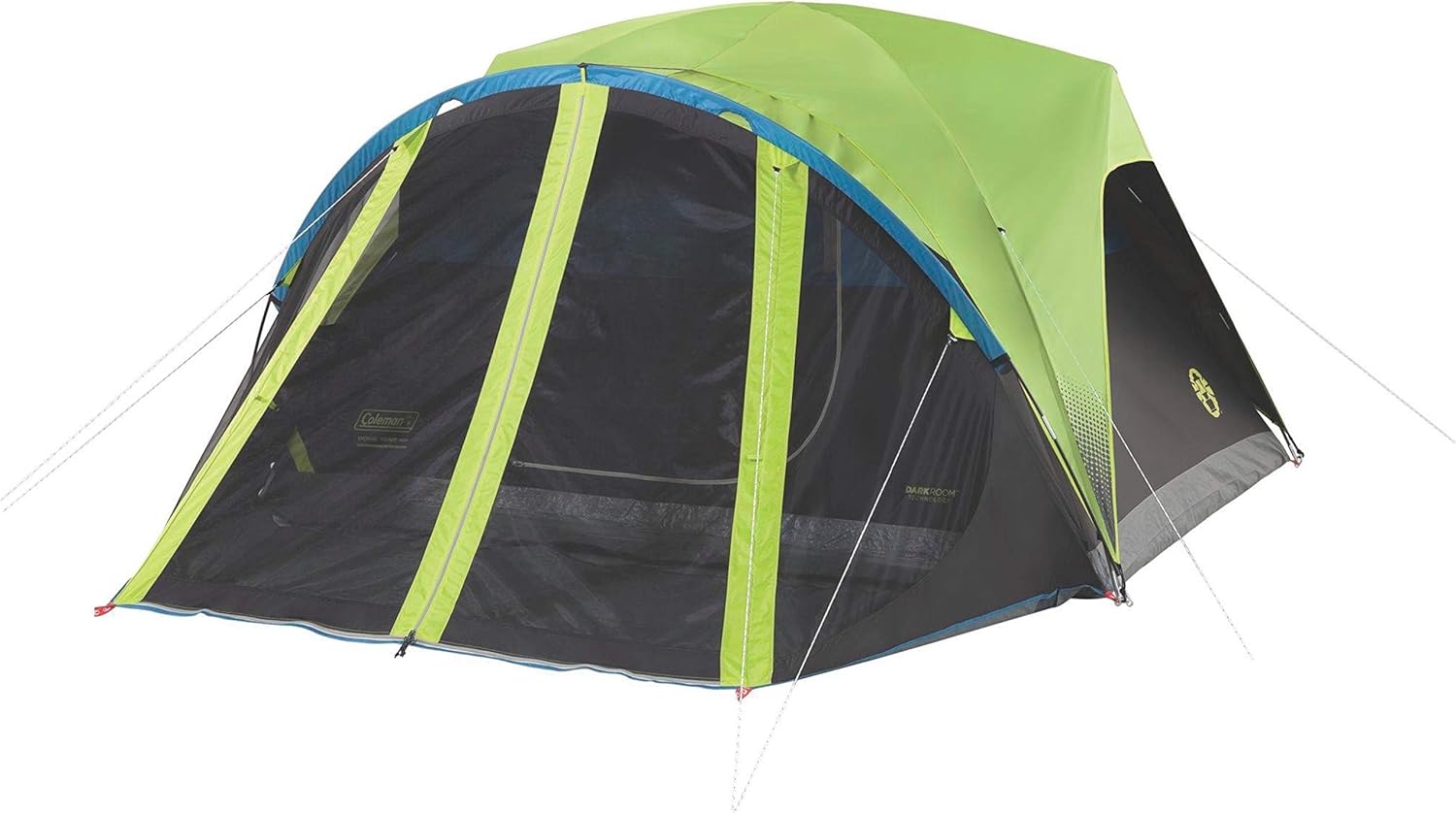
Best Family Tent with Screened Porch: Coleman Carlsbad Dark Room
Dark Room tech blocks 90% of sunlight, full-floor screen room for bug-free lounging
Pros
- Dark Room coating blocks 90% of sunlight, useful for late sleepers and naps with kids
- Full-floor screen room can convert into bonus sleeping space on dry nights
- Reduces interior heat measurably compared to a same-size standard Coleman
- Illumiline reflective guy lines stop nighttime trips to the bathroom from being a hazard
Cons
- Rainfly does not extend over the screen porch, so the porch floods in heavy rain
- Fiberglass poles are typical Coleman, expect to source replacements eventually
- The 4-person version has limited peak height and you cannot stand inside it
The Carlsbad Dark Room solves a problem most family tents ignore: light management. Anyone who has tried to nap a toddler in a regular tent at 2 PM knows. The Dark Room coating drops interior light enough to make daytime sleep possible, and the screen porch gives you a bug-free zone to eat, change, or stage gear without tracking dirt into the sleeping area.
The screen porch limitation is real and worth understanding before you buy. The rainfly stops at the inner-tent wall, so the porch floor pools water during a sustained Pacific Northwest downpour. We treated the porch as a fair-weather feature and used the main tent body for any wet-night sleeping. With that expectation set the Carlsbad punches above its price.
| Capacity | 4 or 6 person |
|---|---|
| Weight (packed) | 21 lb 5 oz |
| Peak height | 5 ft 8 in (6P), 4 ft 11 in (4P) |
| Floor dimensions | 14 x 10 ft (6P) |
| Packed size | 28 x 11 x 11 in |
| Frame | Fiberglass, Fast Pitch system |
| Fabric | Polyester with Dark Room coating |
| Season rating | 3-season |
| Setup time | 5 to 10 min |
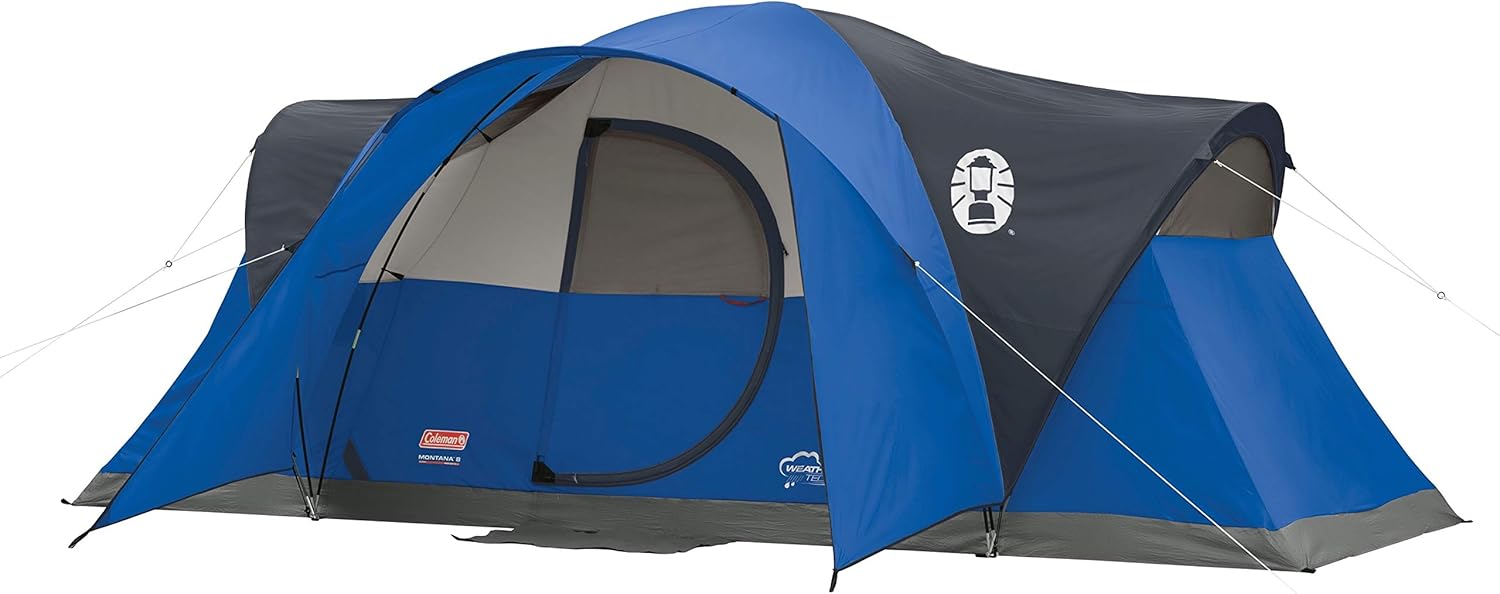
Best Coleman Family Cabin Tent: Coleman Montana 6/8P
Hinged D-door, stand-up center, 4,591 verified Amazon reviews
Pros
- Hinged D-door is the standout feature, no zipper choreography to get in and out
- Tall 6 ft 2 in peak fits adults standing upright in the center zone
- 1000D polyethylene bathtub floor is heavy duty and survives rocky sites
- Massive review pool gives this tent the strongest trust signal in its class
Cons
- Single door for 6 to 8 occupants creates traffic in the morning
- Reverse-angle side windows must stay open for ventilation but leak in driving rain
- Fiberglass shock-corded poles can snap, replacements available but planning required
- Not freestanding, requires staking to hold its shape
The Coleman Montana has been on the market long enough that the early-life manufacturing issues are well documented and the design has been refined. The depth of verified Amazon reviews for this model is exceptional, and that depth is the strongest reliability signal a tent buyer can use. The hinged D-door is the kind of refinement that distinguishes a good tent from a tent that gets sold off after one season.
The 1000D polyethylene bathtub floor is the same material commercial tarp manufacturers use, and it walls up four to five inches around the perimeter to handle puddled water. Pair with a footprint and this tent will outlast the family that bought it. The tradeoff for the price is the fiberglass pole system, which performs fine in calm weather and 15 mph wind but is the first thing to inspect after any storm.
| Capacity | 6 or 8 person |
|---|---|
| Weight (packed) | 24 lb 8 oz |
| Peak height | 6 ft 2 in |
| Floor dimensions | 16 x 7 ft (8P) |
| Packed size | 27 x 9 x 9 in |
| Frame | 7 fiberglass poles, color-coded |
| Fabric | 75D polyester taffeta fly, 1000D PE bathtub floor |
| Season rating | 3-season |
| Setup time | 15 min |
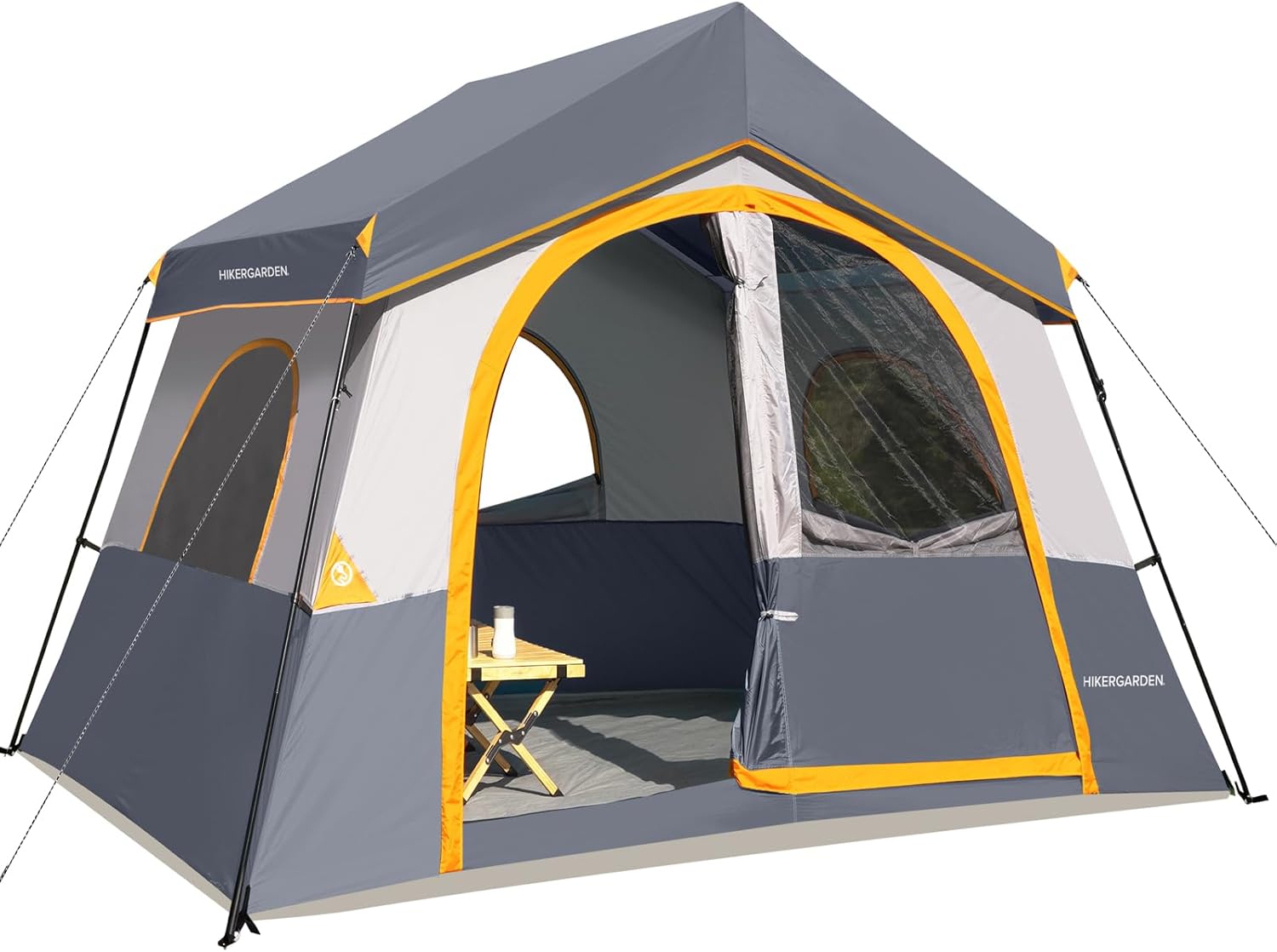
Best 6-Person Family Tent: HIKERGARDEN 6-8 Person
Lighter than the equivalent Coleman, taller peak, double-door
Pros
- Significantly lighter than a comparable Coleman cabin, easier solo loading
- Two doors prevent the bottleneck Coleman Montana suffers from
- PU3000 waterproof coating outperforms most tents in the same price range
- Center peak height fits adults standing upright across most of the floor
Cons
- Brand reputation is newer than Coleman, parts and warranty support less robust
- Pin-and-ring fittings on the poles need careful seating to avoid bending
- Capacity rating is generous, plan for 4 to 5 adults plus gear, not 8
HIKERGARDEN is part of the wave of Asia-direct outdoor brands that have used Amazon to bypass the traditional dealer-and-distribution model. The result is a tent that costs about the same as the equivalent Coleman but has more modern materials, particularly the PU3000 fly that meaningfully outperforms the older Coleman fabrics in driven rain.
The pin-and-ring pole connectors are a small upgrade you notice every time you pitch the tent. They lock with a satisfying click and do not fight you the way the friction sleeves on cheaper tents do. The trade-off is brand depth, you will not walk into a Bi-Mart and find replacement HIKERGARDEN poles. For a family who buys a tent every five years or so, that compromise is acceptable for the build improvement.
| Capacity | 6 to 8 person |
|---|---|
| Weight (packed) | 17 lb 12 oz |
| Peak height | 6 ft 5 in |
| Floor dimensions | 14 x 9 ft |
| Packed size | 26 x 8 x 8 in |
| Frame | Fiberglass with steel pin-and-ring |
| Fabric | 185T polyester with PU3000 coating |
| Season rating | 3-season |
| Setup time | 10 to 15 min |
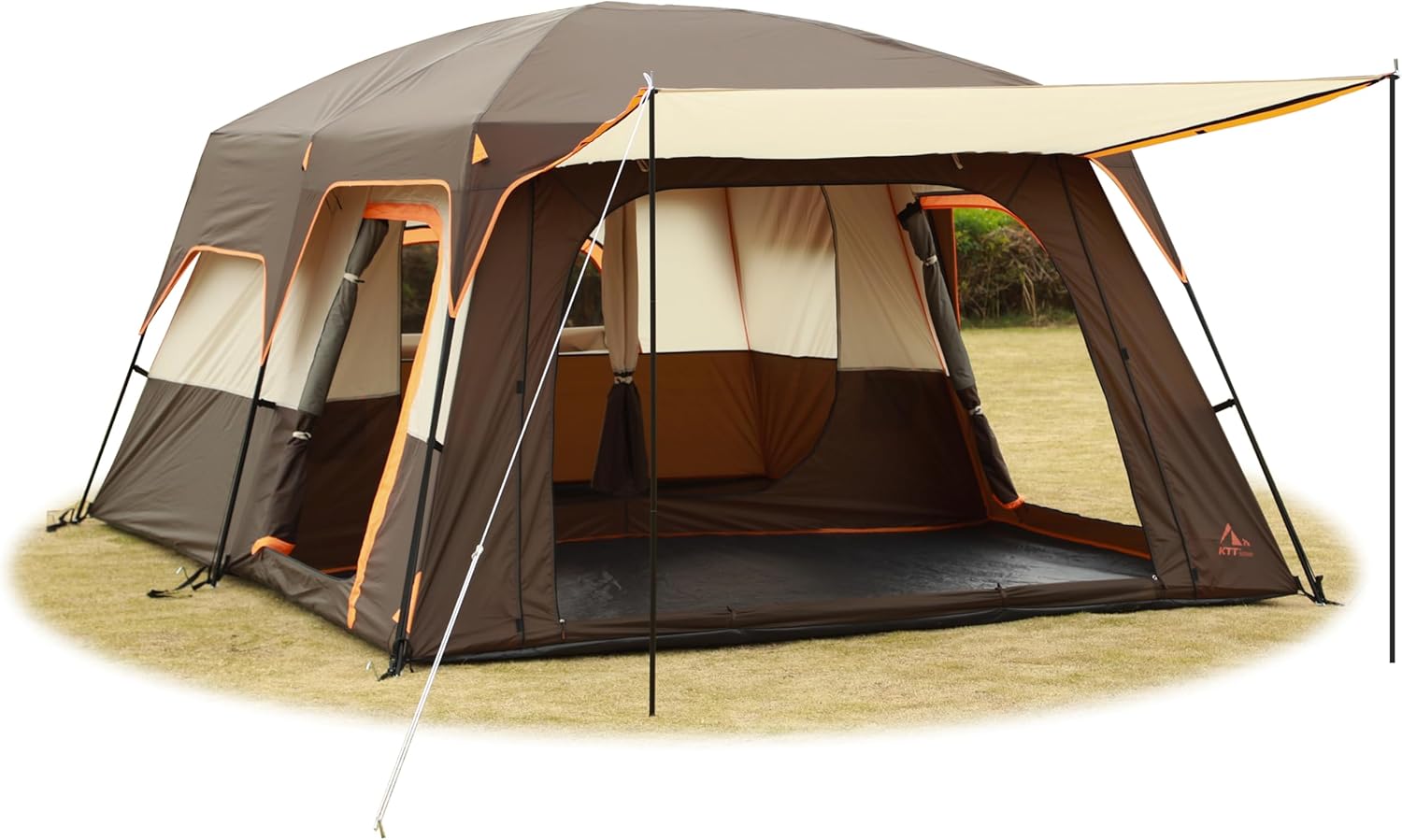
Best Large Group Tent (10-14P): KTT Extra Large 10-14P
Three-room layout, true stand-up height, group camping or extended family
Pros
- True three-room layout with two solid dividers, genuine privacy for adults and kids
- Stand-up height across most of the floor, you can move around without ducking
- 210D Oxford with PU3000 outperforms most large-tent fly fabrics
- Large mesh windows on every wall give cross-ventilation that matters in summer
Cons
- Setup is genuinely a two-person, twenty-five-minute job
- At 32 pounds packed, this is a tent you stage from a vehicle, period
- The fiberglass pole network has a lot of failure points, inspect before every trip
- Brand support is thin compared to Coleman or REI, parts come from Amazon resellers
Large group tents in the 10-plus person bracket all share the same fundamental tradeoff: floor area buys you weight and complexity. The KTT handles that tradeoff better than most by using genuine room dividers (not just curtains) and a steeper roof line that preserves usable interior volume rather than collapsing toward the sides.
The 210D Oxford fly is the spec to notice. Most tents this size use a thinner fabric to keep packed size and weight manageable, and the result is a fly that flaps loud and leaks in sustained rain. KTT chose the heavier fabric and the tent feels markedly more solid in 25 mph wind. The brand-depth concern remains valid, treat this as a tent you buy for one specific use case, not as a 15-year heirloom.
| Capacity | 10 to 14 person |
|---|---|
| Weight (packed) | 32 lb |
| Peak height | 7 ft 3 in |
| Floor dimensions | 20 x 10 ft, 3 rooms |
| Packed size | 32 x 11 x 11 in |
| Frame | Fiberglass with steel reinforcement |
| Fabric | 210D Oxford with PU3000 coating |
| Season rating | 3-season |
| Setup time | 20 to 25 min |
Best Backpacking Tents
Four backpacking tents for solo through four-person trips. Big Agnes is the premium option, Naturehike and ALPS are the value plays, and Kelty handles the four-person group case where one tent is preferable to two.
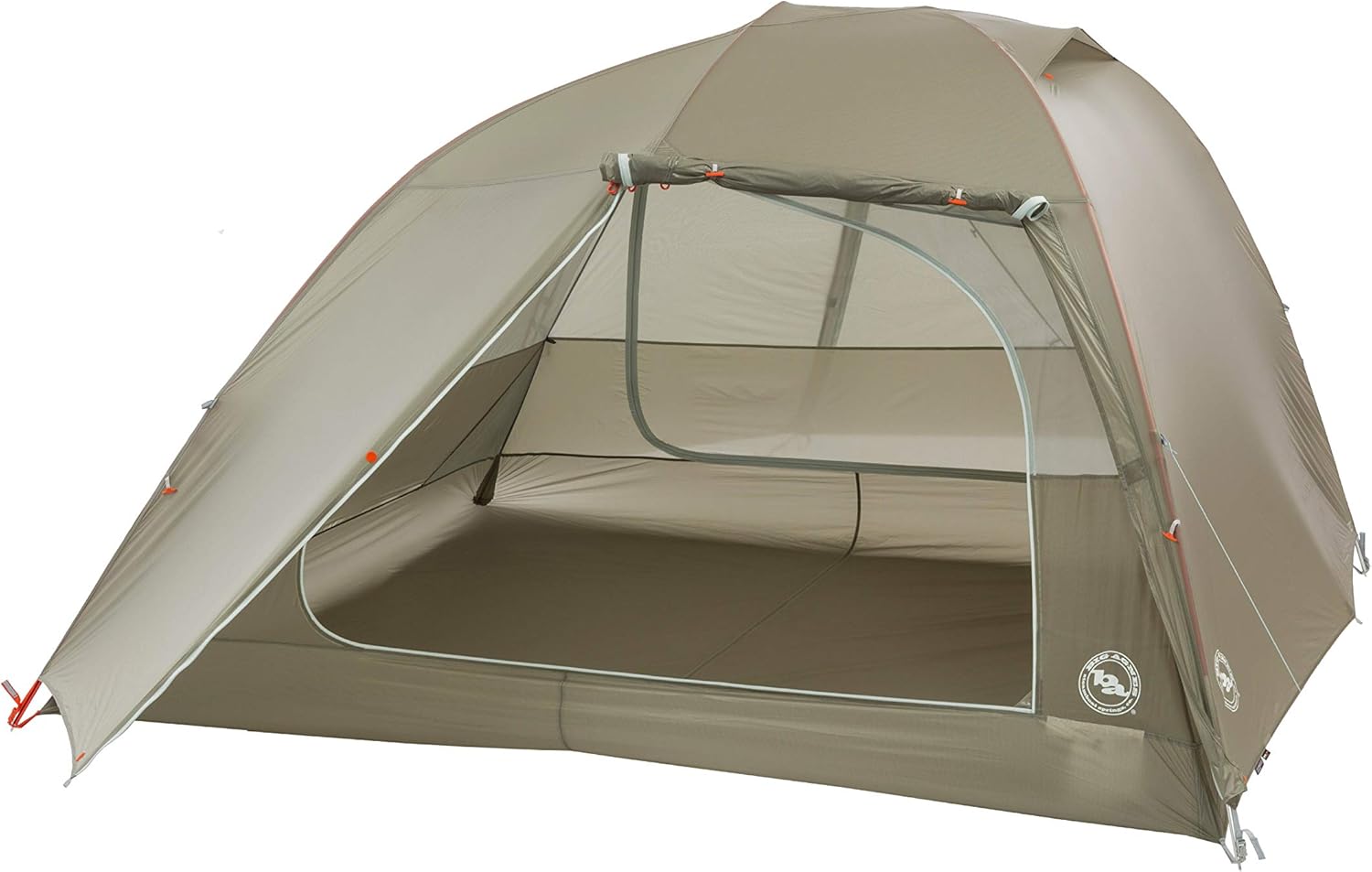
Best Premium Ultralight Backpacking Tent: Big Agnes Copper Spur HV UL2
The benchmark ultralight 2P, sub-3.5 pound packed, true freestanding
Pros
- Sub 3.5 pound packed weight makes this practical for true backpacking, not car-camping with shoulder straps
- DAC Featherlite NSL poles are the gold standard for backpacking pole quality
- Hub-and-pole design pitches in five minutes solo and stands freely
- Steep walls and 40-inch peak give more usable interior volume than the spec suggests
Cons
- Premium pricing, this is the splurge entry in our backpacking lineup
- 20D nylon body is thin, demands a footprint and care with sharp ground debris
- Vestibule space is modest, two large packs eat the entire vestibule on each side
The Copper Spur HV UL2 has been the benchmark ultralight 2P backpacking tent for several model years and the current generation refines it without changing the formula. Big Agnes uses DAC poles, which are the same poles MSR and other premium brands use, and the difference between DAC and the no-name aluminum alternates is genuinely noticeable in the field.
This is a 3-season tent designed for backpacking, not winter camping. If you are headed into snow or sustained sub-freezing temperatures, the Copper Spur is the wrong choice and the OneTigris Stella is our pick. For everything from spring shoulder season through fall in the Cascades, the Copper Spur is the tent we recommend more often than any other on this page.
| Capacity | 2 person |
|---|---|
| Weight (packed) | 3 lb 2 oz |
| Peak height | 3 ft 4 in |
| Floor dimensions | 88 x 52/42 in |
| Packed size | 6 x 19 in |
| Frame | DAC Featherlite NSL aluminum |
| Fabric | 20D ripstop nylon, silicone treated |
| Season rating | 3-season |
| Setup time | 5 min |
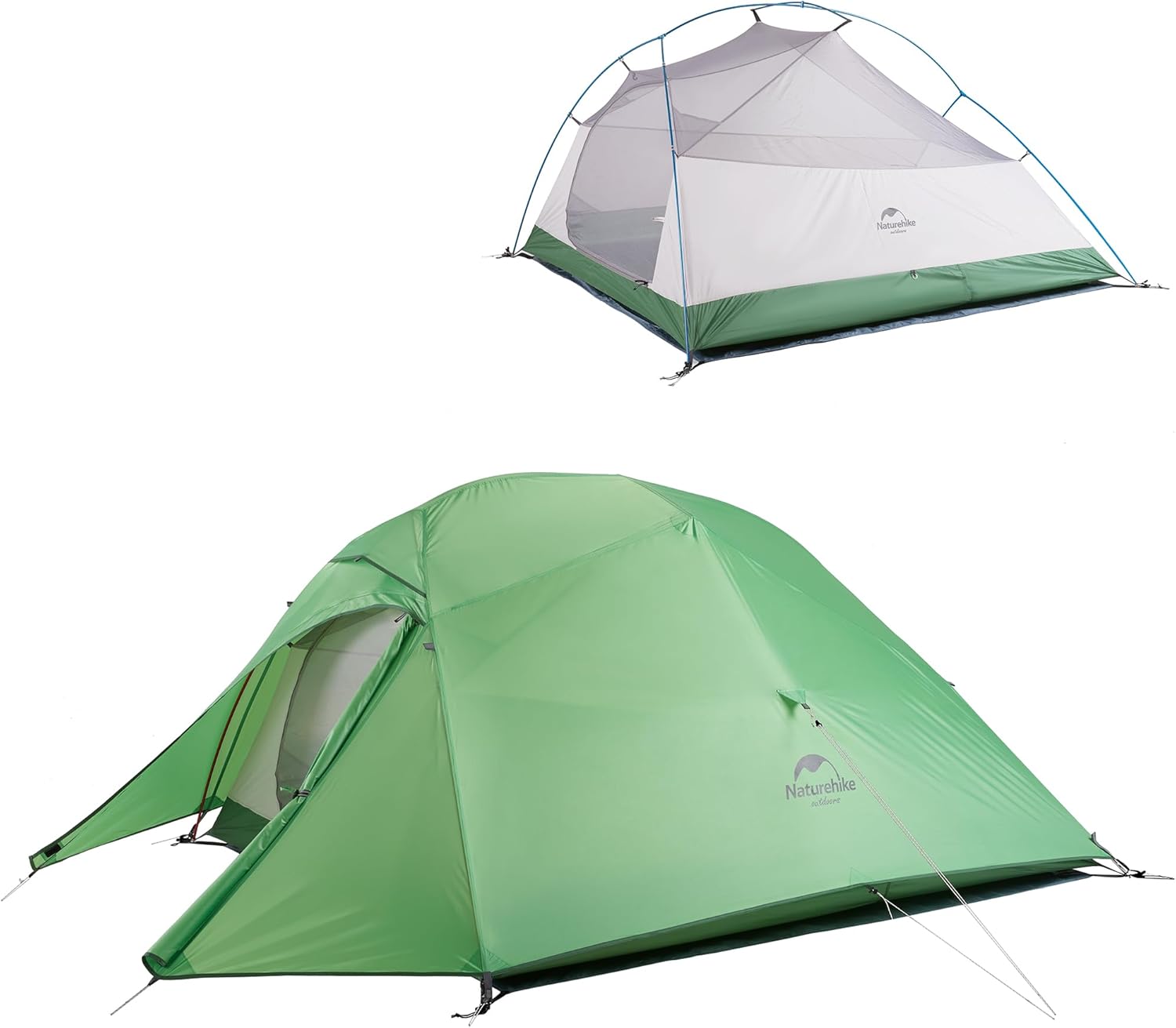
Best Value Lightweight Backpacking Tent: Naturehike Cloud Up 2
The Big Agnes alternative at one fifth the price, real backpacking tent
Pros
- Genuinely competitive backpacking weight at a fraction of the Big Agnes price
- 7001 aluminum poles are not DAC but are entirely adequate for 3-season use
- Massive Amazon review pool gives buyers substantial reliability data before purchase
- Footprint is included, which is rare at this price tier
Cons
- Quality control is variable, occasional buyers report seam-tape inconsistencies
- Ventilation is less effective than premium options, condensation in humid conditions
- Brand support and warranty path are international, slower than US-based competitors
Naturehike has spent the last several years climbing the credibility curve for budget backpacking gear and the Cloud Up 2 is their flagship. The build is not Big Agnes, but it is also a fifth of the price, and for buyers who are not putting hundreds of nights a year on a tent, the math works.
The practical case for the Cloud Up over a Big Agnes is straightforward. If you backpack a few times a year and a tent might sit in a closet for nine months, a budget-tier tent is the right tool. The Big Agnes earns its premium for buyers who treat tents as primary gear. Both are right answers for the right person.
| Capacity | 2 person |
|---|---|
| Weight (packed) | 3 lb 14 oz |
| Peak height | 3 ft 5 in |
| Floor dimensions | 83 x 49 in |
| Packed size | 7 x 16 in |
| Frame | 7001 aluminum |
| Fabric | 20D ripstop nylon with silicone |
| Season rating | 3-season |
| Setup time | 5 to 7 min |
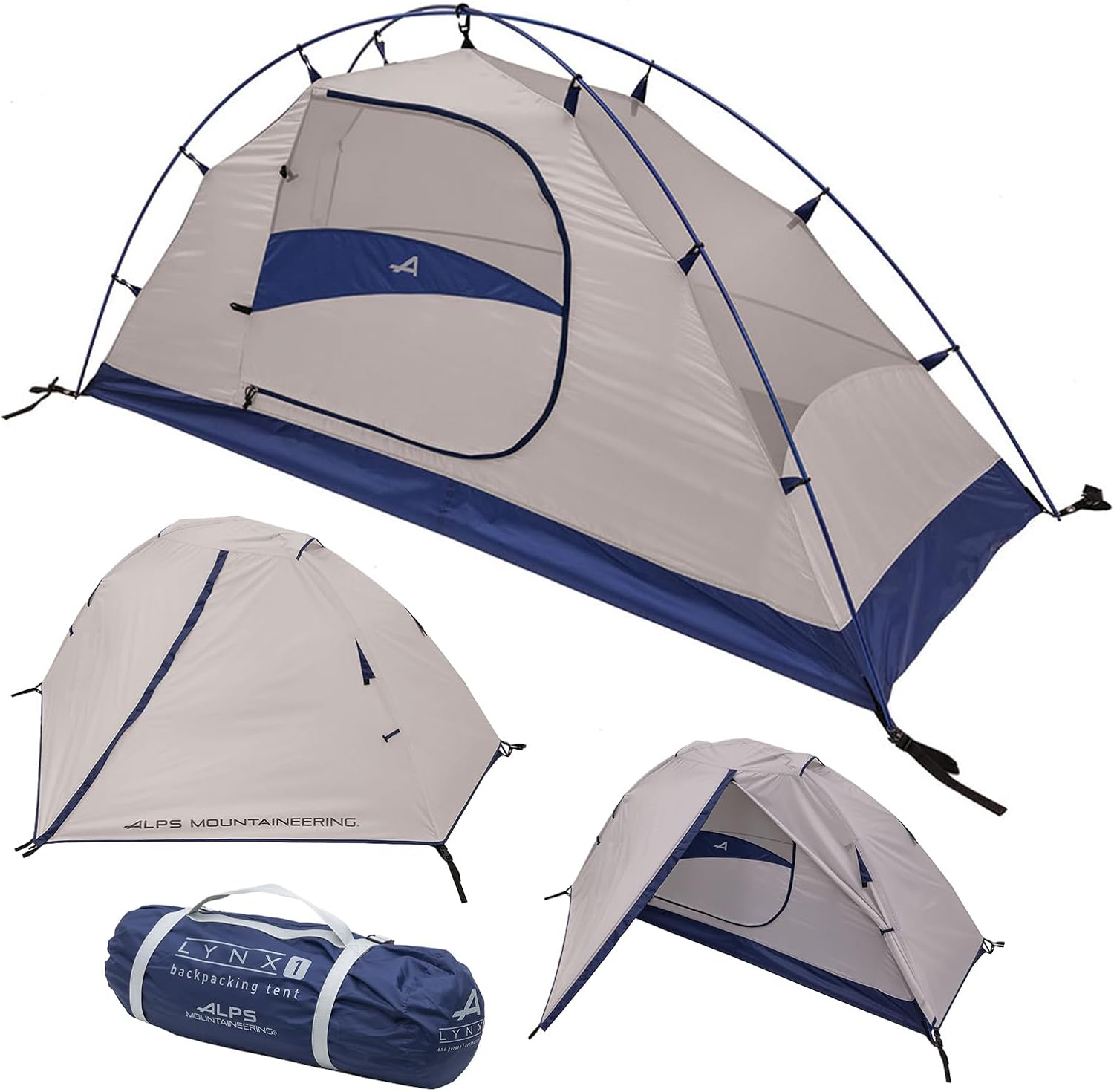
Best Solo Backpacking Tent: ALPS Mountaineering Lynx 1
Honest solo tent, taller peak than most 1Ps, fairly priced
Pros
- Heavier denier fabrics than ultralight competitors, more durable for repeated trips
- Genuinely tall enough at 36 inches to sit upright, not crawl-only
- Two-pole simple geometry pitches in five minutes regardless of fatigue
- ALPS warranty path through US distribution channels, faster claims than Asia-direct
Cons
- A pound heavier than ultralight 1P alternatives, weight nerds will object
- Single side door, no rear vent, manage condensation actively
- Vestibule is small, you cannot stage a full pack inside in driving rain
Solo backpacking tents split into two camps: ultralight gram-counters and mid-weight workhorses. The Lynx 1 is the workhorse pick. At about 4 pounds it gives up to a pound to the lightest competitors but earns it back in fabric weight, and most solo backpackers do not actually optimize for the last 15 ounces.
The ALPS heritage matters here. This is a brand that has been making no-frills outdoor gear since the 1990s and the QC reflects that institutional knowledge. You are not buying the latest material breakthrough, you are buying a tent that will work the same way on its 50th pitch as it does on its first.
| Capacity | 1 person |
|---|---|
| Weight (packed) | 4 lb 1 oz |
| Peak height | 3 ft |
| Floor dimensions | 88 x 36 in |
| Packed size | 5 x 17 in |
| Frame | 7000 aluminum |
| Fabric | 75D polyester fly, 75D nylon floor |
| Season rating | 3-season |
| Setup time | 5 min |
Best 4-Person Backpacking Tent: Kelty Late Start 4P
The honest 4P backpacker, splits across packs, packs small per person

Pros
- Splits across two packs at under 4 pounds each for group backpacking
- Pre-bent aluminum poles maximize floor space without adding weight
- Color-coded clip-on construction makes setup fast and forgiving
- Kelty US warranty path, parts available stateside if anything fails
Cons
- Single vestibule, four people fight for shoe storage in rain
- 88-inch wide floor is tight with four full-size adults
- Lower review count than the rest of the backpacking lineup, less long-term data
Backpacking tents in the 4-person size range are rare because the math is hard, you need a tent light enough to actually carry but big enough to fit four adults. The Late Start hits the balance by using pre-bent aluminum poles that maximize usable floor area without lengthening the pole assembly.
The practical use case is group trips where one tent is preferable to two. Splitting the Late Start between two packs means each person carries about 3.5 pounds, less than a typical 2-person tent split between solo carriers. For a family of four where the kids can carry a few pounds each, this becomes the family backpacking tent.
| Capacity | 4 person |
|---|---|
| Weight (packed) | 7 lb 3 oz |
| Peak height | 4 ft 4 in |
| Floor dimensions | 94 x 88 in |
| Packed size | 8 x 22 in |
| Frame | 6.4 mm pre-bent aluminum |
| Fabric | 68D polyester ripstop |
| Season rating | 3-season |
| Setup time | 7 min |
Best Instant and Pop-Up Tents
Three instant tents covering the speed-of-setup spectrum. CORE for proven long-term durability, FanttikOutdoor for the fastest credible pitch in our test, and Alpha Camp for genuine festival and beach toss-and-deploy use.
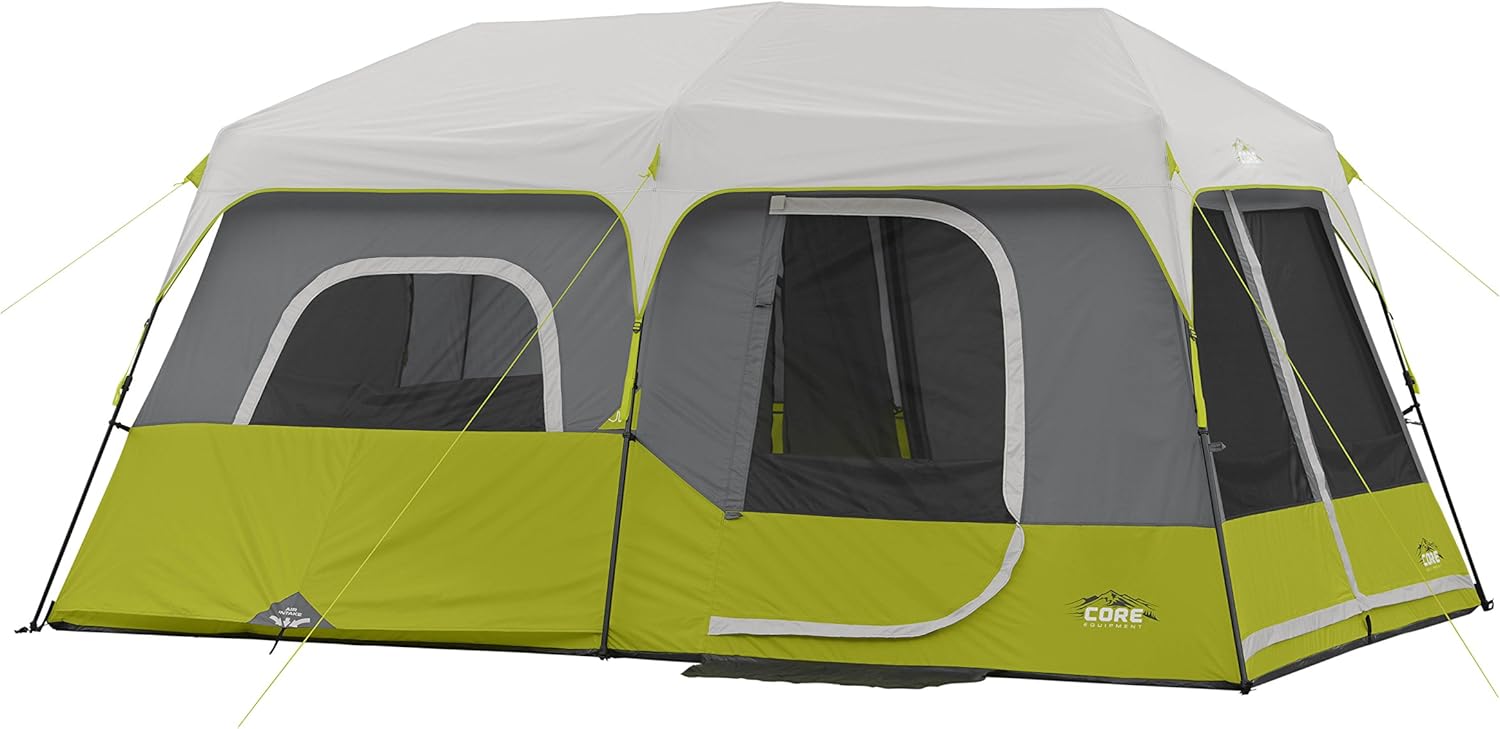
Best Overall Instant Cabin Tent: CORE 9-Person Instant Cabin
Fastest credible setup in the category, biggest review pool on Amazon
Pros
- Steel pole frame, more durable in wind than fiberglass instant alternatives
- Genuine 2-minute deployment with two people, six minutes solo for first pitch
- Room divider creates two separate sleeping zones
- Largest verified review pool of any instant cabin on Amazon, strong reliability signal
Cons
- Heavy at 36 pounds, this is a tent you wheel from car to site
- No tub-style floor, plan for a footprint or tarp underneath
- Pre-attached poles cannot be field-replaced if a section bends
- Marketed dimensions (14 x 9) measure slightly under (13 ft 6 in x 8 ft 9 in) per multiple bought-and-tested reviewers
CORE built its reputation on instant tents and the 9-person model is the flagship. The Instant Hub Technology unfolds the pole frame in one motion, like opening an inverted umbrella, and the body is already attached. Two people get this from carry-bag to staked-out in under five minutes once you have done it once.
The steel pole choice is what separates CORE from the cheaper instant tents. Fiberglass instant tents fail at the pole hubs after one good wind storm. Steel adds weight, and that is the real tradeoff, but it survives. The depth of accumulated Amazon reviews on this model is the longest-running reliability signal in the instant-cabin category, and that signal is real.
| Capacity | 9 person, 2 rooms |
|---|---|
| Weight (packed) | 36 lb |
| Peak height | 6 ft 6 in |
| Floor dimensions | 14 x 9 ft |
| Packed size | 48 x 11 x 11 in |
| Frame | 6 telescopic steel poles, pre-attached |
| Fabric | 68D 190T polyester body and fly |
| Season rating | 3-season |
| Setup time | 2 to 6 min |
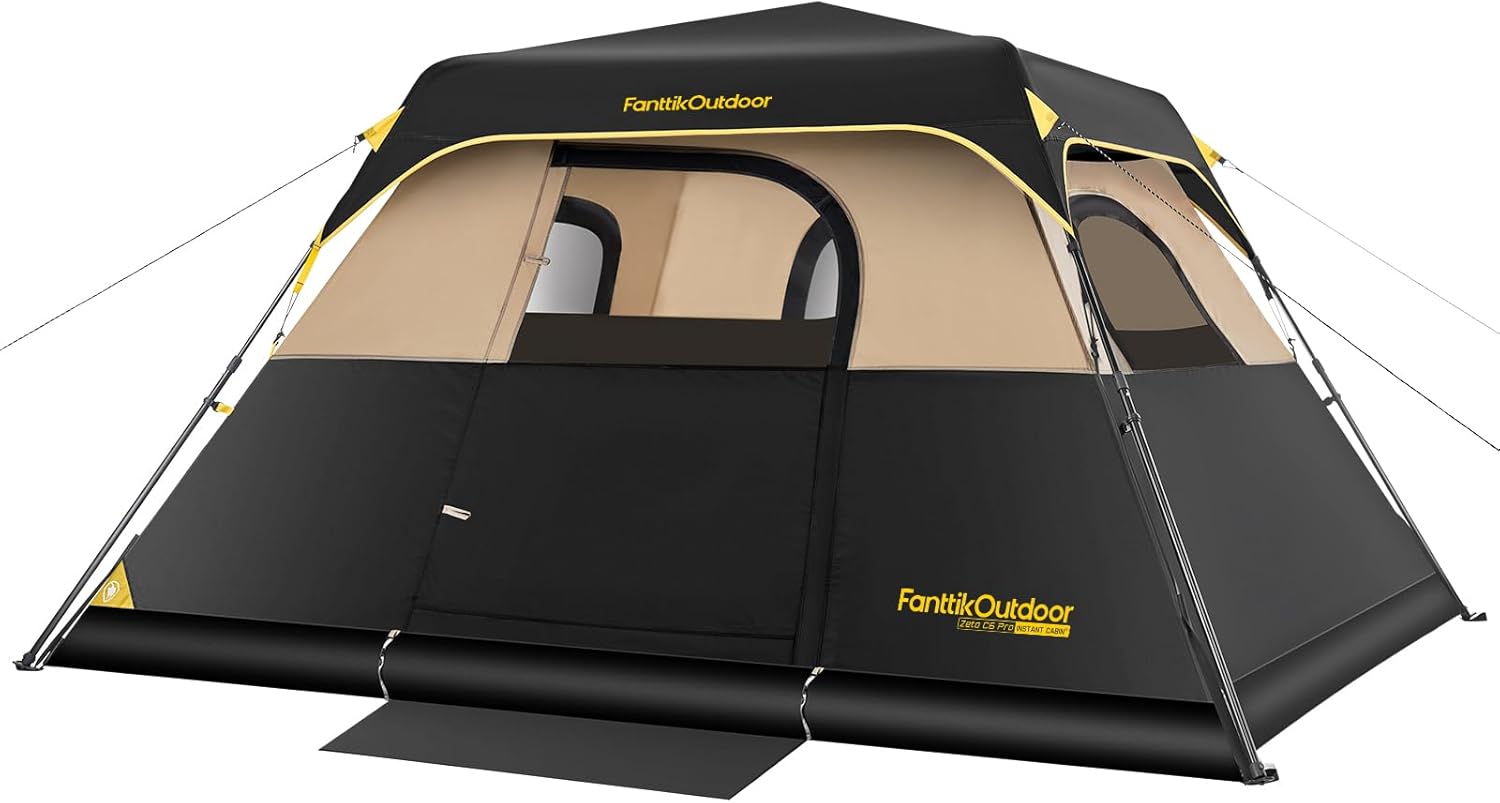
Best Multi-Size Instant Cabin: FanttikOutdoor 4-10P Instant
Pick your size 4P through 10P, fastest sub-minute pitch in our test
Pros
- Genuine sub-minute setup, the fastest credible instant tent we tested
- Available in multiple sizes so you buy exactly what your group needs
- PU2000 fly coating handles light to moderate rain reliably
- Lighter than the comparable CORE for same capacity, easier solo loading
Cons
- Fiberglass pole hubs are the failure point, not steel like CORE
- Build feels less robust than CORE in side-by-side handling
- Brand is newer, less long-term reliability data than the established competitors
- No room divider on most variants, single open interior
The FanttikOutdoor wins the multi-size category because most buyers do not actually know which capacity they need until they have lived with a tent for a season. Offering the same hub-and-pole platform in 4, 6, 8, and 10-person variants lets buyers self-select and the experience is consistent across sizes.
This is the tent for occasional users who want fast setup and accept some compromise on long-term durability. CORE is the better long-haul instant tent. FanttikOutdoor is the more pleasant tent to use weekend-to-weekend, with a faster pitch and a lighter pack-out.
| Capacity | 4 to 10 person variants |
|---|---|
| Weight (packed) | 28 lb (10P) |
| Peak height | 6 ft 4 in |
| Floor dimensions | 13 x 9 ft (10P) |
| Packed size | 42 x 10 x 10 in |
| Frame | Fiberglass with steel hubs, pre-attached |
| Fabric | 210T polyester with PU2000 coating |
| Season rating | 3-season |
| Setup time | 60 sec |
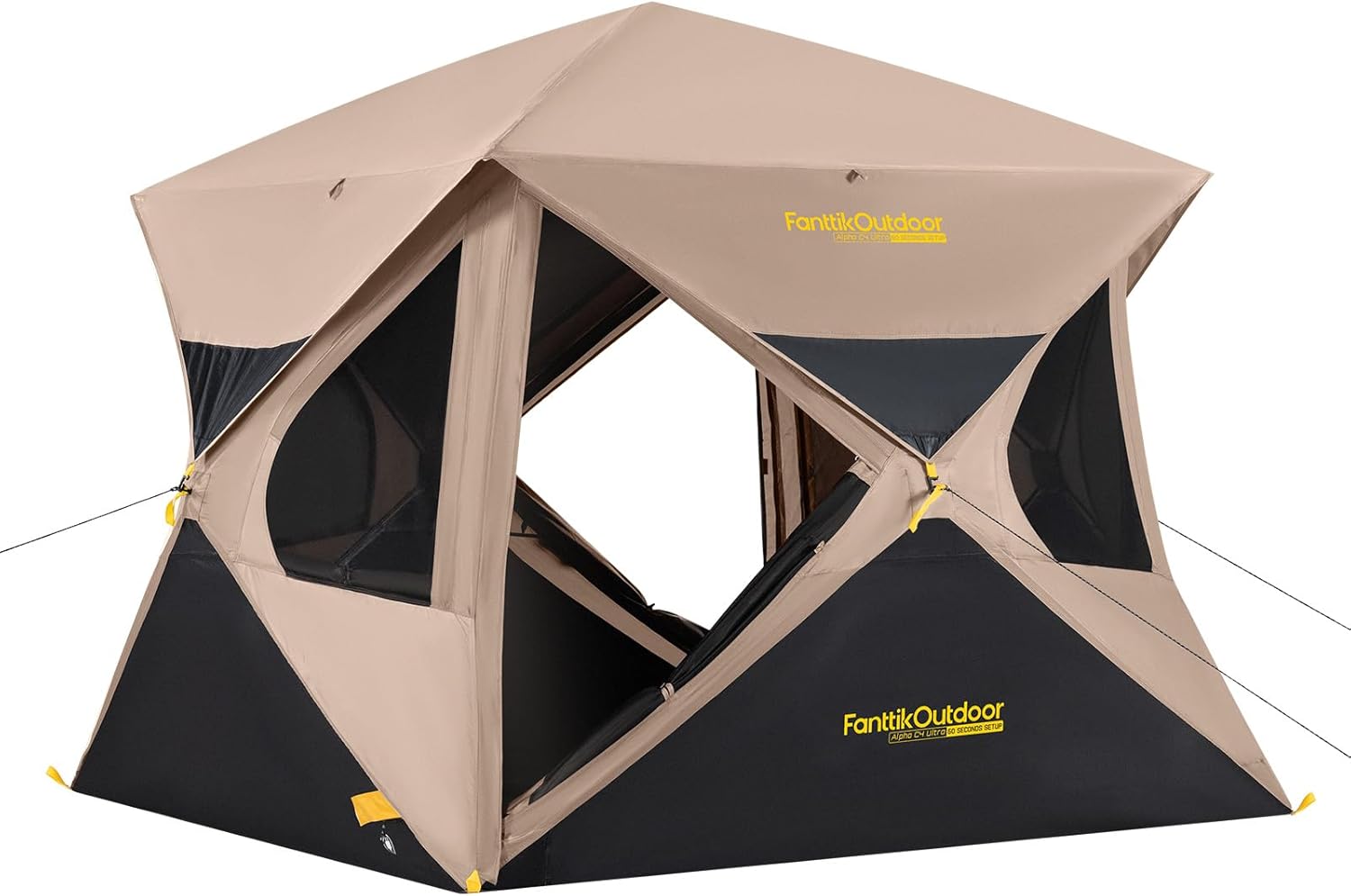
Best Spring-Loaded Pop-Up Tent: Alpha C4 Ultra Pop-Up
Toss-and-deploy festival tent, beach-friendly, three-second pitch
Pros
- Three-second pitch, throw it in the air and catch the deployed tent
- Genuinely lightweight at 8 pounds for a 4-person rated shelter
- Beach and festival friendly, no stakes required for shaded use
- Disc-shaped pack-out fits flat against a car interior or pack frame
Cons
- Pop-up geometry is not strong in wind above 15 mph
- PU1500 fly will weep in sustained heavy rain, this is a fair-weather tent
- Pack-down requires a specific fold sequence, expect a 5-minute first attempt
- Spring-loaded poles cannot be replaced if they bend
Spring-loaded pop-up tents fill a real niche between instant cabin tents and traditional pole-and-clip backpackers. The Alpha C4 nails the niche by pairing the speed of a true pop-up with a slightly heavier fabric and pole gauge than the bottom-tier toy versions.
Understand the use case before you buy. This is the festival, beach, and backyard tent. It is not a backcountry tent, it is not a wind-storm tent, and it is not a tent you pitch on rocky uneven ground. For its real use case it is the right tool, and the speed compensates for the limitations.
| Capacity | 3 to 4 person |
|---|---|
| Weight (packed) | 8 lb |
| Peak height | 4 ft 5 in |
| Floor dimensions | 94 x 84 in |
| Packed size | 36 in disc |
| Frame | Spring-loaded fiberglass |
| Fabric | 190T polyester with PU1500 |
| Season rating | 3-season |
| Setup time | Instant (3 sec) |
Best Inflatable Camping Tents
Two inflatable tents from a still-maturing Amazon category. RBM Outdoors for premium canvas with stove-jack four-season capability, SENLEETO for mid-range buyers wanting the inflatable experience without committing to canvas-tier pricing.
Best Inflatable Hot Tent: RBM Outdoors Panda Air Large
Stove jack, canvas walls, no poles, pump-deploy in five minutes

Pros
- Canvas construction breathes, dramatically less condensation than synthetic
- Built-in stove jack supports a wood-burning camp stove for genuine cold-weather use
- Air-beam structure deploys without poles in five to ten minutes via pump
- Multiple independent air chambers, a single puncture does not collapse the shelter
Cons
- Vehicle-only at 106 pounds, this is glamping weight
- Premium-tier pricing puts this in a different category from typical buyers
- PVC stiffens noticeably in sub-freezing temperatures, plan for cold-weather setup
- Lower review count reflects the newer product category, less long-term reliability data
The Panda Air represents a category most American buyers have not encountered yet. Inflatable canvas tents are well established in European glamping markets and the technology has matured to a point where the build quality matches traditional canvas wall tents while eliminating the pole-and-rope setup time.
The stove jack is what makes this a genuine four-season shelter. With a wood-burning camp stove inside, the canvas walls hold heat in a way no nylon tent matches and the breathable fabric handles the moisture from breathing and cooking. The price is real and reflects the category. For buyers exploring extended winter camping or all-season basecamp glamping, this is the tent the category centers on.
| Capacity | 2 to 6 person |
|---|---|
| Weight (packed) | 105 lb 13 oz |
| Peak height | 7 ft 2 in |
| Floor dimensions | 13 x 10 ft (129 sq ft) |
| Packed size | 29 x 20 x 21 in |
| Frame | Inflatable PVC air beams |
| Fabric | Waterproof breathable canvas |
| Season rating | 4-season above 32F |
| Setup time | 5 to 10 min |
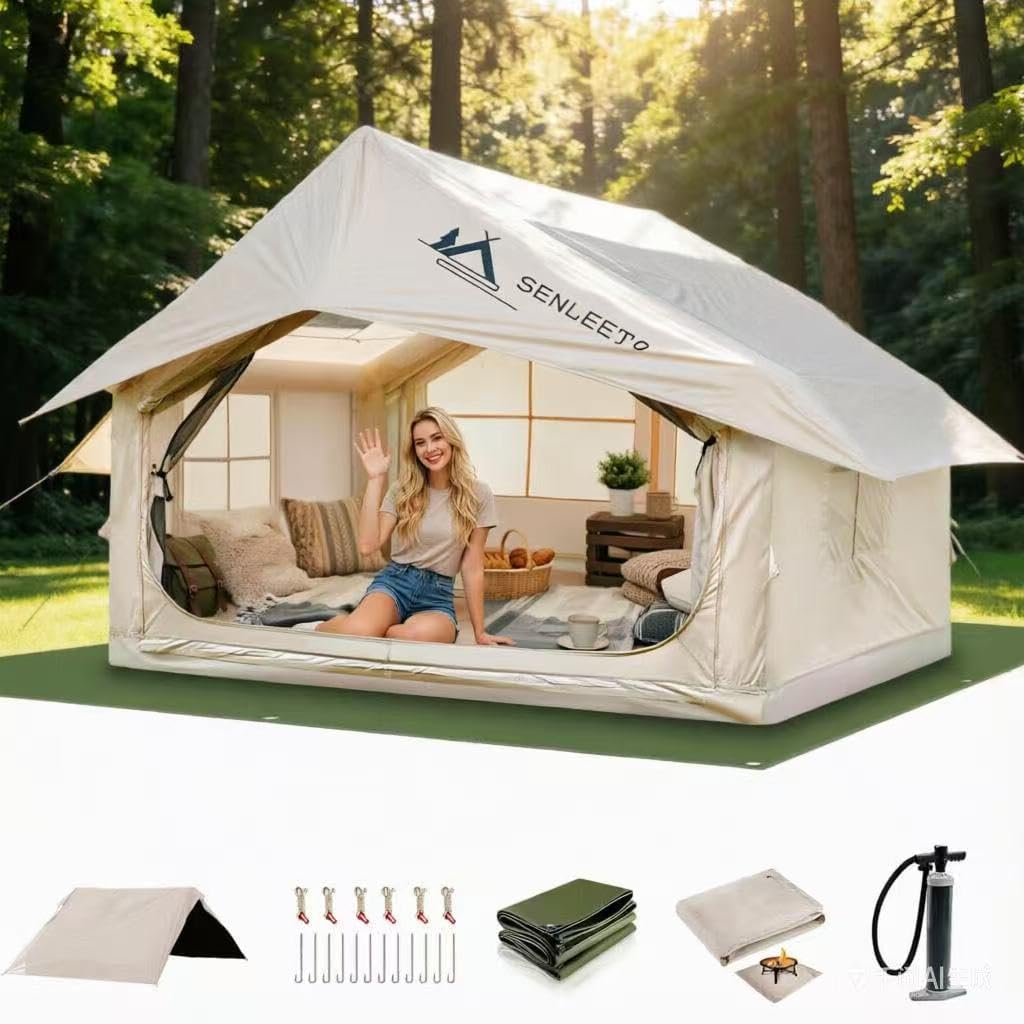
Best Mid-Range Family Inflatable Tent: SENLEETO 4-6P Inflatable
Stove jack and AC port for a third the price of premium canvas inflatables
Pros
- Stove jack and AC port both included, rare combination at this price
- Significantly more affordable entry point than canvas inflatable competitors
- Silver UV-reflective coating reduces interior heat in summer use
- Ships from US warehouses with three to nine day delivery, faster than overseas brands
Cons
- Oxford fabric does not breathe like canvas, more condensation in cold weather
- Lower review count reflects newer brand and product, less long-term durability data
- Capacity rating is generous, plan for 3 to 4 sleepers comfortably, not 6
- Pump is hand-operated, electric pump optional but recommended for repeated use
Inflatable tents are still a maturing category on Amazon, with low review counts across most products. The SENLEETO is the strongest mid-range entry we found because it bundles features that usually require buying up to the canvas tier, specifically the stove jack and the AC port.
The practical case is for a buyer who wants the inflatable experience without committing to a premium-tier canvas glamping tent. The Oxford fabric is a real compromise versus canvas, but the silver UV coating and PU3000 waterproofing handle the typical Pacific Northwest weather window. For a family that camps a half-dozen weekends a year, this hits the value-to-features balance.
| Capacity | 4 to 6 person |
|---|---|
| Weight (packed) | 38 lb |
| Peak height | 6 ft 6 in |
| Floor dimensions | 10 x 7 ft (70 sq ft) |
| Packed size | 26 x 14 x 14 in |
| Frame | Inflatable TPU air beams |
| Fabric | 420D Oxford with PU3000 |
| Season rating | 4-season |
| Setup time | 5 to 10 min |
Best Hot Tents and 4-Season Shelters
Four winter-capable shelters. OneTigris and POMOLY for stove-pipe wall-tent use, Stella for genuine four-season backpacking, and Regatta for canvas bell-tent glamping. All four extend camping into shoulder seasons and winter.
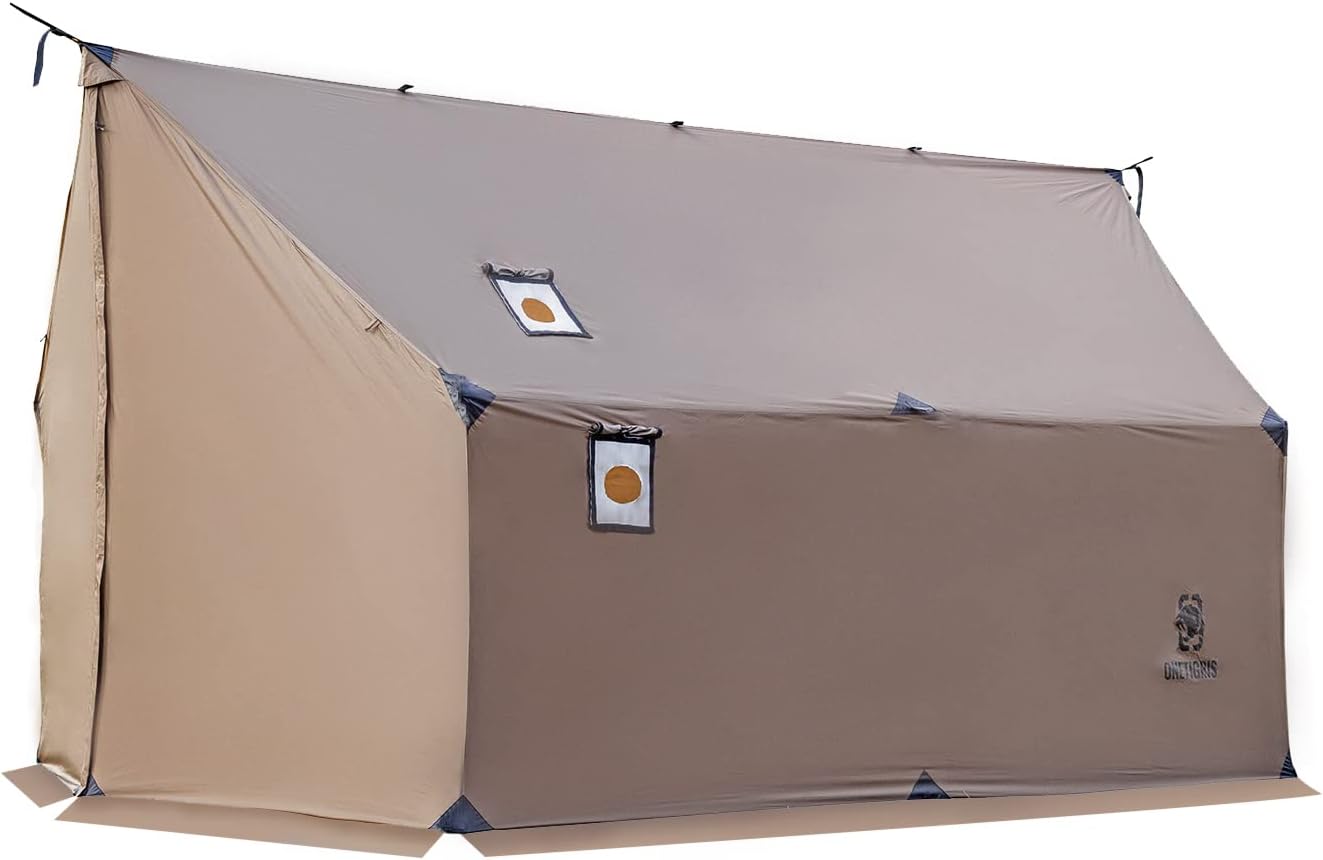
Best Hammock Hot Tent: OneTigris TEGIMEN Hammock Hot Tent
Dual stove jacks, sod skirt, hammock-first floorless wall shelter
Pros
- Dual stove jacks let you angle stove pipe through roof or sidewall
- Wind-blocking sod skirt traps interior heat in winter use
- Backpacking-friendly weight at under 7 pounds for a wall-tent shelter
- YKK zippers throughout, the gold standard for cold-weather hardware
Cons
- No floor included, this is a hammock-first design
- No poles included, you supply trekking poles or hang from a hammock
- Single-wall construction requires active ventilation management to prevent condensation
- Limited window count, this is not a hot-summer shelter
Hammock camping has a winter-shelter problem that most tent makers ignore. The TEGIMEN solves it directly: a wall shelter you pitch over your hammock with stove jacks already cut and a sod skirt around the perimeter to keep wind from undercutting your warmth.
This is a specific tool for a specific buyer. If you do not hammock camp, the TEGIMEN is the wrong tent. If you do, the dual stove jacks and the under-seven-pound packed weight make this the most-used shelter in your winter kit. The price-to-features ratio is exceptional, a comparable canvas wall tent runs three times the cost.
| Capacity | 1 hammock + 2 cots |
|---|---|
| Weight (packed) | 6 lb 13 oz |
| Peak height | 6 ft 2 in |
| Floor dimensions | 12 ft 6 in x 6 ft 6 in |
| Packed size | 21 x 6 x 6 in |
| Frame | No poles included, hang or BYO |
| Fabric | 70D ripstop nylon, PU3000 |
| Season rating | 3-season + winter capable |
| Setup time | 10 min |
Best Stove-Pipe Hot Tent: POMOLY Chalet 70 Pro
POMOLY brand authority, integrated fireproof groundsheet, aluminum poles included

Pros
- POMOLY is the brand winter campers actually search for, signal of category authority
- Integrated fireproof Ember Mat groundsheet under the stove area is a genuine safety feature
- Aluminum alloy poles included, rare at this price point in hot tents
- Cabin shape blends naturally into forest backgrounds
Cons
- Only 4 ft 11 in peak height, you cannot stand up inside
- Tight at 2-person capacity if running a stove plus cot plus gear
- PU2500 waterproof rating is competent but below the premium 3000+ tier
- Limited storage pockets and gear loops compared to higher-end shelters
POMOLY has spent the last several years building credibility in winter camping circles by making serious cold-weather shelters at accessible prices. The Chalet 70 Pro is the tent that brought a lot of buyers into the brand. The cabin geometry, the integrated fireproof groundsheet, and the included aluminum poles make this a genuine entry into stove-pipe winter camping.
The limitations are honest. You cannot stand inside this tent. It is built for sleeping and stove-pipe heating with cots, not for living through a storm-day. If you understand the use case, the value is exceptional, this is the cheapest credible American-shipped hot tent we tested by a meaningful margin.
| Capacity | 2 to 3 person |
|---|---|
| Weight (packed) | 7 lb 8 oz |
| Peak height | 4 ft 11 in |
| Floor dimensions | 8 x 6.5 ft |
| Packed size | 24 x 8 x 8 in |
| Frame | 7001 aluminum, 2 main poles included |
| Fabric | 70D plaid ripstop polyester, PU2500 |
| Season rating | 4-season |
| Setup time | 10 min |
Best 4-Season Backpacking Tent: OneTigris Stella 4-Season
True 4-season at backpacking weight, removable blackout fly for hot weather

Pros
- Genuine 4-season capability at sub-5 pound packed weight
- Thicker 70D floor is more puncture-resistant than ultralight competitors with 20D or 30D floors
- Removable blackout outer fly enables warm-weather use, not just winter
- Tested in real snow and wind by reviewers, build holds up to harsh Pacific Northwest conditions
Cons
- Sit-up peak height only at 3 ft 8 in, you cannot stand inside
- Small vestibule space, full-size packs eat the entire vestibule on each side
- Only single color option (black) on Amazon, less fabric choice than Big Agnes
- Newer model than ultralight Big Agnes line, less long-term durability data
Most 4-season tents are built for mountaineering and weigh 8 pounds or more. Most backpacking tents are 3-season and have 20D floors that puncture on rocky alpine ground. The Stella threads the needle by using a 70D floor (twice as thick as Big Agnes Copper Spur) while staying under 5 pounds packed.
This is the right tent for a buyer who pushes into the shoulder seasons and the high alpine, not for a typical July weekend in the Cascades. For weekend summer trips, the Naturehike Cloud Up at half the price is the better tool. The Stella earns its premium when conditions actually demand a 4-season build.
| Capacity | 2 person |
|---|---|
| Weight (packed) | 4 lb 13 oz |
| Peak height | 3 ft 8 in |
| Floor dimensions | 83 x 50 in |
| Packed size | 20 x 6 in |
| Frame | 7001 aluminum spider with cross brace |
| Fabric | 20D nylon outer, 70D PU-coated nylon floor |
| Season rating | 4-season |
| Setup time | 5 to 7 min |
Best Glamping Bell Tent: Regatta Canvas Bell
True canvas glamping, near-10-foot center peak, sewn-in PVC ground floor

Pros
- Real cotton canvas breathes, dramatically lower condensation than synthetic
- Walk-around interior at 9 ft 9 in peak, this is glamping by any definition
- Sewn-in heavy PVC groundsheet is the right call for repeated use, no separate footprint
- Stove flue option for hot-tent capability with optional accessory
Cons
- Heavy at 60 pounds packed, vehicle-only
- Canvas requires drying after use to prevent mildew, more maintenance than synthetic
- Setup requires understanding the perimeter peg pattern, first pitch takes 30 minutes
- Premium pricing for occasional users, this is a basecamp tent
Bell tents are a category most American buyers have not engaged with because they have been sold mostly as wedding-and-event rentals. The Regatta is the credible Amazon-available bell tent that lets families bring the experience home. The 13-foot diameter and near-10-foot peak give the kind of interior volume that turns camping into something closer to a cabin trip.
The practical use case is repeated basecamp glamping. If you camp from a vehicle and pitch for several nights at a stretch, the bell tent is the most pleasant shelter category to live in. If you move every day or backpack, this is the wrong tent. The maintenance overhead (canvas drying, mildew prevention, perimeter peg discipline) is the cost of admission to the most comfortable category we tested.
| Capacity | 4 to 6 person |
|---|---|
| Weight (packed) | 60 lb |
| Peak height | 9 ft 9 in |
| Floor dimensions | 13 ft diameter |
| Packed size | 34 x 14 x 14 in |
| Frame | Steel center pole + perimeter A-frame |
| Fabric | 300 gsm cotton canvas |
| Season rating | 4-season |
| Setup time | 15 to 20 min |
Best Budget and Modern Dome Tents
Four entry-level and mainstream picks. Coleman Sundome is the most-reviewed camping tent on Amazon by a wide margin, Skydome is the modern variant with vertical walls, Clostnature is the price floor for credible aluminum-pole shelter, and Wonder Lake is the right tool for kids.
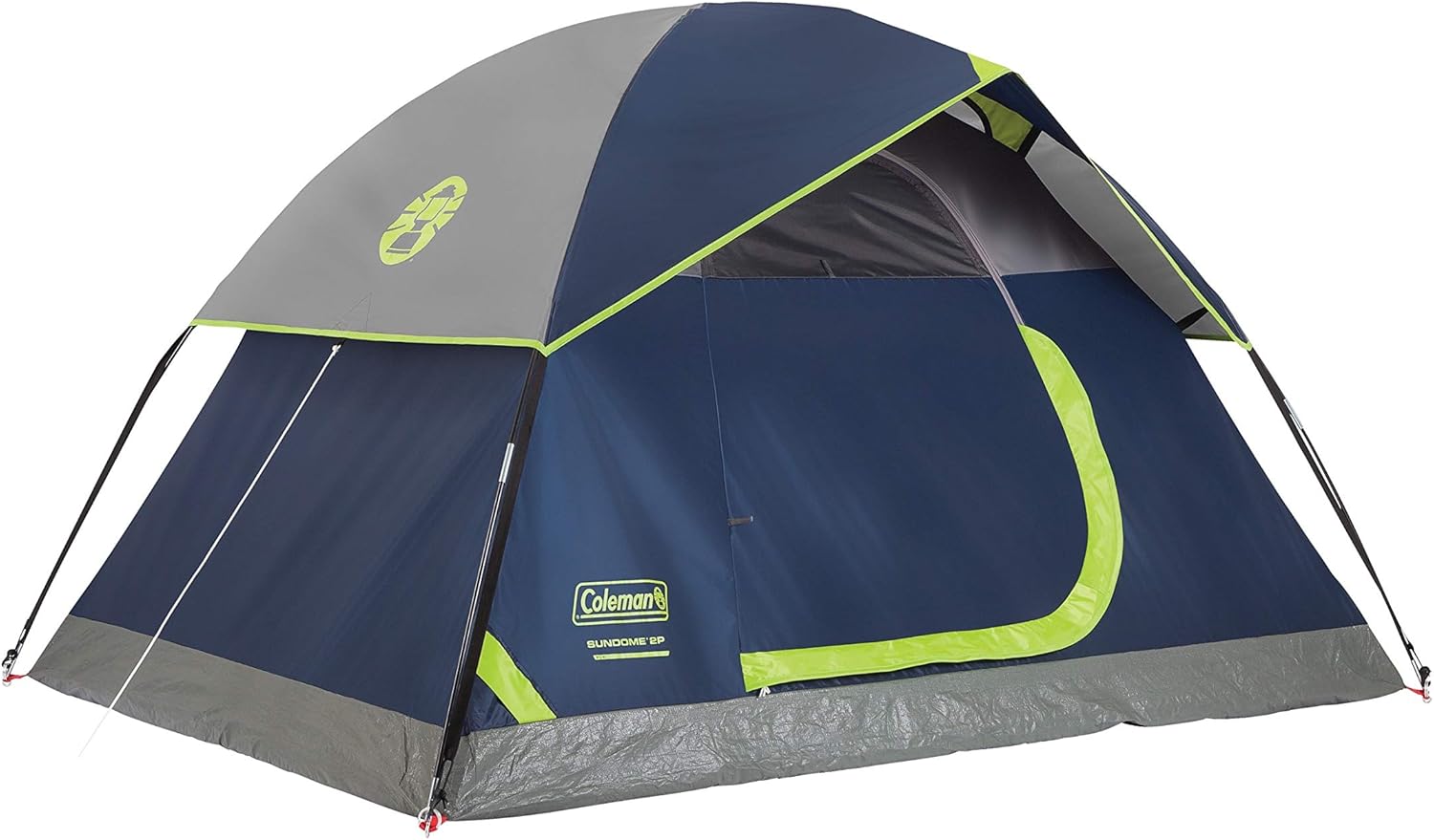
Best Overall Camping Tent: Coleman Sundome
The default first tent for casual car camping, 48,000+ verified reviews
Pros
- Largest review pool of any camping tent on Amazon by a wide margin
- Coleman WeatherTec sealed-corner floor handles real Pacific Northwest rain
- Multiple size variants (2P, 3P, 4P, 6P) at the same proven build quality
- Replacement parts available stateside at virtually any outdoor retailer
Cons
- Mesh ceiling cannot be closed, cold-weather use requires the rainfly fully deployed
- Partial-coverage rainfly leaves sidewalls exposed in driving rain
- Fiberglass poles are typical Coleman, expect to replace at least once over the life
- Single door limits airflow on hot summer nights
The Sundome earns Best Overall not because it is the most advanced tent on this page (it is not) but because it is the right tent for the most buyers. For someone who camps a few weekends a year, wants something proven, and is not optimizing for any specific use case, the Sundome solves the problem reliably.
The verified Amazon review depth on this model is the most powerful trust signal in budget outdoor gear, and the rating itself has stayed consistent for over a decade. That number does not lie. The Sundome has been Coleman’s flagship affordable family tent for over a decade and it has earned its position. Buy it, take care of the fiberglass poles, and it will be there for the trips you actually take.
| Capacity | 2, 3, 4, or 6 person |
|---|---|
| Weight (packed) | 17 lb 9 oz (6P) |
| Peak height | 5 ft 11 in (6P) |
| Floor dimensions | 10 x 10 ft (6P) |
| Packed size | 24 x 8 x 8 in |
| Frame | Fiberglass with steel pin-and-ring |
| Fabric | 75D polyester (Polyguard) |
| Season rating | 3-season |
| Setup time | 10 min |
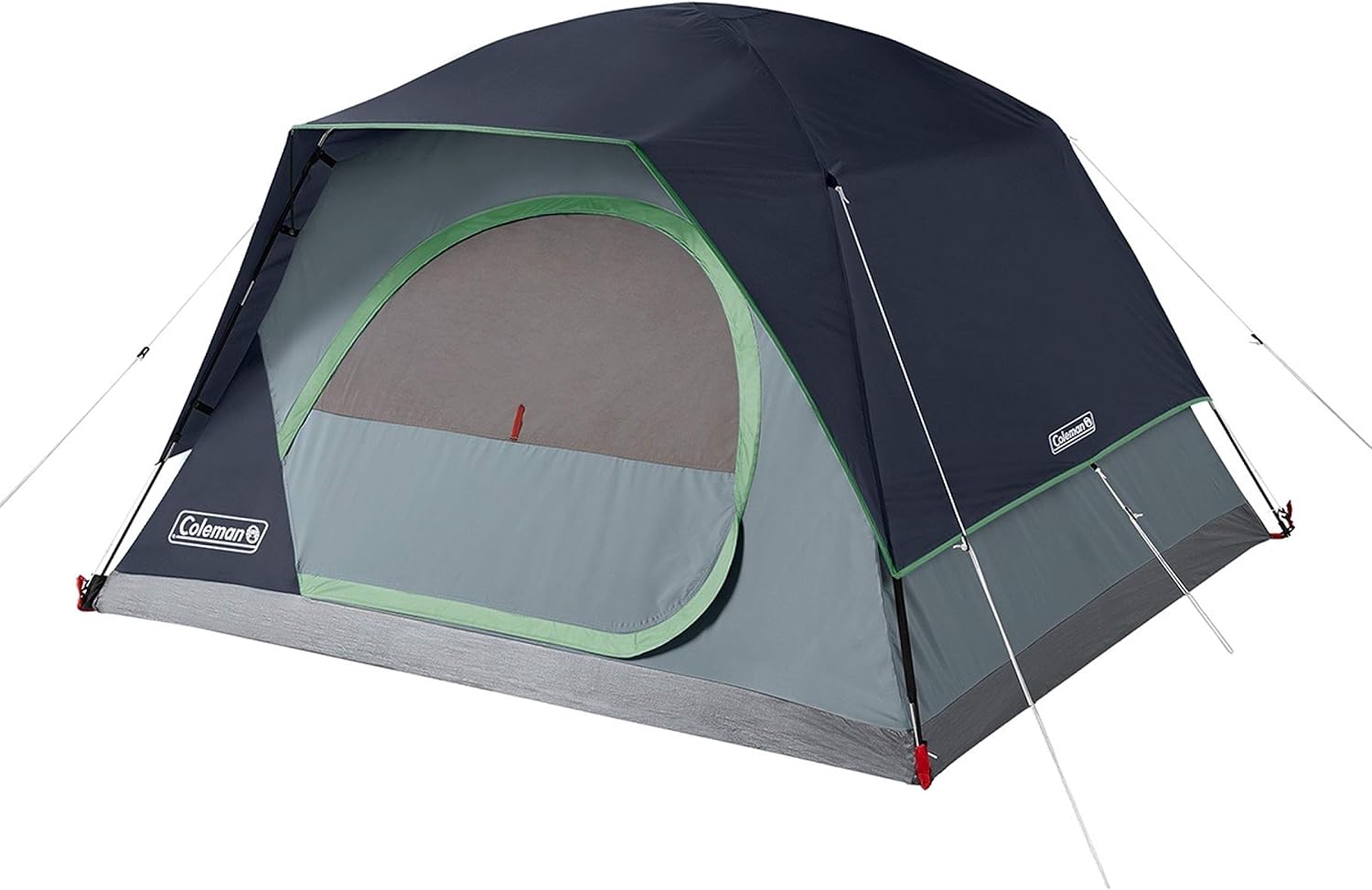
Best Modern Coleman Dome: Coleman Skydome 2/4/6/8P
20% more headroom than Sundome, genuine 5-minute setup, four size options
Pros
- Genuine 5-minute setup is meaningfully faster than the 10-minute Sundome
- Nearly vertical walls give 20% more usable interior volume than dome competitors
- Available in 2P, 4P, 6P, and 8P, dark room and screen room variants exist too
- Coleman warranty path and replacement parts available stateside
Cons
- Partial rainfly is the same Sundome limitation, sidewalls exposed in driving rain
- Fiberglass poles cannot be field-replaced if a section snaps
- Capacity rating is generous, plan for half the marketed number with gear
- Mesh ceiling cannot be closed, cold-weather use needs the fly deployed always
The Skydome is Coleman’s modern answer to the dome-tent category. Pre-attached poles drop setup time noticeably, and the near-vertical walls deliver 20 percent more usable interior space than the Sundome at the same floor footprint. For a buyer choosing between Sundome and Skydome, the Skydome is the more pleasant tent to live in.
The limitation of the partial rainfly is the same as Sundome and worth understanding before purchase. In sustained driving rain the sidewalls do receive water, especially in the corners. Pair with the optional Coleman fly extension or a tarp setup if you are going to camp through a storm system. For typical Pacific Northwest camping windows the standard fly is competent.
| Capacity | 2, 4, 6, or 8 person |
|---|---|
| Weight (packed) | 20 lb 8 oz (8P) |
| Peak height | 6 ft 4 in (8P) |
| Floor dimensions | 12 x 7 ft (8P) |
| Packed size | 24 x 9 x 9 in |
| Frame | Pre-attached fiberglass, Fast Pitch |
| Fabric | 75D Polyguard polyester |
| Season rating | 3-season |
| Setup time | 5 min |
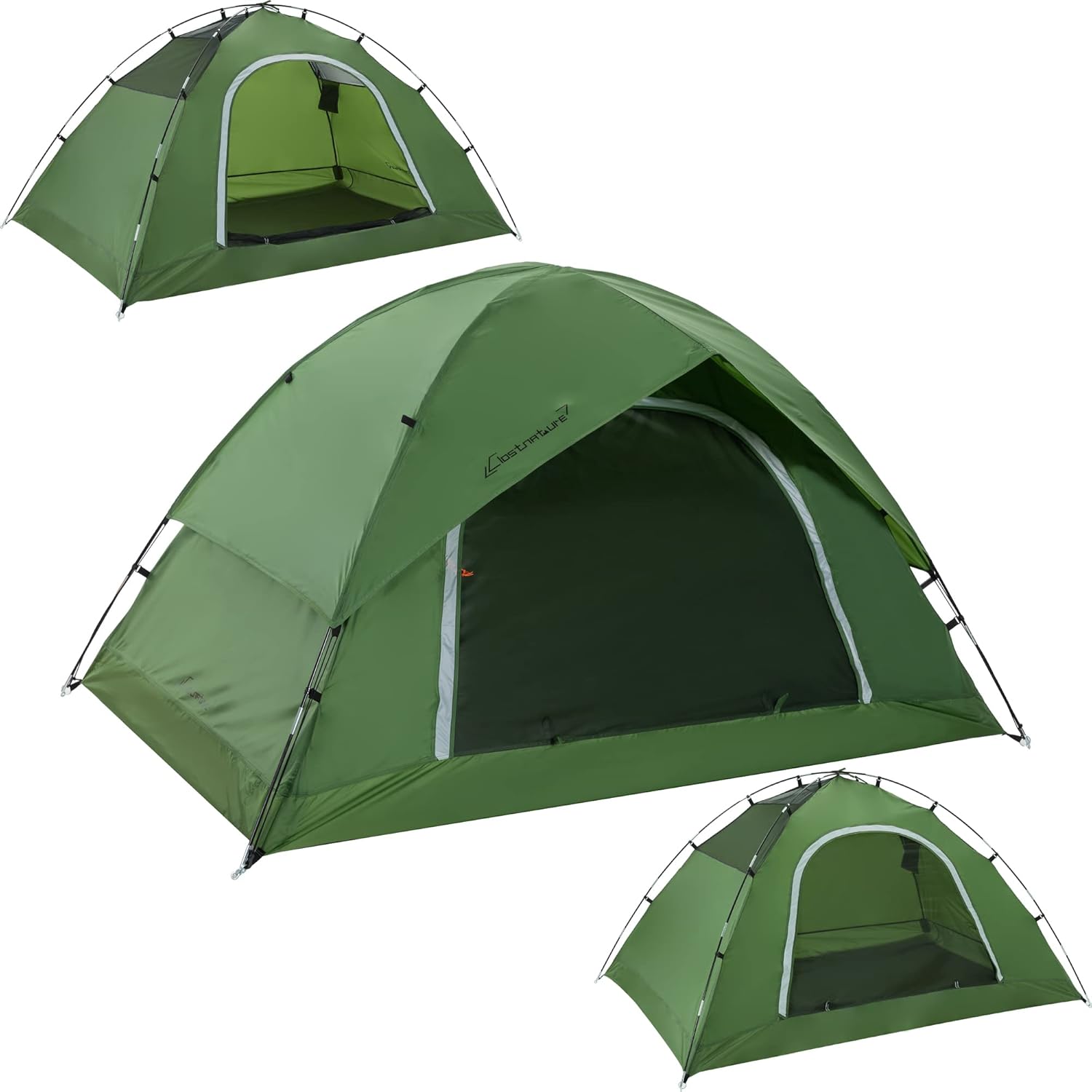
Best Sub-$70 Camping Tent: Clostnature 2/4/6P
Real backpacking tent at a budget price, 2,932 verified reviews
Pros
- Real aluminum poles at the price of fiberglass-pole tents
- Strong review base for the budget tier, reliable QC signal
- Fast 5-minute setup with two-pole simple geometry
- Multiple size options give buyers a real choice without changing brands
Cons
- PU2000 fly coating is competent but below premium 3000+ tier in sustained rain
- Brand support is overseas, warranty paths take longer than US-based brands
- Fabric is thinner than the Naturehike Cloud Up despite similar pricing
- Footprint not included, plan to add separately
Clostnature occupies the same category as Naturehike, budget Amazon-direct backpacking tents, and the comparison comes down to specific build choices. Clostnature is cheaper, Naturehike has slightly better fabric. For first-time backpackers and gift purchases, the Clostnature is the right entry point.
The value case is straightforward. At under 70 dollars for a real aluminum-pole 2-person tent, this is the price floor for credible outdoor shelter. Below this you are buying tents with fiberglass poles that will fail in the second season. Above this the build improvements scale linearly. Clostnature is the inflection point.
| Capacity | 1, 2, 4, or 6 person |
|---|---|
| Weight (packed) | 4 lb 8 oz (2P) |
| Peak height | 3 ft 8 in |
| Floor dimensions | 83 x 55 in (2P) |
| Packed size | 15 x 5 x 5 in |
| Frame | 7001 aluminum |
| Fabric | 210T polyester with PU2000 |
| Season rating | 3-season |
| Setup time | 5 min |
Best Kids Camping Tent: Coleman Wonder Lake Kids
Backyard- and beach-friendly first tent for kids ages 5 to 12

Pros
- Lightweight at 5 pounds, kids can carry their own tent on family camping trips
- Kid-friendly graphics and color choices make it the tent kids want to pitch
- Five-minute setup is achievable by an 8-year-old with one parent guiding
- Sized for two kids or one adult, real dimensions, not toy dimensions
Cons
- Not built for adult-size sustained camping, this is a kids tent
- Fiberglass poles are typical Coleman, kids will bend them eventually
- Limited weather protection, fair-weather use only
- Floor area is tight for two kids plus sleeping bags, plan for some squeeze
Kids tents are a real category that most outdoor brands ignore. Coleman is one of the few that builds them at scale and the Wonder Lake is the right size for the actual use case, sleepovers in the yard, secondary tents on family camping trips, and first solo pitches at age seven to ten.
The build is honest. This is not a tent you would want for a real backcountry trip and Coleman does not pretend otherwise. The graphics, the weight, and the simple pole geometry are designed for the buyer who is teaching a kid to camp. For that buyer this is exactly the right tool.
| Capacity | 2 kids or 1 adult |
|---|---|
| Weight (packed) | 5 lb |
| Peak height | 4 ft 1 in |
| Floor dimensions | 7 x 4 ft 6 in |
| Packed size | 15 x 5 x 5 in |
| Frame | Fiberglass |
| Fabric | 75D polyester |
| Season rating | 3-season |
| Setup time | 5 min |
Full comparison table: best camping tent
Sort by trail score, weight, capacity, or price. Tap the column headers to re-rank the table. The table scrolls horizontally on small screens.
| Tent | Award | Trail score | Weight | Capacity | Peak height | Price | |
|---|---|---|---|---|---|---|---|
|
Big Agnes Copper Spur HV UL2 | Best Premium Ultralight | 88 | 3 lb 2 oz | 2 person | 3 ft 4 in | $549 |
|
CORE 9-Person Instant Cabin | Best Overall Instant | 88 | 36 lb | 9 person, 2 rooms | 6 ft 6 in | $279 |
|
RBM Outdoors Panda Air Large | Best Inflatable Hot Tent | 87 | 105 lb 13 oz | 2 to 6 person | 7 ft 2 in | $1099 |
|
OneTigris Stella 4-Season | Best 4-Season Backpacking | 87 | 4 lb 13 oz | 2 person | 3 ft 8 in | $209 |
|
Coleman 8-Person LED Cabin | Best Multi-Room | 86 | 21 lb 8 oz | 8 person, 2 rooms | 6 ft 8 in | $269 |
|
OneTigris TEGIMEN Hammock Hot Tent | Best Hammock Hot Tent | 86 | 6 lb 13 oz | 1 hammock + 2 cots | 6 ft 2 in | $189 |
|
Regatta Canvas Bell | Best Glamping Bell | 85 | 60 lb | 4 to 6 person | 9 ft 9 in | $599 |
|
Coleman Carlsbad Dark Room | Best with Screened Porch | 84 | 21 lb 5 oz | 4 or 6 person | 5 ft 8 in (6P), 4 ft 11 in (4P) | $176 |
|
Coleman Montana 6/8P | Best Coleman Cabin | 84 | 24 lb 8 oz | 6 or 8 person | 6 ft 2 in | $199 |
|
Naturehike Cloud Up 2 | Best Value Lightweight | 84 | 3 lb 14 oz | 2 person | 3 ft 5 in | $109 |
|
FanttikOutdoor 4-10P Instant | Best Multi-Size Instant | 84 | 28 lb (10P) | 4 to 10 person variants | 6 ft 4 in | $212 |
|
POMOLY Chalet 70 Pro | Best Stove-Pipe Hot Tent | 84 | 7 lb 8 oz | 2 to 3 person | 4 ft 11 in | $169 |
|
Coleman Sundome | Best Overall | 84 | 17 lb 9 oz (6P) | 2, 3, 4, or 6 person | 5 ft 11 in (6P) | $118 |
|
Coleman Skydome 2/4/6/8P | Best 5-Minute Setup | 84 | 20 lb 8 oz (8P) | 2, 4, 6, or 8 person | 6 ft 4 in (8P) | $139 |
|
ALPS Mountaineering Lynx 1 | Best Solo Backpacking | 83 | 4 lb 1 oz | 1 person | 3 ft | $99 |
|
Kelty Late Start 4P | Best 4P Backpacking | 83 | 7 lb 3 oz | 4 person | 4 ft 4 in | $249 |
|
SENLEETO 4-6P Inflatable | Best Mid-Range Inflatable | 83 | 38 lb | 4 to 6 person | 6 ft 6 in | $439 |
|
HIKERGARDEN 6-8 Person | Best 6-Person Family | 82 | 17 lb 12 oz | 6 to 8 person | 6 ft 5 in | $169 |
|
Clostnature 2/4/6P | Best Sub-$70 Tent | 81 | 4 lb 8 oz (2P) | 1, 2, 4, or 6 person | 3 ft 8 in | $69 |
|
KTT Extra Large 10-14P | Best Large Group Tent | 79 | 32 lb | 10 to 14 person | 7 ft 3 in | $369 |
|
Coleman Wonder Lake Kids | Best Kids Tent | 79 | 5 lb | 2 kids or 1 adult | 4 ft 1 in | $79 |
|
Alpha C4 Ultra Pop-Up | Best Spring-Loaded Pop-Up | 76 | 8 lb | 3 to 4 person | 4 ft 5 in | $89 |
How We Test Camping Tents in Oregon
Every tent on this page sat in real Oregon weather. Coastal storms, alpine cold, high-desert sun, and Pacific Northwest winter rain. Each tent earns a 100-point trail score across five weighted categories.
-
25%Weather
Sustained Pacific Northwest rain and wind
We pitch every tent through at least one Oregon downpour and one 20+ mph wind night. We measure how much water reaches the floor, whether seams weep, whether the rainfly sags into the body in driving rain, and whether condensation builds inside the inner tent. The tent that stays dry and dry-feeling earns the 9 plus rating in this category.
-
25%Livability
Real interior volume and how it feels at hour eight
Marketed capacity numbers are reliably optimistic. We measure floor footprint, peak height, the ratio of usable space to total enclosed volume, and how many genuine adult humans fit with their gear. We score for whether you can stand up, change clothes, sit on a chair, eat, and read without feeling cramped after the third night in.
-
20%Setup
Packed-bag to staked-out, in cold wet hands, after a long drive
We time setup with a stopwatch, both two-person and solo. Bonus for color-coded poles. Penalty for any tent that requires reading instructions on the third try. Penalty for tents that demand specific stake patterns to prevent collapse. The tent that pitches in five minutes from a tired driver earns the high score here.
-
15%Build
What survives the season and what does not
Pole material, fabric denier, waterproof rating in millimeters, zipper brand, seam-tape integrity, floor durability against rocky ground. We look at long-term review patterns on Amazon for the failure modes that emerge in seasons two and three. Aluminum poles beat fiberglass. YKK zippers beat unbranded zippers. Thicker floor denier beats lighter floor denier for any tent that will see rocky sites.
-
15%Value
Dollars per camping season
Price is meaningful only relative to expected lifespan. A 100 dollar tent that lasts two seasons costs more per night than a 400 dollar tent that lasts a decade. We score against this real-world math, not against the sticker price alone. Brand support, replacement-parts availability, and warranty path all factor into the long-term math.
Where we tested
Coastal wind, sand intrusion, salt spray. Eight nights across two trips.
Uneven volcanic soil, 35F nights in May, exposed rim sites. Five nights.
85F sun, abrasive grit, sustained dry-air condensation tests. Six day trips.
Every tent sat through one full Oregon downpour and dried for 72 hours.
Anatomy of a Camping Tent
Six parts decide whether a tent lasts ten years or one season. Knowing what to look at on the rack saves you money and saves you a sleepless wet night.
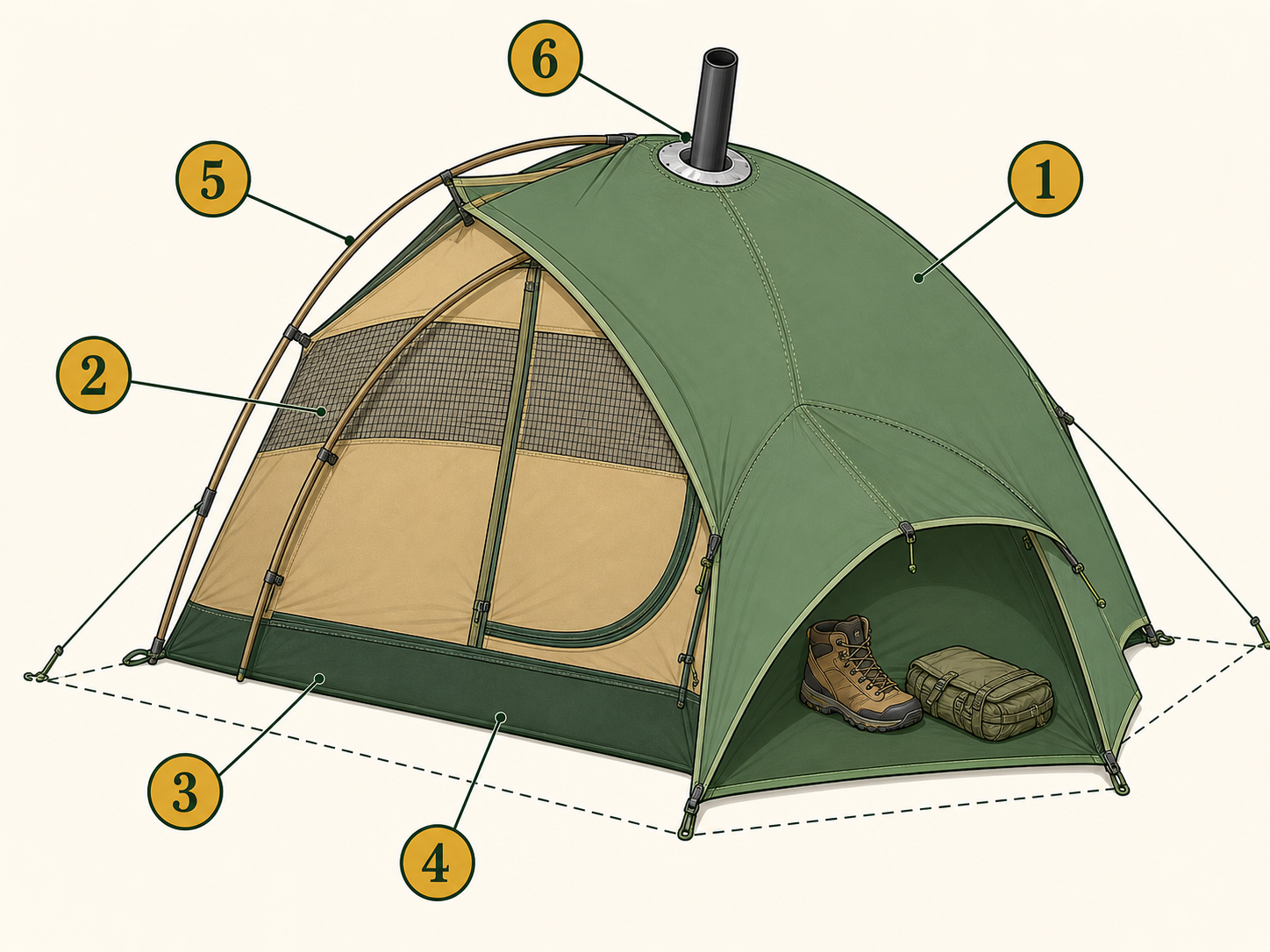
- Rainfly
- The outer waterproof layer. Look for full-coverage flies that reach the ground over partial flies that leave sidewalls exposed. PU3000+ rating handles real Pacific Northwest rain, anything below PU2000 will weep in sustained downpours.
- Tent body
- The inner shelter, often partial mesh for ventilation. Body fabric denier matters more than rainfly denier for tent longevity. 68D and up survives years, anything thinner (20D ultralight) demands a footprint and careful handling.
- Vestibule
- The covered porch zone outside the tent door for boots and packs. Genuine vestibules add usable square footage. Inadequate vestibules force gear into the inner tent, which means dirt, condensation, and morning mess.
- Bathtub floor
- The waterproof tent floor that walls up several inches around the perimeter. The wall-up height matters more than the rated waterproof number. A 4-inch bathtub wall handles puddled water that flat-stitched floors leak through.
- Pole structure
- Aluminum (DAC, 7001 alloy) outperforms fiberglass for both wind and longevity. Fiberglass is cheaper but cracks at hub joints over time. Pre-attached instant poles (CORE, FanttikOutdoor) trade replaceability for setup speed.
- Stove jack or vent
- Hot tents have a stove jack, a heat-resistant opening for a wood-stove pipe. Standard tents have peak vents and rainfly vents for moisture management. Both serve the same purpose, managing condensation and air exchange.
How to Choose a Camping Tent
Five decisions narrow the field from 250+ Amazon listings to the right tent for your trips. Walk through them in order.
1. Capacity: be honest about who is sleeping inside
Marketed capacity numbers assume sleepers shoulder-to-shoulder with no gear. For real comfort, downsize the marketed number by one third. A “6-person” tent fits four adults comfortably. An “8-person” tent fits five with gear. For backpacking pairs the 2-person rating is generally accurate. For family camping, give yourself the buffer.
2. Season rating: 3-season for most, 4-season for cold or alpine
3-season tents handle spring, summer, and fall use including normal rain and wind. 4-season tents add storm flaps, snow skirts, heavier-denier fabrics, and stronger pole structures designed for snow loads and sub-freezing conditions. Most buyers need a 3-season tent. If you camp in actual snow or above 7,000 feet, the 4-season is worth the extra weight. Hot tents are a separate category, designed for stove-pipe heating in winter use.
3. Pole material: aluminum if you can swing it
Aluminum poles bend rather than break, last for decades, and are field-replaceable. DAC and 7001 aluminum are the names to look for. Fiberglass poles are cheaper but become brittle over time and shatter at hub connections. For a tent you intend to keep for ten years, aluminum is the right answer. For a tent you camp in once a year, fiberglass is acceptable.
4. Floor durability: thicker denier survives rocky sites
Floor fabric denier (D rating) is the single specification most buyers ignore that most affects long-term tent life. Polyethylene bathtub floors at 1000D+ (Coleman Montana, Wonder Lake) survive rocky sites for decades. 70D PU-coated nylon floors (OneTigris Stella) are durable enough for backpacking on alpine ground. Below 30D floor fabric (premium ultralight tents) require footprints and careful site selection.
5. Waterproof rating in millimeters
Waterproof ratings are measured in millimeters of water column the fabric will hold before leaking. PU1500 is the minimum for casual rain. PU2000 to PU3000 handles typical Pacific Northwest weather. PU3000+ is for sustained heavy rain or storm camping. Floor fabrics need higher ratings than fly fabrics because they bear pressure from sleepers and gear, look for PU5000+ on the floor for serious use.
Family of 4 to 6, occasional camping
Coleman Sundome 6P or Coleman Skydome 6P. Proven, affordable, replaceable parts at any outdoor retailer.
Backpacking 2-person, premium
Big Agnes Copper Spur HV UL2. Sub-3.5 pound packed, DAC poles, the benchmark.
Backpacking 2-person, value
Naturehike Cloud Up 2. One fifth the price of premium, real aluminum poles.
Cold-weather camping with stove
POMOLY Chalet 70 Pro for entry, RBM Outdoors Panda Air for premium glamping.
Camping Tent FAQ
The questions buyers ask before pulling the trigger on a real camping tent purchase.
What is the best camping tent for families?
For multi-room family camping the Coleman 8-Person LED Cabin gives you genuine separation between sleeping zones with a full hanging divider and built-in lighting. For families camping with younger kids who need to nap during daylight, the Coleman Carlsbad Dark Room Tent with Screened Porch blocks 90 percent of sunlight and gives you a bug-free porch to stage gear. For a longer-term family cabin investment with the strongest Coleman review track record, the Coleman Montana 6/8P is the best-tested family cabin tent on Amazon.
What is the best inflatable camping tent?
For premium 4-season use with stove-jack capability, the RBM Outdoors Panda Air Large is a canvas inflatable that handles real winter camping conditions and breathes the way synthetic shelters cannot. For mid-range buyers who want the inflatable experience at a more accessible price point, the SENLEETO 4-6 Person bundles a stove jack and AC port at roughly a third of the canvas-tier cost. The inflatable category on Amazon is still maturing, expect lower review counts than traditional tents, and prioritize brands with US-based fulfillment for service.
What is the fastest camping tent to set up?
For the genuine fastest credible setup the Alpha Camp C4 Ultra Pop-Up deploys in three seconds from carry-bag toss. For larger family-size instant cabins the FanttikOutdoor 4/6/8/10 Person hits sub-60-second setup with two people. For the longest-term reliable instant cabin, the CORE 9-Person Instant Cabin pitches in two to six minutes with steel poles that survive far longer than the fiberglass instant alternatives. The trade-off in the instant category is durability, faster pitches typically use lighter pole hardware that fails sooner.
How do I clean a camping tent?
Spot-clean only. Use a soft brush, mild dish soap, and cool water on stained or muddy areas. For full cleaning, set the tent up in a yard or garage, hose it gently inside and out, and let it dry fully in the shade for a minimum of 24 hours before packing. Never machine wash a tent, the agitation breaks down seam tape and waterproof coatings. Never put a tent in a dryer, the heat compromises the polyurethane fly coating that gives the tent its rain resistance. Store the tent loosely in a cotton storage sack rather than its compression bag whenever possible to preserve fabric integrity.
How do I set up a camping tent?
Lay out your footprint or ground tarp first, slightly smaller than the tent floor so it does not channel water under the tent. Spread the tent body on the footprint with the door facing your preferred direction. Connect the poles, color-coded systems make this easy, and run them through their sleeves or clip them into the body. Stake all four corners taut before lifting the tent. Attach the rainfly with the door zipper aligned to the tent door, then run guy lines to nearby anchor points if wind is expected. Total setup time for most car-camping tents runs five to fifteen minutes once you have done it twice.
How do I insulate a tent for winter camping?
Floor insulation matters more than wall insulation. A foam closed-cell pad under the entire tent floor (not just the sleep area) cuts conductive heat loss to the ground by a measurable margin. Wool or synthetic blankets layered over the foam pad add R-value at minimal weight cost. For walls, a tent with a smaller volume retains body heat better than a larger one, downsize your shelter for winter trips. A 4-season tent with a snow skirt and storm flaps is the right tool for sub-freezing conditions, the OneTigris Stella 4-Season in our backpacking lineup is built for this. For the most extreme cold, a hot tent with a wood-burning stove like the OneTigris TEGIMEN or POMOLY Chalet 70 Pro changes the math entirely.
How do I make a camping tent waterproof?
Most new tents come with factory-sealed seams that handle moderate rain. For older tents or sustained heavy rain, two products restore waterproofing: a seam sealer applied to every interior seam line on the rainfly and floor, and a polyurethane reproofing treatment sprayed across the entire fly exterior. Clean the tent first, apply seam sealer with a small brush along every stitch line, let it cure for 24 hours, then apply the reproofing treatment in light overlapping passes. Test by spraying water on the dry-cured fly. Always pitch your tent with proper guy-line tension, the most common cause of leaks is fly-to-body contact in wind, not coating failure.
How do I stay warm camping in a tent?
The biggest factor by a wide margin is what is between you and the ground, not what is over you. Use a sleeping pad with an R-value rated for your expected temperatures, R 4 or higher for sub-freezing nights. Wear dry insulating layers to bed, never the layers you sweated in during the day. Eat a meal one to two hours before sleep, your body generates more heat with calories to burn. A wool or fleece beanie traps significant body heat, more than equivalent torso insulation. For the coldest conditions, a hot tent with a wood-burning camp stove is the only fully reliable solution and changes cold-weather camping into cabin-comfort camping. Avoid running propane heaters inside any tent, the carbon monoxide risk is real.
What is hot tent camping?
Hot tent camping means using a tent designed to safely accommodate a wood-burning camp stove inside. The tent has a stove jack, a heat-resistant opening cut into the wall or roof that lets the stove pipe pass through without burning the fabric. Hot tents are typically canvas or heavy-denier polyester, both of which handle the heat better than thin nylon. The result is a tent that can be heated to 70F or higher in below-freezing exterior conditions. Hot tents extend camping into shoulder seasons and winter where typical tents become survival shelters. The OneTigris TEGIMEN, POMOLY Chalet 70 Pro, and Regatta Canvas Bell on this page all support stove-jack use.
How long does a camping tent last?
Budget tents under 100 dollars typically last 10 to 25 nights of use over two to four seasons before fabric degradation, seam failure, or pole damage requires replacement. Mid-tier tents in the 100 to 300 dollar range last 50 to 150 nights with reasonable care, generally six to ten seasons of weekend use. Premium tents in the 400 dollar and up range, particularly canvas tents and DAC-pole backpackers, regularly last 15 to 25 years with proper drying, storage, and seam maintenance. The single biggest factor in tent longevity is moisture. Always dry a tent fully before packing, mildew destroys waterproof coatings faster than any other cause.
Can a camping tent be used in a thunderstorm?
A camping tent provides limited protection against lightning. Lightning strikes the tallest object in the area, so pitching in a low-elevation site away from isolated trees or ridges reduces but does not eliminate risk. The tent fly and frame do not provide a Faraday cage effect, the metal poles can actually channel current. If a thunderstorm develops while you are camping, move to a vehicle or substantial building if possible. If shelter is not available, crouch on a sleeping pad inside the tent away from the poles, with feet together and hands off the ground. For sustained heavy rain in a thunderstorm, modern PU3000-rated tents with full rainflies handle the water reliably, the lightning risk is the limiting factor, not the rain.
What is the best 4-season camping tent?
For backpacking weight with genuine 4-season capability, the OneTigris Stella 4-Season at under 5 pounds packed with a 70D PU-coated floor is the best balance we tested. For winter basecamp with stove-pipe heating, the POMOLY Chalet 70 Pro at 169 dollars is the cheapest credible American-shipped hot tent. For inflatable canvas with stove-jack capability, the RBM Outdoors Panda Air Large is a premium-tier choice that handles real winter glamping. The Regatta Canvas Bell with the optional stove flue accessory is the most spacious 4-season shelter on this page. Match the tent to your exact use case, weight constraint, and budget, no single tent is the right answer for every 4-season scenario.
How do I ventilate a camping tent?
Tent ventilation prevents condensation, which is the main cause of waking up in a wet tent. Open the peak vents on the rainfly, every 3-season tent has them and most buyers never use them. Crack the rainfly door zipper an inch or two from the top to create draft flow. Position the tent so the largest mesh panel faces the prevailing breeze. In sub-freezing conditions, leave a small opening regardless of cold, the moisture from breathing alone produces enough water overnight to soak a sleeping bag if the tent is sealed shut. For wood-stove use in hot tents, the stove pipe creates positive draft that pulls fresh air in through floor-level openings, leave a low corner cracked. The Coleman Carlsbad with its full screen porch is the easiest tent in our lineup to ventilate; the OneTigris Stella has roof and side vents you can adjust without leaving the tent.
How do I make tent camping more comfortable?
Comfort in a tent is mostly about three things: what is between you and the ground, how dry the air inside the tent is, and how well you slept. Use a sleeping pad with R-value at least 4 for spring and fall trips, R 5 plus for winter, the ground steals more body heat than air does. Bring a real pillow or stuff a fleece into a pillowcase, do not rely on a stuff sack of clothes. Use a tent footprint to keep ground moisture from reaching the floor, and pitch the tent on the highest available ground at your site to drain rain away. Inside the tent, manage moisture actively, ventilate at night and dry the body of the tent each morning by removing the rainfly and letting the inner mesh see direct sun for 20 minutes. For longer trips, a small folding cot or two-inch foam pad transforms the comfort math, the Regatta Canvas Bell or Coleman Montana cabin both have the height clearance to accommodate cots.