
Footwear field guide
Merino Wool vs Synthetic Hiking Socks
A hiking sock is a piece of engineered fabric pressed between your skin and twenty thousand footsteps of friction. The fiber it’s made from, the weight of its cushion, and how you wash it decide whether your feet stay blister-free and dry, or whether you peel off a sodden mess at the trailhead.
The Merino Wool vs Synthetic Hiking Socks debate is one of the oldest in hiking gear, and most of what’s written about it online is marketing. The useful truth is less exciting: both fibers work, both have failure modes, and most of the socks that actually get worn on long trails are blends. What follows is the fiber-level science, the real tradeoffs, and the situations where each material genuinely wins. If you’re also sorting through boots and insoles, we have full guides on how to choose hiking boots and how hiking boots should fit.
1. What Makes Merino Wool Different
Merino wool comes from the Merino breed of sheep, which produces fibers far finer than ordinary sheep’s wool. A single merino fiber measures between 17.5 and 24 microns in diameter. Regular wool fibers run 40 microns or more. That five-to-ten-micron difference is the reason merino doesn’t itch: thick fibers bend against your skin and trigger a mechanoreceptor response, while fine ones conform and feel soft.

The fiber is naturally crimped, which traps still air for insulation. It’s also hygroscopic: it absorbs up to 30 percent of its weight in water before it feels wet against your skin. The lanolin and keratin in the fiber resist the bacteria that cause foot odor, which is why you can wear the same pair for three or four days on trail without a noticeable stink.
The downsides are real. Pure merino is slower to dry than synthetic, less abrasion-resistant, more expensive, and shrinks if you hit it with high heat in the dryer. It is not a miracle fiber; it just happens to solve most of the problems synthetic socks have, while creating a few smaller ones.
2. What Synthetic Fibers Actually Are
“Synthetic” is a category, not a specific fiber. Hiking socks are usually made from polyester, nylon, polypropylene, acrylic, or a proprietary blend marketed under names like Coolmax or Drirelease. The common trait is that they’re petroleum-based and hydrophobic: they push water away instead of absorbing it the way wool or cotton does.
Nylon is the toughest of the group and shows up almost everywhere, including inside socks that are marketed as “merino wool.” A pure merino sock without a nylon reinforcement thread would wear through in a few hundred miles, which is why nearly every wool hiking sock has a quiet 25 to 35 percent nylon content holding it together at the heel and toe. Polyester is the workhorse moisture-wicking fiber, pulling sweat across its surface, spreading it out, and letting it evaporate faster than cotton or wool can manage.
Polypropylene is the lightest and most water-repellent of the bunch. It’s the fiber you find in ultralight liner socks and dries almost as soon as you stop hiking, but on its own it pills and thins quickly under abrasion. Acrylic mimics the loft and warmth of wool at a lower price and is the fiber in most of the bargain hiking socks sold at big-box stores. Finally, elastane (sold as Lycra or Spandex) is the small 1 to 5 percent of every sock that keeps the thing hugging your calf. Without it, socks sag to your ankles within a handful of wears.
A “synthetic hiking sock” is almost always a recipe of these fibers, engineered for a specific use case. A trail-running sock might be 60 percent polyester, 35 percent nylon, 5 percent elastane. A waterproof liner might be 90 percent polypropylene. The generic label obscures real differences.
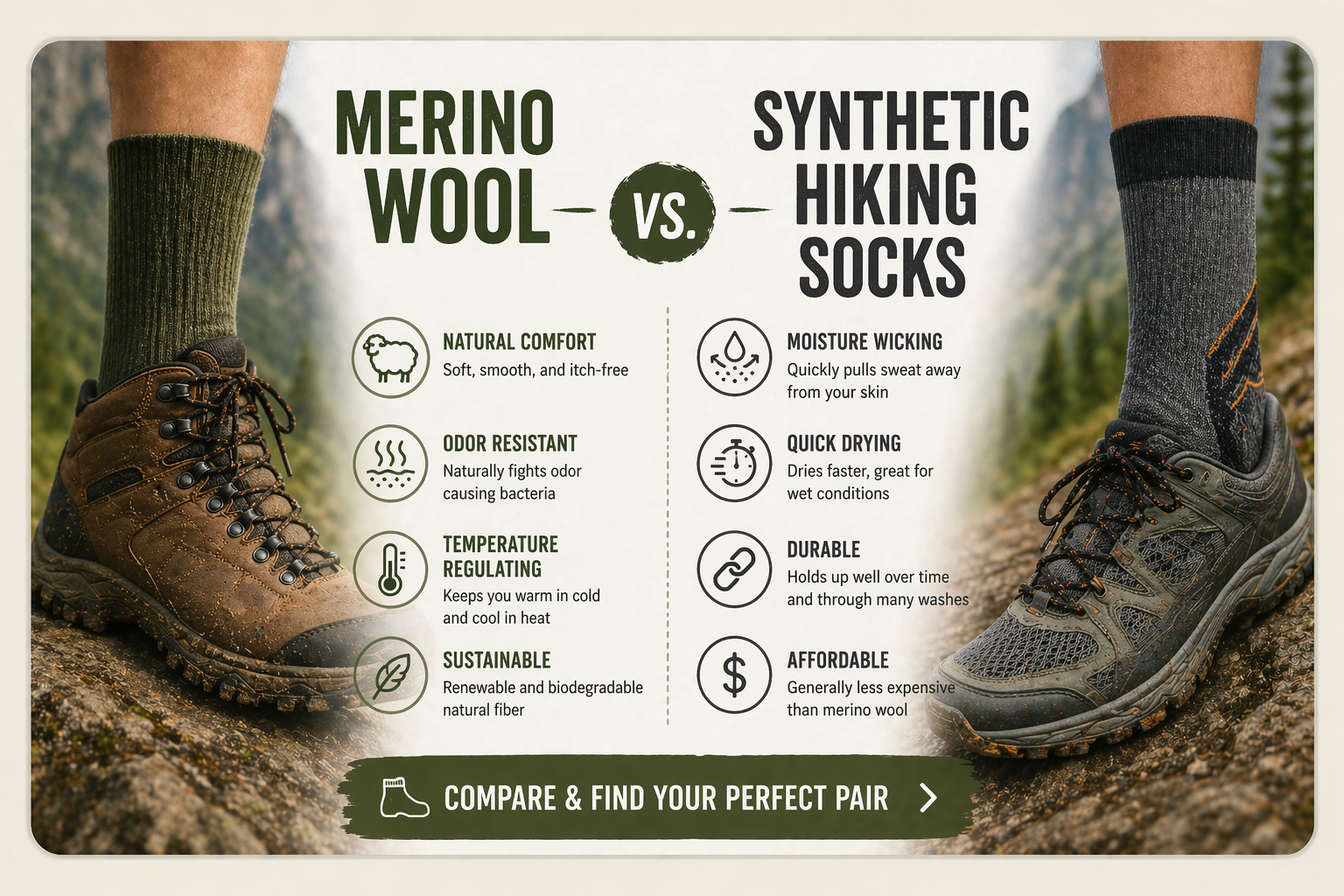
3. Merino Wool vs Synthetic Hiking Socks: Head to Head
Seven categories matter for hiking performance. The table below is honest: it shows where the win actually is, not a tie in every row to keep both fibers happy.
| Category | Merino wool | Synthetic | Winner |
|---|---|---|---|
| Temperature regulation | Warm when cold, cool when hot. Actively regulates. | Insulates only when dry. Feels cold when wet. | Merino |
| Moisture management | Absorbs up to 30% of its weight before feeling wet. | Wicks faster and dries faster, but feels wet sooner. | Depends |
| Odor resistance | Naturally antimicrobial. Stays neutral 3 to 4 days. | Bacteria colonize quickly. Strong smell by day 2. | Merino |
| Durability (abrasion) | Wears through at heel and toe without reinforcement. | Nylon is the hardest-wearing sock fiber available. | Synthetic |
| Drying time (wet) | 2 to 4 hours hung on a pack in sun and wind. | 30 to 60 minutes in the same conditions. | Synthetic |
| Cost per pair | $18 to $30 for a quality hiking sock. | $8 to $18 for comparable cushion. | Synthetic |
| Comfort on skin | Fine fibers conform softly. Rarely itchy. | Smooth but can feel slick. No itch issues. | Merino |
Read the table carefully and the pattern is clear. Merino wins on comfort and trail-specific problems like odor and temperature. Synthetic wins on cost, durability, and any situation where drying speed matters more than warmth. That’s why the blended sock exists, and that’s why it dominates the market.
4. When Merino Wool Wins
There are specific scenarios where the pure merino advantage is decisive and the synthetic tradeoffs aren’t worth taking.
Multi-day backpacking with no laundry access
If you’re three days into a section hike on the Oregon Coast Trail or the Pacific Crest, the sock you put on in the morning is the one you’re sleeping in at night. Merino’s odor resistance isn’t a nice-to-have on trips like this; it’s the difference between dry, neutral-smelling feet and an ammonia-soaked pair of socks by day four. This is also where merino’s moisture absorption pays off: it doesn’t feel clammy even after a long day of sustained sweating.
Cold-weather hiking, roughly 20 to 50 degrees Fahrenheit
Merino’s insulating crimp and natural warmth-per-gram are unmatched by synthetic fibers at the same sock thickness. In the Cascades in late fall or early spring, a mid-weight merino sock keeps feet warm in conditions where synthetic wearers are losing feeling in their toes at the summit of a peak like South Sister or Mount Scott.
Blister-prone feet
The fine fibers of merino create less friction against skin than the smoother, slicker surface of polyester or nylon. Hikers who get hotspots on the ball of the foot or the back of the heel often find that a merino or merino-blend sock reduces the problem noticeably. Pair merino socks with well-fitted boots and the blister rate drops further. Our guide on how to break in hiking boots covers the other half of that equation.
Sensitive skin and eczema
Pure synthetics trap moisture at the skin surface, which can aggravate eczema and heat rash. Merino’s moisture absorption and hypoallergenic structure are better tolerated by most people with skin sensitivities. This isn’t a medical claim; it’s a pattern that shows up consistently in long-distance hiker forums and REI customer reviews.
5. When Synthetic Wins
Synthetic wins less often than merino evangelists admit, but in these scenarios, it’s the right choice.
Hot weather above 85 degrees
In sustained heat, you’re not trying to regulate temperature. You’re trying to evaporate sweat as fast as it’s produced. A thin synthetic sock with a smooth polyester or Coolmax body beats a mid-weight merino sock every time in this scenario. If you insist on wool, drop to an ultralight weight instead of a standard hiking weight.
Wet trails, creek crossings, and sustained rain
On the Oregon Coast in winter or the Hoh Rainforest any month of the year, you’re going to get your feet wet. Once a merino sock is soaked, it stays soaked for hours. A soaked synthetic sock wrings out and dries during lunch. For wet environments, synthetic is the practical choice.
Trail running and fast-and-light missions
Trail runners beat socks into submission with repeated impact and friction at a much higher cadence than hikers. The abrasion resistance of a 70 percent polyester, 25 percent nylon sock is worth the odor cost when the trip is over in four hours anyway.
Budget-constrained gear
A $10 three-pack of hiking-rated synthetic socks from REI or Darn Tough’s synthetic line outperforms any $8 merino sock on the market. Pure merino at that price point is almost always a sparse-knit economy yarn that wears through in one season. If the choice is cheap merino or cheap synthetic, choose synthetic.
6. The Blended Sock Is Usually the Answer
The Merino Wool vs Synthetic Hiking Socks framing is useful for understanding what each fiber does, but it’s a false binary. A well-designed blend captures 80 to 90 percent of merino’s advantages (comfort, odor resistance, temperature regulation) and 80 to 90 percent of synthetic’s advantages (durability, stretch recovery, lower cost). You give up edge cases in both directions and get a sock that works across almost every trail condition.
The ratio that works is roughly 60 to 70 percent merino wool, 25 to 35 percent nylon, and 2 to 4 percent lycra, spandex, or elastane. The merino handles temperature regulation, odor resistance, and the soft hand-feel against skin. The nylon holds the sock’s shape and takes the abrasion hit at the heel and toe, where pure merino would thin through first. The elastane just keeps the fit from going slack over dozens of wears.
If you see a sock advertising 80 or 90 percent merino, it will feel wonderful on day one and have holes in the heel within a few months of regular use. If you see a sock with less than 40 percent merino, you’re paying merino prices for mostly synthetic performance. The middle is the right place to be.
7. Sock Weight Is a Separate Decision
Fiber is only half the sock. The other half is weight: the amount of cushion and loft the sock has, independent of what it’s made from. A lightweight merino sock and a lightweight synthetic sock feel more similar to each other than either does to a heavyweight version of itself.
Four weight categories cover most hiking. Ultralight or liner-weight socks have no cushion and are thin enough to wear under another sock. They’re the pick for hot weather, tight boots, or as a blister-prevention layer worn beneath a thicker wool sock. Lightweight socks add minimal cushion at the heel and ball, which is enough for fast day hikes in moderate weather with trail runners or low-top boots.
Midweight is the default. Full cushion under the foot, lighter knit through the arch and shin so the top of the sock doesn’t bunch. This is the category three-season hikers spend most of their time in, and the right weight for anyone buying a single all-purpose pair. Heavyweight socks have dense cushion throughout and are built for cold-weather hiking, mountaineering, or multi-day trips with a heavy pack, where foot fatigue becomes its own problem and the extra cushion is earning its keep.
Match the weight to the conditions before you worry about the fiber. A heavyweight synthetic sock can be warmer on-trail than a lightweight merino, even though merino is the “warmer fiber” in the abstract. Weight matters more than the material debate most of the time.
8. How to Wash and Care for Each Type
Care rules diverge in ways that actually matter. Getting them wrong will shorten the life of a $25 sock to a single season.
Washing merino wool socks
Machine wash on a warm or cold cycle. Use a wool-safe detergent like Nikwax Wool Wash or a mild detergent without enzymes or bleach. Standard enzyme-based detergents (Tide Original, Persil) slowly degrade the keratin in wool fiber over many washes. You’ll see the damage as a thinning sock that pills excessively.
Never use fabric softener. It coats the fibers and destroys merino’s moisture-wicking and odor-resistance properties. This damage is cumulative and not recoverable.
Tumble dry on low, or air dry. High heat is the fastest way to ruin merino: a single cycle on high can shrink a sock by a full size, and the shrinkage is permanent. If you hike frequently in merino, air drying also extends the life of the fiber noticeably.
Throwing merino socks in a mixed load with bleach, fabric softener, or high-heat drying. Any one of these alone shortens the life of a $25 pair to a single season. All three together ruins them in a single cycle.
Washing synthetic socks
Much less finicky. Warm wash, any detergent, any dryer setting. The one caveat is that high heat degrades elastane (the stretch fiber) over many cycles, so synthetic socks that see the hot dryer regularly lose their shape faster than socks that are air-dried. If you want a synthetic sock to last, treat it the same as merino: warm wash, low heat or air dry.
Drying wet socks on the trail
Clip them to the outside of your pack with the opening facing forward, so they catch airflow as you hike. On a sunny, breezy day, synthetic socks are dry in under an hour and merino socks in two to four hours. Tucking them inside your sleeping bag overnight finishes the job in camp. For merino, the body heat works faster than you’d expect because the fiber absorbs moisture rather than releasing it all at the surface.
9. Brands Worth Knowing
Six brands make most of the hiking socks that end up on real feet on real trails. These are the ones worth your money. Each has a distinct position in the market, which matters because the right sock for a blister-prone thru-hiker is not the right sock for a weekend day-hiker on a budget.

The default all-around hiking sock. Classic 61/36/3 merino-nylon-lycra blend. Unconditional lifetime guarantee that is genuinely honored: any pair that wears through gets replaced, no receipt, no questions.

The PhD Hike line is the flagship. Softer feel out of the box than Darn Tough, sometimes at the cost of longevity at very high mileage. Women’s-specific fits are notably better than most competitors.

Merino-first brand. The Hike+ line uses higher merino content than most competitors (around 70 percent), which means better odor resistance for multi-day trips and slightly less durability.

Popular with European thru-hikers and heavy-pack hikers. The Trailhead and WoolFusion lines are heavier and denser than American equivalents, which makes them ideal for rough terrain.

The toe-sock brand. Each toe is individually pocketed, which eliminates the friction-between-toes blister that forms on long downhills. Polarizing concept: hikers who have that specific problem swear by them.

Solid house brand priced well below the name brands. The merino-blend Co-op line is a legitimate budget option for hikers who do not need the lifetime guarantee or branded cachet.
A midweight Darn Tough Hiker Micro Crew in your shoe size. It’s the single best all-around hiking sock for the widest range of conditions, and when it eventually wears out, they’ll replace it for free.
Our Tested Hiking Sock Roundups
If you’re ready to buy, these are our current picks by category. Every sock here has been tested on Oregon trails in real conditions, with rankings based on independent testing and no brand paying for placement.
Merino vs Synthetic, Answered
Yes, within reason. Merino wool contains keratin and lanolin, and its fiber structure absorbs moisture before bacteria can fully colonize the sock. Most hikers can wear the same pair for three or four days on trail without a strong odor, compared to synthetic socks which typically smell by the end of day two. Rinsing merino socks in a stream and letting them air dry resets them. They are not odor-proof forever, but they stay neutral dramatically longer than polyester or nylon.
Not if you choose the right weight. Ultralight and lightweight merino socks (around 150 to 200 gsm fabric density) are cooler than most people expect because wool regulates temperature in both directions. The fiber traps still air when your feet are cool and evaporates moisture when they heat up. In temperatures above 85 degrees Fahrenheit, a thin merino blend typically outperforms a mid-weight synthetic because it keeps sweat from pooling. The problem is wearing a heavy winter-weight merino sock in July, not the fiber itself.
A well-made merino-synthetic blend should last 400 to 800 miles of hiking before thinning at the heel or toe. Pure synthetic socks last longer in abrasion resistance, often 800 to 1200 miles, but they lose their cushioning and elastic recovery faster. Darn Tough socks carry an unconditional lifetime guarantee, which is not marketing language: they will replace socks that wear through, period. Most hikers replace socks on feel rather than on mileage, when the cushion compresses or the fit goes slack.
Yes for the washer, with caveats for the dryer. Wash merino on a warm or cold cycle with wool-safe or mild detergent. Avoid bleach, fabric softener, and detergents with added enzymes, all of which damage the fiber’s protective scales. Tumble drying on low heat is safe for most blended merino socks. High heat shrinks merino measurably on the first cycle, sometimes by a full sock size, and that shrinkage is irreversible. When in doubt, air dry.
Significantly. A soaked synthetic sock dries in roughly 30 to 60 minutes clipped to the outside of a pack in sun and wind. A soaked merino sock typically takes 2 to 4 hours in the same conditions. This gap matters on wet multi-day trips, during creek crossings, and for anyone hiking in sustained rain. It matters less on dry day hikes where your socks start and finish dry. Blended socks split the difference, drying faster than pure merino but slower than pure synthetic.
Genuinely the best of both, not a compromise. Pure merino lacks the abrasion resistance and elastic recovery needed for a sock that keeps its shape over hundreds of miles. Pure synthetic lacks temperature regulation and odor control. A typical hiking sock of 60 to 70 percent merino, 25 to 35 percent nylon, and 2 to 4 percent lycra or spandex delivers the warmth, comfort, and odor resistance of wool with the durability and stretch retention of synthetic. The major hiking sock brands all settled on this ratio independently, which is a strong signal it works.
