Camp gear field guide
The Best Kids Sleeping Bags
Nine kids sleeping bags across three categories: camping bags with real insulation, bags with a built in pillow, and slumber bags for sleepovers and daycare. A kid’s bag has one job adult bags do not, which is to work for a person who will not tell you it is failing until the night is already ruined.
Quick Picks: The Top 5 in 30 Seconds
If you are shopping in a hurry, these five cover most kids sleeping bag buying intent. Tap a card to grab the price on Amazon.
Find Your Kids Sleeping Bag
Four questions, one personalized pick from our 9. No email, no signup.
Your match
Answer the questions above
We will recommend the right bag from our 9 picks.
Check price on Amazon →Our 9 Top Picks for 2026
Nine bags across three categories. Each pick is the bag we would actually hand a kid for that scenario, scored on a 100 point trail score across warmth, packability, build quality, value, and comfort.
Best Kids Sleeping Bags for Camping
Five bags with real insulation, a shell that handles damp ground, and a stuff or compression sack. These are the picks for a tent. The choice between them comes down to how cold your nights get, how big your kid is, and whether fabric texture is a fight in your house.
Best Kids Sleeping Bag Overall: Coleman Kids 45°F
Built for a child’s body, from a brand that still stocks parts

Pros
- Sized for a child rather than cut down from an adult bag
- Roll control straps let a kid pack the bag without help
- Fits tall kids and most preteens, so it lasts several seasons
- Coleman parts and support are stocked at any outdoor retailer
- Machine washable, which matters more than parents expect
Cons
- Warm weather rating only, no margin for frost
- Rectangular cut gives up efficiency against a mummy
- Bulkier packed than a purpose built backpacking bag
Coleman answers the question parents are actually asking, which is not which bag is warmest but which bag a kid will still be using in three years. It is cut for a child’s proportions, fits up to five foot five, and is assembled well enough to survive being dragged across a campground, crammed into a trunk, and washed after the inevitable spill.
The roll control straps deserve more attention than they get. Most children cannot repack an adult sleeping bag, which means a parent does it every morning of every trip. The straps here let a seven year old roll and cinch the bag themselves, badly at first and then competently, and that small independence changes camping from something happening to them into something they are doing.
| Temperature rating | 45°F |
|---|---|
| Insulation | Synthetic hollow fiber |
| Shape | Rectangular |
| Fits up to | 5 ft 5 in tall |
| Packing | Roll control straps |
| Shell | Polyester, soft liner |
| Care | Machine washable |
| Best for | First real camping bag, ages 6 to 12 |
| Price at last update | $49 |
| Amazon rating | 4.7 of 5 across 2,291 ratings |
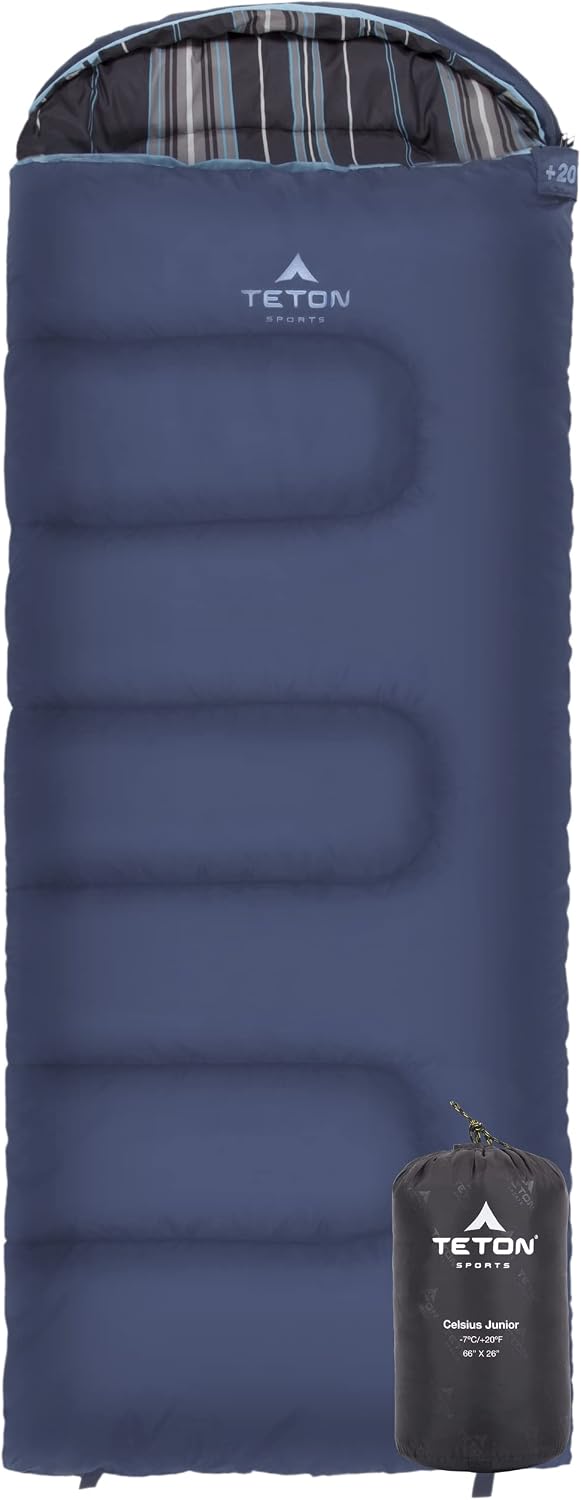
Best Cold Weather Kids Sleeping Bag: Teton Junior 20°F / 0°F
A real cold weather mummy bag scaled down to a kid
Pros
- The only genuinely cold rated kids bag with a deep track record
- Mummy cut and cinch hood hold heat the way an adult bag does
- Synthetic fill keeps insulating when the tent floor goes damp
- Compression sack included, so it fits in a kid’s own pack
- Two temperature versions let you match real conditions
Cons
- Mummy taper feels confining to kids who thrash in their sleep
- Too warm for summer campground trips
- Heavier and bulkier than the warm weather picks
This is the bag for families who camp past Labor Day. Almost everything else marketed to kids is built around summer campgrounds and living room floors. The Teton Junior is an actual cold weather mummy bag scaled to a child, with a cinch hood, a draft tube behind the zipper, and synthetic fill that keeps working when condensation soaks the foot of the bag against a tent wall.
Children run colder than adults at night and they do not wake up and fix it. An adult who gets cold cinches the hood or adds a layer. A seven year old lies there and gets steadily more miserable, and by morning the trip is over. Buying more warmth than the forecast suggests is the highest leverage decision in kids sleep gear, and this is the bag that lets you do it without shopping the adult aisle.
| Temperature rating | 20°F and 0°F versions |
|---|---|
| Insulation | SuperLoft Elite synthetic |
| Shape | Mummy with cinch hood |
| Zipper | Full length with draft tube |
| Packing | Compression sack included |
| Shell | Taffeta with brushed liner |
| Care | Machine washable |
| Best for | Shoulder season, elevation, kid carried packs |
| Price at last update | $56 |
| Amazon rating | 4.5 of 5 across 968 ratings |
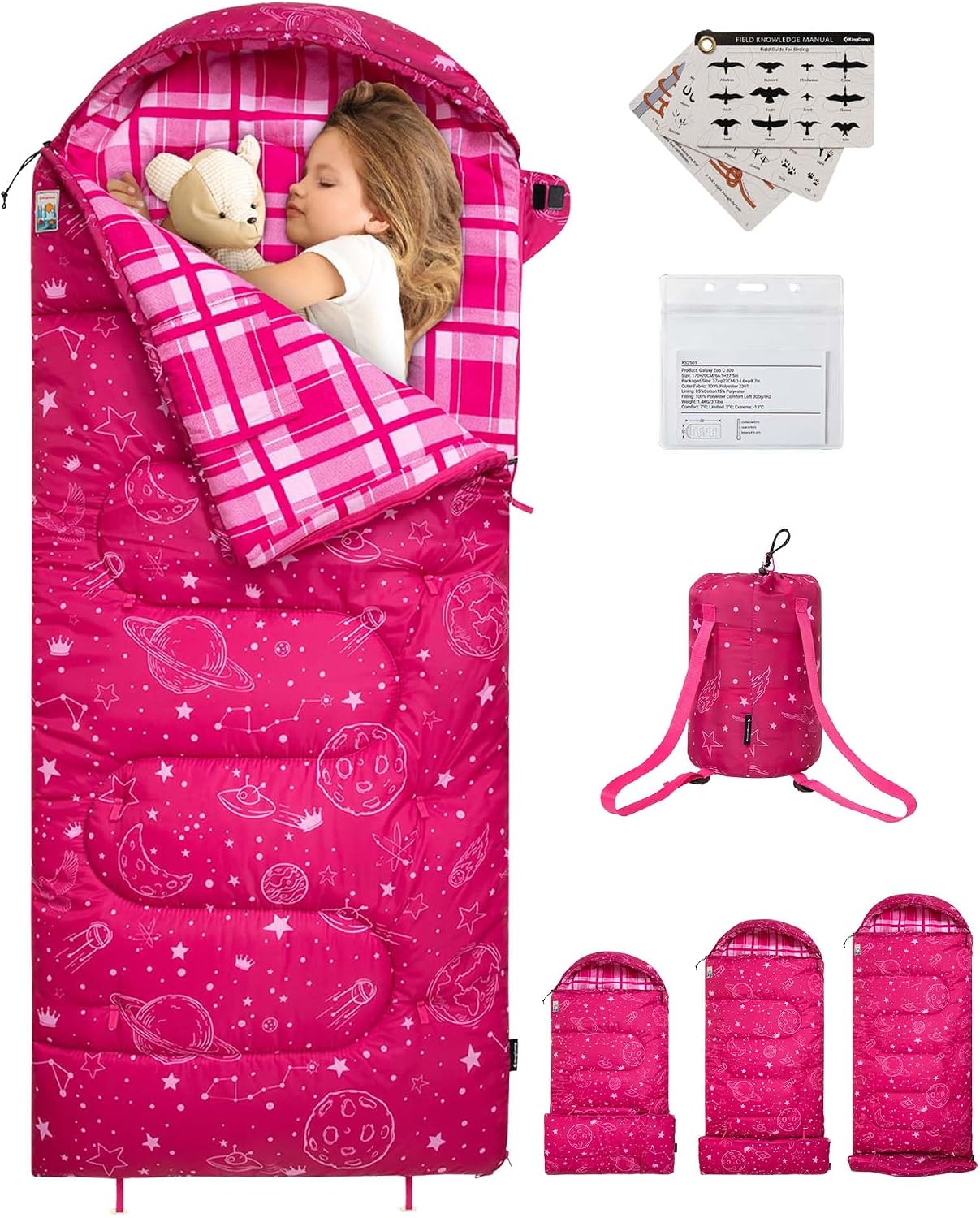
Best Flannel Kids Sleeping Bag: KingCamp 45°F Kids Flannel
Full flannel liner for the kid who rejects synthetic fabric
Pros
- Full flannel liner reads as bedding rather than gear
- Waterproof shell shrugs off spills and damp ground
- Sized for older kids and preteens who outgrew novelty bags
- Several colorways, so a kid can choose their own
- Opens flat to work as a comforter on warm nights
Cons
- Priced above comparable warm weather kids bags
- Flannel adds real weight and packed bulk
- Warm weather rating only
Kids register fabric against bare skin in a way adults have trained themselves to ignore. A slick synthetic liner is a legitimate reason a child announces at ten at night that they cannot sleep, and no amount of reasoning fixes it. The KingCamp addresses that directly with a full flannel liner that feels like the sheets on their own bed.
It also sits in the awkward gap where a child is too big for a character slumber bag and not yet ready for an adult bag, which is exactly the stage where families make a bad purchase and end up with a kid swimming inside something rated for a grown adult. Note that this bag is sold in several colorways at different prices for what is otherwise the same product, so it pays to check a few colors.
| Temperature rating | 45°F |
|---|---|
| Liner | 100 percent flannel |
| Shell | Waterproof polyester |
| Shape | Rectangular, opens flat |
| Sized for | Roughly ages 10 to 12 |
| Colorways | Multiple, priced separately |
| Care | Machine washable |
| Best for | Preteens and kids sensitive to synthetic liners |
| Price at last update | $66 |
| Amazon rating | 4.4 of 5 across 321 ratings |
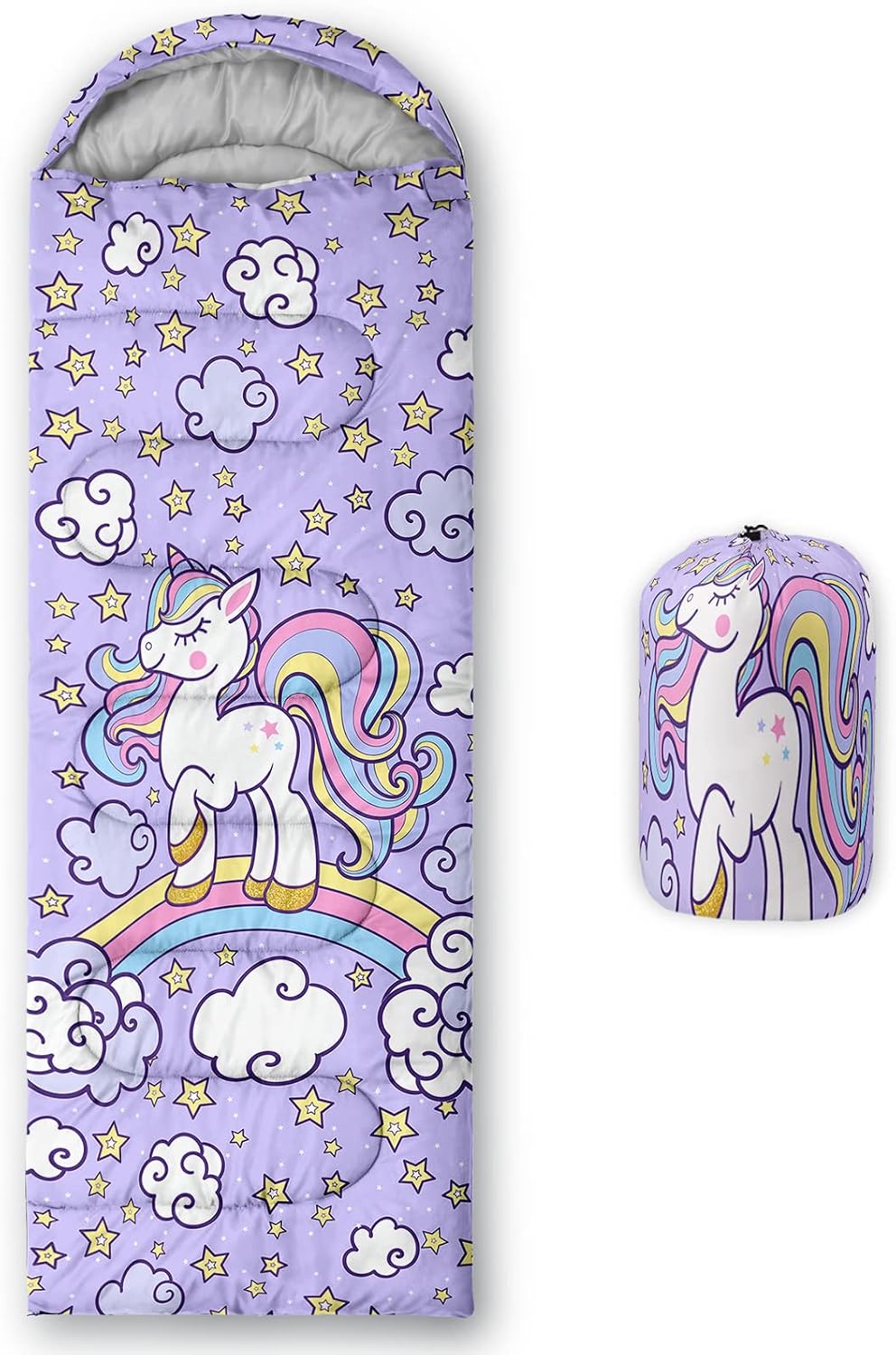
Best Themed Kids Sleeping Bag: Axolotl Unicorn Kids Bag
A real 3 season shell wearing a print a kid picked out
Pros
- Real 3 season construction rather than a novelty blanket
- Water resistant shell handles damp ground and spills
- Packs small enough for a kid to carry their own bag
- Zips flat to use as a quilt indoors
- Priced so an unexpected growth spurt does not sting
Cons
- Build quality is honest about where it sits
- Not warm enough for genuinely cold nights
- The zipper is the part most likely to give out first
This is the crossover pick. It has an actual water resistant shell and a compression sack, which puts it a tier above the plush indoor bags, and it carries a print a child will be pleased about, which puts it ahead of the plain technical bags in the only test that matters at bedtime.
It is the right bag to buy when a kid is between sizes and you already know a replacement is coming in two seasons. Spending less at that stage is the correct call, and this is the least compromised version of spending less that came out of our pool.
| Season rating | 3 season, warm and cool |
|---|---|
| Insulation | Synthetic hollow fiber |
| Shell | Water resistant polyester |
| Shape | Rectangular, opens flat |
| Packing | Compression sack included |
| Sized for | Roughly ages 5 to 11 |
| Care | Machine washable |
| Best for | Campgrounds and sleepovers on one budget |
| Price at last update | $39 |
| Amazon rating | 4.4 of 5 across 282 ratings |
Best Kids Sleeping Bag for Older Kids: Axolotl Gamepad Kids Bag
The same 3 season shell with a print that reads older

Pros
- Print reads older without jumping to a plain adult bag
- Same 3 season shell and compression sack as its sibling
- Light enough for a kid to carry on a short approach
- Opens flat for warm nights or indoor use
- Cheap enough to replace at the next growth spurt
Cons
- Same mid tier build as the rest of this line
- Warm and cool weather only, not cold
- Rectangular cut gives up efficiency against a mummy
Somewhere around eight or nine, kids stop wanting animals on their gear and start noticing what looks babyish. That transition catches parents off guard, and the usual reaction is to jump straight to an adult bag the child does not fit. This one bridges the gap with a print that reads older on the same competent 3 season shell as the rest of the line.
Functionally it is the same bag as the unicorn version, and that is worth saying plainly rather than inventing a difference. Buy on which one your kid will actually be pleased to unroll, because that is the only variable that changes.
| Season rating | 3 season, warm and cool |
|---|---|
| Insulation | Synthetic hollow fiber |
| Shell | Water resistant polyester |
| Shape | Rectangular, opens flat |
| Packing | Compression sack included |
| Sized for | Roughly ages 8 to 12 |
| Care | Machine washable |
| Best for | Older kids past character prints |
| Price at last update | $39 |
| Amazon rating | 4.6 of 5 across 136 ratings |
Best Kids Sleeping Bags with a Pillow
Two picks that solve the pillow problem in different ways. One takes the pillow your child already sleeps on at home, which is the better answer for camping. The other has the pillow sewn on, which is the better answer for anywhere a detachable item would stop coming home.
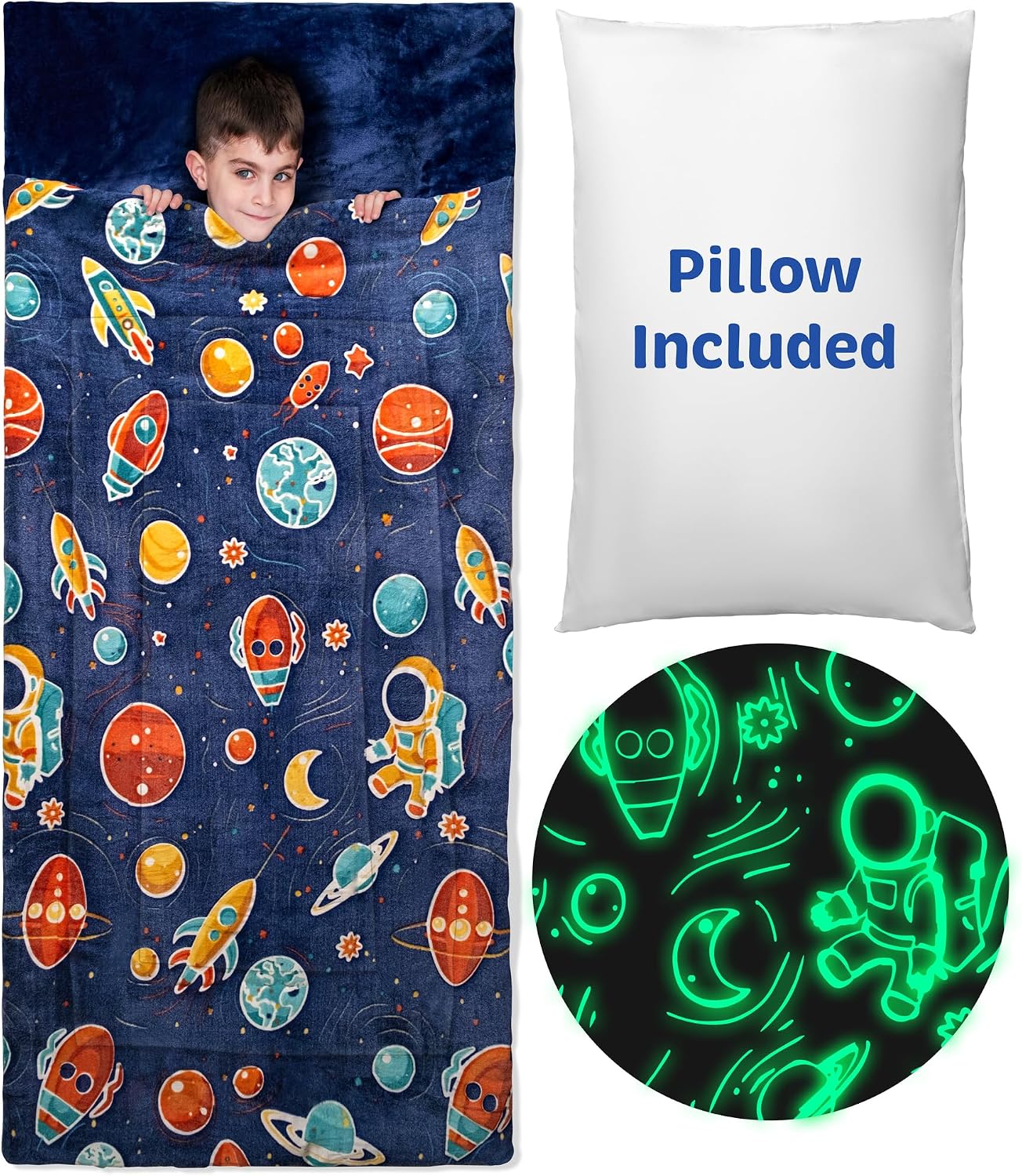
Best Kids Sleeping Bag with a Pillow: Glow in the Dark Kids Bag
A pillow pocket that takes their own pillow from home
Pros
- Pillow pocket means one less item to forget and lose
- Glow print gives a kid a soft landmark in a dark tent
- Oversized cut suits children who hate feeling wrapped up
- Wide age range, so it lasts several seasons
- Washes clean without special handling
Cons
- Not warm enough for cold nights
- Glow effect fades and needs light exposure to recharge
- Bulky relative to the warmth it delivers
The pillow pocket is a feature parents underrate until the first trip. Kids sleep badly on a rolled up fleece, and a loose pillow migrates out the tent door by three in the morning. A pocket that holds their own pillow from home solves both problems and brings a familiar smell into a strange tent, which does more for a nervous first camper than any specification on this page.
The glow print earns its place for a reason that has nothing to do with novelty. A child who wakes disoriented in a pitch black tent needs to locate themselves quickly, and a faintly glowing bag outline does that before anyone has to find a headlamp.
| Age range | 3 and up |
|---|---|
| Pillow | Built in pocket, takes a home pillow |
| Feature | Glow in the dark print |
| Shape | Rectangular, oversized |
| Insulation | Synthetic, warm weather |
| Shell | Brushed polyester |
| Care | Machine washable |
| Best for | Sleepovers and summer campgrounds |
| Price at last update | $50 |
| Amazon rating | 4.6 of 5 across 600 ratings |
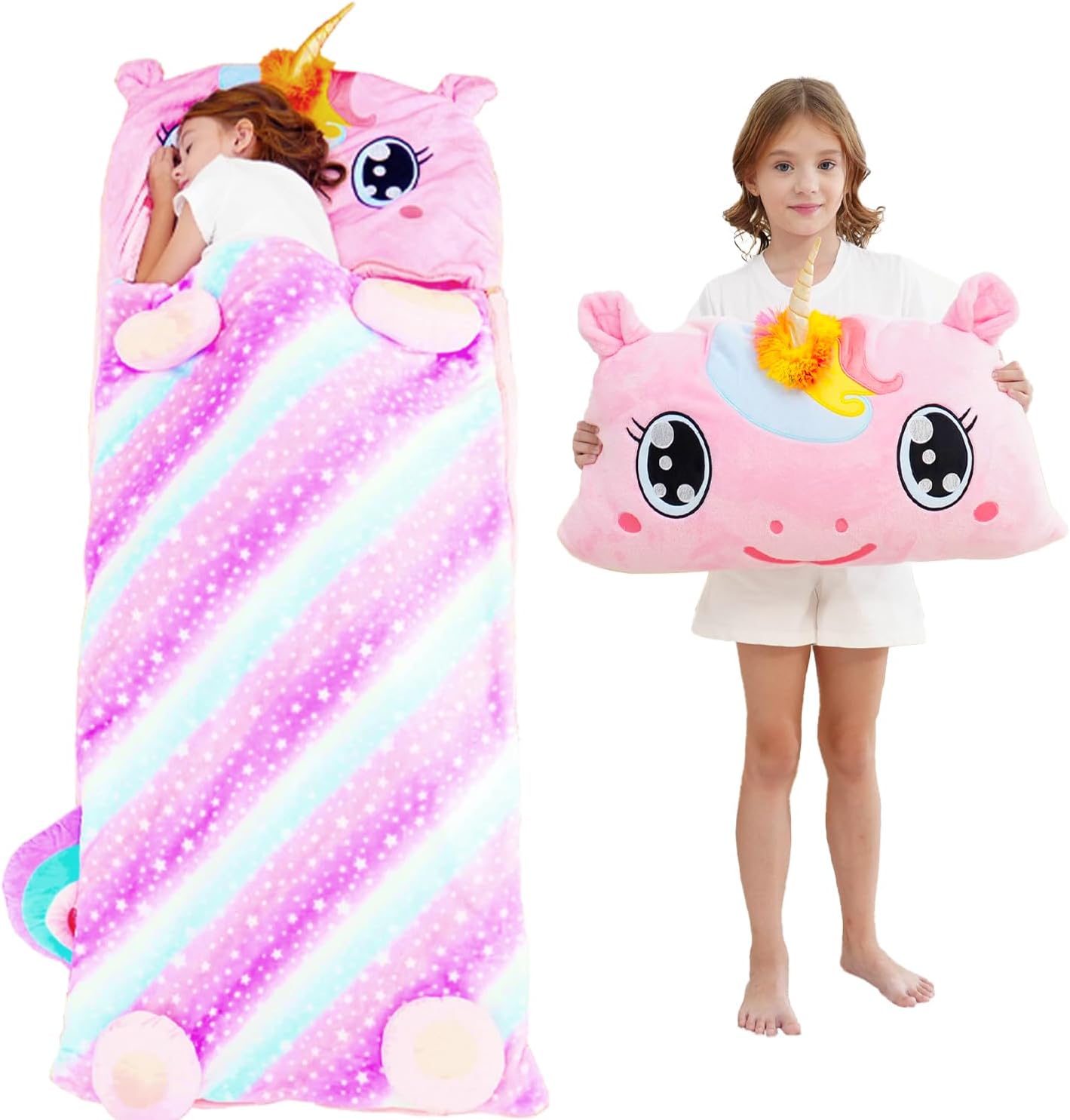
Best Kids Nap Mat with an Attached Pillow: Kids Nap Mat with Pillow
An attached pillow that cannot be left behind at daycare
Pros
- Attached pillow cannot be left behind at daycare
- Runs larger than most mats, so it lasts past preschool
- Rolls into a bundle a small child can carry themselves
- Survives frequent washing without falling apart
- Plush surface is comfortable directly on a hard floor
Cons
- Built for indoor naps, not overnight camping
- Minimal insulation from cold surfaces
- Attached pillow means you cannot swap in a favorite
Daycare and preschool have a specific failure mode, which is that any detachable item eventually stops coming home. An attached pillow removes that problem permanently. It is a mundane advantage and it is the main reason to buy this over a cheaper mat.
It also runs larger than most nap mats, which extends the useful life a year or two past the point where a standard mat leaves a kid’s feet hanging off the end. For families who want one item covering naps, grandparents’ houses, and hotel floors, this is the right shape.
| Design | Nap mat with attached pillow |
|---|---|
| Age range | Preschool and daycare age |
| Pillow | Attached, non removable |
| Padding | Plush top layer |
| Packing | Roll strap and carry handle |
| Shell | Plush polyester |
| Care | Machine washable |
| Best for | Daycare, preschool, travel naps |
| Price at last update | $50 |
| Amazon rating | 4.8 of 5 across 161 ratings |
Best Kids Slumber Bags for Sleepovers and Daycare
Two indoor bags, included because a large share of kids sleeping bag shopping is not about camping at all. Neither has a temperature rating and neither belongs in a tent. For a friend’s living room floor or a daycare classroom, both are more comfortable than any camping bag on this page.
Best Kids Slumber Bag for Sleepovers: Happy Nappers Sleepy Sack
Zips into a plush toy, so the kid carries their own bedding

Pros
- Converts into a plush toy, so kids carry it themselves
- One of the deepest track records in the whole category
- Genuinely soft in a way technical fabrics never manage
- Doubles as a pillow when nobody is sleeping in it
- Survives repeated washing
Cons
- An indoor product, not a camping bag
- No temperature rating and very little real insulation
- Bulky relative to how little warmth it provides
Being honest about what this is: it is not a camping bag. It carries no meaningful temperature rating and it will not keep a child warm on cold ground. It is here because a large share of people shopping for a kids sleeping bag are buying for sleepovers, grandparents’ houses, and road trips, and pretending otherwise would be unhelpful.
For that job it is excellent. It zips into a stuffed animal, which means the child carries their own bedding without being asked, and it stays soft through repeated washing. If your real use case is a friend’s living room rather than a tent, this is the right purchase and the technical bags above are the wrong one.
| Design | Converts between plush pillow and sleep sack |
|---|---|
| Age range | Roughly 3 to 10 |
| Packed form | Zips into a stuffed animal |
| Padding | Plush, no rated insulation |
| Shell | Plush polyester |
| Temperature rating | None, indoor use |
| Care | Machine washable |
| Best for | Sleepovers, road trips, indoor floors |
| Price at last update | $73 |
| Amazon rating | 4.6 of 5 across 2,913 ratings |
Best Cushioned Kids Slumber Bag: Large Unicorn Slumber Bag
A cushioned base that makes a hard floor tolerable

Pros
- Cushioned base makes a hard floor genuinely tolerable
- Highest satisfaction of any themed bag in our pool
- Rolls and straps small enough for a kid to carry
- Print holds up through washing without going dull
- Wide enough that kids do not feel constrained
Cons
- Indoor use, with no real cold weather capability
- Padding adds bulk that does not translate to warmth
- A theme will age out faster than a plain bag
Themed bags get dismissed by gear reviewers and bought by parents anyway, which suggests the reviewers are answering a different question. A child excited about their sleeping bag goes to sleep. A child who is not excited about it negotiates. The practical value of a print a kid chose is real even though it never appears on a spec sheet.
What separates this one from the pile is the cushioned base. Most slumber bags put a single layer of fabric between a child and a hardwood floor. The padding here is thin but it exists, and it is the difference between sleeping through the night and appearing at your bedside at midnight.
| Design | Slumber bag and portable nap mat |
|---|---|
| Age range | Preschool through early elementary |
| Padding | Cushioned base layer |
| Packing | Roll up with carry strap |
| Shell | Brushed polyester |
| Temperature rating | None, indoor use |
| Care | Machine washable |
| Best for | Sleepovers, daycare, indoor floors |
| Price at last update | $60 |
| Amazon rating | 4.8 of 5 across 174 ratings |
Full comparison table: best kids sleeping bag
Sort by trail score, price, warmth, or comfort. Tap the buttons to re-rank the table. The table scrolls horizontally on small screens.
| Bag | Award | Trail score | Temp / season | Shape | Age range | Price | |
|---|---|---|---|---|---|---|---|
|
Coleman Kids 45°F | Best Overall | 85 | 45°F | Rectangular | 5 ft 5 in tall | $49 |
|
Teton Junior 20°F / 0°F | Best Cold Weather | 84 | 20°F and 0°F versions | Mummy with cinch hood | Ages 6 to 12 | $56 |
|
KingCamp 45°F Kids Flannel | Best Flannel | 78 | 45°F | Rectangular, opens flat | Roughly ages 10 to 12 | $66 |
|
Axolotl Unicorn Kids Bag | Best Themed Value | 77 | 3 season, warm and cool | Rectangular, opens flat | Roughly ages 5 to 11 | $39 |
|
Axolotl Gamepad Kids Bag | Best for Older Kids | 77 | 3 season, warm and cool | Rectangular, opens flat | Roughly ages 8 to 12 | $39 |
|
Glow in the Dark Kids Bag | Best with Pillow | 75 | None, indoor use | Rectangular, oversized | 3 and up | $50 |
|
Happy Nappers Sleepy Sack | Best for Sleepovers | 73 | None, indoor use | Converts between plush pillow and sleep sack | Roughly 3 to 10 | $73 |
|
Kids Nap Mat with Pillow | Best for Daycare | 72 | None, indoor use | Nap mat with attached pillow | Preschool and daycare age | $50 |
|
Large Unicorn Slumber Bag | Best Cushioned | 71 | None, indoor use | Slumber bag and portable nap mat | Preschool through early elementary | $60 |
Full comparison table: best kids sleeping bag 2026. Trail score is a weighted average of warmth, packability, build quality, value, and comfort. Prices reflect Amazon listings at the time of the last update and may change.
How We Test Kids Sleeping Bags
We started with 38 kids sleeping bags and narrowed to 9. Each pick earns a 100 point trail score across five weighted categories, weighted for how children actually sleep rather than how adults do.
-
25%Warmth
Rated temperature against the nights a kid actually sleeps in
Kids lose heat faster than adults and will not wake up and fix it, so we score a bag on whether its rating leaves margin rather than whether it hits the number on the label. Manufacturer ratings are calibrated on adult metabolism, which means a kids bag behaves colder than the label suggests. Bags that leave no margin for a frosty night score lower here regardless of what the tag claims.
-
25%Packability
Whether a child can pack it without a parent doing it for them
This category means something different on a kids list. We score for whether a seven year old can get the bag back into its own sack, because a bag only a parent can pack is a bag the parent packs every morning of every trip. Compression sacks and roll control straps earn the high scores. A plain stuff sack with no straps scores lower even on an otherwise excellent bag.
-
20%Build
What survives a season of a child, plus repeated washing
Zipper quality, baffle stitching, shell denier, and how the liner holds up through the laundry. We read long term review patterns for the failure modes that appear in season two, which for kids gear is almost always the zipper or the stuff sack rather than the insulation. Bags with a pattern of zipper complaints came out even where the average rating held up.
-
15%Value
Cost measured against how long before the child outgrows it
Growth rather than wear usually ends a kids bag, and that changes the value math. A bag built to last a decade is worth less here than it would be on an adult list, because the child will be out of it in three to five years. We score against cost per usable season with growth factored in, not against the sticker price alone.
-
15%Comfort
Liner texture, roominess, and whether a kid will fight it
Comfort carries real weight on a kids list in a way it would not on an adult one. Children register fabric against bare skin and they do not endure discomfort quietly. Liner texture, how constrained the cut feels, hood fit, and whether a pillow is handled at all all factor in. A warmer bag a child fights all night is not a warmer night.
Where we tested
Anatomy of a Kids Sleeping Bag
Six parts decide whether a kids bag keeps a child warm or just looks the part on a shelf. Knowing what to check saves you a sleepless night with a cold, unhappy kid.
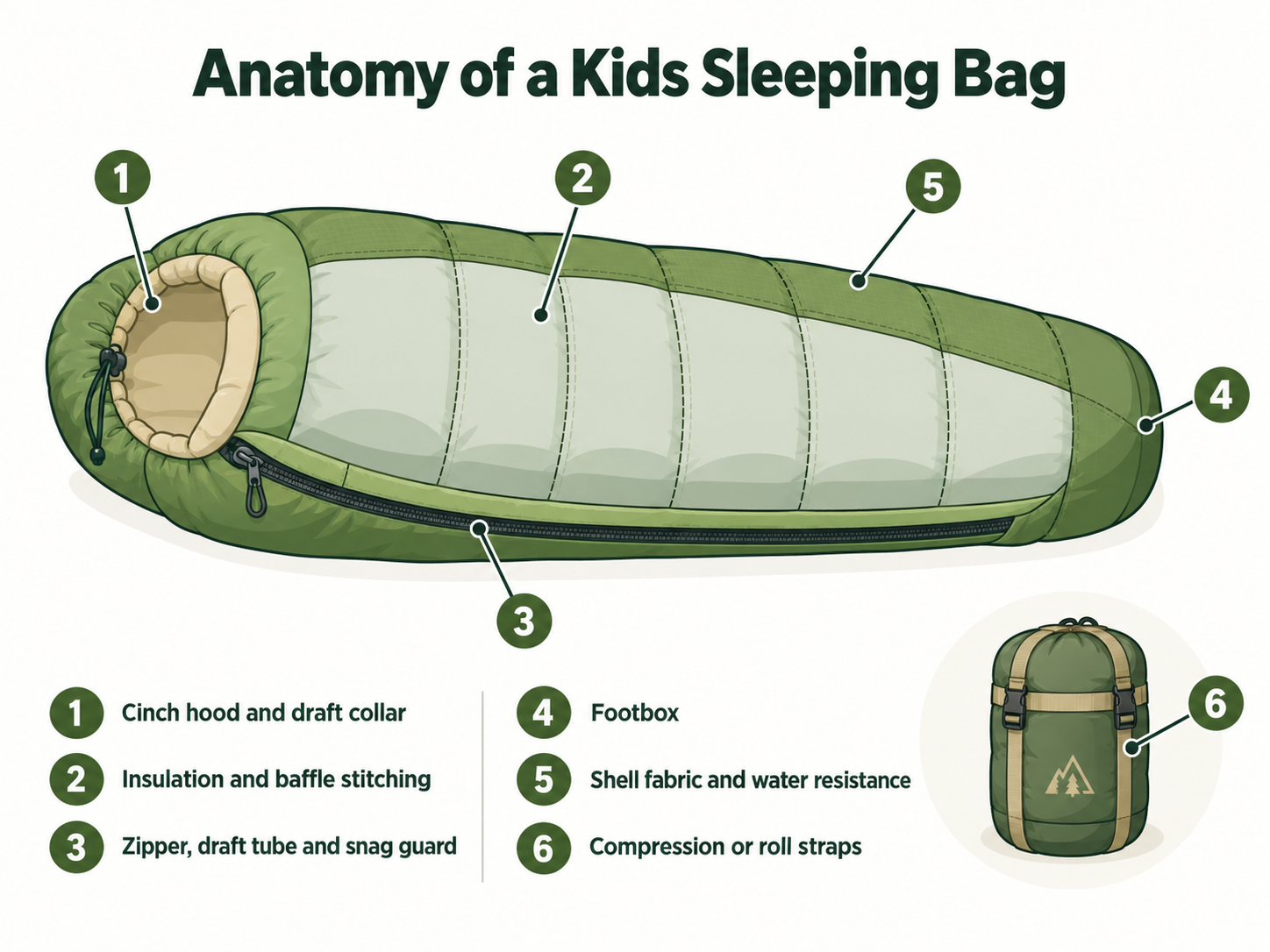
- Cinch hood and draft collar
- The hood that closes around a child’s head is what separates a real camping bag from a slumber bag. On cold nights it seals warm air in around the neck and shoulders, where most heat escapes. It is also the first component to fail on cheap bags, so check the drawcord and toggle before anything else.
- Insulation and baffle stitching
- The stitched channels that hold the fill in place across the bag. Without them the insulation migrates to the low side and leaves cold spots. Synthetic fill is the right choice for kids because it keeps insulating when damp and survives frequent washing, both of which matter more than packed weight at this age.
- Zipper, draft tube and snag guard
- A full length zipper lets you vent the foot on warm nights and open the bag flat as a quilt. The draft tube behind it blocks cold air leaking through the teeth. A snag guard matters more on a kids bag than an adult one, because a child fighting a jammed zipper in the dark will wake the whole tent.
- Footbox
- The closed end where feet sit. On a mummy bag it tapers to cut the air volume the body has to heat. This is where sizing goes wrong: a bag much longer than the child leaves a pocket of unheated air at the feet that the child has to warm all night, which is why buying long backfires.
- Shell fabric and water resistance
- The outer layer that meets a damp tent floor, spilled juice, and dirt. A water resistant polyester shell is worth insisting on for kids gear, since condensation on the inside of a tent wall soaks whatever touches it and children are not careful about where the bag sits.
- Compression or roll straps
- How the bag goes back in the sack. Compression sacks squeeze the bag down small enough for a child to carry in their own pack. Roll control straps do the same job with less fuss and let a young kid pack the bag unaided, which is the difference between a parent doing it every morning and a kid owning the task.
How to Choose a Kids Sleeping Bag
Six decisions narrow the field from dozens of listings to the right bag for your trips. Walk them in order, because the first two do most of the work.
1. Buy more warmth than the forecast suggests
Children have more skin surface relative to body mass than adults, so they shed heat faster in identical conditions, and they sleep through the fix rather than solving it. Take the coldest night you genuinely expect and buy a bag rated 10 to 20 degrees below it. Ratings are calibrated on adult metabolism, so the number on a kids bag is optimistic in a way the label never discloses. For summer campgrounds a 45 degree bag is enough. For spring and fall at elevation, 20 degrees is the honest floor.
2. Size to fit, not to grow into
The instinct is to buy long so the bag lasts, and it works against you. Empty space at the foot is air the child has to heat with their own body, and a kid in an oversized bag sleeps cold in conditions well inside the bag’s rating. This is the most common reason a correctly rated bag underperforms. Measure your child standing, add roughly six inches, and check that against the listed length. If the bag you have is too long, fold and clamp the bottom third so the sleeping space matches the child.
3. Choose between a mummy and a rectangular cut
Mummy bags taper toward the feet to cut the volume of air the body must warm, which makes them meaningfully warmer for the same fill, and it is why nearly every serious cold weather bag is cut that way. The trade is that many children find the taper and hood confining and sleep worse in one, and a warmer bag a kid fights all night is not a warmer night. Rectangular is the right default for summer campgrounds. If you camp into the cold or your child carries their own pack, a mummy earns the adjustment period.
4. Decide whether you are actually buying a camping bag
Search results mix two different products. A sleeping bag has insulating fill, a moisture resistant shell and often a hood, and it is designed to keep a person warm outdoors. A slumber bag or nap mat is plush fabric with light padding built for an indoor floor, with no insulation and no temperature rating. Both are useful and neither substitutes for the other. Buying the wrong one is the single most frequent complaint in this category.
5. Do not skip the sleeping pad
Most heat loss on a tent floor goes downward into the ground rather than upward into the air, and no sleeping bag insulates underneath a sleeper because body weight compresses the fill flat. A warm bag on bare ground still sleeps cold. A pad with a reasonable R value is the other half of the system, and for children it is not optional.
6. Prefer synthetic fill over down
Down is lighter and more compressible for the same warmth, which is why adult backpackers carry it. It also loses most of its insulating value when wet and needs special washing. Kids gear gets spilled on, rained on, and laundered often, and a child outgrows the bag long before the weight savings matter. Synthetic is the right call for almost every kids bag.
First camping bag, ages 6 to 12
Child specific sizing, roll control straps a kid can work themselves, and parts you can actually replace.
Coleman Kids 45°F on Amazon
Camping into the cold or at elevation
The only genuinely cold rated kids bag here with a real track record behind it, in a mummy cut with a cinch hood.
Teton Junior 20°F on Amazon
The kid who hates synthetic fabric
A full flannel liner that reads as bedding rather than gear, sized for preteens who have outgrown novelty bags.
KingCamp 45°F Flannel on Amazon
Sleepovers and daycare, not camping
Zips into a plush toy the child carries themselves. For daycare specifically, the Kids Nap Mat with an attached pillow is the better shape.
Happy Nappers Sleepy Sack on AmazonKids Sleeping Bag FAQ
The questions parents ask before buying a kids sleeping bag.
What temperature sleeping bag does a kid need?
Match the rating to the coldest night you actually expect, then buy roughly 10 to 20 degrees warmer than that. Children lose heat faster than adults because of their body surface to mass ratio, and unlike an adult they will not wake up and fix the problem, they will lie there cold until the trip is ruined. For summer campgrounds a 45°F bag is enough, and the Coleman Kids 45°F is the pick. For spring and fall at elevation, look for a 20°F bag like the Teton Junior. Temperature ratings are also calibrated on adult metabolism, which is another reason to add margin rather than trust the number on the label.
What size sleeping bag should I get for my child?
Measure your child’s height and add about six inches, then compare that against the bag’s listed length. Buying too long is the more common mistake and it is worse than it sounds, because the empty space at the foot has to be heated by the child’s own body and they end up cold in a bag rated well below the conditions. Most kid specific bags fit up to somewhere between four and five and a half feet. Once a child passes that, a short or regular adult bag is usually the better purchase.
Can kids use adult sleeping bags?
They can, but they will sleep colder in one. The excess volume inside an adult bag is dead air the child has to warm, which is why a properly sized kid bag often feels warmer than an adult bag with a higher rating. If an adult bag is what you have, clip the foot end closed or fold and clamp the bottom third so the sleeping space matches the child. Once a kid is close to five and a half feet, an adult bag becomes the right answer anyway.
Do kids need a sleeping pad too?
Yes, and it matters more than the bag for anyone sleeping on the ground. Most heat loss at night goes downward into cold ground by conduction rather than upward into the air, and no sleeping bag insulates underneath a sleeper because body weight compresses the fill flat. A pad with a decent R value is the difference between a warm night and a cold one regardless of what bag is on top of it. This applies to children exactly as it does to adults.
What is the difference between a kids sleeping bag and a slumber bag?
A sleeping bag is built to retain heat outdoors, with insulating fill, a shell that resists moisture, and often a hood. A slumber bag or nap mat is built for comfort on an indoor floor, usually plush fabric with light padding, no real insulation and no temperature rating. Both appear in the same search results, which is why buyers end up with the wrong one. If the destination is a tent, buy a sleeping bag. If it is a friend’s living room or a daycare classroom, a slumber bag like the Happy Nappers Sleepy Sack is more comfortable and easier to wash.
At what age can a kid have their own sleeping bag?
Most kid specific bags start around age three, which is the point at which a child reliably stays inside bedding without loose fabric being a concern. Below that age, wearable sleep sacks sized for toddlers are the safer format because there is no loose material around the face. Between three and five, look for a shorter bag or one with a cinch, since a full size kid bag leaves too much unheated space for a small child to warm.
How do you wash a kids sleeping bag?
Nearly every synthetic kids bag is machine washable on a gentle cycle with mild detergent in a front loading machine. Avoid top loaders with a centre agitator, which tear at the baffles. Tumble dry on low with a couple of dryer balls to break up clumped fill, and make sure the bag is completely dry before it is stored or it will develop mildew. The full walkthrough is in our guide on how to wash a sleeping bag.
Should a kids sleeping bag be a mummy or a rectangular shape?
Rectangular for most families, mummy for cold weather and backpacking. Mummy bags taper toward the feet to cut the air volume the body has to heat, which makes them noticeably warmer for the same amount of fill, but plenty of children find the taper and hood confining and sleep worse in one. Rectangular bags are roomier and easier for a restless kid, at the cost of some warmth. If your trips are summer campgrounds, rectangular is fine. If you camp into the cold, the efficiency of a mummy is worth the adjustment period.
How long will a kids sleeping bag last before they outgrow it?
Plan on three to five years from a bag bought with a little room to grow, and less if you buy one sized exactly to a child’s current height. Growth rather than wear is what usually ends a kid bag, which is a reasonable argument against spending heavily before a child has stopped growing quickly. Buying long is tempting but works against you in cold weather, so the better approach is buying to fit and accepting a replacement later.
Are down sleeping bags worth it for kids?
Rarely. Down is lighter and packs smaller for the same warmth, which is why serious adult backpackers carry it, but it loses most of its insulating value when wet and it needs special washing. Kids gear gets spilled on, rained on, and washed often, and a child will outgrow the bag long before the weight savings pay for themselves. Synthetic fill is the right call for almost every kids bag, and every pick on this page uses it.