
Oregon Tails: State Guide & Stats
60 Oregon Fun Facts
You Probably Don’t Know
World records. Surprising inventions. Weird laws. History nobody talks about. Everything that makes Oregon genuinely strange and genuinely great, organized by category.
Deepest in the US
Deepest gorge in N. America
Oldest footwear on Earth
in Oregon
Most Oregon fun facts lists cover Crater Lake and the two-sided flag, then stop. This one goes further: the world records most people miss, the foods Oregon invented, the history that gets skipped in schools, and the weird laws that only made sense until they didn’t. Sixty facts, organized so you can jump to whatever you want to know.
#01 Oregon’s World Records and Superlatives
Oregon fun facts about records: these are the world records Oregon actually holds, verified and documented.
 1,943
feet deep: deepest lake in the United States
1,943
feet deep: deepest lake in the United States
Crater Lake, Southern Oregon
Formed when Mount Mazama erupted and collapsed roughly 7,700 years ago, Crater Lake filled entirely with rainwater and snowmelt. There are no inlets or outlets, which means no sediment enters the lake, giving it a clarity that lets sunlight penetrate over 100 feet and produces the color that makes it one of the most photographed places in the country. It is also the ninth-deepest lake in the world. Plan your visit →

Hells Canyon, Oregon-Idaho Border
Hells Canyon is nearly 2,000 feet deeper than the Grand Canyon. The Snake River carved it over millions of years, and the canyon walls reach 8,000 feet above the river on the Idaho side.
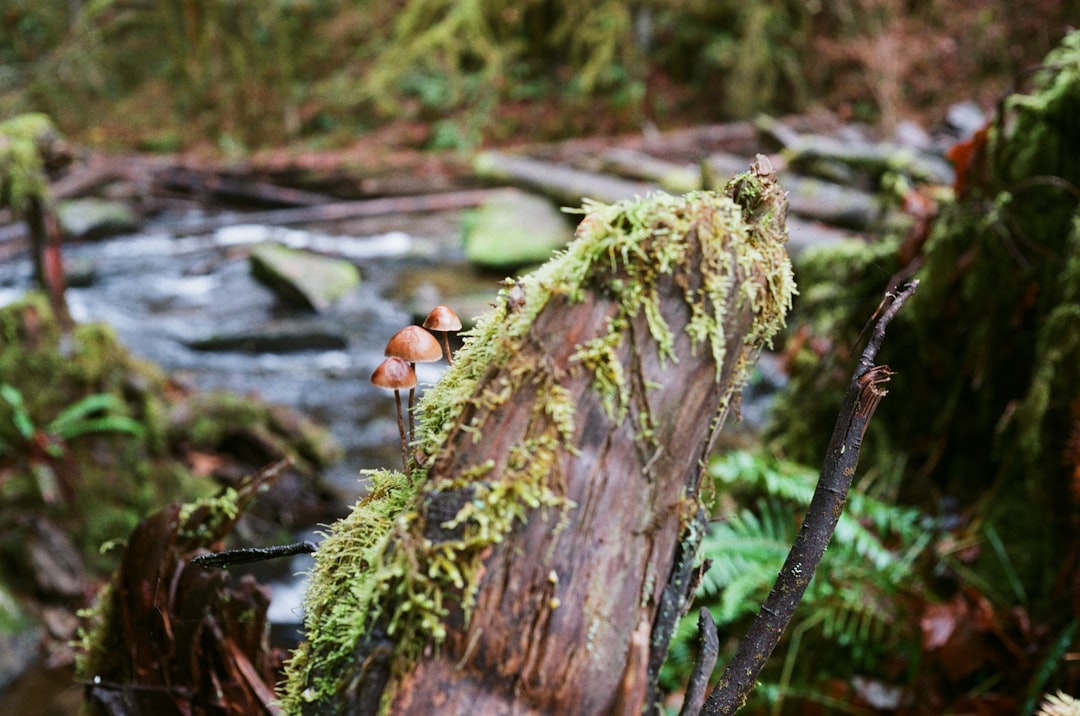
Humongous Fungus, Malheur National Forest
The Armillaria ostoyae honey fungus in Malheur National Forest spans more than four square miles and is estimated to weigh 7,500 tons. Most of it is underground, connected through root systems. Scientists believe it is between 2,000 and 8,000 years old.

Hood to Coast, Annual
Hood to Coast runs from Timberline Lodge on Mt. Hood to Seaside on the Pacific Coast. Founded in 1982, it fields roughly 1,200 teams of 12 runners who cover the distance in shifts over approximately 28 to 34 hours. It sells out on the day registration opens, consistently.

Powell’s Books, Portland
Powell’s occupies a full city block in downtown Portland, contains over one million books across four floors, and has a Gold Room for rare volumes. The most expensive item in the store is an 1814 copy of the Lewis and Clark journals, priced at $350,000.

Mill Ends Park, Portland
Mill Ends Park has been in a median strip on Southwest Naito Parkway since 1948, when a columnist at the Oregon Journal planted flowers in a hole left for a light pole that was never installed. It holds a single tree. Its sole tree was stolen in 2013 and returned within days.

Fort Rock Sandals, Lake County
Sagebrush sandals discovered in Fort Rock Cave in 1938 were radiocarbon dated to 7,300–8,200 BC, making them the oldest known footwear in the world. They are now held by the Oregon Museum of Science and Industry.

Washington Park Station, Portland
The Washington Park MAX station sits 260 feet below street level inside a tunnel drilled through the West Hills. It takes about three minutes to ride the elevator to the platform. The walls display geological samples from the drill core.

Willamette Meteorite, Willamette Valley
The Willamette Meteorite weighs 15.5 tons and is the largest meteorite ever found in the United States. It is sacred to the Confederated Tribes of Grand Ronde, who call it Tomanowos and used rainwater that collected in its craters in ceremonies. It is now on display at the American Museum of Natural History in New York.
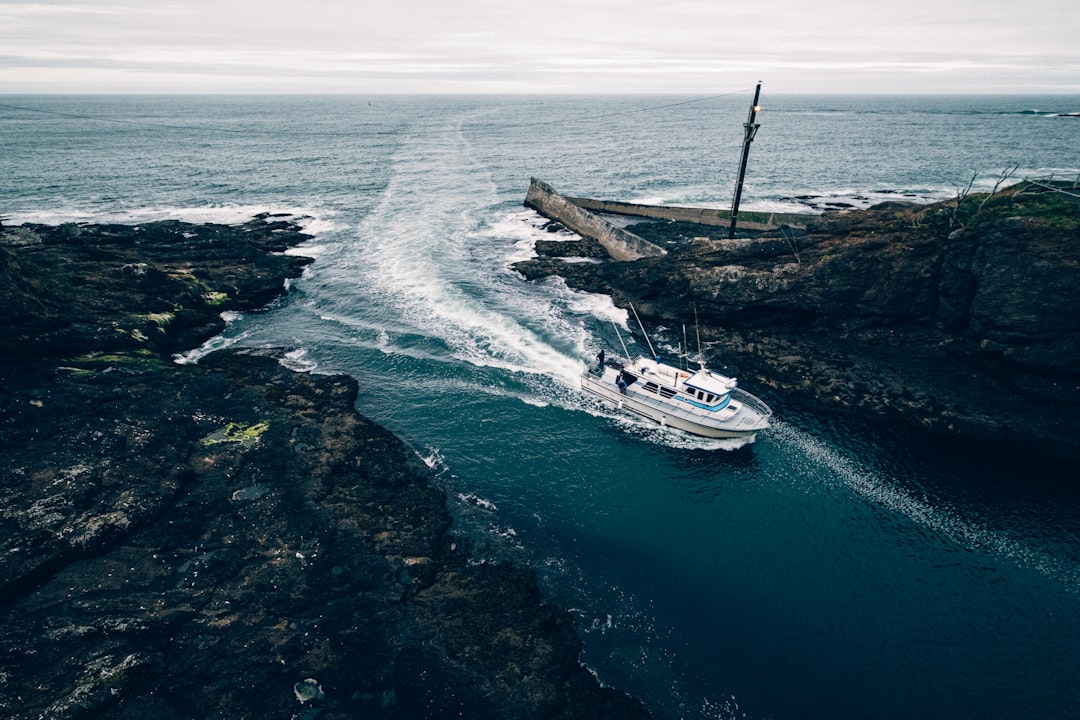
Depoe Bay, Oregon Coast
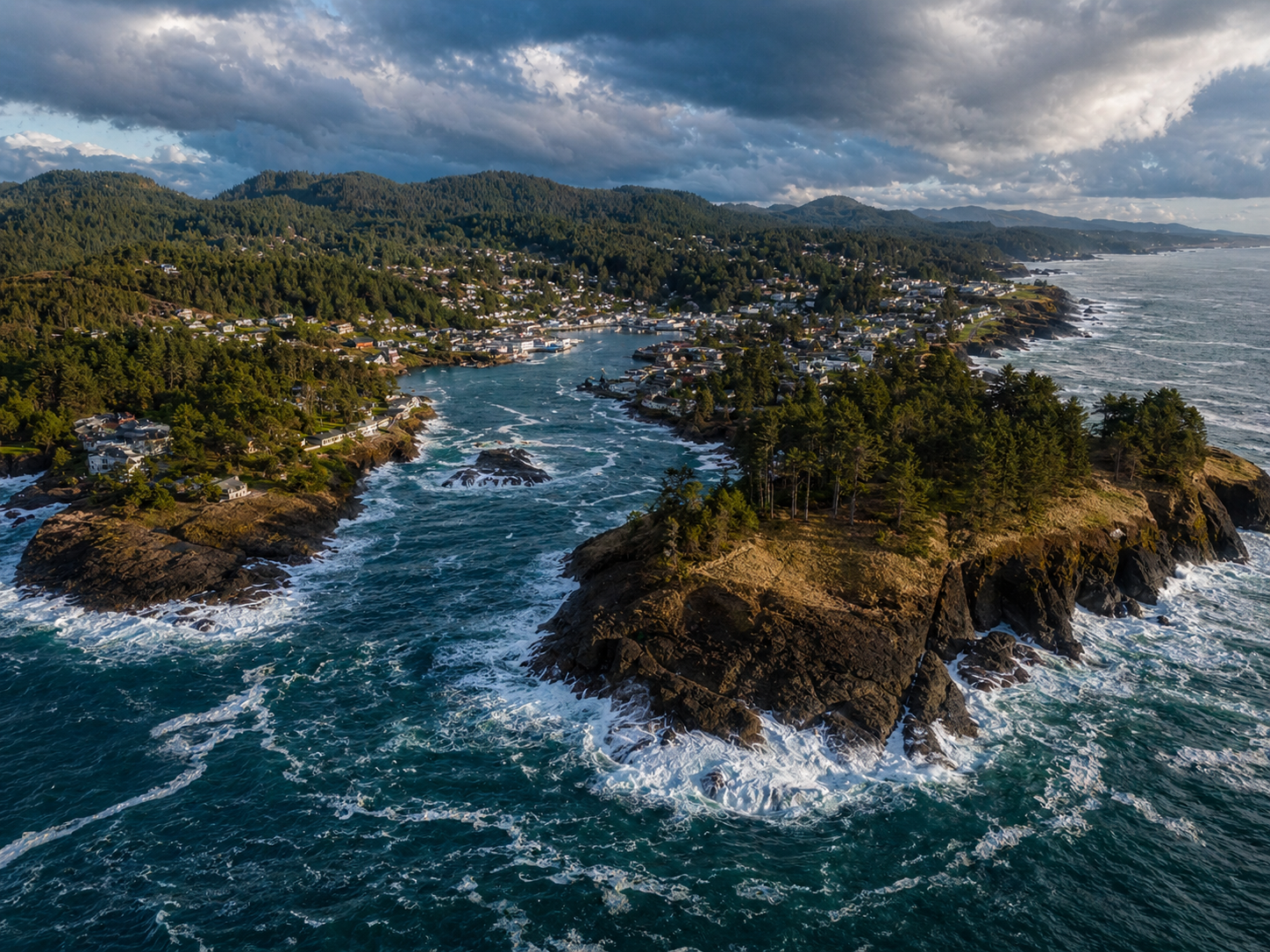
Depoe Bay’s harbor entrance is just 50 feet wide, making it the world’s smallest navigable harbor. Charter fishing boats, whale watching tours, and commercial vessels all navigate the same narrow channel. Gray whales are regularly visible from the seawall. Things to do in Depoe Bay →

Celilo Falls, Columbia River (1957)
Before the Dalles Dam was completed in 1957 and flooded Celilo Falls, it was the sixth-largest waterfall by volume in the world and had been a continuous site of human habitation and trade for more than 15,000 years. Tribes from across the Pacific Northwest gathered there to fish and trade. The flooding took only hours.

Klamath Basin, Southern Oregon
The Klamath Basin draws hundreds to over one thousand bald eagles during January and February, the largest winter concentration in the lower 48 states. The eagles follow wintering waterfowl populations across the basin’s wetlands. Best birding spots in Oregon →

Timberline Lodge, Mt. Hood
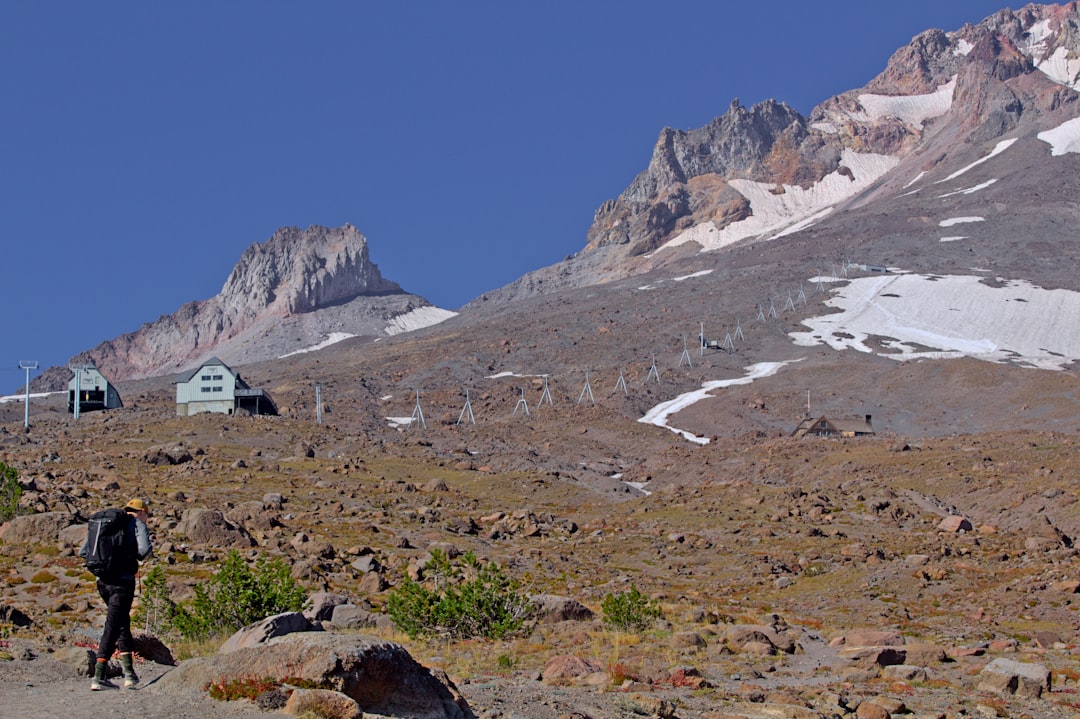
Timberline Lodge Ski Area operates 12 months a year on the upper slopes of Mt. Hood. Spring and summer skiing runs into June and July. The lodge was also used as the exterior of the Overlook Hotel in Stanley Kubrick’s The Shining, though the interior was a soundstage.
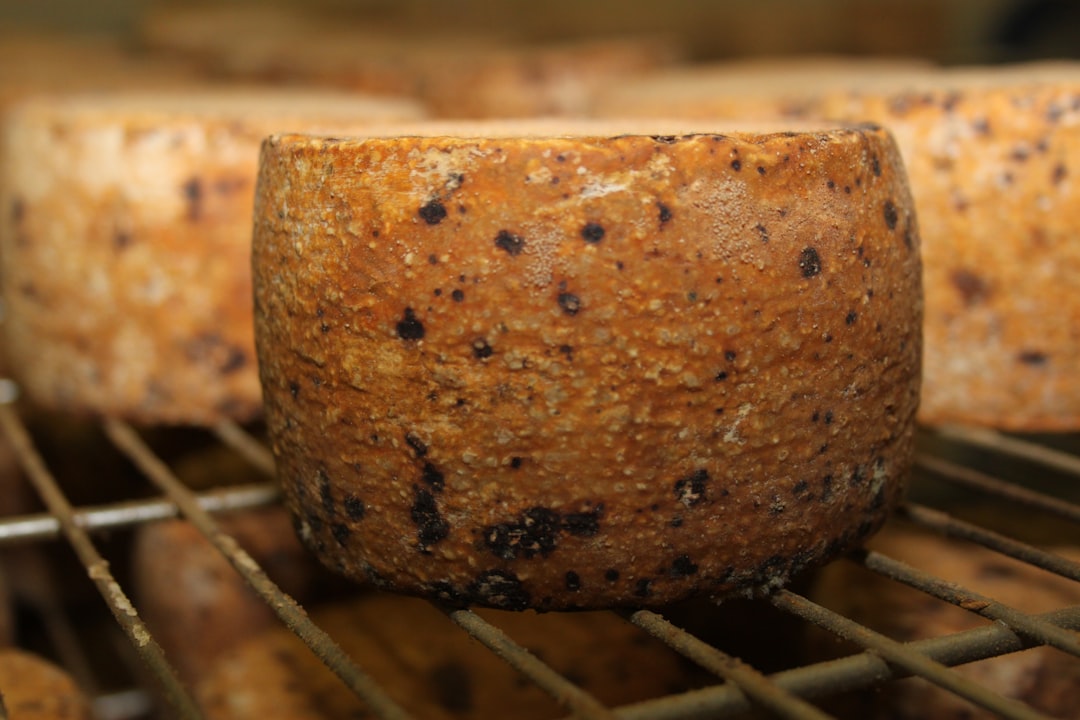
Rogue River Blue, Central Point
Rogue Creamery’s Rogue River Blue was named Grand Champion at the 2019/20 World Cheese Awards in Bergamo, Italy, beating 3,804 cheeses from 42 countries. It was the first time an American cheese had ever won. The cheese is wrapped in Syrah grape leaves soaked in pear brandy and aged for at least a year.
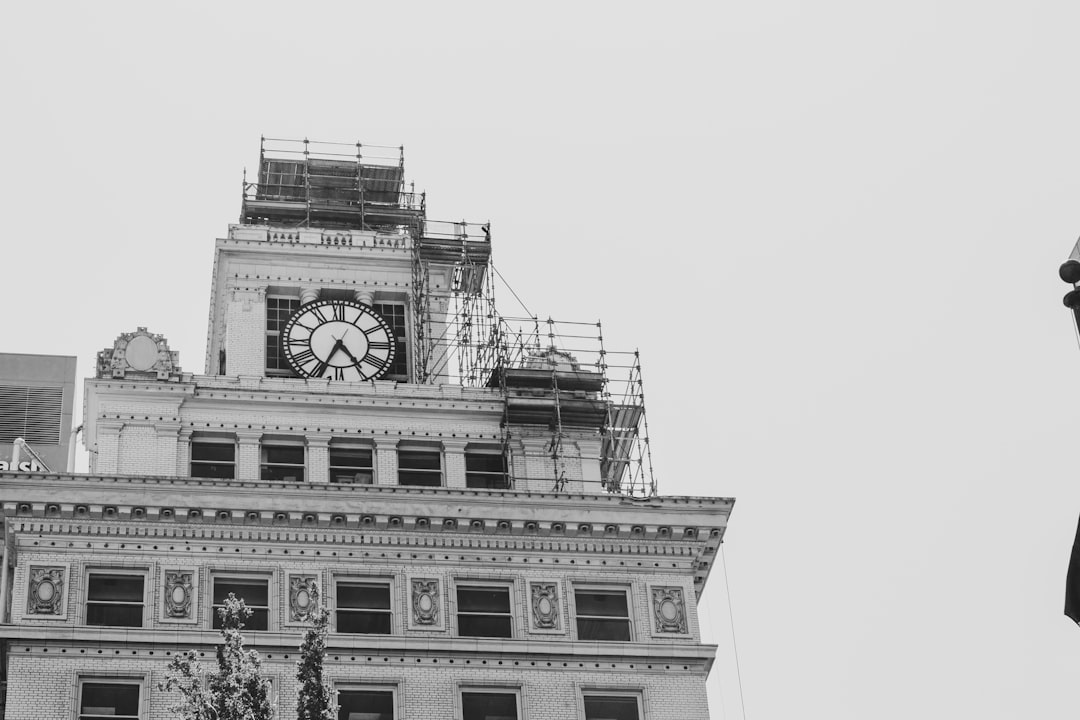
Portlandia, Portland
The Portlandia statue on the Portland Building is 35 feet tall and the second-largest copper statue in the country after the Statue of Liberty. Sculptor Raymond Kaskey modeled the face after his wife. He guards image rights strictly, which is why the statue is rarely photographed commercially.
Chapman Elementary School, Portland
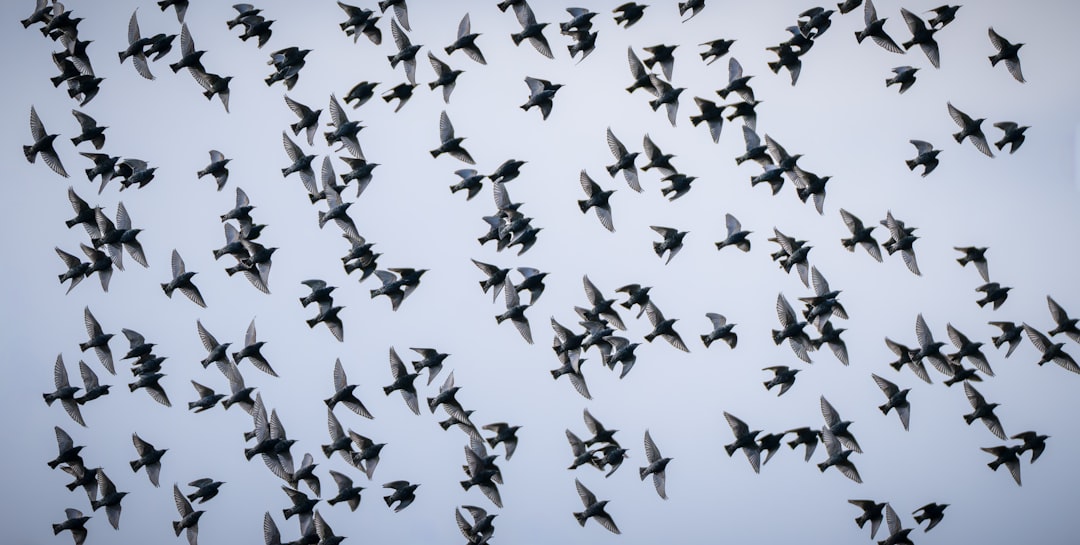
Every September during migration, up to 35,000 Vaux’s Swifts spiral into the chimney at Chapman Elementary School at dusk. Crowds gather on the nearby hillside to watch. Peregrine falcons sometimes intercept the swifts mid-spiral, which the crowd cheers or boos depending on their loyalties. Birding in Oregon →
McDermitt Caldera, Oregon–Nevada Border
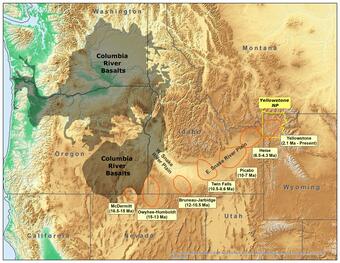
McDermitt Caldera on the Oregon–Nevada border holds an estimated 20 to 40 million metric tons of lithium locked inside ancient clay deposits, the largest known lithium deposit on Earth. A 2023 study in Science Advances identified the deposit, valued at approximately $1.5 trillion. Bolivia’s salt flats previously held the record. USGS research →

Blockbuster Video, Bend, Oregon
In 2004, Blockbuster had over 9,000 stores worldwide. After the company filed for bankruptcy in 2010, locations closed one by one, including stores in Alaska and Australia. By March 2019, every Blockbuster on Earth had closed except one: the franchise in Bend, Oregon, owned and operated by the same local family since 1992. It still rents DVDs, sells Blockbuster merchandise, and draws visitors from around the world. It was the subject of a 2020 Netflix documentary, a Family Guy episode, and displays memorabilia donated by the last Alaskan Blockbuster including items from Russell Crowe’s personal collection. Things to do in Bend →

Sea Lion Caves, Florence, Oregon
Sea Lion Caves, 11 miles north of Florence, is the largest sea cave in the United States. The main cavern has a two-acre floor and a natural rock dome 125 feet high, a 12-story cathedral carved by Pacific waves. The full cave system stretches 1,315 feet. It is also the only mainland rookery of Steller sea lions in the contiguous United States, with sea lions coming and going freely through multiple ocean entrances. An elevator descends 208 feet through solid basalt rock to the observation level. Open to visitors since 1932. Explore Sea Lion Caves →
Phalanx, Rogue River–Siskiyou National Forest
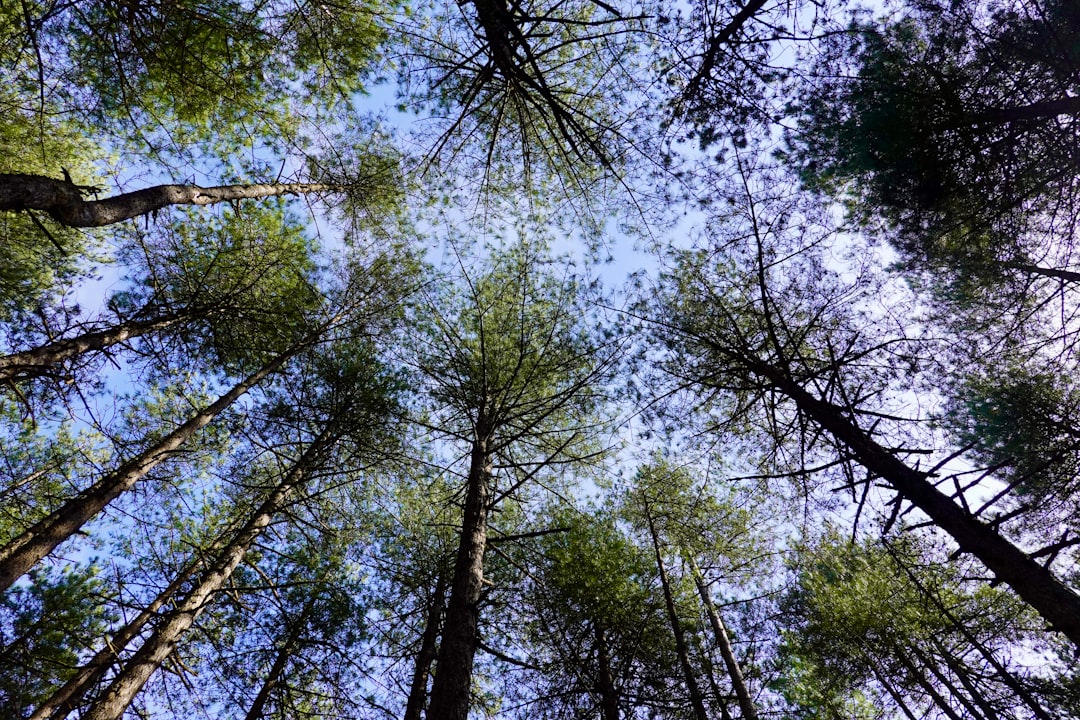
A ponderosa pine named “Phalanx” in the Rogue River–Siskiyou National Forest near Grants Pass is the tallest known pine tree in the world, of any pine species. It was first measured at 268.3 feet in 2011 by a Portland arborist who physically climbed the tree with a tape line. A 2022 measurement recorded it at approximately 273 feet. The USDA Forest Service confirmed the record. It grows in a grove of at least a dozen ponderosas all taller than any previously known pine. The only tree that had come close was a 269-foot sugar pine in Yosemite National Park, which died from a bark beetle attack in 2009. USDA source →

#02 Only in Oregon
Oregon fun facts about things that are true of Oregon and no other state, or that make Oregon categorically different from everywhere else.
The only US state with a two-sided flag
Oregon’s flag shows the state seal on the front and a gold beaver on the reverse. It is the only US state flag with a different design on each side. The beaver represents Oregon’s 19th-century fur trade and gives the state its nickname.
The only state in the contiguous US bombed by Japan in World War II
In 1942, a Japanese submarine shelled Fort Stevens near Astoria, and in 1945, a Japanese pilot flew a fire-bombing mission near Brookings. A balloon bomb later killed a Sunday school group near Bly in 1945, the only combat casualties on US soil during the war. The pilot later returned to Brookings and donated his family’s samurai sword to the city.
The only US state with a fully public coastline by law
Oregon’s 1967 Beach Bill, championed by Governor Tom McCall, declared the entire dry-sand beach from the Columbia River to California a public highway. There are no private beaches in Oregon. Every inch of the 363-mile coast is legally accessible to anyone.
The only US state with an official state nut
Oregon designated the hazelnut as its state nut in 1989. No other US state has an official nut. Oregon grows 99 percent of the US commercial hazelnut crop.
Until 2023, it was illegal to pump your own gas
Oregon and New Jersey were the last two states where self-service gas pumping was illegal. Oregon’s ban dated to 1951. The law was amended in 2023 to allow self-service at most stations. New Jersey lifted its ban in 2024.
Portland’s name was decided by a coin toss in 1845
The city’s two founders, Asa Lovejoy of Boston and Francis Pettygrove of Portland, Maine, each wanted to name the new settlement after their hometown. They flipped a coin. Pettygrove won two out of three. The 1845 penny is on display at the Oregon Historical Society.
Oregon was admitted to the Union on Valentine’s Day
Oregon became the 33rd state on February 14, 1859. The date was coincidental, not symbolic, but Oregonians have leaned into it ever since.
First state to decriminalize marijuana, twice
Oregon was the first state to decriminalize small amounts of marijuana in 1973 and later one of the first to legalize recreational use by ballot measure in 2014. In 2020, Oregon also became the first state to decriminalize possession of small amounts of all drugs.
First state to ban non-returnable bottles and cans
Oregon’s Bottle Bill, passed in 1971, was the first law of its kind in the country. It required deposits on beer and soda containers, which reduced roadside litter by an estimated 83 percent within a decade. It has been updated several times to include more container types.
The state motto is the only US state motto phrased in English that refers to the state as female
‘She Flies with Her Own Wings’ (Alis Volat Propriis in Latin) was adopted in 1987. The ‘she’ refers to Oregon. No other English-language state motto uses a feminine pronoun to refer to the state itself.
Portland is one of only four US cities with an extinct volcano inside city limits
Mt. Tabor, a dormant cinder cone in Southeast Portland, is one of four urban volcanoes in the United States. The others are in Bend (Pilot Butte), Jackson (Mississippi), and Honolulu (Diamond Head). Volcanoes in Oregon →
Oregon is not pronounced the way most non-Oregonians say it
The correct pronunciation is OR-uh-gun, not OR-ee-gone. The two-syllable version is a reliable way to identify someone who did not grow up in the state.

#03 Oregon Invented This
Oregon shows up in the origin story of more everyday objects than almost anyone realizes.
Tater Tots
Invented in Ontario, Oregon in 1949 by Nephi and Golden Grigg of Ore-Ida Foods. They were looking for a way to use leftover potato scraps. The name came from a company contest.
Corn Dogs
A hot dog stand on Highway 101 in Rockaway Beach is credited with the invention of the corn dog. Oregon also claims the corn dog was sold commercially at the Oregon State Fair in the early 1940s.
Maraschino Cherries
The modern red, brined, food-dyed maraschino cherry was developed by researchers at Oregon State University in the 1920s as a replacement for the European liqueur-preserved version that became unavailable during Prohibition.
Bing Cherries
The Bing cherry was developed in 1875 by Ah Bing, a Chinese-American orchard worker at Henderson Luelling’s nursery in Milwaukie. It remains one of the most widely grown sweet cherry varieties in the United States.
Marionberries
The marionberry was developed by USDA scientists at Oregon State University and first grown commercially in Marion County in 1956. Oregon grows over 90 percent of the world’s supply.
The Commercial Barcode Scanner
Spectra Physics, based in Veneta, Oregon, built the first commercial barcode scanner systems in the early 1970s. The technology was adopted by grocery chains and transformed retail logistics.
The Leatherman Multi-Tool
Tim Leatherman of Portland spent years developing a folding multi-tool after being frustrated by a cheap knife on a trip through Europe in the late 1970s. He sold his first unit in 1983 after struggling to find a manufacturer.
The Phillips Head Screw
Henry F. Phillips of Portland acquired the patent for a self-centering screw design in the 1930s and licensed it to American Screw Company. The design allowed machine-assembly lines to drive screws automatically.
The Forstner Bit
Benjamin Forstner of Westport, Oregon patented a precision wood-boring drill bit in 1874 that cuts flat-bottomed holes in wood. It is still the standard tool for cabinetmakers and furniture builders.

#04 Oregon by the Numbers
Oregon fun facts by the numbers: the quick-reference statistics that come up most often.
| Stat | Number |
|---|---|
| State size | 98,380 sq miles (9th largest in the US) |
| Population | Approximately 4.3 million |
| Statehood | February 14, 1859 (33rd state) |
| State parks | 361 |
| National forests | 11 |
| Wildlife refuges | 21 |
| Miles of coastline | 363 (entirely public) |
| Lakes | More than 6,000 |
| Rivers and streams | 112,000 miles |
| Forested land | ~30 million acres (nearly half the state) |
| Covered bridges | 53 (more than any state west of the Mississippi) |
| Total bridges | More than 7,000 |
| Vineyards | More than 1,500 |
| Wine varietals grown | 80+ |
| Farms | 38,500+ |
| Hot springs | 50+ known |
| Federally recognized tribes | 9 |
| Scenic bikeways | 18 (first state to establish the program) |
| Earth biomes represented | 4 of 5 |
| Highest point | Mt. Hood at 11,239 ft |
| Deepest point | Crater Lake at 1,943 ft |
| Annual hazelnut crop | ~$130 million (99% of US supply) |
#05 History Worth Knowing
Oregon fun facts about history: the Oregon history most people skip, from sandals made before pottery existed to the only government-funded rock festival in US history.
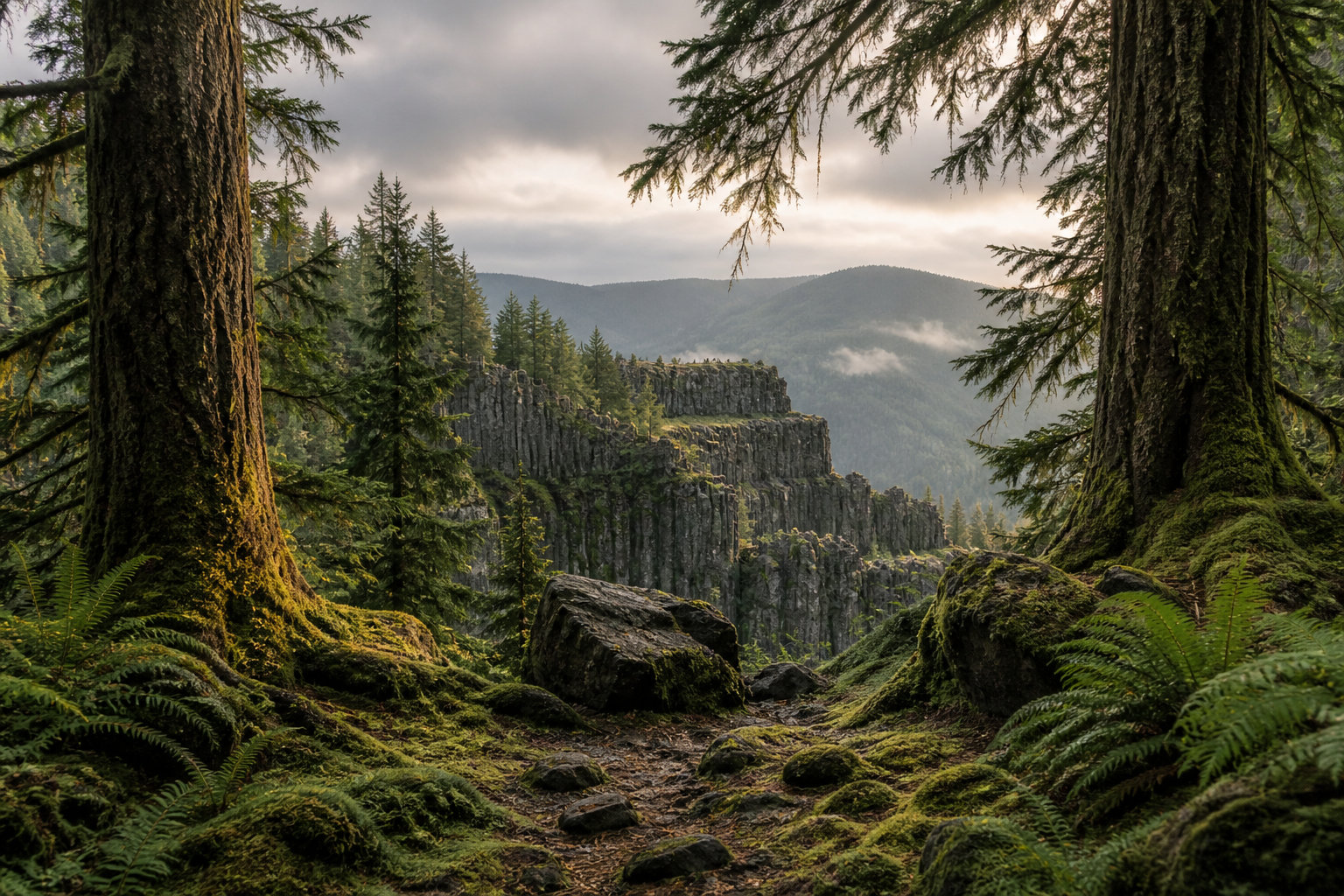
Fort Rock Sandals: the oldest footwear ever found on Earth
Sagebrush sandals unearthed in a volcanic cave in Lake County were radiocarbon dated to 7,300–8,200 BC. They are the oldest known footwear ever discovered, anywhere in the world.
Celilo Falls: 15,000 years of continuous occupation
Celilo Falls on the Columbia River was one of the most significant fishing and trading sites in the Americas, occupied continuously for at least 15,000 years. It was the sixth-largest waterfall by volume in the world. The Dalles Dam was completed in March 1957. The reservoir filled in hours, flooding the falls and the villages downstream. Tribal members who had fished there their entire lives watched from the banks.
Oregon Country: four nations claimed the same territory simultaneously
Before Oregon became a US territory, “Oregon Country” covered present-day Oregon, Washington, Idaho, parts of Montana and Wyoming, and most of British Columbia. At various points Spain, Great Britain, Russia, and the United States all held competing claims. Spain ceded its claim to the US via the Transcontinental Treaty in 1819. Russia’s monopoly claim was pushed back by the Monroe Doctrine in 1823. That left Britain and the US at an impasse for two decades. American expansionists in Congress adopted the slogan “54 degrees 40 minutes or fight”, demanding the US claim territory all the way north to what is now Alaska’s southern border. The boundary was ultimately settled at the 49th parallel. The Senate ratified the Oregon Treaty 41–14 on June 18, 1846. Source: U.S. State Department →
Oregon entered the Union with racial exclusion written into its constitution
Oregon’s original 1857 constitution included an exclusion clause barring Black residents from living, owning property, or making contracts in the state. It also made it illegal for Black people to move to Oregon at all. The clause was not formally removed from the constitution until 1926, and the vote ratifying its removal was not fully certified until 2001.
The only state in the contiguous US attacked by Japan in WWII
Japan attacked Oregon three ways: submarine shelling of Fort Stevens in 1942, balloon bombs carrying incendiary charges (one killed six people near Bly in 1945), and a single plane that dropped incendiary bombs near Brookings in 1945. The Japanese pilot, Nobuo Fujita, returned to Brookings in 1962, presented his family’s 400-year-old samurai sword to the city, and was later named an honorary citizen.
Oregon tried to dispose of a beached whale with 20 cases of dynamite
In November 1970, the Oregon Highway Division detonated 20 cases of dynamite beneath a 45-foot sperm whale carcass on a beach near Florence, hoping to scatter the remains for sea birds to consume. The explosion sent large chunks of whale flying hundreds of feet in every direction. A car parked a quarter-mile away was crushed by falling blubber. Local TV reporter Paul Linnman filed a report that became one of the most-viewed video clips of the early internet era.
The only state-sponsored rock festival in American history
When President Nixon was scheduled to visit Portland in 1971, Governor Tom McCall, concerned about large anti-war demonstrations, offered to fund a rock festival at Milo McIver State Park to give protesters something else to do. The event, called Vortex I, drew up to 100,000 attendees. Nixon ultimately cancelled his Oregon trip, but the festival went on anyway.
The largest biological terrorist attack on US soil
Members of the Rajneeshee religious commune near The Dalles contaminated salad bars at ten local restaurants with salmonella in an attempt to suppress voter turnout in a local election. 751 people were sickened. It remains the largest biological terrorist attack in US history. The incident was the subject of the Netflix documentary Wild Wild Country.
Primary Source Archive
Oregon History Project
Understanding Oregon’s past through photographs, objects, and archival materials. The Oregon History Project is where to go to find primary source records, historical photographs, and documented accounts behind the facts on this page.
Browse historical records#06 Food, Farms, and Drink
Oregon fun facts about food and farming: Oregon’s agricultural output is deeply underrated outside the Pacific Northwest.

Wine Country
Oregon Vineyards
Oregon is the fourth-largest wine-producing state in the country, with over 1,500 vineyards and 80 varietals under cultivation. The Willamette Valley, at the same latitude as Burgundy, is best known for Pinot noir but produces award-winning examples of more than a dozen varieties. Oregon wineries list →

Agriculture
The State Nut
Oregon grows 99 percent of the US commercial hazelnut crop. Only Turkey and Italy produce more globally. The hazelnut has been Oregon’s official state nut since 1989, the only state to designate one. The annual crop is worth approximately $130 million.
Seafood
Dungeness Crab Capital
Newport, Oregon is widely recognized as the Dungeness crab capital of the world. The central Oregon coast, particularly Yaquina Bay, is one of the most productive Dungeness crab fishing grounds in the country, and the industry is central to the local economy.
Awards
First American Cheese to Win World’s Best
Rogue Creamery’s Rogue River Blue, made in Central Point in Southern Oregon, was named Grand Champion at the 2019/20 World Cheese Awards in Bergamo, Italy, beating 3,804 cheeses from 42 countries. It was the first time an American cheese had ever won the award.

Agriculture No. 1 Rankings
Oregon Leads the Nation In
Oregon is the country’s number one producer of: blackberries, hazelnuts, peppermint, cranberries, rhubarb, grass seed, florist azaleas, and Christmas trees. It also grows over 90 percent of the US commercial marionberry crop.

Brewing
Craft Beer Pioneer
Oregon, and Portland in particular, was a founding state for American craft brewing. Portland has more craft breweries per capita than any other city in the country. The city has more than 70 breweries within city limits and the state has more than 300 total.
#07 Culture, Film, and Pop Culture
Oregon fun facts about culture and film: more major films were shot in Oregon than most people realize, and a surprising number of cultural touchstones trace back to Portland or the Oregon coast.
-
 The Simpsons
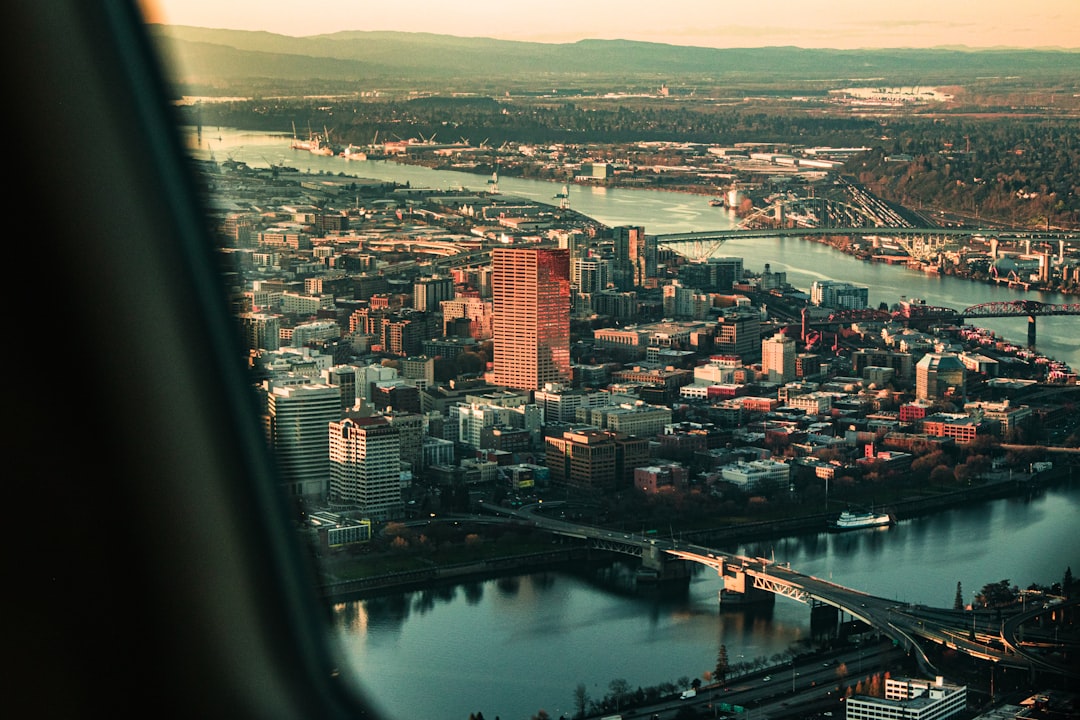
Matt Groening grew up in Portland. Many of the show’s character names come from Portland street names: Flanders, Lovejoy, Quimby, Van Houten, and Terwilliger. Groening has confirmed the connection in interviews. Portland’s NW Flanders Street and the fictional Ned Flanders were named from the same source.
-
 The Shining
Timberline Lodge on Mt. Hood was used as the exterior of the Overlook Hotel in Stanley Kubrick’s 1980 adaptation of The Shining. Kubrick had the room number ‘237’ changed to ‘237’ in the film because the real lodge asked him to use a different number so guests wouldn’t avoid that room.
-
 One Flew Over the Cuckoo’s Nest
Ken Kesey’s novel and Milos Forman’s 1975 film were both based in Oregon. The film was shot at the Oregon State Hospital in Salem. The building now houses the Oregon State Hospital Museum of Mental Health. Jack Nicholson won the Academy Award for Best Actor for his role.
-
 Animal House
National Lampoon’s Animal House (1978) was filmed on the University of Oregon campus in Eugene. It was one of the most commercially successful comedies in history at the time of its release. John Belushi’s toga was an actual bed sheet borrowed from the film’s producer.
-
 The Goonies
The Goonies (1985) was filmed primarily in Astoria, with additional scenes at Cannon Beach. The Goonies house in Astoria still stands and draws visitors year-round. The Cannon Beach rock formation called Haystack Rock, visible in the film, is one of the most photographed spots on the Oregon coast. Things to do in Astoria →
-
 Nirvana / Kurt Cobain
Kurt Cobain met Courtney Love at Satyricon, a Portland music club, in 1989. Portland and the Oregon music scene were central to the early development of Pacific Northwest alternative rock in the late 1980s and early 1990s.
-
 Dune
DuneFrank Herbert based the desert planet Arrakis on the Oregon Dunes. Herbert lived in Florence, Oregon, and spent years documenting the coastal dunes for an article that became the seed of the Dune universe. The Oregon Dunes National Recreation Area stretches nearly 40 miles along the coast. Explore the dunes →
-
Wild (2014)
Reese Witherspoon’s film Wild was almost entirely shot in Oregon, despite the story spanning multiple states. All but seven scenes were filmed in Oregon, and only two scenes were on the actual Pacific Crest Trail route from the book.
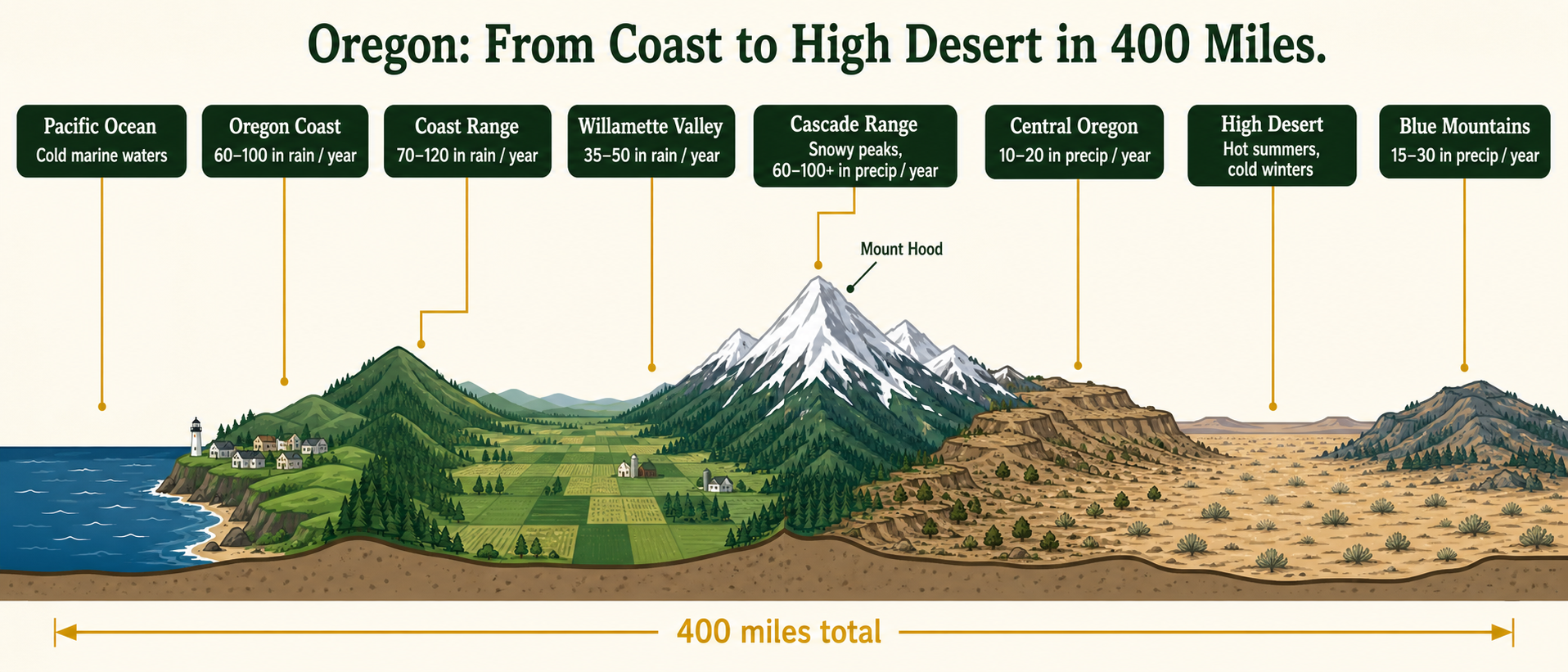
#↓ Maps, Timelines & Comparisons
Visual references for Oregon fun facts. Shareable infographics and maps. Click any image to open full size.
Interactive map guides
#⚲ Sources & Further Reading
Government and academic sources behind the Oregon fun facts on this page.
Cite or share this page
Every Oregon fun fact on this page is verified and sourced. You’re welcome to use any fact or infographic with a link back to this page as credit. Click any fact card to copy a pre-formatted citation, or use the formats below.
Share a specific fact
Each button below opens a pre-written tweet, or copies the text if you prefer another platform.
More on Oregon history and geography
The Oregon Trail history guide and the Oregon regions guide go deeper on the history and geography behind these facts.
#Oregon fun facts: frequently asked questions
Common Oregon fun facts questions, answered directly.
-
What is the most interesting fact about Oregon?
Among Oregon fun facts, few are more surprising than this: Oregon is home to the largest organism on Earth: the Humongous Fungus, a honey fungus in Malheur National Forest that spans four square miles and weighs an estimated 7,500 tons. Other strong contenders include Hells Canyon being nearly 2,000 feet deeper than the Grand Canyon, the Fort Rock sandals being the oldest footwear ever found anywhere on Earth (dated to 8,200 BC), and Oregon being the only US state with a two-sided flag.
-
What food did Oregon invent?
Oregon invented tater tots (Ore-Ida, Ontario, 1949), corn dogs (Rockaway Beach), maraschino cherries (Oregon State University researchers in the 1920s), Bing cherries (Milwaukie, 1875), and marionberries (OSU research, commercial cultivation from 1956). On the tool side, Oregon also gave the world the Leatherman multi-tool, the Phillips head screw, the Forstner drill bit, and the commercial barcode scanner.
-
Why is Oregon the only state with a two-sided flag?
Oregon’s flag, adopted in 1925, shows the state seal on the front and a gold beaver on the reverse. It is the only US state flag with a different design on each side. The beaver design represents Oregon’s 19th-century fur trade economy and the state’s nickname, The Beaver State.
-
What is Oregon famous for?
These Oregon fun facts about geography and culture are what most people know: Crater Lake (deepest lake in the US), the Columbia River Gorge, Mt. Hood, the entirely public Pacific coastline, Hells Canyon (deepest gorge in North America), and Portland. It is also well known for Willamette Valley wine, craft beer, and its outdoor recreation across six geographically distinct regions. Less famously, it holds more world records than most people realize.
-
What records does Oregon hold?
Oregon fun facts about records are extensive. Oregon holds a large number of verified records: deepest lake in the US (Crater Lake), deepest river gorge in North America (Hells Canyon), largest organism on Earth (Humongous Fungus), longest relay race in the world (Hood to Coast), largest independent bookstore in the world (Powell’s Books), smallest park in the world (Mill Ends Park), deepest underground transit station in the western hemisphere (Washington Park MAX), oldest footwear ever found (Fort Rock sandals), largest meteorite found in the US (Willamette Meteorite), and smallest navigable harbor in the world (Depoe Bay).
-
When did Oregon become a state?
Oregon became the 33rd US state on February 14, 1859, Valentine’s Day. It was admitted to the Union as a free state during the political tensions that would lead to the Civil War two years later. Notably, Oregon’s original constitution also included a racial exclusion clause barring Black residents from living in the state, a fact that is part of the state’s complicated history.